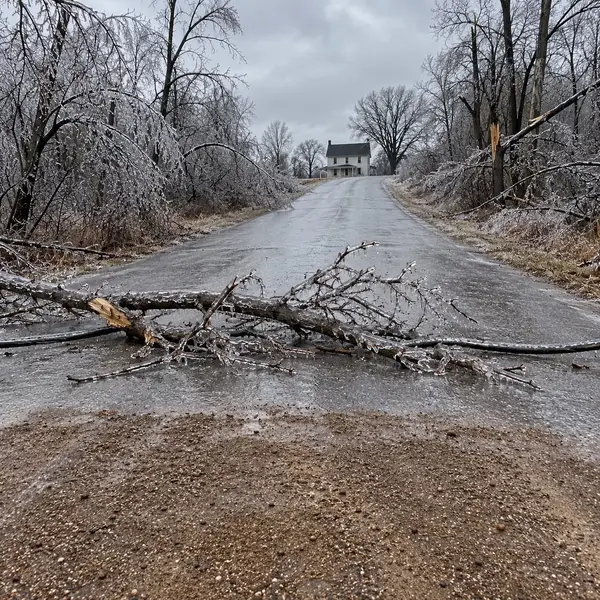
He told his dad: stay home
I found the man who runs our county's warming centers telling his own father not to come to one. It was the week the Energy Secretary issued an emergency order “to mitigate the risk of blackouts” across 13 states. He stood alone in the dark with his palm flat on the warming-center map. 'Stay home, Dad. Stay in your own bed.' For years I'd told my sister our father could go to the warming center if the power was out long. He's 84, alone on a hill road nobody gets up in an ice storm. What he put in my hand when I asked where Dad fit is why I'll never say it again. At two in the morning, the man in charge of every warming center in our county stood by himself at the map on the wall, on the phone telling his father to keep away from them. My father is 84. He lives alone up a hill road no truck can climb in a bad storm, and the warming center was the whole of my plan for him. I was on my round, second floor of the county emergency operations center, walking past the room where they run the storms. The overheads were off. There was the exit sign over the far door and a strip of light from the hall... and there was Dale, in his shirtsleeves, standing at the back wall with his palm pressed flat on the warming-center map and his phone at his ear. “Dad, don't go to the school. “Stay home. “Stay in your own bed.” I stood in the doorway with my flashlight pointed at the carpet. He didn't know I was there. He kept that hand on the map like he was holding something down. “I know what I said last year. “I'm telling you now. “Your own bed.” For years I'd told my sister the same thing every time the weather turned: if the power's out long, Dad can go to the warming center. What Dale put in my hand twenty minutes later is why I'll never say it again. You'd wonder what the county's emergency manager was doing in the building at that hour. I did. It was the week the Energy Secretary used emergency powers across 13 states, Pennsylvania one of them. The order said it was “to mitigate the risk of blackouts.” The break room TV ran it every hour, and every hour somebody reached up and turned it louder. That same week the Pentagon ordered every base to run 90 days without the civilian grid. Ninety days... I'm a guard. I don't know what those people know, and I won't pretend to. But I spent twenty years in the Army as an MP, and you learn to watch what people do, because what they say is the last thing to change. What they were doing was getting their own places ready to stand alone. Dale had been at his desk past midnight every night that week, going over the county's plan for a long outage. A blackout of the kind that order was written to head off wouldn't be one night of candles out here. It would be days without power, on roads like my father's. So at two in the morning, with the whole plan on the wall in front of him, the man who wrote it was on the phone telling his father to stay in bed. Let me back up. I'm 58. After the Army I came home to this county and married Carol, and we've been married 33 years. Nine of those I've been the night guard at the operations center. The shifts run twelve hours. On a storm night nobody on the overnight walks out until the day crew can get in, and on roads like ours that can be noon. That's the job. You don't leave the building that keeps things running for everybody else. My flashlight has slid across that warming-center map on every round for nine years. Thousands of times. I couldn't have told you where one pin was... it was just part of the wall. Still, every winter, when Linda called from Pittsburgh worried about Dad, I said the same two things. If the power goes out long, Dad can go to the warming center. The county has a plan. I said it like I knew. I work in the building where that plan gets written. My father is Walt Kovac. He lost my mother, Anne, nine years ago. He lives in the farmhouse he built with his own hands on a hill road 25 minutes out of town, and his is the only house on that road. There's no neighbor to look in on him. The nearest porch light is a mile down, at the bottom. He drives his old pickup to church on Sunday and to the feed store, and nowhere else. Every morning he reads his Bible at the kitchen table. At night it goes up to the nightstand, open, beside his reading glasses and a glass of water. He sleeps under the quilt Mom made for their wedding, with his work coat on the bedpost where he can reach it. Ask him about a storm and he says, “I've been through worse than a power outage.” He probably has. Though here's the part he doesn't think about: his furnace burns oil, but it won't run without the electric. When the line on that hill goes down, the furnace goes down with it. He also has a secret he thinks I don't know. Every winter I ask about his thermostat. “It's at 68, son,” he says. One afternoon I was backing down his drive and glanced at the kitchen window. Through it, across the kitchen, I could see into the hall... and his work glove coming up to the old round dial and turning it. I'd barely put the truck in reverse. It lives at 62. He'd rather wear the coat than pay the oil man for six degrees, because he has paid his own way since he was fourteen and he's not about to start leaning on anyone now, his son included. I drove on. I never said a word. Here's what I had riding on that hill. My father first, in the house he will never leave. Me, I'm the son who lives close. Linda is four hours off in Pittsburgh with her own family, so I'm the one who gets up the hill. Nobody ever said so. It's just been that way since Mom. And Linda. She trusts I've got him. Every night at nine I call Dad from the guard desk. Every night he says, “I'm fine.” And every night I hang up and leave my hand on that phone a second longer than I need to... ...and I don't ask the one thing I should. I'd ask about the thermostat. He'd say 68. I never once asked about his bedroom. Not even after last winter. Linda thinks I ask. I've let her think it. Last winter we lost power on Dad's hill for two days. The line came down the first night, and the furnace quit with it, the way it always will. I was on shift, and on a storm night I don't leave. The second morning, when the sun finally got on that road enough for my tires to bite, I drove up. I called Linda from the truck and put her on speaker in my shirt pocket. Nobody was in the kitchen. The Bible wasn't on the table. I found him upstairs, in bed, buttoned into his work coat under Mom's quilt, and from the look of the room he'd hardly been out of it since the lights went. “Dad.” “I'm fine.” I sat on the edge of the bed and put my hand on the quilt. The edge of it was clammy under my palm, like a towel left in a gym bag. The collar of his coat stuck to my fingers where his chin had rested on it all night. His reading glasses were on the nightstand, the Bible open beside them. And the glass of water next to it had a skin of ice across the top. I touched it with one finger. It didn't give. Inside my father's bedroom. Next to his Bible. Linda had stopped talking in my pocket. She knows his voice better than I do, and she'd caught it. Flat. Like a man reading “I'm fine” off a card somebody handed him. “Get your boots on,” I said. “You're coming home with me.” He looked at me like I'd come up there to take something from him. “This is my home.” He'd never said anything to me in that voice. I stood there a minute, and then I drove down that hill alone, because you don't carry a man out of the house he built. The power came back that afternoon. I've thought a lot about what happens if it doesn't. You'll ask what Carol asked me that night. Why didn't I just take him to the warming center? The warming center is real. There's a generator and there are cots, and whoever gets through the door sleeps fine. But it's a school gym clear across the county. Dad doesn't drive in a storm. And you know what he told me. He will not leave his house. Why didn't I get up there sooner? I tried. The afternoon after the line went down, when the day crew finally relieved me, I drove out. The county's sand stops in a clean line far below his house, and past that line the hill just shines. My tires spun, the truck slid back to the sand, and that was as far as I got until the next morning. The first night I couldn't even try, because on a storm night I can't walk off a twelve-hour shift. The building doesn't empty because my father lives on a hill. His furnace and Mom's quilt carry every normal night he has. With the line down, that furnace was a dead box in the cellar. I offered him a generator once. He looked at me over his coffee. “And who hauls the gas up this hill?” That was the end of the generator. Linda would've come, but she's four hours off on a good road, and that week there wasn't one between us. I did every single thing a good son does, and the storm still got up that hill before I did. Dale finished the call. “Love you too. “Go to sleep, Dad.” He set the phone face down on the ledge under the map. He turned around and saw me. Dale is 52. Before he ran emergency management for this county he spent eleven years on the county ambulance, and he's been at that desk fourteen. He knows where every generator in the county sits. He is not a talker, and he didn't want to be talking now. He reached for his coat on the chair back. “Go finish your round, Ray.” I should have. Instead out came what I'd been telling Linda for nine years. “Dale, the county has a plan.” His hand stopped on the coat. Then he let go of it. “So where's my dad on it?” I said. “Walt. “He's 84. “Up the hill road past the river.” “First show me where he is.” He tapped the map. “Every pin is a warming center. “A place with its own generator that keeps going through a power outage.” There was a coffee cup on the ledge full of spares.
Loading the ad's image