What "managed on the exercises" actually hides
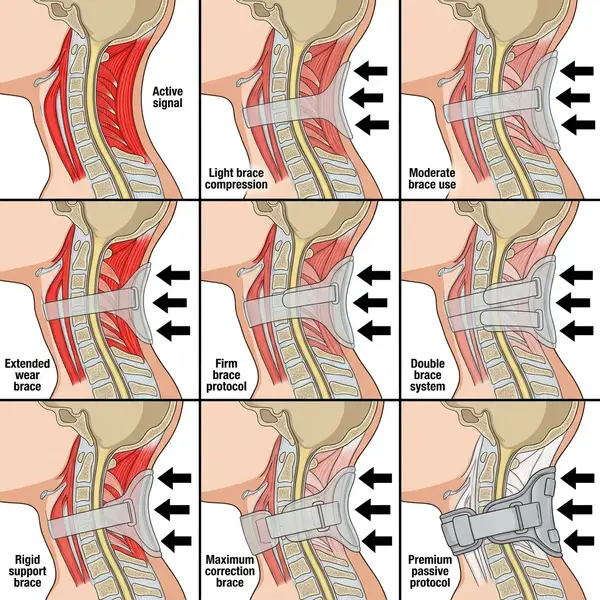
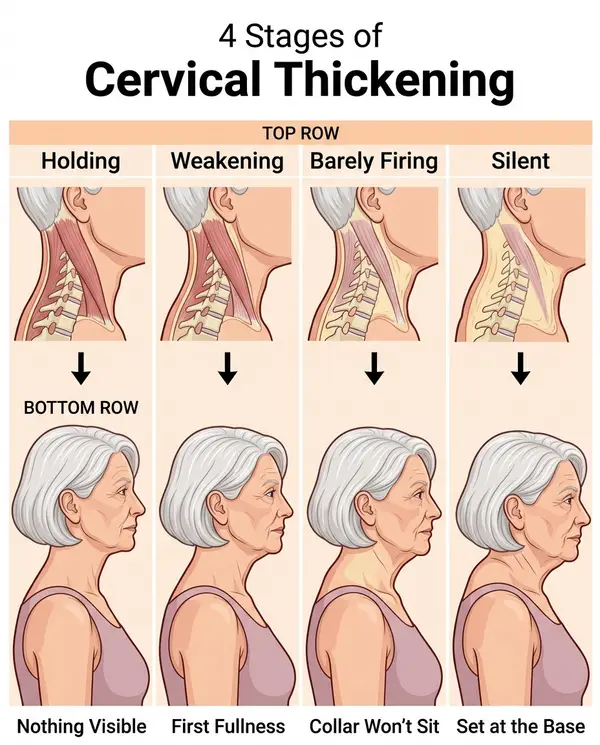
If you have a neck hump and your specialist has never checked your deep cervical signal density — and I would bet everything you own that she has not — you are going to be furious when you read this. Because I just found out three things about the standard neck hump protocol that explain why nothing has changed in seven years. And once you know them, you cannot unknow them. One — your specialist has never checked your deep cervical signal. Not once. Not in any of the appointments she has had with you in years. The check exists. It takes fifteen minutes. It would show whether the neuromuscular pathway that is supposed to be holding your head automatically is actually firing. My specialist never checked it in seven years and fourteen appointments. A cervical rehabilitation specialist checked it in the first ten minutes of my first visit. My result came back at 23 percent — below the functional threshold of 60. The signal was barely firing. Nobody had checked. For seven years. Two — every treatment in the standard neck hump protocol — posture braces, surface exercises, physiotherapy — works DOWNSTREAM of the thing that check would have revealed. They hold the position and strengthen the surface AFTER the signal has already failed to activate it on its own. They do not touch the signal itself. My specialist prescribed three different treatments in seven years. The brace held the position but the signal stayed dormant. The exercises strengthened the surface but the deep pathway went quieter every year underneath the compliance. The physiotherapy sessions improved the visible position but the signal was still failing between appointments. Not one of those treatments addresses the deep cervical motor pathways that fire the holding signal. They all work at the wrong layer. And three — the intervention that actually wakes the signal — a specialized tool that delivers sustained input at the exact anatomical address the motor pathways respond to — is not in primary rehabilitation training. There is no billing code for "deep cervical signal reactivation." There is no insurance reimbursement pathway for a $44.95 home device. My cervical rehab specialist told me she learned about it from research that had been published for decades before anyone mentioned it to her in a clinical context. She said most rehabilitation specialists she has talked to have never heard of deep cervical signal density by that name. My specialist still does not know it is a measurement. I called her office to ask. Those three things cost me seven years, $14,000, and the social presence I have not been able to access since 2018. Here is the full story. Because every woman I know with a progressive neck hump is sitting on top of the same unchecked number right now. I am sixty-three. I was started on a brace protocol at fifty-six, four months after my neck hump became visible. I remember the exact appointment because I drove home from the specialist's office and sat in my driveway for forty minutes holding the prescription in my hand and thinking "so this is it." For seven years I followed the standard protocol. I was a good patient. I wore the brace every morning on time. I did the surface exercises before breakfast. I attended the physiotherapy sessions every week. I watched my posture throughout the day. I did everything she told me to do. Every six months I went to my specialist. Every six months she measured my forward head position with the assessment tool. Every six months she said "your measurement looks good — managed on the exercises." Every six months I walked to my car and sat there. The measurement she was taking is the measurement she was trained to take. It checks the forward head displacement at the morning assessment, after the brace has held overnight position. It is a real measurement. It is the right measurement for confirming the exercises are doing their job. It is not the right measurement for finding out what is actually causing the drift to creep every afternoon despite the exercises. Because it does not measure the deep cervical signal. I did not know this for seven years. I did not know until last October when a friend of mine — a woman at the quilting circle whose daughter works in cervical rehabilitation — told me she had gone to a cervical rehabilitation specialist and the first thing the specialist had checked was something called deep cervical signal density. I found a cervical rehabilitation specialist the next week. Her office was in a medical building on the second floor above a pharmacy. She had diplomas on the wall, a model of a cervical spine on her desk, and a clipboard that looked like it had been in use since 2016. She let me talk for thirty-five minutes without interrupting. Then she said "I am going to check one thing. It is the thing that should have been the first thing anyone checked when you started the exercise protocol seven years ago. It takes fifteen minutes." She placed the assessment tool at the base of my skull — at the exact point where the suboccipital muscles attach — and measured how much signal the deep cervical pathway was actually firing with each activation attempt. Deep cervical signal density: 23 percent. Functional threshold for a healthy woman my age: 60 percent. Below the bottom of the functional range. She pointed at the number and said "this is your deep cervical signal density. It tells us how much automatic holding instruction your deep cervical muscles are actually receiving. Yours is below functional. In a healthy woman the deep cervical signal fires continuously and maintains nearly seventy percent of the automatic holding capacity against gravity. Your signal is barely firing. The motor pathways that activate it have gone dormant." She said "the drift has been building every afternoon for seven years because the signal that is supposed to hold it has stopped firing on its own. The exercises hold the position through the morning session. The measurement says managed. But the signal underneath is at 23 percent and nobody has checked it." She said "and then every afternoon, you have had nine hours of gravity pulling your head forward with nothing neurological working against it. By 2 PM the drift has been building for eight hours with nothing from the deep pathway opposing it. That is why your afternoons have been worse than your mornings for seven years despite the managed measurement." See how that works? Seven years. Fourteen appointments. $14,000 in treatment. Not one of those appointments had checked the one number that would have shown the dormant signal in fifteen minutes. Because deep cervical signal density is not part of the standard neck hump workup. It is a cervical rehabilitation metric, not a primary care metric. There is no standard protocol for checking it in a standard office. So it does not get checked. So specialists, who follow the standard of care in good faith, do not know to check it. See how that works? And the online retailers sell generic tools that address surface position and never reach the deep motor pathways. And the brace industry sells correctors that hold the position from the outside while the signal underneath goes more dormant every year. And the supplement industry sells collagen and anti-inflammatory products one ingredient at a time and none of them touch the signal. See how that works? The specialist told me the signal needs one thing. Sustained input delivered at the exact anatomical address of the deep cervical motor pathways. The specific suboccipital placement the dormant pathways respond to. Gravity-assisted. Ten minutes. Every night before bed. The motor pathways wake. The deep muscles reactivate. The signal turns back on. She said "the exercises address the position. That is the mechanics. The tool wakes the signal. That is the neuroscience. You have been doing the mechanics for seven years. Nobody ever gave you the neuroscience." She said "and the generic neck stretcher you tried from the internet? It worked at the wrong anatomical address. It stretched the visible area. The deep cervical motor pathways respond to sustained input at the exact C1-C2 suboccipital address — not general neck stretching. The signal from that device never reached your deep cervical pathway. That is why it did nothing." She told me about a tool from a small company. A cervical release tool designed to deliver input at the exact suboccipital address. Gravity-assisted through the weight of your own head. Ten minutes before bed. $44.95. She said she had been recommending it to patients for two years. She said it was the only home tool she had found that addressed the exact anatomical location instead of the general neck region. The Cevera Posture Release Tool. I ordered it that night. Week 1: tool at the base of my skull. Ten minutes before bed. Felt the deep cervical muscles actually release — not crack, not cramp, but release in a slow sustained decompression — for the first time since the drift started. Week 2: morning profile more natural than it had been in years. The constant sense of forward pull lighter by the second week. Weeks 3-4: afternoon drift starting later. Making it through a full Saturday without reaching for my collar. Month 2: consistently different by 5 PM. The positioning calculations fading. The collar habit quieter than it had been in seven years. At my sixty-day follow-up the specialist checked the signal density again. Deep cervical signal density: 47 percent. Up from 23. Moving toward functional for the first time in possibly years. She looked at the number and said "this is the fastest deep cervical signal recovery I have seen in a home-use patient." So if your specialist has never checked your deep cervical signal density — and she has not, because it is not in the standard workup — you now know three things she does not: 1. The check exists. It is called deep cervical signal density. Ask for it by name. Or find a cervical rehabilitation specialist who already knows to check it. 2. Every treatment she has prescribed you works downstream of what that check would have shown. The brace holds the position. The exercises strengthen the surface. Neither one wakes the signal. 3. The intervention that wakes the signal is sustained input at the exact suboccipital address where the dormant motor pathways respond. Not a generic neck stretcher. Not a brace. Not a surface exercise. The specific anatomical placement the deep motor pathways respond to. You cannot unknow this now. I am sorry. I wish someone had told me seven years ago. The tool is the Cevera Posture Release Tool. Ten minutes before bed. Gravity-assisted. Exact suboccipital placement. 90-day money-back guarantee. $44.95. Please call your specialist or your doctor's office before you add anything alongside your current exercise protocol. Two minutes. The most important two minutes. Hope this helps someone whose chart says "managed" while she sits in her car in the parking lot wondering why the afternoons keep getting worse. I was skeptical too. I had seven years and $14,000 worth of proof that the standard protocol was not going to fix what was actually wrong. But they have a 90-day guarantee so you are genuinely not risking anything. 👉 https://trycevera.com/pages/adv-womens-wellness-report P.S. After my follow-up I called my specialist's office. I told the receptionist I wanted to ask Dr. Stewart whether she had ever heard of deep cervical signal density. The receptionist put me on hold. She came back and said Dr. Stewart was not familiar with that specific measurement but would be happy to discuss it at my next appointment. Seven years. Fourteen appointments. $14,000. And the measurement that explained everything was not something my specialist had ever heard of. That is not her fault. That is the standard of care. And the standard of care is seven years behind what the cervical rehabilitation clinics have known since the research was published.
Loading the ad's image