“Headaches that start at the base of your skull? It's not migraines…
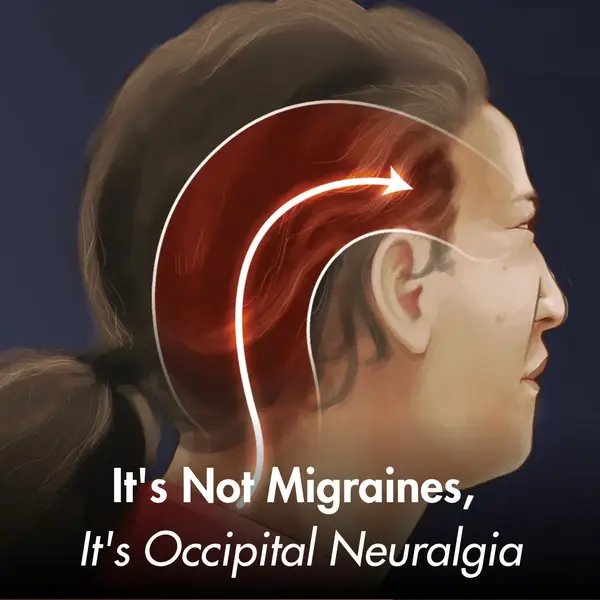
How to tell if your headaches are Migraines or Occipital Neuralgia in 5 seconds ⚡ The only question you have to ask is: Where does the pain START? If it's: •A throbbing or pulsing pain across one whole side of your head •Accompanied by nausea, sensitivity to light or sound •Sometimes preceded by visual auras (flashing lights, blind spots) •Triggered by specific foods, weather changes, or hormones It's probably a MIGRAINE. But if it's… •A sharp, electric, or stabbing pain that STARTS at the base of your skull •Wraps up over the back of your head or behind one eye •A tender spot at the back of your skull that hurts when you press it •Gets worse after long hours at a desk, driving, or reading …It's most likely OCCIPITAL NEURALGIA. Occipital Neuralgia happens when the small muscles at the base of your skull — called the suboccipital muscles — become chronically tight and compress the occipital nerves running underneath them. These nerves are responsible for sending sensation signals from the back of your head up over your scalp and around to your eyes… The ones that, when compressed, fire the exact kind of pain that mimics a migraine. Here's how it happens: ➡️ Step 1: Hours of forward head posture (desk work, phone scrolling, driving) chronically shortens the suboccipital muscles at the base of your skull. ➡️ Step 2: These muscles tighten and form trigger points around the greater and lesser occipital nerves running underneath them. ➡️ Step 3: The nerves get compressed and start firing pain signals up over the scalp and around to one eye — pain that gets mistaken for migraines, tension headaches, or stress. That tender pressure at the base of your skull? Those headaches that wrap up over your head or behind one eye? That's not a "migraine". It's not a "tension headache". It's not "just stress". It's your occipital nerves being compressed by chronically tight muscles. ======== Unfortunately, most doctors quickly write it off as migraines, tension headaches, or "just stress" without ever putting their thumb on the actual spot where it starts… The result? Millions of people needlessly suffering in pain and left wondering… "What the f**k is going on with my head?" I was one of those people. I still remember one of the doctors DISMISSING me when I said the pain always started at the base of my skull and wrapped up over my head. "Sounds like tension headaches," he said, barely looking up from his notes. "Take some ibuprofen, cut back on caffeine, and try to manage your stress." I wanted to scream. "I've been taking ibuprofen for SIX months," I said, my voice shaking. "I've tried magnesium, neck stretches, special pillows, heating pads, and the pain is STILL there. It's there when I wake up. It's there at the end of every workday. It's there when I'm doing absolutely nothing stressful. Yet no one can tell me what's wrong." He shrugged. "Look, you're in your 50s. This is what happens. People spend hours on screens, life gets stressful, headaches happen. There's not much we can do about it." Stress. The magic word doctors use when they don't want to actually investigate. The doctor before him told me it was probably migraines and put me on triptans. So I took them for four months. The acute attacks felt slightly shorter. My neurologist said I was "responding to treatment." But the base of my skull? Still throbbing. Every. Single. Day. Note to self: Don't seek help from doctors who never once put their hands on your neck during a headache appointment 🤦 I left that appointment knowing I couldn't rely on GPs or neurologists for answers. So I did the logical thing: I went to a cervical spine specialist — someone who specialized in headaches that originate from the neck, not the brain. === === === === === === The Doctor Who FINALLY Took Me Seriously === === === === === === Dr. Reyes's office felt different immediately. The walls had posters about the cervical spine, occipital nerves, and posture — not just generic health tips about hydration and stress management. When she walked in, she sat down across from me. Didn't pull up a computer. Didn't glance at the clock. Just looked me in the eye and said: "Tell me everything. And don't leave anything out." So I did. I told her about the constant tender pressure at the base of my skull. The way the pain would wrap up over my head and stab behind my left eye, like an ice pick. The shooting pain that came on after long workdays. How reading in bed for twenty minutes triggered a flare-up that lasted hours. How driving for more than an hour guaranteed a wrap-around headache. The three doctors who dismissed me. The triptans that didn't really work. The neurologist who told me it was "chronic migraines" without ever once touching my neck. By the time I finished, I was crying. "I'm not crazy," I said. "Something is really wrong." Dr. Reyes leaned forward and handed me a tissue. "You're absolutely not crazy," she said firmly. "And I believe you." === === === === === === The Tests That Changed Everything === === === === === === She started with something called "palpation tests" — specific pressure points designed to test the suboccipital muscles and the occipital nerves underneath them. "I'm going to press my thumb into the back of your skull, just below where it meets your spine," she said. "Tell me if this reproduces the pain that travels up over your head." The moment she applied pressure, that familiar electric pain shot up from the base of my skull and wrapped around to my left eye. "Yes!" I winced. "That's exactly it." She nodded, taking notes. Then she did a few more tests — having me tilt my head forward, rotate it side to side, and extend my neck while she palpated specific spots in the suboccipital triangle. Each one brought back that same sharp, localized pain. Then she asked something none of the other doctors had: "Does the pain get significantly worse after long periods at a desk, driving, or reading in bed?" I blinked. "Yes, actually," I said. "Those are the absolute worst triggers." Her eyes lit up. "And does the pain wrap up over your head or behind one eye? No nausea, light sensitivity, or visual auras like with a real migraine?" "Exactly!" I said. "But what does that mean?" She set down her pen and pulled up a diagram on her tablet. "Everything," she said. === === === === === === The Nerve Nobody Talks About (But Everyone Has) === === === === === === Dr. Reyes sent me for a cervical MRI and a specific palpation-guided exam — and a week later, I was back in her office to review the results. "Just as I suspected… It's Occipital Neuralgia caused by chronic suboccipital muscle tension," said Dr. Reyes. "Occipital… what?" I asked, confused and terrified at the same time. She pulled up an image of the upper cervical spine on her tablet. "The suboccipital muscles are these four tiny muscles at the very top of your neck, right here," she said, pointing to the base of my skull. "They're responsible for the fine adjustments your head makes — the tilts, the rotations, the constant micro-movements you don't even notice. And running directly underneath them are the greater and lesser occipital nerves — the nerves that send sensation to your scalp and around to your eyes. But here's the problem: Modern life keeps these muscles in a chronic state of tension. Hours of forward head posture at a desk, on a phone, behind a wheel. Stress. Poor sleep position. The muscles never get to fully release. They shorten and harden into trigger points — and they sit directly on top of the occipital nerves. That compression is what fires the pain. That's why it travels up over your scalp. That's why it wraps around to your eye." I stared at the screen in disbelief. "Why didn't any of the other doctors catch this?" "Because occipital neuralgia is one of the most commonly misdiagnosed conditions in adults over 40," she said. "Most doctors see 'recurring headache' and immediately think migraines or tension-type headaches. They don't palpate the suboccipital triangle. They don't ask where the pain starts and how it travels. And they certainly don't consider that the headache is actually a neck problem in disguise — even though that's exactly what cervicogenic headaches are." === === === === === === Then Came The BIG Bombshell… === === === === === === "Here's what you need to know," Dr. Reyes said, her tone turning serious. "All those migraine medications you took? They weren't wrong for migraines. Triptans work great on actual migraines. But you can't treat occipital nerve compression with a migraine drug. The medication can dull your perception of the signal… But if the muscle compressing the nerve is still chronically tight, the pain comes back the moment the drug wears off. One more thing: Painkillers, generic neck stretches, percussion massage guns, even Botox for migraines won't fix this. They might mask the pain temporarily, but they don't address the root cause — chronically shortened muscles compressing the nerve. In fact, percussion massage guns can sometimes make this worse by aggravating an already-irritated nerve. So while you might feel 'better' for a few hours, the muscle clamps right back down. And before you ask… no, generic neck stretches or YouTube exercises won't fix this either." === === === === === === Everything FINALLY Made Sense… === === === === === === I sat there quietly — digesting the huge knowledge bomb Dr. Reyes just dropped on me. It explained why the triptans, the heating pads, the stretches, the night guard, and the magnesium I'd been taking didn't make the pain go away. I felt this wave of validation wash over me. "So all those doctors who told me it was just migraines or stress..." "Had no idea what they were looking at," Dr. Reyes finished. "They saw recurring headaches and immediately thought a brain or vascular problem. They never considered the neck — or the muscle compression component." "That's why your brain MRI came back 'normal.' Because your brain is fine. It's the muscles at the base of your skull compressing your occipital nerves — and that doesn't show up on a brain MRI without specific palpation tests and someone who knows what to look for." === === === === === === "So… how do I stop the pain, Doc? I can't keep living like this." === === === === === === Dr. Reyes pulled out a notepad. "We need to address occipital nerve compression at three levels," she explained. "First, we need to physically decompress the cervical spine at the exact angle that opens space at the base of the skull." "Second, we need to apply sustained therapeutic heat to soften the chronically shortened suboccipital muscles." "Third, we need to use targeted vibration to break up the trigger points that keep clamping down on the nerve." She wrote down three key therapies: ✅ 26-degree cervical traction (the angle clinics use) ✅ Sustained therapeutic heat (deep, not surface-level) ✅ Targeted vibration (to release trigger points) "Together, these three work to decompress the spine, release the muscles, and let the nerves stop firing," she said. ✅ "26-degree cervical traction is the exact angle physical therapists use in clinics to decompress the upper cervical spine. It opens space at the base of the skull where the occipital nerves exit — taking pressure off the nerve. ✅ "Sustained therapeutic heat penetrates deeper than a heating pad or hot shower. It increases blood flow into the suboccipital muscles, softening them enough that they actually start to release instead of just feeling temporarily warm. ✅ "Targeted vibration breaks up the trigger points and adhesions that have built up in the suboccipital muscles. Unlike a percussion massage gun, which works on the surface and can aggravate the nerve, it focuses on the exact suboccipital triangle where the compression happens." She looked up at me. "You have to apply all three together: decompression, heat, and vibration. If you only do one or two — like just stretching, or just a heating pad — the muscles clamp right back down and the nerve stays compressed." ======= That night, I went down the Google rabbit hole, researching every therapy Dr. Reyes mentioned. Most home neck devices just offer a basic stretch without applying the specific angle needed for cervical decompression… While most heating pads only warm the skin without penetrating deep enough to reach the suboccipital muscles… But then, I found a community of people talking about a device called FisioRest. They were in their 40s, 50s, 60s, even 70s. They had the same constant pressure at the base of their skull — and the same wrap-around headaches that doctors kept calling migraines. And they were raving about how they got their lives back — because FisioRest combined all three therapies into one device: ⭐ Janet W, 57 ⭐ I had constant pressure at the base of my skull for almost three years. Pain level was 8-10 daily. I tried chiropractic, deep tissue massage, Botox for migraines, two different preventatives. Then I saw one of your videos talking about how this kind of headache isn't really a headache at all — it's a compressed nerve. I ordered FisioRest. By the end of week two, I could press the spot at the back of my skull and barely feel any tenderness. By the end of week four, I was going whole days without the wrap-around eye pain. I recommend it to anyone who's been told they have "chronic migraines" and nothing has worked. ⭐ Ron M, 61 ⭐ I had headaches every day for years. Doctors couldn't figure it out. I had trouble focusing on anything by 3pm because the pressure at the back of my head was so distracting. With FisioRest, it has taken most of that pressure away. I can work a full day now. I don't reach for the ibuprofen by lunch anymore. It is unbelievable. ⭐ Leslie W, 66 ⭐ I really am amazed at how quickly — within one week — the tenderness at the base of my skull started easing. I've been using FisioRest since December and am feeling so good. I shared my experience with several friends who are now also using it with positive results. ==== Even healthcare professionals — who are usually skeptical of home devices — were recommending FisioRest for cervicogenic headaches: ⭐ Hope T, 55-64, Registered Nurse ⭐ I couldn't sleep at all because of the pressure at the back of my head, and was getting weekly massages that lasted maybe a day. Finally, I found FisioRest on FB. I've been using it for a year and my headaches are almost gone. I work twelve-hour shifts in a busy ICU. So happy I found it. =========== Skeptical but desperate, I cross-referenced the device's specifications… And they matched Dr. Reyes's recommendations exactly: 🦴 26-degree cervical traction angle •The exact angle clinics use for upper cervical decompression •Opens space at the base of the skull where the occipital nerves exit •Takes pressure off the nerve at the source 🔥 Adjustable therapeutic heat •Penetrates deeper than a heating pad or hot shower •Increases blood flow into the suboccipital muscles •Softens chronically tight tissue so it actually releases 〰️ Targeted vibration •Focused on the suboccipital triangle, not generic neck massage •Breaks up trigger points and adhesions •Doesn't aggravate the nerve like a percussion gun can This wasn't just another generic neck massager. This was specifically designed to target occipital nerve compression at the source — by combining the exact three therapies clinics use into a single 15-minute home session. ====== I ordered FisioRest that night. I wanted to give it a proper shot… Plus they had a 365-day money-back guarantee — a full year… So I figured: "What did I have to lose?" When the package arrived, I sat on the edge of my couch and took a deep breath. After years of pain, dismissive doctors, and failed treatments... This felt like my last shot. I started using it for 15 minutes a day as instructed, and prayed that it would work. === === === === === === My Healing Timeline === === === === === === 🗓️ Week 1: The tender spot at the base of my skull started to ease. I could actually press it without flinching. 🗓️ Week 2: Woke up without that constant pressure. It wasn't the first thing I felt every morning anymore. 🗓️ Week 3: Made it through a full workday without a single wrap-around eye headache. First time in three years. 🗓️ Week 4: Drove to my sister's house — three hours — and didn't have to pull over for the pressure to ease. 🗓️ Week 6: Read in bed for an hour without triggering anything. Used to be a guaranteed flare-up. 🗓️ Week 8: The brain fog started clearing. I didn't realize until a colleague said I seemed sharper in meetings. 🗓️ Week 12: I went through an entire day — work, dinner, reading, sleep — without thinking about my neck once. I'm now four months in. And I'm never going back. I highly recommend FisioRest to anyone over 40 who has constant pressure at the base of their skull or headaches that wrap up over the head — and is sick of being told it's just stress or migraines. It was the only thing that worked. And I hope it works for you too ❤️ Remember: they have a 365-day money-back guarantee. So there's nothing to lose but that constant pressure at the base of your skull: 👉 Try FisioRest Risk-Free Today: https://artuvate.co/pages/reasons-bosp P.S. My story is not a one-off miracle. FisioRest has helped thousands of people work, drive, read, and sleep without that wrap-around headache showing up. Here are some of their stories: ⭐ Valerie D, 55 ⭐ "I bought FisioRest and am halfway through my second month. I was very skeptical at first, and didn't notice much for a few weeks, until it hit me. The pressure at the back of my head is GONE, and the headaches that used to start there have almost completely stopped." ⭐ Brian D, 57 ⭐ "I was living on Aleve and Tylenol to manage the constant base-of-skull pressure and the headaches that came with it. I started using FisioRest and within the first two weeks, I was down to one Aleve a day. After the next week, I used Tylenol three times that week and haven't needed any since. I'm so happy." ⭐ Kim H, 53, USA ⭐ "LOVE IT. I have always been skeptical about reviews but I have to leave one. Before this, I had constant pressure at the back of my head that made working at a computer almost impossible by mid-afternoon. I felt 98 and I'm only 53. They said modern desk work wreaks havoc on your neck and boy, does it. I found FisioRest and I'm now in my second month. Being able to work a full day without the wrap-around headache showing up is the biggest change for me. The pressure at the back of my head is gone for the first time in years. I can work without thinking about it." ⭐ Larry G, 51, USA ⭐ "Suffered from constant base-of-skull pressure for years. But within one month, I was sleeping through the night without waking up with that tight feeling. By the second month, the headaches that used to start there were almost completely gone. I had Botox injections before and was on constant pain meds… but the headaches always came back. That's why I cannot believe the tremendous difference FisioRest has made in my life. I recommend it to all my friends and co-workers who have similar headaches." ====== Are these people any different from you and I? No, they're not. They aren't special or genetically lucky. They used to wake up and spend every day managing that constant pressure at the back of their head, just like you. But now? They're working, driving, reading, sleeping, and living without that wrap-around headache holding them back. All they did was put their skepticism aside for a little while — and gave FisioRest a try. Now, you can too. 👉 Try FisioRest Risk-Free Today: https://artuvate.co/pages/reasons-bosp ===== Work, Drive, Read, Sleep, & Live Without That Constant Pressure In 365 Days… Or It's Free! ===== If you don't see significant reduction in your base-of-skull pressure and headache frequency within a full year… Simply email FisioRest and they'll refund every cent. No questions asked. 12 months from now, you can be: •Waking up without that immediate pressure at the back of your head •Working a full day at your desk without the wrap-around headache showing up •Reading or driving for hours without a flare-up •Sleeping through the night and waking up clear •Going through a normal day without thinking about your neck once All you have to do is take this first step. 👉 Try FisioRest Risk-Free Today: https://artuvate.co/pages/reasons-bosp 💕 365-Day Money-Back Guarantee — use it for a full year, then decide 🦴 Clinical-grade design by physical therapists and engineers 📍 Built to clinical-decompression standards 🧬 Targets the REAL cause of base-of-skull pressure — occipital nerve compression ⭐ Trusted by thousands of customers worldwide 🔐 One-time purchase. No subscriptions.
Loading the ad's image