Advertiser

LiB002

Meta Ad Library

79
Running ads
74 new in 30 days
Sep 2026
Advertising since
longest ad 2 months
—
Reach
running ads, summed
29% video
Formats
23 video · 7 image
1
Products advertised

🔥🔥 Click to Read 👉🏻👉🏻

On my eighteenth birthday, I found my boyfriend, Dylan, in bed with my older sister, Chloe. I'd brought a cake and a new dress. After three years together, I'd decided tonight would be our first time. Then I'd heard her through the door—a woman's voice, high and breathy. Underneath it, Dylan's lower moan. I pushed it open. Dylan. My Dylan. Three years of my Dylan. And under him, blonde hair spread across HIS pillow, is my sister. Chloe. The girl he swore he couldn't stand, currently digging her nails into his back. He was thrusting into her without a single brake. More grunting, more slapping...filled my ear. The cake box hits the floor. Neither of them hears it. Of course they don't. I don't scream. That's the weird part. Some fuse inside me just - pops. Clean break. No spark. I walk down the stairs on legs I can't feel, past the flickering light, out into air that tastes like copper. I pull out my phone. My fingers are shaking so hard I miss the contact twice. Third try, I find it. The number Noah made me save a year ago. *Noah, the Prez of the Asphalt Demons MC* ———————— The door isn't even locked all the way. It drifts open an inch under my knuckles before I ever knock. And I see them. Dylan. My boyfriend. Three years of my Dylan. And under him, blonde hair spread across his pillow, is my sister. Chloe. The girl he swore he couldn't stand. “Your sister's exhausting, Lex.” “Your sister's fake, Lex.” Your sister, Lex, currently digging her nails into his back. The cake box hits the floor. Neither of them hears it. Of course they don't. It's my eighteenth birthday. A few hours ago, I had a plan. A bag with a new dress, a cake box balanced on one arm, and a heart running about two thousand RPM over redline. Dylan didn't know I was coming. His shift got cancelled—his buddy let it slip this morning—so I decided to surprise him. Tonight was going to be the night I gave him the one thing he hadn't gotten in three years of us. Me. All of me. Eighteen felt like the right line to cross it on—my rules, my timing, my choice. I even bought a dress. Me. A dress. The cashier looked at my boots and my dress and visibly rebooted. I parked Phoenix, the first bike I ever rebuilt from actual ashes, around the corner from his building. Killed the engine. The evening went quiet. Almost quiet. His building has exactly one working light in the stairwell, and it flickered like it was sending morse code. I climbed to the second floor, cake box in both hands, running lines in my head. Surprise. Happy birthday to me. Hope you like the gift, it's—well, it's me. God, that's terrible. I'll improvise. Three steps from his door, I heard it. A woman's voice. High and breathy. Underneath it, Dylan's voice, low, saying something I couldn't make out and absolutely did not need to, because the tone said everything. My hands knew before my brain did. The box dipped. I caught it. My legs carried me those last three steps anyway. Traitors. Now the door is open. Chloe's hair is on his pillow, her nails in his back, and the cake is on the floor. I don't scream. That's the weird part. Some fuse inside me just—pops. Clean break. No spark. I walk down the stairs on legs I can't feel, past the flickering light, out into air that tastes like copper. Phoenix waits around the corner, patient as always. I pull out my phone. My fingers are shaking so hard I miss the contact twice. Third try, I find it. The number Noah made me save a year ago. Asphalt Demons. I press call. One ring. My thumb hovers over the red button, because it's almost midnight and I'm the girl who said no a hundred and three times. Noah has spent a year trying to recruit me. I've spent a year fixing his motorcycle and saying I can't, because Dylan doesn't want me joining a club. Bikers, Lex? Seriously? Those clubs are a cult with extra chrome. You're MY girl. My girl doesn't wear someone else's name on her back. His voice in my head. Still giving instructions. “Lexi?” Noah's voice on the phone, and the fuse that popped on that stairwell starts sparking again. I open my mouth to say something normal. Hey, quick question about clutch cables. What comes out is half a word and a leak in a pressure line. “Lexi.” Sharper now. Something scrapes on his end. A chair, him standing up. “Where are you?” “I don't... Noah, I don't know where to—” “Are you hurt?” “No.” A laugh falls out of me, ugly and wet. “Body's fine. Best condition of my life. Full diagnostic, everything works except the parts you can't touch.” Two seconds of silence. “Come here,” he says. “Just come.” “It's midnight, I can't just—” “Lexi. You know the address. Just come.” He doesn't hang up. I hear him breathing, a TV murmuring behind him, some other guy asking something and Noah not answering. He's waiting for the sound of my engine. I shove the phone in my jacket and pull the helmet on over a wet face. Pro tip from your local mechanic: terrible idea. The visor fogs and tears have nowhere to go. Phoenix catches on the first try. Good girl. At least one of us works. ... Forty miles. The speedometer and I agree not to discuss it. The road doesn't ask why I'm doing eighty at midnight, and it doesn't say maybe you saw wrong. I didn't. Three years of not those jeans, Lex. Of do you have to smell like gasoline. Shrinking degree by degree like cooling metal and calling it love. And her. Blonde hair on his pillow. Nails she gets done every two weeks, the same nails that passed me potatoes last Sunday at Mom's table while she asked, sweet as syrup, how's Dylan, still putting up with your little hobby? She knew. She looked right at me and she knew. Something clanks in my chest like a rod about to throw. I roll the throttle harder. It doesn't help. The picture is mounted inside the helmet, so it rides with me. I flip the visor up and let the wind slap the tears sideways. The turn-off appears out of nowhere: gravel, a bent reflector post, a rut I know from the napkin map Noah drew me “in case you change your mind.” Up the slope: a long low building, amber windows, three bikes out front, chain-link fence, and a steel gate. ... The next morning, at the clubhouse, I finally look at the phone I've been avoiding since the call to Noah. Forty-seven missed calls. Dylan. Dylan. Dylan. A column of his name like a piston that won't stop firing. Nine voicemails. Texts I stop reading at the previews: baby it's not, Lex answer me, ANSWER YOUR PH— Forty-seven moments in one night when he thought calling would fix what I saw. Not one of them came before he took my sister to bed. “Lexi.” Noah, careful. “Your hands.” The phone is fine. My hands are shaking like an engine on a cracked mount. I press decline. I press block. That should have been the end of it. Forty minutes and one very aggressive session of dishwashing later, I hear an engine. Not a bike. A car. Four-cylinder, front-wheel drive, a fan belt one payday from snapping. I've told him about that belt six times. My hands go still in the soap. “Lexi?” “That's his car.” I'm at the window against every vote from my brain. Dylan is standing in the yard in his good jacket, the one he wears when he wants something. He's carrying gas station flowers. They still have the price sticker. How did he find me? Chloe. Obviously. “Lexi!” His voice cracks through the glass. “I know you're in there! Baby, please, just five minutes!” Noah is already taking his apron off. “I can make him leave.” “No.” It's out before I decide it. “I need to look at it in daylight.” I dry my hands on my jeans and open the door. Daylight is rude. Last night was headlights and shadows. Now it's just gravel and honesty, and Dylan is standing in the middle of it looking smaller than my memory of him. Weird. Three years I looked up at this guy. Turns out I was standing in a hole. “Lexi.” Dylan exhales my name. “God, look at you. Did you sleep HERE? With them?” Ten seconds. He lasted ten seconds before making it about them. “What do you want, Dylan.” “I called you forty-seven times—” “Forty-eight.” “—I thought you were dead in a ditch! Do you have any idea what that felt like?” I laugh. It scrapes. “Do I have any idea what something felt like. That's the question you drove out here to ask me.” “Lex—” “Say her name. You've said mine four times. Say what I saw. In daylight.” I watch the Dylan I know boot up. Shoulders drop, eyes go wet, the voice slides down into the register that worked on me for three years. “It meant nothing.” There it is. “Nothing, Lexi, I swear. One time. She came over about your birthday, we had wine, it just happened. It was never her, it's always been you—” “You told me she was exhausting. Fake. Three years you built me a story where you could barely stand her.” “Because I could barely stand her!” “You stood her fine last night. Horizontally.” His face does something ugly. Then the tears arrive, real ones, and the hand with the bouquet comes toward me. I step back like it's on fire. The horrible part, the part I'll be ashamed of forever, is that some old, well-trained piece of me twitches toward him. Comfort him. Fix it. That's your job. “One mistake in three years! You're throwing US away over HER?” “You threw us away. I just found the receipt.” “I'll fix it! I'll block her, I'll block your whole family! Come HOME. Look at this place.” His arm sweeps at the clubhouse, the bikes, the porch. “These people are strangers. You fix their bikes, that's all you are to them! They're circling, Lex, you cried at their gate and you can't even see—” “Careful.” “—I'm the one who LOVES you! I put up with ALL of it! The grease, the attitude, the bike, that stupid garage. I put up with all of you, and this is what I get?!” Put up with. Three years I ran on that fuel and called it premium. Like I was a knock he'd learned to drive around. Something in my chest goes quiet and cold, like a workshop when you finally shut off the compressor and realize how loud it was. “You should go.” “Not without you.” He drops the flowers on the gravel, plastic sleeve and price sticker and all, and lunges for my wrist like a man grabbing a handrail he owns. “You're hysterical. Get in the car, we'll talk at home like normal—” His fingers get within six inches of me. They never arrive. Damon steps between us before I hear him leave the porch. He doesn't touch Dylan. Doesn't raise a hand. He just stands there, filling the space. Dylan's hand is still hanging in the air where my wrist used to be. “Who are you?” Damon looks at the hand until Dylan looks at it too and lowers it himself. “This is between me and my girlfriend. Step aside, buddy.” “She asked you to leave.” “She's confused—” “She asked you to leave. I heard it from the porch. The gravel heard it.” Dylan laughs. “Three years. You've known her since last night. I'm not leaving my girl at a compound with four grown men—” The yard goes quiet. Dylan's mouth opens and closes. I watch him dig through his toolbox for the wrench that fits this bolt. Tears didn't work. Reasonable-guy didn't work. Out comes the last one. “Fine. Keep her. A grease monkey with an attitude who'll choose a carburetor over you every time. You'll figure her out.” That one lands in the old wiring, the part he installed himself, screw by screw. He's right, you're too much and not enough. I open my mouth. Damon gets there first. “You keep saying mistake.” Quiet. Almost conversational. “The road doesn't betray. You did. A mistake is grabbing a ten instead of a twelve. What you did, you did with both eyes open, in a bed, for however long it took. 'One time' is just the once you got caught.” Dylan has gone primer-gray. “So you get in your car,” Damon tells him, “the one with the fan belt about to snap, get that looked at, though not by her, and you drive off my land.” Silence. A crow flaps off the fence like even it has somewhere better to be. Dylan, three years of my Dylan, the future I decorated in my head like a room I'd never get keys to, bends down, picks up his gas station flowers, price sticker and all, and carries them back to his car. He actually takes the flowers. The door slams. The fan belt shrieks, and the silver car reverses out in a spray of gravel. We listen until the trees eat the sound.

Loading the ad's image
LiB002 — 🔥🔥 Click to Read 👉🏻👉🏻
Promising

🔥🔥 Click to Read 👉🏻👉🏻

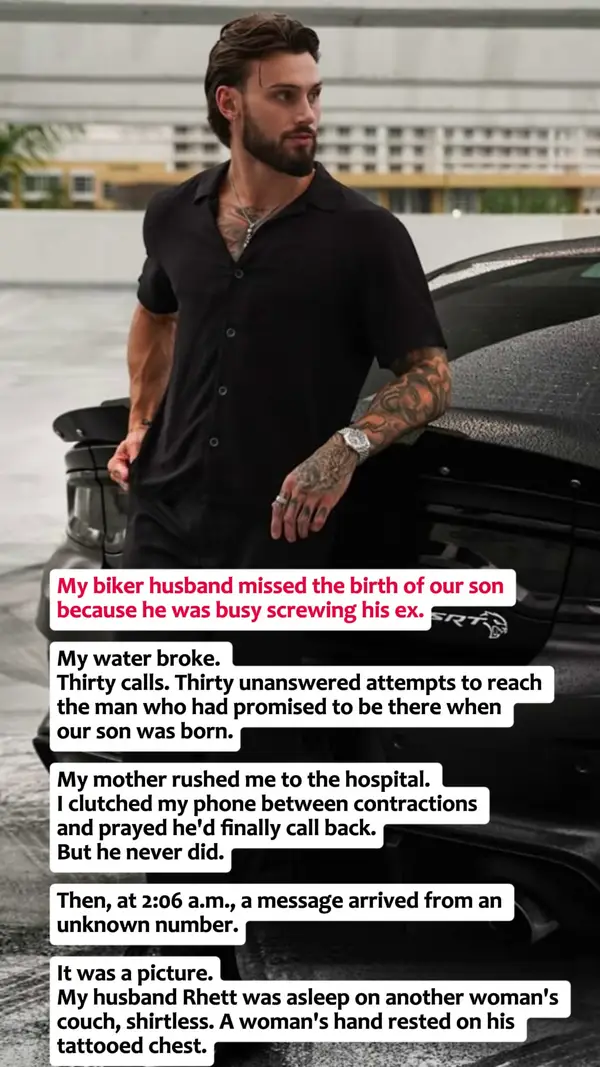
My biker husband missed the birth of our son because he was busy screwing his ex. My water broke. Thirty calls. Thirty unanswered attempts to reach the man who had promised to be there when our son was born. My mother rushed me to the hospital. I clutched my phone between contractions and prayed he'd finally call back. But he never did. Then, at 2:06 a.m., a message arrived from an unknown number. It was a picture. My husband Rhett was asleep on another woman's couch, shirtless. A woman's hand rested on his tattooed chest. Under the photo, a line of text. "He's fine. He's with me. Stop calling." My heart shattered. While I was fighting through labor, begging for him to answer, he was sleeping with another woman. At 5:52 a.m., I gave birth to our son. Rhett finally showed up hours later. His shirt was inside out. His eyes were bloodshot. And there was a black velvet hair tie around his wrist. "Whose is that?" He froze. "Did you sleep with her?" I asked. "Yes." "While I was giving birth to your son?" He said nothing. "Get out," I whispered. "You don't get to hold him. Not with her still on you." __________ The sun came up orange the week I was due, and it stayed orange all day, a flat coin hung over Spokane like somebody had forgotten to take it down. That was smoke week. Every August had one now. Fires up in the Okanogan and across the line in Idaho, and the wind would turn, and for six or seven days the whole Inland Northwest breathed through a dirty rag. Ash on the windshields in the morning. The pines along the river gone soft and gray, like a photograph left in a window. The air quality app on my phone was a cheerful shade of purple that meant nobody should be outside, especially not pregnant women, especially not pregnant women who had been on their feet in a bakery since three-thirty in the morning. I was thirty-nine weeks and three days. I knew the number the way I knew how long a croissant dough needed to rest between turns. You don't have to look it up. It lives in you. "Go home," Imani said, around noon. She said it to the oven, not to me. She talked to ovens and to Agnes, the sourdough starter, more kindly than she talked to most people. "You've glazed the same tray of morning buns twice." "I glazed it once and then I fixed it." "You glazed it twice, Jolene. I watched you." She turned around, six feet of chef in a black apron, gold hoops swinging, and pointed a bench scraper at my stomach. "That baby is coming this week and I am not delivering it next to the walk-in." "You'd be good at it." "I'd be excellent at it. That's not the point. Go home. Put your feet up. Drink a gallon of water. Tell that husband of yours to rub your ankles." I went home. I'd like to say that was the smart thing to do. It was just the thing I did. * * * Our duplex was off Sprague in Spokane Valley, a tan box with a carport and a strip of yellow grass that the landlord called a lawn. Rhett's bike was in the carport when I pulled in, a black Dyna with a sissy bar he'd put on so I could ride behind him back when I could still swing a leg over anything. It ticked as it cooled. He'd been out already. He was in the kitchen eating cold cereal out of a mixing bowl, standing up, still in his cut. The Silver Valley patch on the back caught the light from the window over the sink: the crossed pick and hammer over a single pine tree, silver thread on black leather, the rocker underneath that said SPOKANE. He'd been a patch-holder for three years. He'd been my husband for two years and nine months. He was twenty-eight and still ate like he was fifteen. "Hey, Jo." He set the bowl down and came and put both hands on my belly, the way he did every time I walked in, like he was checking a tire for air. "How's he doing?" "Kicking my bladder like it owes him money." "That's my boy." He bent and k1ssed my stomach through my apron. Then he k1ssed me, and he tasted like Froot Loops and the smoke that was in everything that week. "You're home early." "I mani kicked me out. She thinks I'm going to have him next to the walk-in." "You might." He grinned. Rhett had a crooked front tooth that he hated and I loved. It made him look like he was about to tell you a secret. "Hey, so. Wilder wants a few of us to ride over to Wallace this afternoon. Some thing at the Smokehouse with the Idaho guys. I'll be back by ten." I looked at him. "I know," he said. "I know. I'll have my phone. It's thirty-five minutes to the line and another forty to Wallace. If anything happens I'm an hour and change out. Your mom is ten minutes away." "I'm thirty-nine weeks." "And three days," he said. "I know, babe. First babies come late. Everybody says. The app says." He held up his phone, as if the app were a doctor. "The nurse at the class said first babies average forty-one weeks." "The nurse at the class did not say that." "She said something like it." He k1ssed my forehead. "Ten o'clock. I swear. You want me to bring you back one of those huckleberry shakes from the place in Kellogg?" "In this heat it'll be soup." "I'll ride fast." I want to tell this part right, because I've told it wrong to myself a hundred ways since. I was not afraid. I was tired and a little annoyed and my ankles were the size of grapefruits, but I was not afraid. I was married to a man who put his hands on my belly every time I walked through the door. I had no reason to look at his face and wonder what was behind it. So I didn't. I said okay. I said okay, okay, the way I do, and I told him to wear a bandana over his face because the smoke would get in his lungs. He said yes ma'am. He took his helmet off the hook by the door. At ten minutes after four, the Dyna rumbled out of the carport and down the street toward Sprague, and the sound of it got smaller and smaller until the smoke swallowed it up. He did not wear the bandana. I saw it on the counter later, folded in a square. * * * I did what Imani told me. I put my feet up on the arm of the couch and drank water until I sloshed and watched three episodes of a show about people renovating farmhouses in Texas. The hospital bag was by the door. I'd packed it at thirty-four weeks, unpacked it at thirty-six to add the good socks and the lip balm, and packed it again. The car seat was already in the back of my little Corolla, installed by a firefighter at the station on Pines Road who told me I'd done it right the first time and then checked it twice anyway. The first one came at seven-oh-four. I know because I looked at the clock on the stove. It felt like the cramp you get before a period, only lower, and wider, like a belt being cinched around my hips from the back. Then it let go. I sat very still on the couch and waited, the way you wait for a loaf to tell you it's done. Fifteen minutes later, another. I opened the app. Not the smoke app. The other one, the contraction timer I'd downloaded in my second trimester and played with like a toy. I pressed the big pink button when the next one started and pressed it again when it stopped. Forty seconds. Fourteen minutes apart. "Okay," I said to the empty living room. "Okay." At seven-forty I called Rhett. It rang five times and went to voicemail. His voice, recorded the summer we got married, laughing because I was tickling him while he tried to record it: "It's Rhett, you know what to do." Then the beep. "Hey," I said. "It's me. I think something's maybe starting. It's early, it's not a big deal yet, they're like fourteen minutes apart. Just call me when you get this, okay? Okay. Love you." I hung up. I went and peed, which was a whole production at thirty-nine weeks. I stood in the kitchen and ate four saltines from the sleeve because the class nurse had said eat something light in early labor, you'll need the energy. I looked at the folded bandana on the counter. Eight-fifteen. Twelve minutes apart. Fifty seconds. I called again. Five rings. "It's Rhett, you know what to do." "Hey, it's me again. They're closer. Can you call me? I just want to hear you. Call me." Eight-thirty, I texted. **Contractions 12 min apart. Call me.** The little word under the text said Delivered. It did not say Read. I want to be fair to the version of me standing in that kitchen. She was not stupid. She knew that riding through the passes on I-90 meant spotty service. She knew the Smokehouse in Wallace was a brick building with walls a foot thick and a band that played too loud. She knew that her husband put his phone in the inside pocket of his cut, against his chest, where he might not feel it buzz over the vibration of a motorcycle. She had a dozen reasons. She lined them up like rolls on a sheet pan. At nine I opened the app that showed where he was. We'd turned on location sharing when we found out I was pregnant, both of us, because Rhett said he wanted to know I was safe when I drove to work in the dark. **Location not available.** Not "no service." Not a little gray dot frozen somewhere outside Kellogg. Not available. That was the message you got when someone had turned it off. I stood there and read it four times. Then a contraction came and bent me over the counter, and I held onto the edge of the laminate with both hands and breathed the way the class had taught me, low and slow, like fogging a mirror, and when it let go I was sweating. Fifty-five seconds. Ten minutes apart. * * * I called the clubhouse at nine-twenty. I had the number because every old lady had the number. The Silver Valley MC rented an old roadhouse on Trent, a cinderblock building painted pine green with a neon sign out front that still said EATS from when it was a truck stop. There was a landline behind the bar, a beige phone with a cord, and somebody always answered it, because Wilder Maddox believed a club should always pick up. It rang twice. "Silver Valley." A young voice. A prospect. Behind it I could hear a jukebox and the clack of pool balls. "Hi. It's Jo Pomeroy. Rhett's wife." A little pause. "Oh. Hey, Mrs. Pomeroy. It's Kimball." Kimball was nineteen, with a neck tattoo he was clearly regretting and a habit of carrying my grocery bags at club barbecues whether I wanted him to or not. I liked him. "Hey, Kimball. Is Rhett there? Or did they get back from Wallace? He's not answering and I'm..." A contraction was starting. I could feel it rising in the small of my back like a wave pulling back from shore before it breaks. "I'm in labor. I think. I need to talk to him." The pause was longer this time. Long enough that I heard someone at the pool table laugh. Long enough that I heard Kimball breathe. "He's on a run," Kimball said. "Is he with Wilder? Can you get Wilder to call him?" "He's on a run, Mrs. Pomeroy," Kimball said again, and his voice did something in the middle, a little crack, like ice under a boot. "I'll tell him you called. Okay? I'll tell him. Hey, congratulations." He hung up before I could say anything else. I stood holding my phone and the contraction broke over me, and I didn't fog any mirrors. I just held on. Later, much later, I would understand that a nineteen-year-old prospect had been told exactly what to say if I called, and that he had said it twice because he couldn't think of anything else, and that the crack in his voice was the only honest thing anybody in that club gave me that night. I would even, years from now, feel a little sorry for him. That night I only knew one thing for sure. Wallace was not a run. A run was the whole club on the highway, colors flying. A run was planned. You did not go on a run to the Smokehouse for a burger and be home by ten. Somebody was lying to me. I just didn't know yet who it was.

Loading the ad's image
LiB002 — 🔥🔥 Click to Read 👉🏻👉🏻
Promising

🔥🔥 Click to Read 👉🏻👉🏻

I built a lookout room so I could watch my husband come home. On opening night, I found him screwing with another woman in it. I went upstair to the Lookout to see if my husband’s car was on the road. Then I heard a woman soft laugh. Then Gage's voice. "Crys. Hush." My heart twisted. I put the key in, and pushed the door open. The lamp was on. A blonde woman's bare back. Under her, with shirt open and belt undone, was my husband. She screamed and grabbed his cut to cover herself. "Shelby," his face went gray. I walked past them to my window. I'd built that to watch his headlights come up out of the dark. He'd come in the back with his mistress. "Shelby, please. Just let me—" Gage said, coming closer. I dashed down the stairs. The song ended, and two hundred people turned their heads at me. Then my daughter's voice, high and cracking: "Daddy?" Callie was holding her phone up, the camera pointed up the staircase. She got her father. She looked at his open shirt. His belt hanging loose. And then his chest, her eyes stopped there. A smear of pink lipstick on his collarbone. "Turn it off, baby. Please." Gage got to her, reaching for her shoulder, she twisted out from him. She turned the phone around. Not off. The screen faced him. The red LIVE tag blinked. 803 viewers. 900. "You tell them," Callie's eyes were full. "Tell everybody who that woman is." —————— The noise followed me up the stairs and got thinner with every step. One, two, three. I counted without meaning to. My boots on the oak treads, my hand on the rail I'd had carved by an old man in Unicoi who wouldn't take a dime more than he'd quoted me. Seven, eight, nine. Down below, the chant was turning into a song, and somebody was banging the bar in time. At the top was the cherry door, and the hallway light I'd put in made the wood glow red. Fifteen, sixteen, seventeen. I put my hand on the knob out of habit and turned it. It didn't give. Of course it didn't. I'd locked it myself at half past five that morning. I dug my key ring out of my dress pocket. Then I stopped, with the key halfway to the lock. There was a sound behind the door. It was low and it was soft, and if the party downstairs had been one bit louder, I'd never have heard it. A woman laughing. Not a party laugh. The kind you only do with one person, close up, in the dark. I stood very still. I told myself it was a prospect who'd snuck his girl up the back stairs. There was that second door on the far wall, the steel one off the back stairs, with a panic bar that only opens from inside. Some boy had probably propped the outside door at the bottom to haul ice, the way they'd been doing all night, and found himself a quiet room. That's what I told myself. I'd have to run him off. I'd have to tell Breaker. I already felt tired thinking about it. Then a man's voice said, "Crys. Hush." I knew that voice the way I know my own porch steps in the dark. I'd heard it say I do in the Greene County courthouse. I'd heard it on a truck stop pay phone saying two more hours. I'd heard it through a garage wall on the night we buried his mama. Only two keys fit that deadbolt. One rode on Gage's ring. The other was in my hand. The man who'd locked that door from the inside didn't think anybody else could open it. He'd forgotten who made the lock. I put the key in. It went in smooth, because I'd sanded the strike plate down twice to get it right. I turned it. The bolt slid back with a clean little click, the sound of a job done well. I opened the door. The lamp by the couch was on, the low one with the iron base I'd found at a flea market in Jonesborough. In its light I saw a woman's bare back and two tan shoulders, the deep, even brown you only get from living somewhere it's summer most of the year. Her hair was long and blond at the ends and dark at the roots, and it was spread out over the leather couch I'd ordered from a furniture maker in Hickory. Under her, half sitting up, with his shirt open and his belt undone and his face gone gray as concrete, was my husband. She screamed and grabbed for something to cover herself. It was his cut. She pulled Gage's Burnt Chapel cut up over her chest with both hands. "Shelby," he said. That was all. Just my name. Like it was a question he didn't want answered. I didn't look at them. People have asked me about that since, and some of them seemed to want something worse. They wanted me screaming. They wanted me pulling hair. I didn't. I didn't look at her face, and I didn't look at his. I couldn't. If I'd looked at his face I'd have seen every year of the last six on it, and I wasn't ready to read that yet. So I walked past them, across the floor I'd laid with my own crew out of white oak, and I went to the window. My window. The one I'd drawn at the kitchen table long after midnight. The one I'd fought the steel man over, because he said a window that size on a second floor would need a header the club couldn't afford, and I said then I'll pay for the header. I stood in front of it and looked out. There it was. Highway 11, two full miles of it, black and empty, from the Sinclair lights clear down to the little bridge over Lick Creek. One car was coming, way off. A pair of headlights crawling up out of the dark. It wasn't him. It couldn't be him. He was behind me with his shirt open. I'd built a room to watch him come home, and he'd come in the back. Behind me there was scrambling. A zipper. A boot hitting the floor. The woman was saying something fast and high, oh my God, oh my God, in an accent that wasn't from anywhere near here. Gage was saying my name again, lower, coming closer. "Shel. Shelby. Look at me." I didn't. I watched those headlights come up the highway past the feed store and the Dollar General, and I counted. One second. Two. Three. I don't know why. My body just did it. Twenty-three years of standing at windows and counting, and it was still all my body knew to do. "I can explain," he said. I almost laughed. That's what people say in movies. I didn't think real people said it. The headlights reached the bottom of our hill and kept going, on past the turn, and out of sight toward Greeneville. Somebody else's husband. Somebody else going home. And then, because the window was big and the security lights were on, I looked down. Right below me was the gravel lot behind the kitchen, where the prospects park and the ice truck comes in. Gage's black Peterbilt was sitting at the far end of it with no trailer, nosed in against the tree line like he was hiding it, which he was. And parked crooked right behind it, under the big pole light, was a blue pickup truck I'd never seen before in my life. The light was shining right on its back bumper. On the license plate. It wasn't a Tennessee plate. --- I turned away from the window and walked to the steel door across the room. Gage stepped toward me with his hands out in front of him, palms up, the way you walk toward a dog you aren't sure about. His shirt was still hanging open. There was a smear of somebody's lipstick on his collarbone, a pink I'd never once worn. "Shelby, wait. Please. Just let me—" I went around him like he was a post in the yard. The woman was on the far end of the couch with his cut still clutched against her. She was younger than me. Not as young as I'd have guessed from the shoulders, though. Mid-thirties, with laugh lines at her eyes and a little silver hoop in the top of one ear. She was staring at me like I was the one who'd broken in. I hit the panic bar with my hip and the fire door swung open onto the back stairs. The back stairs were the ones I'd built plain on purpose. Pine treads, a pipe rail, a bare bulb in a cage at the landing. Stairs for hauling ice and kegs and trash. Not for company. I went down them fast, my hand sliding on the cold rail, and the noise of the party came up through the wall on my left like water through a dam. They were singing "Free Bird" now. Somebody always does. At the bottom, the outside door was propped open with a cinder block. Just like I'd thought. A boy hauling ice. Or a man who wanted a way in that nobody would see. I stepped out into the cold. It was the middle of October in the mountains, and the air had that bite in it after dark, like the inside of a refrigerator. My breath came out in a little cloud. The gravel crunched under my boots. Somewhere out front, past the corner of the building, somebody laughed and a beer can hit the ground. The blue truck was a Ram, maybe five years old, with a crack across the bottom of the windshield and a sticker on the back glass that said LIFE'S A BEACH. The license plate had a little orange in the middle of it, with green leaves, and across the bottom it said Sunshine State. Florida. Pensacola. Two adults, one child. I didn't decide to walk over to it. My legs did that. The back window on the driver's side was rolled down about two inches, the way you'd leave it for a dog. I stepped up close and looked in. There was a car seat in the back, the tall kind with a high back and a cup holder, and there was a little boy in it, sound asleep. He had his head tipped over against the side wing of the seat, and his mouth was open a little. His hair was dark and stuck up in the back where he'd been lying on it. He had on a pair of pajama pants with dinosaurs on them and a tiny black leather vest over his T-shirt, the kind you'd buy at a mall kiosk, with a patch on the back I couldn't see. A silver balloon shaped like the number six was tied to the headrest in front of him. It had lost some of its air and was hanging down sideways, turning a little in the breeze from the window. On the seat next to him was a blue plastic inhaler, a juice box, and a paper plate holding half a slice of cake. The frosting was black and orange. Somebody had piped a little motorcycle on it. I kept my hand on the cold door of that truck and looked at him. I've told myself plenty over the years. That Gage was running late. That the receipt belonged to Rudy. That the roses came from Lavonne. That an old woman with a sick brain didn't know what she was saying. I couldn't tell myself anything about this. I don't know how long I stood there. Long enough that the boy felt it. Kids do. He stirred and scrunched his face up and opened his eyes, and he looked at me through the window, a strange woman in a green dress standing in the dark. He wasn't scared. He blinked a couple times. Then he smiled at me. And it was Gage's grin.

Loading the ad's image
LiB002 — 🔥🔥 Click to Read 👉🏻👉🏻
Promising

🔥🔥 Click to Read 👉🏻👉🏻

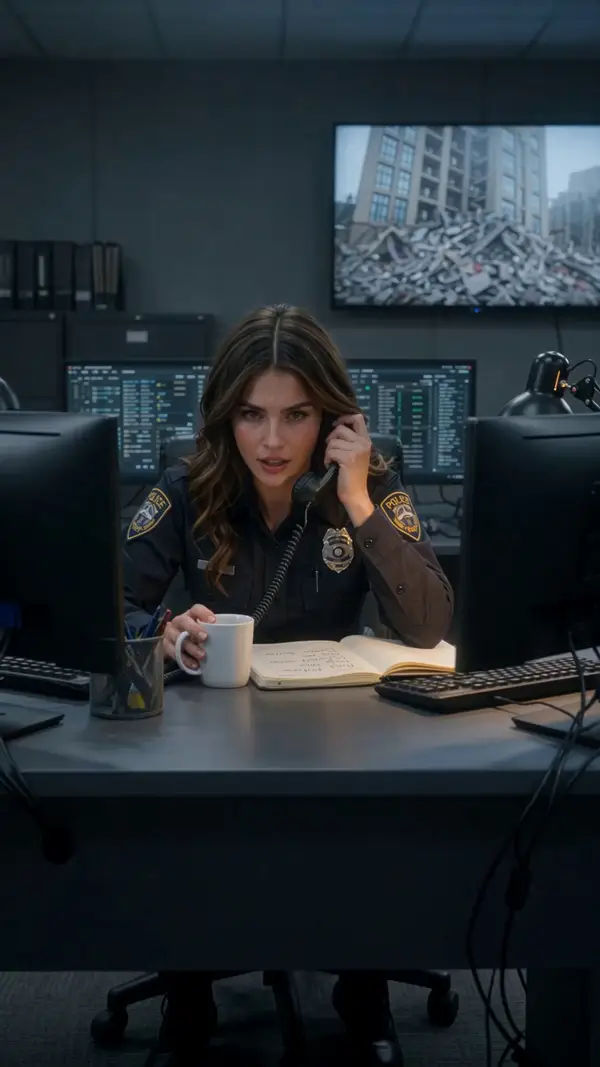
At 2:41 a.m., I heard my husband's voice on the emergency radio. He is supposed to be seventy-five miles away. Instead, he is trapped beneath a collapsed hotel room with a woman he calls Fox. “Central. Central, copy. Sutter.” I froze. Chris. Rimrock, seventy-five miles east, no service. "Report your situation." "East wing, second floor, corner room, 216. I’ve got one more with me. A guest. Female. Left leg pinned under the slab below the knee. " A guest. I wrote: Pt 2, F. "Patient's name and age." He was quiet for two seconds. "Paige. About thirty." "Last name?" "Don't know." I heard him turn away from the radio. I heard the blanket rustle, and his voice dropped, quiet and low and different. “Fox. Fox, look at me. Right here. Look at me, okay?” Then a woman’s faint voice. “Don’t push with your right. Kit.” Kit, the name only I know...now she knew... Then he answered something I couldn’t make out, and the scraping started again. “Is that her?” the woman paused, “Can she hear everything?” “Not now.” Click. The channel went dead. Something isn't right between them. I searched the hotel records while keeping the rescue moving. Room 216 was registered under Paige Marlow and Christopher Sutter. Three nights. Paid upfront. My eyes burned. He lied. My husband wasn't at training. He was with her in the hotel. And the injured woman beside him was his mistress. ———————— I made the thermos myself this time. Thyme from my mother’s garden, a spoon of honey, a slice of lemon I’d fish out and throw away anyway. Exactly the way Chris made it before every one of my night shifts for eleven years. On Monday he’d left for a three-day winter exercise at Rimrock, seventy-five miles east. “No service out there,” he said at the door, zipping his jacket with one hand and finishing his coffee with the other. “Don’t worry about me.” So I didn’t. On Tuesday afternoon Lupe called to ask if I could take her night, because her youngest was running a hundred and two. I could. I called my mother to come down and stay with the kids, and I didn’t text Chris. No service, right? The tea came out wrong. I’d been drinking it since midnight and couldn’t figure out what was different. By two the snow was coming down wet and sideways, and the winter storm warning had been sitting in the corner of my screen since dinner. At 2:37 the night manager at the Larkspur Lodge called. She didn’t scream, and that was worse than screaming. The east wing, she said, the roof, all that snow. Something inside had folded, the second floor and the third, and there were people in there. I paged the duty crew, Blanco Fire, and two ambulances. I pulled the fire preplan for the Larkspur and asked the county building department’s after-hours line for the renovation drawings. At the next console Tyler was already on the phone with the deputy at the road closure. Then Channel One came alive. At first it was only noise, dry and torn, like somebody holding a radio in his fist under a blanket. Then a voice, hoarse with dust. “Central. Central, copy.” Channel One wasn’t 911 or a cell phone. It was our own frequency, the one where there are no strangers. “Central, go ahead,” I said. “Identify.” The pause went on so long that I glanced at the signal bar, which was still holding. “Nat?” Only one person said my name like that. Not Natalie and not babe, just one syllable, hard on the front, like he was calling it across a pass and was afraid the wind would take the rest. At night the channel plays on the overhead speaker, that’s procedure, and Tyler turned his head. I saw it from the corner of my eye. I didn’t turn mine. Rimrock, seventy-five miles east, no service. And his radio on his chest, because Chris didn’t go out for milk without his radio. “Sutter,” I said. My voice was level. I noticed it the way you’d notice somebody else’s vitals. “Report your situation.” “Nat, I—” “Later. Location.” So he reported. Clean and in order, like a debrief. East wing, second floor, corner room, 216. The third-floor slab had come down at an angle, one edge on the outside wall, the other on the wardrobe. There was a pocket in between, maybe four and a half feet high, maybe less. It was dark and thick with dust, and he had a light. Cut over his eyebrow, bleeding, not critical, arms and legs fine. Somewhere over the corridor something was settling every five minutes or so, one short heavy shift, like someone big moving his weight from foot to foot. He always reported like that. Twelve years I’d listened to him call in from the field, first standing next to him on the same rope, then from here, behind the console. Every time, the way he sorted a mess onto shelves made it easier to breathe, and it did even now. He’s alive, he’s reporting, we’ll get him out. Maybe they called off the exercise for weather. Maybe he drove up to surprise me and didn’t know I’d picked up a shift. Except we lived forty minutes down the mountain in Cinder Springs, not in room 216 at the Larkspur. “I’ve got one more with me,” he said. “A guest. Female. Left leg pinned under the slab below the knee. Conscious.” A guest. I wrote: Pt 2, F. The pen moved fine. “Don’t touch the leg,” I said. “Don’t lift that slab, even if you can. How long has she been pinned?” “Twenty minutes.” “Start a clock. That leg comes free with medics and fluids on scene, or you lose her when it does. You have anything to cover her with?” “Blanket. My jacket.” “Cover her. Nothing hard under her head. Save your battery. Check in every fifteen, or the second anything changes. Patient’s name and age.” He was quiet for two seconds. I could read his pauses like a topo map: here’s where it drops, here’s where he’s thinking, here’s where he doesn’t want to say. “Paige. About thirty.” “Last name?” “Don’t know.” I wrote: Paige, approx. 30, last name unknown. In my own handwriting, in the log that would end up on a review board’s table someday. That’s procedure. “Copy. Hang in there.” ....... He didn’t let go of the key. I heard him turn away from the radio. I heard the blanket rustle, and his voice dropped, quiet and low and different. “Fox. Fox, look at me. Right here. Look at me, okay?” Click. The channel went dead. Tyler was studying his monitor very hard. Nothing on it had changed. I reached for the thermos to pour myself some tea, just to give my hand a job, and missed the cup. Tea went across the log, right onto the word unknown. It was still hot. It ran down the page through the time column and dripped onto my knee, onto the old scar I’d apparently been rubbing under the desk with my left palm the whole time. Fox. We don’t call patients by nicknames. Chris taught me that my first year, when I still tripped over my own radio traffic. A name holds a person, he said. Say their name and they remember they’re somebody, that somebody’s waiting for them. Keep saying it while they look at you. He told every rookie on the team. I’d heard it a hundred times. Paige. She had a name, and he’d just given it to me. Maybe her friends called her that and he’d picked it up in the hallway, at the front desk, in the elevator. Maybe it was her last name, something with Fox in it, Foxworth, Foxley, and he’d said he didn’t know it because... Maybe people say anything in the dark, or I’d misheard it through the static. Maybe. He wouldn’t call a guest that. He didn’t say look at me in that voice to someone he’d met that night. I knew that voice. Two years ago I lay under it in the Seep, with my right knee bent in a direction knees don’t go, and waited three hours while the team chopped out the ice shelf above me. He came down on a rope and lay on the ice beside me, so close that I could see his face in my headlamp. Look at me, he said. We’re counting. Four breaths in, hold, four out. He counted out loud and I breathed to his count, and as long as he was counting I knew I wasn’t going to die. Not because people don’t. Because he wasn’t going to allow it. Later, in the hospital, I told him I’d married him twice now, the second time out there on the ice. He laughed and said it counted. I sat with a wet knee over a wet log, and one thought kept spinning like the wheel of a bike somebody flipped over and gave a push and walked away from. He didn’t know I was here. He thought I was home in our bed with my phone on silent and both kids down the hall. He hadn’t gone to Rimrock. He’d come here, forty minutes from our kitchen, with a woman who had no last name, and he’d called her something you don’t call strangers. He didn’t know I was here. He didn’t know. “Natalie.” Tyler was holding out a pack of tissues. He held it at arm’s length, the way you’d hold out something hot, and he was looking at a spot somewhere around my shoulder. “Let me take the channel,” he said quietly. “You take the building. Or. However you want it.” He was a good kid, twenty-six and six months on the floor. He was offering me a way out, the right one, the decent one, and any supervisor in my chair would have taken it. I took the tissues and blotted the log. Unknown had bled out, but you could still read it. “No,” I said. “I read plans better than you do. The channel’s mine. Call Mesquite County and request Ironwood. Struts, cutters, the whole package. Tell them pancaked floors, two in a void, possible secondary collapse.” “Copy.” He turned to the phone like a man let out of a locked room. I wiped my knee, threw the tissue away, settled my headset, and keyed up. “Sutter, Central. Patient status.” “Breathing’s fast,” he said, a beat late. “She’s starting to panic.” Again he kept the key down. I could hear her breathing, short and quick, with a whistle on every breath in. And his voice, dropped again, down to wherever I wasn’t. “Like Tahoe. Four breaths. You know how.” The four breaths were mine. And Chris had been to Tahoe exactly once in the last five years. Last March, a ten-day avalanche instructor course at the lake. He’d called me every night at ten to complain they were feeding him nothing but chili. I got the coordinates for the east entrance into the system for Ironwood on the first try. Then I typed the latitude a second time, right on the end of the first, so the field held a number that didn’t exist anywhere on earth. I deleted it, checked it, and sent it. ....... I couldn’t break in, because as long as his key was down, the channel belonged to him. First there was scraping, and then his breathing, heavy, with that short catch in it he always gets when he’s holding a load. Then a woman’s voice, very close to the radio, quiet but clear. “Don’t push with your right. Kit. Not your right, you know that.” He answered something I couldn’t make out, and the scraping started again. Three people knew about Chris’s right shoulder. Me, his mother, and Dr. Pryor, who’d read the MRI. A year and a half ago Chris went to physical therapy twice a week, Tuesdays and Thursdays, all the way through New Year’s, even though by fall, he said, it barely hurt anymore. And none of us called him Kit. Tyler reached for the volume knob on the console. Slowly, like I might not notice. I caught his hand before it got there. “Don’t touch it.” He took his hand back. The overhead speaker is procedure, so that both people on shift hear the channel. But this wasn’t about procedure. I simply wasn’t going to let anybody else decide what I was allowed to hear. “Is that her?” the woman asked. Then, after a pause, “Can she hear everything?” “Not now.” He finally shifted. The key came up, and the channel went empty. Something was off. Then I called the night manager back. “Marisol, it’s Central. I need the full guest list for the east wing. Who’s out and who isn’t.” She read slowly, and I wrote. The third floor was closed for remodeling, so it was empty. Four rooms were occupied on the second. Room 210, out. Room 212, out. Room 219, out, an older couple, and somebody was getting them warm in the main lobby. “Two-sixteen,” she said. “A double. Checked in Monday, three nights, under Paige Marlow. Two guests, Marlow and Christopher Sutter.”

Loading the ad's image
LiB002 — 🔥🔥 Click to Read 👉🏻👉🏻
Promising

🔥🔥 Click to Read 👉🏻👉🏻

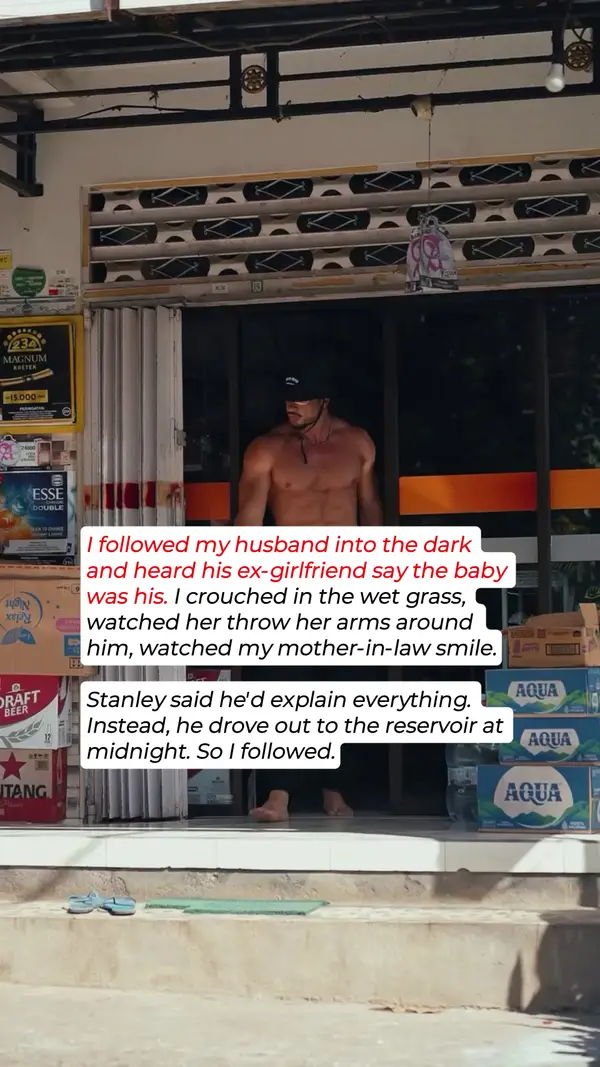
I followed my husband into the dark and heard his ex-girlfriend say the baby was his. I crouched in the wet grass, watched her throw her arms around him, watched my mother-in-law smile. Stanley said he'd explain everything. Instead, he drove out to the reservoir at midnight. So I followed. The site lights were on. Alicia's SUV sat beside Serena's truck, and the three of them stood in the gravel with the dam rising behind them. Serena was crying. "You can't keep pretending this isn't happening," she said. "I'm not raising this baby alone, Stanley. It's yours." The ground went out from under me. I put my hand flat in the grass to keep from falling. He didn't say anything. That was the worst part. He just stood there. Then Serena threw her arms around his neck and pressed her face into his shoulder, and he didn't push her away. He held her. Alicia watched them and smiled. "Finally," she said. My tears flowed down... He’s had one this whole time. My husband, his mother, his ex. Everyone knew but me. I crawled backward until the lights were behind me, then ran. I called my mother from the truck with my hands shaking so badly I dropped the phone twice. "Mama. Please. I need you to hide me." ———————— My husband left at two in the morning because his ex called. I followed him barefoot, and at his mother's house, I heard Serena Harrington tell him the boy in his truck was his son. … At nine that evening, Stanley had come into the guest room where I was lying in the dark. I kept my eyes shut. He pecked my temple. It was so gentle I barely felt it. “I'm sorry,” he whispered into my hair. “For not being there, baby. All of it.” His voice cracked. He stayed there with his forehead resting against my hair. After a while, the mattress lifted. The old armchair in the corner creaked as he sat down in it. He wasn't going back to our bed. He was going to sleep in that chair. The phone wakes me. I freeze under the blanket with my eyes shut. Then I crack one open. The clock on the nightstand says 2:14. Stanley is fumbling in the armchair, and the screen lights up his face blue in the dark. He answers. “Serena?” His voice is rough with sleep. “What is it?” I hold my breath. I can't make out her words, but I can hear the panic in them. Stanley sits up straight. “Where?” More fast words. “Is anybody hurt?” He listens. His jaw sets. “Stay there. I'm coming.” He hangs up. He's on his feet before the screen even goes dark, grabbing his boots off the floor by the chair, his keys off the dresser. He doesn't look at the bed or say a word to me. He walks out, and a moment later the front door opens and closes. I pull on my jeans over my sleep shirt. I don't bother with shoes. I grab my keys and run out to my car barefoot across the cold gravel. … I keep my headlights off for the first mile. The moon is up and the caliche glows white under it. Up ahead, his taillights swing left onto the east road and pick up speed. I wait until they're small before I flip my lights on. My bare foot is shaking on the gas pedal. The gravel from the driveway is still stuck to my heel. Serena? What is it? I was lying right there in the bed with my eyes open, and he never turned his head. The refinery comes up out of the flat ground ahead, white lights and red beacons blinking on the towers. His taillights turn in. I pull off onto the shoulder a quarter mile short of the access road and kill my lights again. I can see the office from here. His truck is parked beside Alicia's white SUV. A shape moves in front of the windows. A minute later, the front door swings wide open and stays that way, hanging crooked. Three people come out. His mother, Alicia, comes first. Stanley follows, then Serena, last. Serena is carrying a bundle. I lean forward over the steering wheel and squint through the windshield. She's holding it against her chest with both arms, and it's big enough that she has to lean back a little to carry it. As she passes under the lamp post, the light catches it. It's a child. A little boy, asleep, his head on her shoulder and his legs dangling. One of his sneakers is hanging off her elbow by its laces. She puts him in the back of my husband's truck. I watch Stanley hold the back door open for her while she buckles the boy in. He closes the door, walks around to the driver's side, and gets in. Then the headlights come on, and they pull out of the lot. I wait until they've passed me. Nobody looks over at the dark car parked on the shoulder. Then I pull out and follow them. They don't go to town. They go west, back past the turnoff to our house, and I watch his taillights go right past our road without slowing down. Then north, up onto the bluff road. He's taking them to his mother's house. Serena Harrington and a sleeping child, at three in the morning, and I'm following him in my sleep shirt without any shoes. Their taillights pull into Alicia's drive. I pull over on the shoulder a hundred yards past it, behind the cedar windbreak, and turn off the engine. I sit there. My hands won't let go of the wheel. Go home, a small voice in my head says. Go home and get in bed and pretend you never saw any of this. Wait for him to come back and tell you it's nothing. I've been listening to that voice for three years. I open the door and get out. The grass along the windbreak is cold and wet under my feet. I walk back along the fence line toward the house with my arms wrapped around myself. By the time I reach the edge of Alicia's yard, they're already inside. Through the big front windows I can see the hall light on and the kitchen light. Alicia is moving around in there, filling a kettle at the sink. Then I see them. They're in the den, walking toward the back of the house. Serena is in front, and she's holding Stanley by the wrist, pulling him behind her. She's leading him, and he's letting her. Through the window I see his face for one second, and he looks pale. They disappear through the back French doors. I go around the side of the house. There's a gate in the white picket fence by the garage. It doesn't latch right, never has. Alicia's been after Stanley to fix it for two years. I push it open, and it doesn't make a sound, and I slip through into the back garden. It's dark under the live oaks. The porch light spills across the lawn, but the far end by the rose beds is in shadow. Two dark figures stand close together under the biggest tree. I move along the fence until I'm behind the stone birdbath, maybe thirty feet away from them. I crouch down. The grass soaks through the knees of my jeans. I can hear them. “…almost three in the morning. My wife is asleep at home. She doesn't know I left, and I need to get back to her.” My chest squeezes. He said my wife. Then Serena says, “The boy. He's yours.” The crickets keep going. I don't move, and I don't understand the words. I hear them, and they go into my ears, and they sit there not meaning anything. I keep waiting for them to turn into a sentence that makes sense. “What?” Stanley says. “He's your son, Stan.” She's crying. I can hear it in her voice, broken. She's saying more, the words spilling out of her in a rush: college, when we split, he keeps asking for his father. I catch every one, and I can't hold on to any of them. He's your son. The little boy asleep in the back of my husband's truck. The blue sneaker hanging off her elbow by its laces. I remember Alicia's words: You know how much my Stanley dreams of being a father. Last week, a doctor held my hand and told me I'd never be able to give my husband a baby. My knees give out. I don't decide to fall. My legs just stop holding me, and I go down in the wet grass behind the birdbath, and I put both hands over my mouth so hard my teeth cut into my lip. I can't breathe. I'm making a sound I've never made before, and I press my hands harder to keep it in. I don't know how long I stay down there. A minute. Five. When I finally lift my head and look over the edge of the birdbath, Serena has her arms around him. She's pressed up against his chest with her face buried in his shirt and her arms locked around his waist, and she's sobbing. Stanley is standing there with his arms hanging at his sides. He isn't holding her back, but he isn't pushing her away either. He's staring straight ahead over the top of her head into the dark, and his face is completely blank. He doesn't move, and she doesn't let go. Behind them, through the back windows of the house, Alicia is standing at the kitchen sink with the kettle in her hand. She's watching them. She's smiling. I get up. My legs are shaking, and my jeans are soaked from the knees down, and my face is wet. I can't see well. I stand up behind the birdbath, and nobody turns around. Serena is still clinging to him. Alicia has turned away from the window to pour her tea. I walk back the way I came. Along the fence, out through the gate that doesn't latch, and up the side of the house. I cross the front yard in the dark, past my husband's truck, where the back door is still standing open. On the seat inside, there's a little jacket. I don't stop. I walk out the front gate and down the shoulder of the road to my car behind the windbreak. I get in and close the door, and put my hands on the wheel. For a long moment I sit there with tears pouring down my face and my whole body shaking. Go home, that small voice says again. Home is a house full of his things and his mother's dishes and a calendar on the fridge with a crooked heart drawn next to a doctor's appointment. I'll lie in the guest bed and listen for his truck. He'll tell me it's not what I think, and to drop it. I start the car. At the end of the bluff road, I turn left. Left goes past our turnoff, past the winery and the vineyard, toward the interstate. I pass the sign for our road at eighty miles an hour, and I don't slow down. It's four-ten when I hit the interstate. The on-ramp sign says I-40 East, Oklahoma City. I take it. The road is empty except for semis. I stay in the right lane with the cruise control on and the radio off. My phone is in my back pocket. I pull it out. The screen lights up. No new messages. He hasn't noticed I'm gone. I scroll to my mother's name and press it before I can think about the time. It rings three times. Then her voice comes on, wide awake. “Eleanor? What's wrong?” I open my mouth, and nothing comes out. “Eleanor. Sweetheart. Talk to me.” “Mom.” My voice cracks. “Mom, I need you to come get me.” There's one second of silence. Then her voice changes. “Where are you?” “I-40. East of Amarillo. I just passed… I don't know where I am.” “Are you hurt?” “No.” “Is anyone with you?” “No. It's just me.” “Is he following you?” “No.” I laugh, and it's a terrible sound. “He doesn't even know I'm gone. He's at his mother's house with her, Mom.” My mother doesn't say anything for a long moment. I can hear her breathing on the other end. “Listen to me, sweetheart. I want you to keep driving. Don't stop until you get to Oklahoma City.” “Mom.” I'm sobbing now, gripping the steering wheel with one hand. “Mom, I can't look at him. Please. Whatever you have to do, don't let him find me.” “He won't.” Her voice doesn't waver. “Not unless you want him to. Nobody will know where you are, Eleanor. I'll make sure of it. You have my word.” “Promise me.” “I promise. Now keep driving, baby. I'll be right there.” She hangs up. I put the phone face down on the passenger seat. Then I reach over, pick it back up, and hold down the button on the side until the screen goes black.

Loading the ad's image
LiB002 — 🔥🔥 Click to Read 👉🏻👉🏻
TestingVideo

🔥🔥 Click to Read 👉🏻👉🏻

Bullets tore through my kitchen window and shattered our family photograph the second my husband Wade lied about an emergency duty, hiding away in a remote lodge to cheat with his mistress. Glass sprayed. The red dot appeared on Sam's chest, trembling above the printed astronaut. "Mom, what is that?" I got both hands under his arms and took him down behind the island a half second before the window blew inward again. "Josie, get down!" The third round hit the cabinet above where her head had been. Somebody was working the lock. "Faster," I whispered. The shutters hadn't moved. The alarm hadn't made a sound. The two cameras over the front door were dark the way a thing is dark when somebody has switched it off. Over the splitting screech of blades sawing through our front door, the intruders called out coldly, “Mrs. Kessler… We know you’re in here. We know your husband isn’t coming. He's screwing his bimbo's vulva.” Desperate and shaking, I dialed Wade’s number again and again. Each call went straight to a hollow, unforgiving automated message—The person you're trying to reach is not available. Huddled in the dim shelter, staring at my children’s tear-stricken, petrified faces, I shattered completely. ———————— In forty-seven minutes the first round will take my husband’s face out of our family photograph. Right now the photograph is still on the wall above the couch and all four of us are still whole in it. Right now there’s a casserole on the counter waiting to go in the oven. Right now Sam is asking for the third time how much longer, because when you’re seven, forty minutes is half a lifetime. Right now Josie is standing in the front hall with her arms crossed, watching her father zip his jacket. Wade is leaving. He says he got called in. He says he’ll change at the station. He says don’t wait up. Josie opens her mouth to ask him something else. At sixteen you already know how to test what adults hand you, and my daughter tests better than most. I catch her eye. Don’t start. She doesn’t start. Out of everything that happens tonight, that’s the piece I’ll keep going back to. On the last quiet evening of our lives, I told my daughter to be quiet. I don’t wait up. I set the fourth plate on the table because I’ve set it every night for seventeen years and my hand gets there before my head reminds it that he isn’t coming home for dinner. His phone is on the counter by the fruit bowl. Face down. I don’t turn it over. Women married to men like Wade get years of training in not turning it over. There are drawers you don’t open. Folders you don’t touch. Calls he takes out on the back steps with the storm door pulled shut behind him. And we get proud of it. We wear our own good manners like a commendation nobody ever pinned on us, and then one morning you wake up and understand that you spent seventeen years being proud of your own blindness. Twenty-one miles from this kitchen there is a lodge out by the lake with two warm lamps over the entrance and pine needles tracked all over the lobby floor. A woman has already turned down the bed in room 214. She works with my husband. She knows my children’s names. In forty-seven minutes the first round comes through the window over my sink, and four men come through our gate, and they know which room we eat in, and what time his truck clears the end of the driveway, and how to shut off every single thing he built to make us feel safe. I’m going to call him four times. He’s going to see the first one. You want to know what I was doing the minute my husband looked at my name lit up on a nightstand in room 214? I was flat on the kitchen tile with my son underneath me, telling him the one thing I had believed my whole adult life. Dad’s coming. I used to think the worst word in the English language was cheating. It’s unavailable. --- The first round took my husband’s face out of our family photograph. Glass sprayed across the floor in bright little pieces. The frame hit the wall and dropped somewhere behind the couch, and where Wade had been standing a second earlier with his hand on my waist there was a white torn hole with crumbling edges. His smile was gone, clean. A crack ran diagonally through my half of the picture. The kids in the photo were untouched. That’s what my brain decided to notice. Not the sound. Not the window coming apart over the sink. Not whatever happened inside my chest, which felt like a hand had gotten in there and turned all my organs a quarter turn counterclockwise. I looked at the two children in that photograph and my first thought was alive. Then the red dot appeared on Sam’s chest. It sat on the blue fabric of his pajamas, just above the printed astronaut, trembling a little the way a laser does when the hand behind it is real. My seven-year-old looked down at it with mild interest. The way you look at a ladybug that lands on your sleeve. He had no idea that somebody standing out in my yard in the sleet had already picked the spot where the next round was going, and had marked it, and was waiting. I have never in my life wanted so badly to be somewhere else in a room. “Mom, what is that?” I went across the kitchen. I don’t remember standing up. A stool went over under my knee, the corner of the table caught me across the hip, my plate came off the edge and the casserole went face down on the tile. None of it registered. I got both hands under Sam’s arms and took him down behind the island a half second before the window blew inward again. Something fast and unkind went over our heads. In the wall behind us there was a short dry crack, like a knuckle. Sam started screaming after we were already on the floor. His body had let me save him first and only then given him back the right to be scared. “Mom!” “Shh. Shh, buddy. I’m here.” The cold arrived about four seconds later. It came in through the hole where my window had been and rolled along the tile at floor level, carrying the smell of wet gravel and the sleet that had been coming down sideways since eight o’clock. Under my cheek the floor was already going slick with it. Then the oven timer went off. Three cheerful electronic notes, the same three notes it had made every night since we bought the range, announcing that the casserole was done and the four of us should come sit down. Nobody turned it off. It ran its little cycle and quit on its own, the way it always did, and then there was only the wind coming through the wall. He got his fingers into the collar of my shirt and dug his nails in so hard it wasn’t a hug, it was an attempt to get inside me, to climb under my ribs and let me cover him with bone instead of arms. Josie was still at the table. My daughter was sitting completely still with her back against the wall. Sixteen years old, black hoodie two sizes too big, one earbud in, phone loose in her hand. There was a thin cut on her cheekbone from the glass, and a single drop of blood was sliding down toward her jaw. She wasn’t looking at me. She was looking at the window. Out past the shredded curtain the yard was black and moving. Not wind. Shapes, low, coming up through the dark toward the deck. “Josie, get down!” She didn’t move. “Josie.” She flinched, dropped the phone, and came off the stool. In the same second the third round hit the cabinet above where her head had been. The door split, cups came down in a rush, and one of them broke across her shoulder. I lunged toward her and Sam swung off my neck. “Don’t go! Mommy, don’t go!” His voice opened me up from my throat to my stomach. One child was under my hands. The other was ten feet away. I had one body, two arms, and no method for dividing myself. “Josie. Crawl to me. Do not stand up.” “Wasn’t planning on it,” she said. Even now. Wade always claimed she got the mouth from me, and I always said if she’d gotten it from him she’d come home twice a week, say work, and consider the subject closed. We used to joke about that. An hour ago we were joking about it. Josie came across the floor on her elbows through the glass. I watched a shard go into the heel of her hand, watched the red prints start appearing on the tile behind her, and she didn’t stop. Outside, something heavy hit the front door. Not a shot. The whole frame shuddered in the wall and settled. Somebody was working the lock. “Faster,” I whispered. “Am I not crawling elegantly enough for you?” “Not now.” “Then when? Give me some warning, I’ll prepare.” Her voice was shaking. Sarcasm was the only plank she had in very cold water and I wasn’t going to take it away from her. She reached the end of the island and I caught her wrist and hauled her in. She hissed. There was a long piece of glass standing up out of her palm. “Leave it,” I said. “We’ll get it later.” “‘Later.’ Sure. Great.” The door shuddered again. Plaster came down from the ceiling in a fine dust and settled on Sam’s hair. Wade hardened this house four years ago, after a man from a case he worked started mailing photographs of our driveway. New locks. Cameras on both approaches. Motion sensors along the fence line. A hard-wired landline in the pantry because cell service out here is a rumor in bad weather. Security shutters plumbed to drop automatically on the sound of a gunshot, which he demonstrated for me twice, standing out in the yard clapping his hands over his head and looking so pleased with himself that I couldn’t be angry about the nine thousand dollars. I used to tell people I lived in a minimum-security facility with better landscaping. He had a line he’d come back with about which side of the door the locks were on, and he delivered it every single time like it had just occurred to him. The shutters hadn’t moved. The alarm hadn’t made a sound. The two cameras over the front door were dark, and I could see the near one from where I was lying, and it was dark the way a thing is dark when somebody has switched it off. That went up my spine on small cold feet. Then I understood what else was wrong, and it was worse, because it was a thing that wasn’t happening. The Delaneys’ dog. He is a shepherd mix with an opinion about every vehicle inside a quarter mile, and he had been barking at our mail carrier for six years without ever once being right about her. Four men had come up my fence line in the dark and he hadn’t made a sound. These people had not come here for a television. Nobody robbing a house kills the alarm on a SWAT commander’s place and puts a laser on a child through the kitchen window. They knew which room we ate dinner in. They knew what time Wade’s truck cleared the end of the driveway. They knew about the dog. They had waited for him to leave us alone. “Shelter,” I said. Josie turned her head. “It’s at the other end of the hall.” “I know.” “The front door is between us and it.” “I know that too.” “Fantastic plan, Mom. Very reassuring.” “You got a better one?” She looked at her brother, and something in her face changed. The fear didn’t leave. Something came up underneath it, a kind of focus that has no business being on a sixteen-year-old, and I recognized it because I had watched Wade’s face do exactly that a hundred times before a hard decision. A steel plate coming down between what you feel and what has to happen. “I’ll go first,” she said. “Absolutely not.” “If they shoot, you cover Sam.” My stomach turned over. Not from the blood, or the noise, or the men on the other side of my front door. From how calmly my daughter had just offered me the choice of which of my children to keep. “I’ll cover both of you.” “You’re not made of rubber.” “No, but I’ve got a lot of temper left.” Sam had stopped crying. He was watching us with wet eyes and his mouth slightly open. “Does Dad know?” I put my hand on the back of his head. His hair was damp with sweat. “He’s about to.” “Is he coming?” The answer came up out of the part of me where there had never been any question at all. Wade could be cold. He could be distracted. He could forget a dinner, miss a concert, sleep with his back to me for three weeks running. But if his family was in danger, he came. That was not faith. That was arithmetic, as reliable as the sun. Seventeen years of my life were built on it. “He’s going to bring the whole department down on this house,” I said. “Nobody’s explained to these people yet whose kitchen they picked.” It came out steady. Almost amused. Exactly the way you have to say things to children when what you actually want is to get your teeth into your own scream so it doesn’t get loose in the room. Josie looked at me over the top of her brother’s head. She didn’t say anything. She didn’t have to. My daughter has known since she was about nine that I do a voice for Sam, and she has never once given me away, and every year that silence costs her a little more. “There’s four of them,” she said instead. “I counted at the window.” “Okay.” “Mom, I counted four.” “I heard you. That’s a good count. That’s useful.” It was not useful. There was nothing on this earth I could do with the number four. But she needed the information to have gone somewhere other than into her own chest, so I took it off her and put it in my pocket. My phone was six feet away, next to the tipped-over stool, face up, screen still glowing. The thread on it was ours. His last message had come in at 8:44, thirteen minutes after his taillights went around the bend. Rolling. Going dark. Behind me, the top hinge of the front door tore out of the frame.

Loading the ad's image
LiB002 — 🔥🔥 Click to Read 👉🏻👉🏻
TestingImage

🔥🔥 Click to Read 👉🏻👉🏻

I moved across the country to escape my useless ex-husband. The last thing I expected was to fall for a six-foot-tall, tattooed biker who looked like trouble in a leather vest! At forty, divorced, and raising two children, I was done with men. After twenty years of marriage, I wanted peace, not another grown-as$ man to take care of. But my new life in South Carolina had other plans. My movers dumped my enormous bed frame in the garage. Then my best friend Chelsea offered to send her husband Grant to help. Unfortunately, her husband didn't come alone. And that's when I met Bull. Holy freaking testosterone! Broad shoulders. Tattooed arms. A thick beard. Dark eyes. And a black leather vest with SAVAGE SAINTS plastered across the back. I looked him up and down. "Is Bull your actual name, or did your mother just take one look at you and decide that was appropriate?" Bull stared at me before bursting into a deep, rumbling laugh. "You're something else, ain't you?" "So I've been told, sweetheart." But the biggest surprise? The man who looked like he could scare the he.ll out of anyone was gentle enough to help assemble my autistic daughter's dream playground, checking every bolt to make sure it was safe. I moved to South Carolina to rebuild my life—not to fall for a tattooed biker. But one look at Bull, one unexpected laugh, and my heart was already in trouble. ___________ FORTY! I'm forty freaking years old. And I just packed up my entire life, loaded my two children and our German Shepherd into a vehicle, and moved across the country to South Carolina. Why? Because after twenty years of marriage, I finally divorced my husband. Twenty years. Two whole decades of unbelievable stupidity. And before anyone gets offended, I'm referring to my own stupidity. I was stupid when I let my brother set me up with the man who would eventually become my husband. I was stupid when I stayed after discovering he'd cheated on me. I was stupid when I forgave him. Then I was stupid enough to believe having another child together might somehow make things better. Don't misunderstand me. I wouldn't trade either of my children for anything in this world. They're the two best things that ever came out of that marriage. But the husband? Yeah. I probably should've returned him to the manufacturer about nineteen years ago. Unfortunately, I lost the receipt. And apparently, there's a strict no-return policy on defective husbands. Who knew? For years, I worked my as$ off while that man sat at home coming up with every excuse imaginable for why he couldn't get a job. "The job market is terrible." "I'm sensitive to heat." "The kids need someone home." "The schedules don't work." Blah. Blah. Freaking blah. You know what else doesn't work? One person paying every bill. While another perfectly capable adult sits around doing absolutely nothing to contribute financially. Apparently, my ex missed the historical development where two parents could actually work and raise children simultaneously. Fascinating concept, I know. Meanwhile, I was managing a storage facility. Dealing with customers, meeting sales goals, balancing accounts. And trying to keep up with company policies that changed more often than I changed my underwear. And believe me, I change my underwear daily. Eventually, I reached my breaking point. I quit. Yep. Walked away from a job I'd spent years pouring my energy into. Was it terrifying? Absolutely. Did I have everything figured out? Not even remotely. But something had to give. And for once, that something wasn't going to be me. My husband finally got himself a job. Imagine that. Apparently, employment opportunities magically appear when your wife stops carrying the entire financial burden. A modern-day miracle. But while all that nonsense was happening, something else had been quietly growing in the background. Something that would eventually change my entire life. My books. I've always loved stories. Reading them, imagining them, getting completely lost in fictional worlds. Where I could control what happened next. And somewhere along the way, I started writing my own. Nothing fancy. No elaborate office. No expensive equipment. Just me, my laptop, a pair of headphones, and whatever music happened to match my mood. Country, rock, pop, heavy metal, oldies. You name it, I probably have it somewhere on my playlist. Except jazz. I cannot stand jazz. Don't ask me why. I just can't. Some people find it relaxing. I find myself wanting to throw the nearest available object through a window. Anyway. After the kids went to bed, I'd put on my headphones, turn up the music, and write. Sometimes I'd write about love. Sometimes betrayal. Sometimes a woman getting revenge on the man who destroyed her life. Those particular scenes tended to be very therapeutic. Especially after an argument with my husband. Instead of screaming at him. I'd sit down and write some poor fictional prick into an extremely unfortunate situation. Healthy coping mechanism? Debatable. Cheaper than therapy? Absolutely. For years, those stories sat on my computer. Then, after quitting my job, I decided to do something with them. Partly because I needed another way to make money. Partly because I wanted to prove to my husband that I wasn't going to sit around doing nothing. And partly because I was curious. Would anyone actually want to read the nonsense floating around inside my head? So I started publishing my novels on online reading apps. At first, I was excited when ten people read a chapter. Ten! Actual human beings willingly reading something I'd written. I probably checked my phone fifty times that first day. Then ten readers became a hundred. A hundred became a thousand. Comments started appearing. Readers wanted more chapters. People were discussing my characters, arguing about their decisions. And threatening to hunt me down if I killed off their favorites. Which, frankly, was hilarious. Then the money started coming in. Actual money. From writing books. I stared at my first earnings statement for so long that I thought there had to be a mistake. There wasn't. And somehow, the books just kept growing. Before I knew it, I was making enough to support myself and my children. Not private-jet-and-a-butler money. But enough that I could breathe. Enough that I didn't have to panic every time a bill arrived. Enough that when I finally decided my marriage was over, I knew I could stand on my own two feet. For the first time in twenty years, I wasn't trapped by finances. I had options. And I chose myself. Well, myself and my children. We're a package deal. Unfortunately, success also introduced me to an entirely new species of prick. Book thieves. Yes. Apparently, stealing someone's entire novel and uploading it onto another reading platform is an actual business strategy. Who knew? One day, I discovered one of my books on an app I'd never even heard of. My cover. My characters. My story. Except my name had mysteriously disappeared. On another platform, someone had gone the extra mile and changed the title. How thoughtful. I spent months creating those characters, developing their stories, and writing thousands upon thousands of words. And some jackass decided to help themselves. I swear, after twenty years of dealing with a man who took advantage of me, I was starting to wonder whether I had a sign permanently attached to my forehead. PLEASE HELP YOURSELF TO MY HARD WORK. Needless to say, I sent emails. Lots of emails. Professional ones, too. Well... Professional enough. My first drafts generally contained several words that probably would've gotten me banned from polite society. Thank God for the delete button. And just when I thought I'd finally escaped people taking advantage of me. Complete strangers had apparently decided to give it a try. Wonderful. Forty years old, divorced, and already considering whether murder was an acceptable plot twist. For my books, obviously. What kind of person do you take me for? Of course, not every reader loves everything I write. And my absolute favorite complaint? "You use too many curse words." Oh, sweetheart. If you only knew. Before I became a mother, I could swear like a sailor who'd just stubbed his toe, dropped his beer. Then discovered someone had stolen his paycheck. I didn't give a da.mn who heard me, either. Then I had children. Two beautiful children who happen to be on the autism spectrum. And suddenly, I had to start watching what came flying out of my mouth. Because the last thing I need is Ana learning a new word and proudly announcing it in the middle of a grocery store. Can you imagine? After spending years celebrating every new word she learns. I certainly don't want her next big milestone to be dropping an F-bomb in front of her teacher. Or Evan deciding that one of my more colorful expressions is the perfect response to a difficult homework assignment. No, thank you. So, where does all that pent-up profanity go? Into my books. Every bit of it. My fictional characters get to say all the things I bite my tongue to keep from saying. And let me tell you, after twenty years of marriage, dealing with customers. While raising children, and navigating life's endless supply of stupidity, I've accumulated quite the vocabulary. Writing is my outlet. My escape. My little corner of the universe where nobody gets to tell me what I can and cannot say. So, to the readers who think my characters swear too much? I appreciate you reading my books. I really do. But here's the thing. I spent twenty years accommodating everyone else's expectations.

Loading the ad's image
LiB002 — 🔥🔥 Click to Read 👉🏻👉🏻
TestingVideo

🔥🔥 Click to Read 👉🏻👉🏻

While my younger brother passed away despite all rescue efforts, my husband—whom I couldn’t reach—was busy singing a love song with his female partner on a live television broadcast. "I'm sorry. We did everything we could." My phone was still in my hand. Fourteen calls. All to the same man. "Logan, it's me. Ryan's been hurt. He was in a motorcycle accident. They said he's critical. Please call me. Please." I'd left that on his voicemail before I ran for the hospital. I'd sent it before the surgeon came out with his hands folded. Nobody answered. Not once. A nurse turned up the television in the waiting room around four-thirty. StageOne live from Crownline Hall. The room he'd rearranged around a would-be holiday he promised me he'd keep. The upper seats packed to the back wall. The duet he'd argued about for twenty minutes that morning. If Forever Wore Your Name. Marissa beside him, note for note, her hand resting on his sleeve, cameras circling a stage in Iceland while my brother's blood was still on the sleeve of a stranger who'd stopped for a dog. "I'll be there," he'd told me. He'd checked the itinerary. Monday show. Tuesday flight. Wednesday our anniversary. Wednesday came. Ryan died at 4:19. My husband hit the last refrain and ten thousand people stood up for him. I was already standing. In a hallway. Holding a phone that never rang. I didn't call him again. I sat down on the floor with my back against the wall and let the applause come through the waiting-room speakers, louder than anything I'd ever gotten from him. ———— Erin The staffed doors in Vanderbilt's trauma area stopped me before I made it ten feet. I gave the woman at the desk Ryan's full name, then mine, and watched her turn toward a screen I couldn't read from where I stood. My phone was still in my hand. I shoved it into my pocket before I crushed the case, willing the woman to move faster. "I'm his sister. Dr. Erin Wilder." The title came out from habit, useless here except to explain why my questions arrived one after another. "Is he awake? What have you done so far? Can I see him?" "Dr. Wilder, the physician treating your brother is coming to speak with you." "I don't need somebody to come speak with me. I need to get to Ryan." A man in hospital clothes came through the doors before she could answer. He introduced himself, but his name disappeared as soon as he said it. Ryan's name stayed. Everything else had to fight for room. "Your brother's injuries are critical," he said. "He isn't awake right now. The team is working to support him, and we're watching him very closely." "Can I see him?" "I need you to understand that he's very sick." "I understand what 'critical' means." My hand landed on the edge of the counter, then pulled back when I realized I had started pressing against it. "Can I see my brother?" His expression changed, not into reassurance. I knew that look. I had offered versions of it for frightened owners at Three Oaks when certainty would have been a lie. "I can arrange a brief visit," he said. "You'll need to stay where the staff directs you, and if they ask you to step out, you have to go." "Take me to him." He turned toward the secured doors. I stayed close enough that he glanced back once, perhaps expecting me to fall behind, and I almost told him that Ryan had spent my whole life making me chase him into bad ideas. Instead I kept walking. "What happened on the road?" I asked. "The information we received is that he lost traction on loose gravel at a bend and struck a guardrail. He was the only rider involved." Loose gravel. A bend. A guardrail. Those were ordinary things. They belonged beside roads, not in a sentence explaining why my brother was somewhere behind those doors. "So there wasn't another rider?" "Not according to what we have." "Was he conscious when they brought him in?" "I don't want to tell you something I can't confirm." That answer followed me down the corridor. A clinician met us outside Ryan's bay and gave me another version of the same instructions. I was allowed in for a few minutes. I was not to touch the equipment, move him, or get in the staff's way. If they needed space, I would leave. Then she stepped aside. Ryan lay in the bed. For several seconds, everything in the room became too specific. A monitor blinked beside him. Clear tubing crossed the space between machines and his bed. At the edge of a dressing, blood had seeped far enough through the fabric to show. Ryan didn't move. My brother could turn replacing a bolt into a lecture. He could spend ten minutes explaining why a labeled bag made perfect sense while I stood beside him holding the part that proved it didn't. He talked through oil changes, patient rounds, bad coffee, traffic, football games he claimed not to care about, and every repair he had ever convinced himself would take only an afternoon. The man in that bed said nothing. I stepped closer until the clinician put out a hand. "Right there is good." "That's my brother." "I know. You can stay beside him. Just don't come past the rail." The rail was low enough that I could have crossed it with one step. I hated it for existing. I hated the machines for having rules I understood, and I hated myself for understanding why the woman would not let me interfere with them. "Can he hear me?" "We can't promise you that." "That wasn't what I asked." She held my gaze. "Talk to him." So I did. "Ryan, you are in so much trouble." Nothing. The monitor kept working beside him. "You left me with that stupid XS650, and if you think I'm finishing it without you, you've finally lost whatever judgment you had left." My voice rushed ahead before the room could take it away from me. "Also, your parts system is still deranged. I don't care what you said. Putting a label on every bag does not make the system good if nobody except you knows what the labels mean." His face stayed still. I moved my hand toward him, then stopped before I touched anything. "Where can I hold him?" The clinician came around the other side of the bed. She checked the lines near his arm, then indicated his hand. "Here. Don't move his arm." "Fine." My fingers closed around his. There was no wrench grease on his skin. No little cut from the garage. No smear of oil he had failed to notice before touching something he shouldn't. His hand looked wrong without evidence of whatever project had occupied him last. "You missed work, by the way." I leaned closer without crossing the rail. "You know that patient we were waiting on? The one you were supposed to examine? I had to leave Isaac with everything, so congratulations. You've managed to annoy both your partners from a hospital bed." Ryan gave me nothing back. "You're supposed to argue with that." The words came out smaller than I wanted, so I tried again. "Come on. Tell me Isaac likes running the place without us. Tell me the motorcycle is none of my business. Tell me I used the wrong wrench last time, even though we both know I didn't." The screen beside him changed numbers I refused to turn into predictions. I knew too much to mistake equipment for a promise and too little to do anything useful with what I knew. Here, I wasn't the veterinarian deciding what happened next. I was Ryan's sister, standing where another clinician had put me. His hand remained inside mine. "You still have to show me what comes after that fitting," I said. "You don't get to leave me with half a motorcycle and your ridiculous handwriting. That's not how this works." No smart answer came back. The room carried on around us. Staff crossed behind me. The monitor kept its measured sound. Somewhere beyond the bay, a cart rolled through the corridor, and somebody called for another clinician. I bent closer to my brother. "You can wake up now, Ry." I held the part of his hand they gave me and kept talking. The monitor changed before I finished the next sentence. One tone cut through the others, then another joined it, and the clinician beside me turned toward the screen. Ryan's hand stayed in mine until someone reached across the bed. "Ryan?" I bent toward him. "Ryan, come on." "I need you to step back." "What changed?" The clinician touched my wrist, not pulling, only making the instruction impossible to misunderstand. "Let go of his hand, please. We need room." I looked down at my fingers around his. For one stupid moment, letting go seemed like the one thing I could refuse. They could move equipment, call another doctor, do whatever came next, but his hand was mine to hold because I was his sister and he had not told me to stop. Then two more people came through the doorway, and the space beside the bed vanished. I released him. "What happened?" I moved back as a clinician took my place. "Tell me what happened." Nobody answered me at first. Hands moved over Ryan. One person adjusted the bed while another reached across him. The physician who had brought me in stepped close enough to block my path when I tried to move around the foot of it. "Erin, stay back." "Don't call me Erin and then not tell me what's happening." "We're treating him." "That tells me nothing." Another alarm joined the first. A clinician leaned over Ryan and began compressions. Every argument left me. I knew what compressions meant. Knowing did nothing useful. It only stripped away the last excuse I had for pretending this was another change in treatment, another adjustment, another thing that could be explained if somebody would give me the right words. "No." I stepped toward the bed. The physician moved with me. "You have to give them room." "I can stay out of the way." "You need to step outside." "No." His attention flicked toward the team and back to me. "They need this space." "So do I." A woman at Ryan's side called for something I didn't catch. Another clinician answered. The words were clipped, ordinary to the people saying them, while Ryan lay beneath their hands and gave none of his own. I tried to move past the physician. He shifted in front of me. "Please," I said. "I'm not going to touch anything. I'll stand against the wall. I don't care where you put me." "We need you outside the room." "He's my brother." "I know." "No, you don't." My voice rose before I could pull it back. "You don't know him. He hates hospitals. He'll wake up and start complaining about every person in here, and I need to be here when he does." The physician didn't argue with me. That was worse. Behind him, the compressions continued. "Ryan!" His name tore out of me, and I leaned far enough to grab the edge of the doorway as someone guided me backward. "Ryan, I'm right here." A staff member opened the door wider so I could be moved through without colliding with anyone coming in. I twisted toward the bed, refusing to give up the view. "Ma'am, this way." "Don't call me ma'am. Tell me what they're doing." "They're trying to stabilize him." "Is it working?" No answer came. I stopped moving. The person beside me put a hand near my elbow. "You have to come out." "I am out." "Farther, please. We need the doorway clear." The corridor might as well have been another city. I stepped out of the way because a cart was coming toward us, then turned back so fast my shoulder struck the wall beside the door. Ryan was still visible between bodies. Someone pressed down on his chest. Another clinician stood near the monitor, calling out information to the rest of the team. The physician had already turned away from me and gone back to Ryan. I kept waiting for one of them to stop and look relieved. Nobody did. "Ryan!" I called again. A clinician near the door glanced toward me before returning to the bed. The staff member beside me shifted her position, leaving me one narrow line of sight into the room. That was all I had left of him. The bed. The hands working over him. His face between two people moving around him. The brother who had spent Sunday arguing about tools now lay in a room full of strangers trying to keep him here. Keep going. The thought came without language big enough to hold anything else. Please keep going. Someone inside called for another cycle. The compressions continued. I pushed away from the wall and reached the doorway again. The staff member caught my movement. "You need to stay back." "I just want him to know I'm here." "You can talk to him from here." "Ryan, I'm here." My voice broke on his name, but I forced the rest out. "I'm not leaving. Do you hear me? I'm right here." The door began to move. "No, don't close it." "We have to keep the entrance clear." "I'll stand back. Just leave it open." The gap narrowed anyway. I stepped sideways to keep Ryan in view for another second. A shoulder blocked him, then shifted, and there he was again beneath the clinician's hands. "Ryan!" The staff member held the door until the last person entered the bay. For one more moment I could see the bed, the team around him, and the compressions still going. Then Ryan disappeared behind the closing door. The door closed between us. The waiting room had a clock I kept staring at without ever registering the time. The second hand kept crossing the same numbers while my phone sat in my palm, its screen gone black. I had called Logan until there was nothing left to do but stare at his name in the list and wonder whether another attempt would change anything. Across from me, a man turned a magazine page. A woman stood beside the vending machines with both hands around a paper cup. The television mounted near the ceiling carried music into the room, but it might have been coming through the wall for all the attention I gave it. The door opened. The physician who had spoken to me before came through alone. I stood before he reached me. "Is he awake?" He stopped. That was my answer before he gave me one. "Dr. Wilder, can we sit down?" "No. Tell me." His eyes shifted toward the chairs, then returned to mine. "Please." I hated him for asking. I hated the chairs for being there. Still, I sat because standing had not made Ryan come through the door. The physician took the seat beside mine. My phone stayed in my hand. He leaned forward, forearms resting on his legs. "Your brother's condition deteriorated while you were with him. The team began resuscitation at once." "I know. I was there." "They continued after you left the room." "I know." His pause lasted too long. "Tell me how he is." "We were unable to restore circulation." The sentence sat between us, neat and professional, as if there were another line after it that would explain what came next. I waited. The physician lowered his voice. "Ryan died." The television audience erupted behind him. I looked at his mouth because it had moved around the word 'died' and I could not make that word belong to Ryan. Died was something written in a chart after an old dog's kidneys failed. Died belonged to calls made after midnight, to owners sitting on examination-room floors, to things I had learned how to say without making promises I could not keep. It did not belong to my brother. "What do you mean?" His face changed again, settling into the same careful sorrow I had already learned to despise. "His heart stopped. We tried to resuscitate him, but we weren't able to bring him back." "No." My thumb moved over the blank phone screen without waking it. "What do you mean?" The physician stayed beside me. "Ryan died." I stared at him. The same answer. That was the part I could not understand. I had asked again, and he had given me the same answer, as though I had not corrected the question well enough to make him choose different words. "Can you try again?" The physician's silence lasted a moment. "The team did everything they could." "That isn't what I asked." "I know." "Then can you try again?" His eyes remained on me. "I'm sorry." The words should have done something. They should have made me cry or stand or throw the phone across the room. Instead, my fingers remained wrapped around it while the screen reflected the ceiling lights back at me. A guitar came through the television speakers. I turned my head. Logan filled the screen. For a moment, I thought the waiting room had made some mistake. Crownline Hall could not belong here. Logan could not belong here. He was supposed to exist on the other end of my phone, somewhere I could reach him if I kept trying long enough. Then the camera cut wider. Marissa stood beside him. I knew the song before either of them reached the next line. "If Forever Wore Your Name." The physician said something beside me, but the television had taken the center of the room. Logan wore the clothes he used for the stage, the kind meant to catch light when the cameras moved. His guitar was gone now. Marissa faced him as they sang, and the camera moved close enough to make the rest of the stage disappear. I had watched him perform more times than I could count. I knew the smile he used when a crowd gave him exactly what he wanted. I knew the lift at one corner of his mouth when another singer surprised him with a phrase. I knew how much he loved this part of the work. He was smiling now. Marissa reached for his forearm. Logan stayed turned toward her. The camera cut to their faces, then their hands, then back again. My phone remained in my palm. I had called him. That was the only thought that arrived with any shape. I called you. The screen changed to Marissa, then back to Logan. He sang the song we had both laughed about when it first became a hit. Strangers had started using it at weddings before the album had even been out a month. Forever. The physician had just told me Ryan had none. I waited for anger. Nothing came. That frightened me more than anger would have. I should have wanted to scream at Logan through the television. I should have wanted to demand why he was there, why I had been sitting beside Ryan while strangers pressed their hands over his chest and my husband was standing under stage lights singing about forever to another woman. Instead, I watched. The physician rose from the chair beside me. "I can give you a few minutes. When you're ready, someone can talk you through what happens next." What happened next. There it was again, another sentence built for a world that assumed there would always be something after. I nodded because he seemed to need an answer. He walked away. Someone crossed the waiting room carrying a coat over one arm. The man with the magazine turned another page. A nurse called a name from the doorway, and the woman by the vending machines moved toward her. Nothing stopped. On the television, Logan and Marissa reached the last refrain. The camera moved in close as they faced one another. Marissa still had a hand on his arm. Logan held her gaze because that was what the performance required, because the cameras were there, because thousands or millions of people were watching and none of them knew that my brother had just died in a room down the hall. Maybe Logan didn't know either. I had no answer to that. All I had was the phone that had never connected me to him. The audience cheered. Logan smiled. I stayed in the chair with my phone in my hand while people moved through the waiting room around me. The song kept playing.

Loading the ad's image
LiB002 — 🔥🔥 Click to Read 👉🏻👉🏻
TestingVideo

🔥🔥 Click to Read 👉🏻👉🏻

My husband invited his mistress to Thanksgiving. By midnight, he still wasn't home from driving her back to her apartment, and his smart glasses caught him live-streaming his affair with her. The camera is sitting on something, pointed at a white leather couch in an apartment I've never been in. A man's linen shirt lies in a heap on the floor. And on the couch is Micah. He's undressed, and so is Elise, my heartbeat racing as I take in what I'm seeing, a coldness hitting at my core. She's on her back and her legs wrapped around his waist, and he's moving over her, on top of her, inside her. Then Elise starts to laugh. "Poor Jenna," she says, trailing her fingers through his hair. "Stuck at home with your whole family while you're here with me." Micah laughs too. "Don't feel too bad for her. She's got plenty of practice with them." "You're terrible." Elise pulls his face back down to hers. I've been sick to my stomach. I bite my lips hard to hold my tears back. The glasses keep sending its recordings. I copy everything onto flash drives. My husband isn't only a cheater, but he's a liar too. I'm the one serving up revenge. —— JENNA Micah said he wouldn't be long. He lied. An hour and a half after the front door clicked shut behind him and Elise, I've served pie and decaf and three scoops of ice cream, broken up another fight over the iPad, and listened to Tanner explain to Doug, at full volume, everything that's wrong with the state of California. Patrice has asked twice when her son will be home, as if I'm the one keeping him. Brielle has asked if there's any more of that pinot, then finished the bottle herself. I'm at the end of my rope, so I step into the pantry, the only room in this house where nobody will follow me, and text him. Are you okay? When will you be back? His answer comes a few minutes later. Sorry babe. Traffic was brutal. Just got to San Jose. Elise and I are going to knock out some launch stuff while we're at it so we're ahead of things. Back in a couple hours at most. A couple of hours. I read it twice, then put my phone in my pocket and go back out to refill Doug's coffee. That was more than four hours ago. Since then, there have been two more texts. One to say he's sorry things are running long. Another asking me to apologize to his family for him, that he'll be home as soon as he can. But his family is already gone. Tanner and Brielle herded the kids out around eight, Sloane complaining the whole way to the car that this was the worst Thanksgiving ever, and Patrice and Doug left soon after. I'm surprised my sigh of relief wasn't heard by the neighbors. With any luck, I won't have to see any of them again until Christmas. That's one thing I can be thankful for. I should leave the cleanup for tomorrow. I know I should. I should go out to my little studio over the garage, put on some music and sketch or paint until my shoulders come down from around my ears. It's what I always do when I need to decompress, and it always works. But I'm too pissed to relax. So instead I'm in the kitchen, alone, with my sleeves pushed up and my hands in hot, soapy water. I scrub the roasting pan. I wrap the turkey in foil and pack the leftover stuffing into containers. I scrape Sloane's untouched plate into the trash, the turkey she swore was dry pushed into a little pile at the edge. This is supposed to be the good part. Every year, this is when Micah rolls up his sleeves beside me and grabs a dish towel. He does a pretty spot-on impression of his mother inspecting the turkey, and I tell him he's lucky she didn't hear him, and we laugh so hard I have to set the dishes down before I drop one. It's the part of the holiday that makes the rest of it worth it, just the two of us at the end of the day, on the same side. Tonight, it's just me and a sink full of dishes. I think about my mother, and how she never wanted to make a big deal out of Thanksgiving. I always thought it was because she didn't care, or because she'd rather work than spend the day with me. But standing here at almost eleven o'clock at night, with my feet aching and my back sore and a mountain of pots still waiting on the stove, I wonder if maybe she just knew what it actually takes. All the shopping and chopping and basting, all for a meal that's gone in forty minutes and leaves hours of cleanup behind it. Maybe two frozen dinners and a movie on the couch was her way of saying it wasn't worth it. Maybe she was right. I think about Clay again, too, and I wonder if he went on that hike. I picture him somewhere up in the hills above the coast with the sun on his face, no family to cook for or argue with, no one telling him how he should have made the sweet potatoes. It sounds like heaven, honestly. Maybe that's what I'll do next year. Just say to inferno with Thanksgiving and spend the day outdoors, under the sun, with a sandwich in my backpack and nobody to impress. Then my stomach twists, because I find myself wondering whether Micah will be around next year to come with me. I set down the gravy boat I'm drying and grip the edge of the counter. It's a ridiculous thought. Micah is my husband. We've been married ten years. We're about to start trying for a baby. But I keep coming back to the way he looked at Elise all through dinner, the way he jumped up to drive her home before she'd even finished saying goodbye, the way the hours have stretched on and on with nothing but apologies on my phone. Coworkers don't do that, not on Thanksgiving, and not for five hours. My phone buzzes on the counter, and I snatch it up. I'm so sorry, Jenna. I know this is a crappy end to your day. But Elise and I are getting SO much done, which means I'm all yours tomorrow. No work, no phone. Just us, all day. I promise. Love you. I stand here and read it, and for the first time all evening, I smile, sort of. It's been a long time since he's offered a full day together, maybe since last summer, and I can't remember the last time he turned his phone off for anything. Maybe this late work night is what he needed to do to give me that. Maybe I'm being paranoid because I'm exhausted and my mother-in-law spent three hours treating his marketing director like royalty. Okay, I text back. Drive safe. Love you too. I feel lighter as I finish up. I wipe down the island and clear the rest of the table, then gather up the linen runner and the tablecloth, stained with gravy and cranberry and a ring of red wine, and I carry them, along with an armful of dish towels and cloth napkins, down the hall to the laundry room. I'm pouring in the detergent when I hear it. Ping. I glance toward the hall. Micah's den is right next door, his own private space, where he takes his late calls and plays his video games and keeps the collection of first-edition sci-fi novels he's so proud of. I don't go in there. It's the one rule we've always had, that we each get a room that's just ours. I have my studio over the garage. He has his den. Ping. Ping. I close the lid on the washer and start the cycle, but even over the rush of water, I can hear it, over and over again, like someone is texting him every few seconds. Ping. Ping. Ping. It doesn't stop. I step out into the hall and stand outside his door. It's slightly open, and I can see the blue glow of his monitors on the far wall. I tell myself it's probably just work, some automated alert from the launch, and that Micah would hate me going in there. Ping. But it's eleven o'clock at night, and I'm tired, and the noise is going to drive me crazy. I push the door open. The den smells like him, like leather and the cedar candle he likes to burn. His computer screen has gone dark, but in the corner of it a small notification is flashing, again and again, each new one stacking on top of the last. They're all from the same place, an app with the VidoLux logo. And then I remember. A few months ago, when Micah was going on and on about the glasses at dinner, he told me you could set them to send whatever you recorded straight to your home computer, so it saved everything right there instead of somewhere in the cloud. "Think about it," he'd said, so excited he'd forgotten about his food. "Weddings. Vacations. Your kid's first steps. All of it safe on your own hard drive. Nobody can lose it or hack it or sell it." I'd told him it sounded great, and I'd meant it. That must be what this is. He must have his glasses recording while he and Elise go through their launch plans, and every few minutes it's sending another file here, pinging every time. I'll just mute it. That's all. I sit down in his leather chair and wiggle the mouse. The screen wakes up. There's a window open, a video player with the VidoLux logo in the corner, and a small red dot that says Live. I'm already reaching for the volume, bracing myself for a bunch of boring slides and Elise's voice talking about market share. And then my heart stops. Because that's not what I see. The camera is sitting on something, a coffee table maybe, pointed at a white leather couch in an apartment I've never been in. The lamps are low. A cream sweater dress lies in a heap on the floor beside a man's linen shirt, the same shirt I watched my husband button this morning. And on the couch is Micah. He's undressed, and so is Elise, my heartbeat racing as I take in what I'm seeing, a coldness hitting at my core. She's on her back with her bobbed dark hair spread out against the white leather and her legs wrapped around his waist, and he's moving over her, on top of her, inside her, and the sound comes through the speakers a second later, her moaning his name, him groaning in a way I know far too well. I'm breathless, disoriented, and I don't move. I can't. I sit here in my husband's chair with my hand frozen over the mouse, and I watch him, and the little red dot keeps blinking in the corner of the screen, telling me this is happening right now, that my husband isn't only a cheater, but he's a liar too. I can't look away. It's like driving past a wreck on the freeway, the kind with flares in the road and an ambulance pulled across two lanes, where they're bringing people out under sheets. You know you shouldn't look. You know whatever you see will stay with you for the rest of your life. But your eyes go there anyway, and they stay there, because some part of you needs to understand how something that terrible could happen. That's what this is. I'm sitting here in Micah's chair, watching the worst thing I could ever imagine, and I can't stop. Elise's nails dig into his back. He busses her neck, right below her ear, the same place he busses me. She says something I can't make out, and he laughs low in his throat, and I know that laugh too. I pinch the soft skin on the inside of my wrist, hard enough to leave a mark. It hurts. I'm awake, so this isn't some nightmare I'm going to wake up from beside him, gasping, while he rubs my back and tells me it was only a dream. I push away from the desk so fast the chair rolls into the bookshelf behind me, and I walk out of the den on legs that don't feel like mine. In the kitchen, I take a glass from the cabinet and fill it at the sink, and my hand is shaking so badly that water slops over the rim and runs down my wrist. I drink half of it in one long swallow. Then I set the glass on the counter and grip the edge of the sink and stare out the window above it. It's black outside, and the glass has turned into a mirror. A woman stares back at me with her hair pulled up into a messy ponytail and a tired look in her eyes, a woman who spent all day cooking for people who didn't appreciate it. She looks like a fool. "This can't be true," I tell her out loud, my voice too loud in the quiet kitchen. "It's not real." But my reflection doesn't believe me, and neither do I. "It is," I whisper. "I saw it. I saw him." My husband, the man who stood up in front of everyone we know and told me he loved my art while I told him I loved his heart, the man I was about to give up my career for so we could have a baby, is lying on a couch in San Jose with his marketing director. And he told me he was working. He told me he'd be all mine tomorrow, and he signed off with I love you, and the whole time he was texting me, she was right there beside him, waiting for him to put his phone down. I finish the water. I fill the glass again and drink that too, and slowly my breathing evens out, even if my heart is still slamming against my ribs like it wants out. Then I go back to the den, because I have to. Because some stubborn part of me needs to see it one more time to accept that it's real. I don't sit down this time. I stand behind the chair with my arms wrapped around myself and make myself look at the screen. They're still on the couch, and it doesn't take long for Micah to finish. He drives into her one last time with a groan, his whole body going tight, and he comes inside her, and she holds him there with her legs around his waist like she doesn't want him to go anywhere. But he pulls out enough for me to see he didn't even bother with a protection, his glasses recording with high definition, and I want to throw up. For a while they just lie there, tangled up and catching their breath. Then Elise starts to laugh. "Poor Jenna," she says, trailing her fingers through his hair, which has come loose from its bun. "Stuck at home with your whole family while you're here with me." Micah laughs too. "Don't feel too bad for her. She's got plenty of practice with them." "You're terrible." "I'm not really, because I plan to make it up to her tomorrow. I'll take her to brunch or something." "That's tomorrow." Elise pulls his face back down to hers. "But right now, I want all of your attention on me." "You've got it," my husband says, and he busses her, and they start again. I've had enough. I reach past the chair and turn the monitor off, and the room goes dark except for the glow of the hallway light through the door. I stand here in the silence with the washing machine thumping away next door, cleaning the gravy off my tablecloth, and I feel something cold settle over me. I want to run upstairs and throw everything I own into a suitcase. I want to get in my car and drive until I'm somewhere Micah can't find me, somewhere I never have to hear that laugh again. I want to take his precious first editions off the shelf and rip out the pages one by one and leave them in a pile on his desk for him to find when he finally gets home. But that's what he'd expect, having once said he was always waiting for my artist's temperament to come out in one of our arguments, for me to cry and throw things, even though I never had. Meanwhile, he'd be calm and reasonable, explaining to everyone how his wife just snapped. I'm not going to give him that. Because there's going to be a divorce. That much I know as surely as I've ever known anything. And Micah has lawyers, very expensive ones, and a public image he's spent years building, and a family that already treats me like I'm not good enough for him. If this gets ugly, I'm going to need something he can't explain away. I turn the monitor back on, careful to keep my eyes off the live window, and I minimize it so I don't have to see them anymore. Then I start opening drawers. His desk is as organized as he is. Pens in a tray, cables coiled and labeled, a stack of VidoLux notepads. In the bottom drawer, I find a box of flash drives, some still in their packaging, all of them stamped with the VidoLux logo. Swag from some trade show, probably. I tear one open and plug it in. I'm not a tech person, but I've watched Micah do this a hundred times, and I spend a lot of my day managing other people's files. It doesn't take me long to find the folder where the VidoLux app saves its recordings. There's tonight's, still growing as the glasses keep sending it more, and I copy everything that's there so far onto the drive and watch the little progress bar crawl across the screen. Then I see the rest of the folder. There are dozens of other recordings. Maybe more than a hundred. Each one is labeled with a date and a time, going back months, to around when Micah first started wearing the glasses, and none of them have names that tell me what they are. They could be demos, or meetings, or him narrating his morning workout. They could be nothing at all. Or they could be more of what I just watched. I don't open any of them. I can't, not tonight. But I copy them anyway, one at a time, filling one drive and then another and another, my knee bouncing under the desk the whole time. I don't know what I'll find on them, but I know I might need them one day, and I know I may never get another chance like this. By the time I'm done, it's almost midnight, and I have five flash drives lined up on the desk. I put everything back the way I found it, the box in the bottom drawer, the chair pushed in at just the angle he leaves it. I don't know if he'll be able to tell what I've done, and I'm counting on him being too pleased with himself tonight to check. Then I take the drives out to my studio over the garage. I tuck them into an old tin of colored pencils at the back of my supply shelf, under a layer of pencil stubs, where Micah would never think to look, because Micah has never once cared what's in my supply shelf. When I'm finished, I stand in the middle of my studio for a minute in the dark, surrounded by canvases and paint tubes and the smell of linseed oil, and I let myself shake. I don't cry. I'm not sure why. Maybe it's too big for that yet. Maybe I'm too angry. But I bottle it all up, every bit of it, and I put it somewhere deep inside, because I have to be smart about this. I go back to the house and switch the tablecloth to the dryer. I turn off the kitchen lights. I go upstairs and wash my face and brush my teeth and change into my camisole top and sleep shorts like it's any other night, and I get into bed a little after midnight. Micah still isn't home. I lie in the dark and stare at the ceiling. I don't sleep. Every time I close my eyes, I see the white couch, Elise's legs wrapped around him, and I hear him laughing about me. It's sometime around two in the morning when I hear the garage door rumble open below me. A few minutes later, he creeps into the bedroom. He doesn't turn on the light. I hear him in the bathroom, the water running in the shower for a long time, and then he slides into bed beside me, smelling like soap, like he's washed every trace of her off him. My skin crawls. I lie very still with my back to him and keep my breathing slow and even, like I'm asleep. I wait for him to reach for me, and I don't know what I'll do if he does. But he doesn't. He stays on his side of the bed, and within minutes he's snoring softly, the way he only does when he's really worn out. I don't sleep much at all. Before dawn, I slip out of bed and gather some clothes from the closet in the dark. I shower in one of the guest bathrooms down the hall so I won't wake him. I stand under the hot water until it starts to go cold, scrubbing at my skin even though he never touched me, and then I get dressed and do my hair and makeup like it's any other work day. In the kitchen, I write him a note and leave it on the island, propped against the fruit bowl where he'll see it. Had to go into the office. Something came up. It's the excuse he used last night. I'm not ready to face him, not with what I know. I can't stand in this kitchen and watch him pour his coffee and tell me how tired he is from working so late. I can't let him buss me good morning. If I have to be close to him right now, I'll lose it, and I'm not ready for that yet. So I grab my keys and my bag and go out to my car, and I back down the driveway while the sky over the hills is still gray. The office will be empty today. Clay sent everyone home until Monday, and nobody works on the day after Thanksgiving anymore if they don't have to. It will just be me and the quiet and a stack of work that has nothing to do with my marriage. For a few hours, at least, I can lose myself in it.

Loading the ad's image
LiB002 — 🔥🔥 Click to Read 👉🏻👉🏻
Testing

🔥🔥 Click to Read 👉🏻👉🏻

I finally found my Daddy—and he's a seven-foot alien who took one look at me in Club Zoom and decided I was his. Rochein didn't ask. He didn't wonder. He said Fate put me in his path, and Fate doesn't make mistakes. One minute I was a lonely astronomy professor who had never let a man close enough to see me na.ked. The next, I was in his arms, being carried into his apartment while he called me "Little one" and told me I would never return to my old life. I should have been terrified. Instead, I was trembling for a different reason. "You're mine, Camila," he said. "You'll learn to turn everything over to Papi." And he meant everything. He fed me in his lap, one huge hand cradling my head while he held the bottle to my lips. "Drink for Papi, Baby girl." I felt so small, so cared for, so claimed. Later, when he laid me on the enormous changing mat and unfastened my diaper, my face burned. "Such a messy Little girl," he murmured, wiping me clean with slow, careful strokes. "Papi will always keep you fresh." "Why are you doing this?" I whispered. He k1ssed my forehead. "Because you're my Little. And I take care of what's mine." ____________ Camila "You're not serious, are you?" I glance up from my desk and shrug. "Why not?" My coworker, Jeff, plants his hands on my desk and leans toward me. "Camila, you're a smart woman. You have a PhD in astronomy. You're an amazing professor. The students here love you. Don't take this kind of risk." I lean back in my chair and meet Jeff's gaze. It's only when I'm sitting and he's standing that we're eye-to-eye. I'm six-two. I tower over nearly all women and a lot of men. Jeff is about five-seven. "At least half my students have been to Club Zoom. They talk about it all the time. I want to see for myself." "See what? You've seen pictures. The aliens look just like us only bigger. What's to see? Please reconsider." He doesn't get it. Few people do. I was taller than everyone in my class by the fifth grade. I kept growing for a few more years. By the time I was in high school, I often cried myself to sleep because I hated being so tall. I thought it would never end. Sometimes, I feared I would be some giant who would go down in the history books as the tallest woman who ever lived. That didn't happen, of course. I stopped growing in the ninth grade, but there were only two boys in my high school who came close to my height by graduation. No, Jeff doesn't understand. I would give just about anything to stand next to a man who is over seven feet tall, even if it's only for a minute. Perhaps one of them will dance with me, humor me while I look up at him. I've spent the day making sure all my ducks are in a row. My office is clean and well-organized. My lesson plans are prepared for the next two weeks. I've left envelopes in my drawer for my coworkers in case I never see anyone again. It's ridiculous, of course. There's no reason whatsoever for me to think I could be chosen by an Eleadian man and whisked off this planet. But a part of me secretly hopes that's what will happen. My interests are twofold. One, my life's dream is to meet a tall man, fall in love, and live happily ever after with my head tipped back to look up at him. Body dysmorphia? Yes. I can't help it. Two, my passion is astronomy. Traveling to another planet would be the most interesting thing to ever happen to me. What's tethering me to Earth? Almost nothing. Sure, I have friends. Coworkers. I'm a bit too nerdy for regular humans. My circle is composed of other dorky professors with PhDs in sciences. My parents are gone. I was an only child. Yes, I'm going to Club Zoom. Taking a deep breath, I stand and look down at Jeff. "Your concerns are duly noted. Thank you for sharing. Maybe I'll see you Monday," I joke. There's a ninety-nine point nine percent chance I'll be here myself next week, but maybe I'll get lucky for once. Rochein "I see you finally took the plunge." Drexan chuckles as he slaps me on the shoulder. I turn toward him from where I'm staring at the monitors and smile. "Yeah. I guess bachelorhood isn't going to cut it for me for the rest of my life. I'm bored. I figured I should find a mate." Drexan nods. "I finally got jealous myself. So many men have returned with a human mate, and they look so da.mn happy. It's gotten to the point where I want to vomit a bit every time I run into one of my mated friends." He laughs, but the sound isn't filled with humor. He's serious, and I understand. I've experienced the same thing. "Do you think it's really as good as they say?" It's truly hard to imagine being as attached to another being as many of our peers seem to be. Sure, I've studied this topic extensively, but reading about it apparently isn't the same as experiencing the unique, undeniable bond they all talk about. So, here I am. I've been alive and alone a hundred and thirty years. I'll live for several more centuries. Why not take a chance and see if I can find someone to pass that time with? Drexan shrugs. "Who knows? I guess we'll find out. It's not as if anyone has left Earth empty-handed. A few men have waited longer than they expected to meet the right female, but it would seem we're guaranteed to encounter her eventually." "How long have you been here?" I ask. "Three days. I left Eleadia right before you." He nods toward the monitor. We're on the second floor of the club in a viewing room. I was told it would be a good idea to observe the main floor below us for a bit before descending. "It's a wild experience. Soak it in for a while." I return my attention to the monitor. "There's so many of them. Do this many females come every night?" "Yes. There's a line outside by this hour every evening. It's shocking how many females are dying to take this kind of risk just so they can get a glimpse of us. The building has a maximum capacity, so the females end up waiting outside until someone leaves." I lean in closer to see better. "They're jammed in down there." "Yep. And they like their music loud and their drinks stiff." I shudder. We don't drink mind-altering substances on Eleadia. It's a foreign concept to us. But it's obvious many of the females I'm looking at have consumed a lot tonight. The drunk ones stand out in the crowd. They laugh too hard, make exaggerated gestures, and often end up spilling their drinks on themselves, others, and the floor. Some of them are staggering. Why do humans do this to themselves? "Has anyone discovered their mate while she was wasted?" I ask. "Oh, definitely. I heard Bialar's mate, Kendra, was so drunk she was puking in the bathroom when he confronted her." I wince. "Yikes." Scanning the room, I take in the wide variety of females. I don't know why I'm surprised. Humans are as different from each other as Eleadians. They come in all sizes, shapes, and colors. "Wow." Drexan points to the left of the screen. "That gal is tall." He smirks. "Not anywhere near as tall as us, but tall for a human female." "Nanish and Bamgin bonded with a really tall mate," I mutter absently as I lean in closer. Something about the female who entered captures my attention. She's different. I can't put my finger on it. Not her height. I don't care about that. Her demeanor. She moves with an air of confidence. Her head is held high. My heart lurches. She's the one. I can feel it. I just got here, and already I know. "Sh1t, man. Is she yours?" Drexan asks, his voice fading into the background. I twist around and rush from the room without acknowledging him. He'll understand. No explanation needed. Taking the stairs four at a time, I'm on the first floor and pushing through the door that leads to the main room of the club in seconds. da.mn, it's loud in here. Louder than I expected. The music is stifling. And the scent of alcohol is pungent. My mate is easy to spot. She's a head or more above every female in the room. And, yes, there's no doubt about it. She's mine. I move slower now that I have her in my line of sight. She's not going to escape. I won't take my eyes off her. I want to enjoy these moments. She hasn't spotted me yet, but she's scanning the room as though looking for someone. The moment her gaze lands on me, she freezes. One of her hands comes to her chest, her eyes widen, and her jaw drops open. She's startled. Does she already feel the connection? I've heard for most humans it takes a while for them to internalize what we know instinctively, mostly because a Fated bonding is so foreign to humans that they can't believe what they're experiencing, and they ignore it. I smile at her and move in her direction. She's on the dance floor, standing still while everyone around her is moving to the beat of the music. The beat is making my entire body vibrate. It's overstimulating, a sensation I'm not fond of. But I knew this would be the case. Females speak to me as I skirt the edge of the dance floor. I hate to be impolite, but I ignore them. My sights are on the tall female who's watching me with the same level of interest, following me with her gaze as I approach. I notice several things. She's slightly older than the average female in this club. Not nearly as old as me, of course. She's also not dressed like anyone in the room. She's wearing jeans, brown flats, and a beige sweater. Her hair is shorter than most. I've learned about human hairstyles. This one is a bob. It's all the same length and curls under past her chin. She has it tucked behind her ears. Her makeup is minimal, and she's clutching the pendant of the necklace she's wearing, fingering it absently. The earrings match. I don't know what stone they are, but they're green. Perhaps emeralds. They remind me of livinet, and they look so pretty against her skin that I already know what stones I'll be ordering for her ni.pple rings. Livinet will look lovely on her. She swallows hard as I reach her, and as her head tips back to look at me, she smiles. "Wow. You really are as tall as they say. How refreshing." I return her smile as I slide one hand behind her and clasp her fingers at her chest with my other. "And you really are as short as they say," I tease. She chuckles. "Are we just going to stand here? Or are you going to dance with me?" I press her body closer to mine. "Is that what you want? To dance?" "I've waited my entire life to dance with a man I could feel petite next to. It's the reason I came here tonight." Her words startle me. "You came here to dance with me?" Another laugh. It's so pretty. "Well, not you specifically, but I was hoping to dance with a tall man. You're the first one I've seen." "Ah, the others haven't made their way to the main club level yet tonight," I inform her as I start swaying to the beat. Eleadians don't really dance, but we're not incapable, and we do take some lessons before arriving because it's expected of us at Club Zoom. My mate leans into me. She's so pleased. I'm not sure why. "This is nice. Totally worth the visit." My brow furrows. "The visit?" "To the club." She doesn't understand. I spread my fingers on her back, covering the majority of the expanse. I wish we could fast forward, materialize upstairs in my apartment to a future moment when she's stripped na.ked, and I'm holding her chest to chest. My co.ck is already hard at the thought. Every inhale draws more of her into me. I'm beginning to understand what all the hype is about. The bond is forming. I thread my fingers with her small ones between her breasts and hold her tight. I have limited dancing experience, but she doesn't seem to notice or care. It's not difficult. We're just swaying. "So, you're pleased because your main objective tonight was to dance?" "Well, yes." I chuckle. "Do you realize we're going to do a lot more than dance, Little one?" Her smile falters, and she licks her lips. "Are we?" "Yes. Can you feel it?" "Feel what?" "The bond. It's growing between us." She hesitates, lips parted. "I think I do, actually." Her heart rate picks up at the revelation. I wonder if this distresses her. Most females come to this club out of curiosity. They want to see one or more of us. We're an anomaly on Earth. They don't expect to get chosen, which isn't unreasonable because statistically it's incredibly unlikely. But it's also ridiculous how shocked they sometimes are when they discover they were selected. "Did you come here alone?" I ask. I didn't see another female with her. "Yes. Much to the dismay of my coworkers. They didn't want me to come at all. I ignored their advice." "Where do you work, Little one?" She giggles. "What's so funny?" I can't help but smile broader. "You keep calling me Little one. I feel like I got dropped into an alternate universe. I haven't been little to a single person since I was about fourteen." "Well, you're Little to me. And I haven't even asked your name." "Camila. What's yours?" "Rochein, but you'll call me Papi." Her brow furrows. "Is Papi a nickname for Rochein?" I grin. "No, Baby girl. It's an endearment. It's what females on Eleadia call their mates." Her heart is racing faster. I think she liked it when I called her Baby girl. It made her feel even smaller, and that's obviously an issue for her. "You didn't tell me where you work," I nudge. This small talk is killing me, but it's necessary. She'll be more comfortable in the coming hours if I take the time to get to know her a bit before we go upstairs and then leave the planet. "I'm a professor at the university." "Oh. I'm impressed. In what subject?" "Astronomy." My eyes widen. "Really? What a coincidence. I work for the space program on Eleadia. I bet we have similar interests." Her smile is so wide it takes up the entire room. "I guess if we want to explore this connection, at least we won't run out of things to talk about." I rub her back and squeeze her fingers. "There's no exploring, Little one. You're mine. It was predetermined probably from the beginning of time. Fate put you in my path, and She doesn't make mistakes." Her breath hitches. "Just like that?" "Just like that. I'm humoring you," I admit. "With this dancing and chitchat. It changes nothing. In a minute, we will go up to my apartment. You will never return to your previous life." She's panting. "I should be more freaked out than I am, but I'd hoped..." "You'd hoped to be chosen?" She nods. "That's unusual. Are you unhappy with your life?" "No. I'm bored and lonely. I enjoy my job and my students, but at the end of the day, I go home to an empty apartment. I'd rather not go my entire life without a partner." "Why are you alone, Baby girl?" She shrugs, still swaying with me. We're in a vacuum. Dozens of females surround us, but I'm ignoring them, and Camila is, too. "I'm self-conscious about my height. I always have been. So, I don't date. I've never had a serious relationship." "I'm sorry you've been so lonely, Little one. You'll never experience that again. I promise."

Loading the ad's image
LiB002 — 🔥🔥 Click to Read 👉🏻👉🏻
TestingVideo

🔥🔥 Click to Read 👉🏻👉🏻

I was stolen the day I was born. Eight years in a basement. A mattress with no sheet. A door that locked from the outside. A woman who called herself my mother and a man who never once said my name. Then one night there was a crash and sirens and nobody came down the stairs. The police found me in a corner with my hands over my ears, eight years old, forty-one pounds, my hair cut to the scalp because it was easier to keep clean. A woman in a blue jacket knelt down and said, "Sweetheart, you're safe now," and I didn't know what the word meant. They did the DNA. It came back to a name I'd never heard. Then a detective sat down beside my hospital bed with a folder and a photograph of a man with gray at his temples and seven sons standing behind him. "This is your father," he said gently. "He's been looking for you for eight years. He's flying in tonight. He's bringing your brothers." I looked at the picture for a long time. I have a father. I have seven brothers. I have a house in Palermo with orange trees. I was somebody's precious daughter the whole time, and I spent eight years as nobody's anything. They're coming for me. ———————— PUNCH, KICK, SLAP, AGAIN. That's the order Madame and Sir use when they punish me. They say they're doing it because I'm a bad girl and I need to learn how to behave. I believe them. I mean, they only do it when their meals aren't ready on time like they're supposed to be, or when I do something that bothers them. They have a son named Julian. They don't do that to him, because he never disappoints them. They let him punish me instead, and he's a lot more brutal about it. They say having a role model to learn from will help me figure out what to do faster. I've never been to school. They say if I went I'd find even worse role models, and they don't want that for me. I suppose you'd describe them as wildly overprotective, though really they have just one rule: I'm never allowed outside. Apart from that, whatever becomes of me is none of their concern. I may not attend school, but I'm far from stupid. Down in the basement—my spot, except when I'm scrubbing or handling chores—I came across a really ancient computer, and it's mine now. I've taken classes over the internet. My grade level is called junior, though my own age is a mystery to me. Nobody ever gave me details like that—no age, no name, no birthday—so whenever school forms needed a birthday, I simply invented one. I've learned a lot in school. Languages, math, science, history, and my favorite, English. I love English. The reading, the writing, everything about it. Reading most of all, though. I get to read about all the things I've never done—going outside, school, sisters, this drink called soda, and all these other drinks I've never even heard of. Reading is like an escape from the pain of my punishments and the dim light I see every day, all day. I like to challenge myself by reading things in different languages. Italian is my personal favorite, or Japanese, sometimes even Spanish. I also taught myself to hack, and honestly, I'm rather skilled at it. I can switch off the cameras around the house, which lets me climb up to a window and gaze at the stars. Once, purely to test how capable I was, I slipped into the government's system. That felt pretty cool. I made my way inside, poked around for a while, and then withdrew without leaving any trace. Nighttime is the only chance I get to keep up with my lessons. In daylight hours, the computer has to stay hidden from them—if they caught me using it, they'd confiscate it and I'd be punished for sneaking around. Sleeping isn't something I enjoy much, since my dreams are crowded with memories of being shut away with Julian and his harsh cruelty. Madame and Sir turn up in those dreams sometimes as well. I'm not fond of having them, mainly since I sometimes scream. The last time it happened, my screaming woke everyone in the house, and let's just say that day is burned into my memory forever. My days never vary. At seven I'm awake; five minutes later I fix their breakfast and scrub the whole house; by eight I'm back down below and out of sight; nine o'clock means correction. That's normally when the punishment comes—for missing a spot while cleaning, for running late, or simply because they figure a lesson will do me good and remind me who holds the power. Then at about ten in the morning, once they've warned me a few more times, they head off to do whatever the heck it is they do all day. From ten until noon, I'm alone in the house—except they've rigged motion alarms on the steps and cameras all around it, just to ensure I don't attempt an escape. I normally try to grab some sleep somewhere between eleven and four, never any later, terrified they might return early. It's five in the morning and I just woke up. My whole body hurts from the beating I took earlier. I figure I'll get some work done and keep an ear out for them coming back. I work for about four hours, mostly reading but a little of everything. By the time I shut my laptop it's ten, and they're still not back. That doesn't surprise me—they usually don't show up until around midnight. I hack the alarms and cameras so I can sneak upstairs for some food, because I haven't eaten in over three weeks. They give me a big cup of water every day, but they usually forget about food. They always feed me eventually, but this time I can't wait. I go up the steps and into the kitchen, and I don't waste any time—straight to the pantry, where I grab four cereal bars to keep downstairs so I don't have to come up every time I need to eat. I hurry back down and turn everything back on. Then I get on my computer and start studying Icelandic, one of the rarest languages there is. I do that for a couple of hours, and then I realize it's already two in the morning and they're still not home. That's really weird, because they would never leave me alone this long without checking on me or sending one of their friends. I shrug it off and just enjoy the quiet. I don't know how or why, but I end up falling asleep on the floor like always—apparently I can't have a bed or a blanket until I learn to behave. When I wake up, someone's banging on the door. I ignore it at first, because I know I'm not allowed to answer the door under any circumstances. The knocking keeps going, and this time there are police. I throw on an old hoodie that Julian gave me after he decided he didn't like it anymore. It hangs down to my knees, but it's the only thing I have that isn't covered in blood. I slip it on and head up the stairs. At the mirror I pause to confirm the marks are out of sight, since Madem used to tell me they made me ugly—that anyone who caught a glimpse would take off and never return. That's why I keep them covered, even around them, despite them being the ones who put the bruises there in the first place. I open the door and there are two police officers. They look down at my small frame, and each of them has to be at least six feet tall. "Hi, sweetheart. I'm Officer Miller, and this is my partner, Officer Hayes." He crouches down to my level. I nod, not knowing what to say. "Well, um, I'm afraid we have some bad news," his partner says, crouching down too and speaking softly. "Um, o-okay?" I say, not sure what could be so bad that the police had to come. "Um, o-okay?" I say, not sure what could be so bad that the police had to come. "At three o'clock last night, your parents and your brother got into some trouble," he says carefully. I nod. "Do you mind telling us your name?" "I—I don't know," I say. I'm not really sure how to answer, since every name they've ever used for me is a lie. They exchange a puzzled glance and rise to their feet. "What do you mean, you don't know your name? I—well—nobody ever told me." My fingers twist together nervously. "Okay. Can you tell us how old you are?" Panic floods my body, because I don't know the answer to that one either. "I—um—I don't know that either." They seem to have a conversation with their eyes before looking back down at me. "Would you come to the station with us so we can try to help you out?" Officer Miller offers. "Well—um—they'll be out soon, right? I mean, I'm fine staying here until one of their friends comes." I panic, because I know that if I step one foot outside this house, I'm dead. They both give me a look and drop back into a crouch. "Well, sweetie, here's the situation. For a while, your parents and brother won't be around, so we need to arrange for someone to look after you until you can see them again." Pity drips from his words. Then it hits me—he means they died. "They aren't dead, are they?" I ask, my voice shaky, dreading whatever comes next. They both look surprised, then nod. I let out a breath. It's not like I'll miss this place. They hurt me more than I can even say. "What happens to me now?" I ask. "Do I go to foster care?" I read about foster care in a book once. "Maybe," he says. "But first we need to get you to the station and see if we can find any family." He points at the car sitting in the driveway. I nod. I'm still not sure I believe him, but I've got no other way to learn the truth, and none of this is my fault anyway. "C-c-c-can I grab a couple things first?" I ask, quiet. They nod, so I hurry down to my room in the basement and get my computer and the little journal I draw in sometimes. I wrap them in a t-shirt, careful to only show the parts that aren't soaked in blood. I tuck in a few cereal bars too, just in case I don't get to eat for a while. Then I go back up the steps to the front door. Officer Hayes is still there waiting. "Ready to go, sweetheart?" I nod, and he leads me out of the house and into the car. They turn on the radio, and nobody says anything the whole way to the station. When we get there, they bring me inside and one of the officers takes me to his office to wait. "Okay, kiddo. First we need a DNA sample so we can figure out who you are. Then we'll check the system for any family willing to take you in." I nod. He swabs a q-tip along the inside of my cheek, then walks out and leaves me alone with my thoughts. I'm actually outside. Like, in the real world. Not looking through a window or watching somebody's cameras. A small smile sneaks onto my face — then it's gone, because what if I do have family and they're just as strict as the last one? Or worse, what if they're like Julian, with no restraint at all? My mind starts running, but I pull myself together and take a deep breath. I just have to be careful, I tell myself. I'm so lost in my head that I don't notice Officer Miller come in. "Hey, kiddo," he says, soft, like he doesn't want to scare me. I look up at him, wondering how long I've been in my own head. "I've got great news," he says, all cheerful. I don't know how I feel about that. Not that I've got a choice about hearing it. I just nod, because what else am I supposed to do? "Your name is Elena Vance. You're eight years old, and you've got a father and seven brothers who've been looking for you ever since you were kidnapped at a week old." I stare at him. I can't even think. He reaches out to touch my shoulder, trying to be comforting, but I flinch back. He frowns and pulls his hand away. "You okay?" he asks, quiet. I nod, fighting to get ahold of myself. "They've already agreed to take you in. They'll be here tomorrow. So you'll sleep here tonight. We don't have a bed for you, so you'll have to make do with the couch behind you." I turn and look at the couch. Compared to the cement floor in the basement, it looks like heaven. "Thank you," I say quietly, not meeting his eyes. "You're welcome. I'll bring you some blankets in a minute." He leaves, and I go over and sit down. I almost die from how comfortable it is. I lie back and I'm tired right away, even though I never sleep at this time. My body can't help it when it's this soft. Somebody comes in and gently lays a blanket over me. I snuggle deeper into the couch and pull the blanket up to my chin, and I'm asleep faster than I've ever been in my life.

Loading the ad's image
LiB002 — 🔥🔥 Click to Read 👉🏻👉🏻
TestingVideo

🔥🔥 Click to Read 👉🏻👉🏻

My biker husband slept with my sister while his club celebrated our baby. I opened the Prez's office door. Sienna's dress was bunched around her waist. Brett stood behind her, his jeans down, his wedding ring catching the light against the sofa. Our baby-name cards lay on the desk. I gasped at the sheer shock. Brett turned and saw me; there was neither guilt nor apology on his face. His first words were, "Go wait in the next room." His tone was calm—as if I were merely a task to be dealt with, rather than a wife who had just caught him in the act. "It isn't what you think," Sienna whispered. She pulled her skirt down with unsteady hands. "Then tell me what I think." Brett stepped between us, shielding Sienna. "She's been struggling. Don't turn this into a scene." I looked at him. Really looked. I stood right before him, carrying his child, yet he still spoke up for her. I reached for the anniversary pin on my lapel, with OLD LADY engraved across it. "Elena, don't make a decision while you're upset." I took it off. "I made it the moment I opened the door." ———————— I push open the Prez's office door to collect my prenatal folder. Sienna is bent over the arm of the sofa, her dress shoved up around her waist. Brett stands behind her with his jeans down and his belt hanging loose. One hand is planted against the leather, his wedding band bright beneath the office light. They haven't heard the latch over the music. I stand there with vanilla frosting on my sleeves, watching my husband with my sister while the Iron Vultures celebrate our baby outside. Then Sienna sees me. Her face changes. Brett jerks away from her and reaches for his clothes. His belt buckle strikes the floor. Our baby-name cards sit on the desk. Elliot. June. Nora. Miles. I printed them so his brothers could help us choose. Now they lie beside the sofa where he has been with my sister. "Elena," Brett says. "Go wait in the next room." I look at him. He is still trying to fasten his belt. His eyes pass over my face and go straight to the hallway behind me. "What?" "Please. Just go next door. We can talk privately." Ten feet away, glasses clink. Minutes ago, Brett stood beside our cake in his Iron Vultures cut and told everyone how long I had waited to give the club a new generation. His brothers cheered. He put his hand on my waist, and I leaned into him. Eleven weeks. That is how far along I am. For years, I took the injections and marked the calendars. When Dr. Patel finally showed us a heartbeat, Brett sat beside me trying not to cry. Tonight, I wore his anniversary gift: a silver key-shaped pin engraved OLD LADY. He said it gave me a place beneath his colors. Now he wants me out of the room so he can finish getting dressed beside my sister. "It isn't what you think," Sienna whispers. She pulls her skirt down. One strap is twisted, and she keeps tugging at it as though that will change what I saw. "Then tell me what I think." "I was upset. I needed someone. Brett was here, and I—" "You needed my husband?" Her mouth trembles. "I didn't mean for it to happen." Brett steps between us, shielding the sister who knows exactly how much this child means to me. "She's been struggling," he says. "You know what she's been dealing with. Don't turn this into a scene." Sienna knows about every test, every appointment, every sick morning. She knew what we were celebrating when she went into this office with him. "You're worried about a scene?" I ask. "I'm worried about the club." His patch. His reputation. I am carrying his child, and he hasn't asked once whether I am all right. I reach for my pin. The clasp catches in the wool, and my fingers struggle before it comes free. I set the silver key beside the baby-name cards, pointing toward the names we may never choose together. "Elena, don't do that." "Don't do what?" "Make a decision while you're upset." I look from the pin to his face. "I made it the moment I opened the door." Sienna starts crying harder. "I love you," she tells him. "I never wanted to hurt her." Even now, she expects my husband to comfort her. "Sienna—" he begins. "You can keep comforting her." I turn away. Brett catches my wrist, certain he can stop me until he finds an explanation I can live with. "Elena, wait." I look at his hand. I keep looking until he lets go. "I saw you." His face drains. I walk out before he can ask me to pretend I misunderstood. At the bar, Marcus still holds a name card. Tessa arranges cupcakes. Someone says Brett should make his speech before the frosting melts. My husband follows me. "Elena." I stop and turn. Every face shifts toward us. Brett waits for me to choose words he can survive. I hold his gaze. "I saw you." The room goes quiet. Sienna appears behind him, her dress still crooked, one strap twisted over her shoulder. People look at her clothes and Brett's face. No one asks who I mean. I step through the garage door into the cold. A cramp cuts through my abdomen. I press a hand to my stomach. The pain eases, then returns more deeply. "Elena?" Tessa calls. Warmth slides down my thigh. I touch the hem of my dress and lift bloody fingertips. A stain spreads through the fabric. I reach for the doorframe and miss. The silver-and-blue decorations blur. A motorcycle roars up the driveway. Ronan Cross, the club Prez, jumps off and sees the blood on my hand. "Call an ambulance!" His boots strike the concrete. He catches my shoulders before my knees give way and lowers me carefully, telling me to look at him. I try. Over his shoulder, I see Brett beside Sienna. Then my vision slips, and I can no longer keep them in focus. I wake to a hospital monitor. An IV pulls at my wrist. Pain catches in my abdomen, and my hand goes there before I can think. "Where is my baby?" The nurse stops adjusting the IV bag. I see her expression change, and I grip the blanket before anyone answers. Dr. Priya Patel comes through the curtain. I search her face for the reassurance she used to give me. "Elena, you had a severe bleed. We did another ultrasound while you were unconscious." "Don't say it gently." She pulls a stool close. "There is no longer cardiac activity. The pregnancy has ended." The monitor keeps beeping. I wait for the rest. Another test. A treatment. The part where she tells me what we do next. "No." "I'm sorry." "You told me the heartbeat was strong." "It was." "Then fix it." My voice breaks. She reaches for my hand, and I pull it against my chest. I still see the tiny pulse on the ultrasound screen, Brett trying not to cry beside me. I cannot find a question the doctor can answer differently. Brett appears in the shirt he dragged into place in the office. I look at his crooked cuff instead of his face. "Can we have a minute?" "She needs rest," Dr. Patel says. "I know. I just need to explain." She reminds me to press the call button if the pain increases or I feel dizzy. When she leaves, Brett takes the chair beside the bed. "How long were you with Sienna?" I ask. "Elena—" "Don't start with my name. Answer me." He looks toward the curtain before he answers. Even here, he checks who might be listening. "It was one time." "One time is still with Sienna." His jaw tightens. "I know what you saw." "Then stop calling it a mistake." He rubs his face. "We were upset. She's been fragile. I was trying to help her." "By having intercourse with her in the Prez's office?" "Lower your voice." I stare at him. "Why? Is the club going to hear me through the walls?" "If this gets out tonight, it will become a circus." The cuff around my arm tightens. My child is gone, and Brett is explaining why this is a bad night for people to discover what he did. "You want me to keep quiet." "I want you to wait until you're thinking clearly." "No. You want me to protect you." He reaches for my hand. I slide it beneath the blanket, and his fingers close on nothing. "Elena, please. Don't make this worse for everyone." "Everyone?" "Your parents. Sienna. The brothers. The club." I listen to him include my sister among the people whose comfort I am supposed to protect. He still hasn't mentioned me. "And me?" His mouth opens. Nothing comes out. I press the call button. When the nurse appears, I ask her to make him leave. Brett gets up so fast the chair legs scrape. "Elena." "I said leave." She steps between us. "Sir, she needs to rest." Before she guides him away, he leans toward the bed. "We can still handle this privately. Don't tell anyone what you saw until we've talked." I face the window. The nurse takes him out. The door closes, and I can finally lie here without being asked to make this easier for him. An hour later, his voice reaches me from the hallway. "She's not stable. The loss has hit her hard. She thinks she saw something, but she's confused." He knows what I saw. He said so beside my bed. Now he is using the baby I lost to make sure no one believes me about my sister. After discharge, I take a small suitcase and my hospital papers to my parents' house. Mom has put a blanket on the couch. For a moment, I want to put everything down and let someone look after me. "Put the bag down, sweetheart," Mom says. Dad sits in his armchair with both hands resting on his cane. Two of his friends from the club are there. Their cuts hang over the dining chairs, patches turned toward the wall. No one asks how I feel. "We need to talk before this gets out of control," Dad says. I hold the hospital folder against my ribs. "What exactly is out of control?" "The club is already talking," Mom says. "Brett says you're upset and confused. Sienna is devastated. She lost the baby too." "She lost my baby?" Mom presses her lips together. "You know what I mean." "No. I know what happened to my body. I know who was in that office. I know who told me to wait next door so the brothers wouldn't hear." Dad lifts a hand. "Elena." "You asked me to talk." "We're asking you to be reasonable." I set my folder on the coffee table. The ultrasound slips out, creased where I have held it too tightly. Mom reaches for it. I cover it with my hand. "Don't." She pulls back. "Sienna knew every detail," I say. "The tests. The appointments. How sick I was. She knew exactly what this baby meant to me." One of Dad's friends shifts in his chair. "It might not have been planned." "Was Brett's belt planned?" He looks away. Mom closes her eyes. "Please don't describe it." "My husband had intercourse with my sister during a party celebrating our pregnancy. He asked me to hide it because he was worried about the club's reputation. That is what you keep avoiding." Dad tightens his hands on the cane. "Brett made a terrible mistake. That doesn't mean you have to destroy two families while you're grieving." "He destroyed our family before I walked through that door." Mom begins to cry. "Sienna is your sister." "And I was her sister when she slept with my husband." No one answers. My phone vibrates in my coat pocket, and I take it out. In the family chat, Sienna has posted a photograph of herself with red-rimmed eyes. I never wanted this to happen. Beneath it is a heart from my mother. I look up at her, then unlock the screen. "What are you doing?" Dad asks. "Removing myself." I leave the family chat and open our shared cloud drive. I gave them my appointment dates and scan pictures because I trusted them. Now I open HEALTH and revoke Sienna's access. My thumb pauses over the confirmation. My first ultrasound is in there. Then I press confirm. Access removed. "Elena," Mom says. "That's family information." "It's my medical information." "You're punishing her." "I'm protecting myself." Dad leans forward. "Think about the consequences. If you make this public, Ronan will have to act. Brett could lose his position. Sienna could lose her place in the club." "She should lose the place she used to hurt me." "The Iron Vultures are not your battlefield." "Then Brett should have left their office out of our marriage." Brett calls before Dad can answer. My parents look at his name on the screen, hopeful that he might put the room back the way they want it. "Answer him," she says. "At least hear him." I press the green button and put him on speaker. "Elena." His voice is careful, almost warm. "Where are you?" "At my parents'." "I went by the house. You should be resting there." Our house. The nursery we planned. The appointment schedule beside the coffee machine. The life he expects me to resume. "I'm not coming back." There is a pause. "You're not thinking clearly." Dad flinches. Mom covers her mouth. They both hear how he answers a choice he doesn't like. "I'm thinking clearly enough to end the call," I tell him. "Elena, listen to me. We can fix this. It was one time. Sienna was—" I hang up before he finishes explaining my sister again. Then I block his number while my parents watch. "You can't make a marriage decision while you're in shock," Mom says. "I already made it in the office." "You don't mean that." I put the ultrasound back inside the folder and close it. "I do." His call is gone. My sister's access is gone. The pin I wore into his clubhouse is no longer on my coat. I am still hurting, but none of them gets to turn that pain into permission to decide for me. They can forgive him for whatever they like. They don't get to volunteer the rest of my life.

Loading the ad's image
LiB002 — 🔥🔥 Click to Read 👉🏻👉🏻
TestingVideo

Showing 12 of 79 · all in Meta's Ad Library

From the ads Sniped has collected from this page (119 so far, first seen Nov 2026). Reach is what Meta reports; no spend or sales estimates.