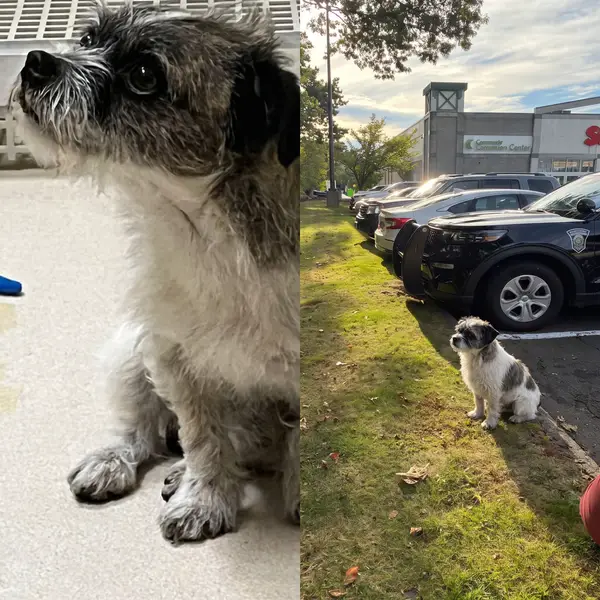
8 Months Later, He's Still Waiting For Gene
I found a dog in the Walmart parking lot last Tuesday. Small thing. Brown and white. Sitting by the cart return like it was waiting for someone who wasn't coming back. I almost walked past it. I was loading bags into the trunk — laundry detergent and garbage bags, nothing exciting — and I saw it out of the corner of my eye. Just sitting there. Not barking. Not running around. Looking at every car that drove by like it was checking to see if this one was the right one. My husband says I can't walk past anything that needs help. A stray cat. A kid who dropped their ice cream. A woman struggling with a grocery cart. He says it like it's a character flaw. I say somebody has to care. I walked over. The dog didn't run. He looked up at me with these big brown eyes — the kind that are too tired to be scared anymore. He had a collar. Faded red, worn soft at the edges. And a tag — not an engraved one, but a blank metal tag someone had written on in permanent marker. A name: Benny. And an address. No phone number. Just the address. The handwriting was shaky. The kind that belongs to someone whose hands don't work as well as they used to. I pulled the address up on my phone. Thirty minutes away. I stood in that parking lot and had a conversation with myself I'm not proud of. Thirty minutes is a long drive. I could take him to the shelter. They'd scan him. They'd probably call the owner. Probably. But this dog was old. You could see it in his face — the gray around his muzzle, the way he moved slow and careful when he stood up. And if his owner came looking for him at Walmart and he wasn't there, she'd spend the whole night believing he was gone. I know what that feels like. Not the dog part. The part where you lose something and the not-knowing eats you alive. Plus it was Tuesday. My day off. Not exactly a packed schedule. I opened the back door of my car and Benny climbed in like he'd been waiting for a ride. Curled up on the seat and put his chin on his paws. The GPS took me off the highway onto a two-lane road that got narrower the farther I went. Past a dollar store. Past a church with a gravel lot. Past a farm stand closed for the season. The house was small and white, set back from the road behind a chain-link fence. The yard was neat but tired — the kind of yard someone used to take care of and still tries to. A garden bed with stakes in it and nothing growing. A dry birdbath. A truck in the driveway that hadn't moved in a while; you could tell because the leaves had settled around the tires. I noticed the gate right away. One hinge snapped, hanging open at an angle. That's how Benny got out. It was obvious. Twenty minutes with a screwdriver and a new hinge. The kind of thing a husband handles on a Saturday morning. Nobody had fixed it. I sat in the car a minute. Benny was sitting up now, tail sweeping slow across the seat. He knew this place. I knocked. It took a while. I heard slow, careful steps inside. A chain sliding. The door opened four inches and a face appeared in the gap. Small. White hair. Eyes sharp but tired. "Can I help you?" "Ma'am, my name is Charlotte. I think this is your —" I didn't get to finish. Benny pushed past my legs and through the gap. The woman stumbled back a step, and then she saw him, and her whole body changed. Her hands went to her mouth. She went down to her knees right there in the doorway — slowly, carefully, the way someone kneels when their body doesn't move the way it used to — and Benny was in her arms before she reached the floor. She was shaking. Holding this dog against her chest with both hands, her face in his fur, saying his name over and over. She looked up at me. Her eyes were wet. "The gate," she said. "It's been broken 2 months. I keep meaning to call someone and I —" She stopped. Pressed her face into his fur again. "Gene would have fixed it in an hour. He'd have fixed it the same day it broke." "Gene?" "My husband." She said it the way you say a word that means more than what it means. "He's been gone 8 months. He got me Benny the year before. Said he didn't want me alone in this house." She held the dog tighter. "He still sits by Gene's chair every morning. Eight months and he still waits for him." Her voice broke. "I can't lose him too. He's all I have left." Then she looked at me — a stranger on her porch who'd driven 30 minutes instead of dropping her dog at a shelter — and said, "Please. Come in. Let me make you coffee." Her name was Ruth. She was 78. The kitchen was small and clean the way a kitchen is clean when one person uses it. One mug on the drying rack. One plate. The table had 2 chairs, but only one had been sat in recently. The other had a stack of mail on it. Envelopes. Medical bills. A lot of them. Benny walked straight to that chair and lay down beside it. Chin on the floor. Looking up at it. Waiting. She made coffee in a percolator on the stove. Not a Keurig. The kind that takes 10 minutes and fills the whole house with the smell. While it brewed, she talked. She didn't start with the sad part. That's how you know somebody really loved somebody. They don't begin with the loss. They begin with what was there before it. "Gene was a plumber. Forty-one years. The kind people called at 2 in the morning on Christmas because a pipe burst and they knew he'd come. And he always came." She poured the coffee and sat down across from me. "He was strong. That's what I noticed about him even when we were young. He had these hands —" she held up her own, small and thin — "twice the size of mine. He could hold a pipe wrench like it weighed nothing. Carry a water heater up a flight of stairs by himself." "We were married 52 years. People say that like it's a number. It's not a number. It's every Tuesday morning for 52 years where he made the coffee before I woke up. It's a man who put snow tires on my car every November without being asked." She looked at the chair with the mail on it. "That was his." I didn't say anything. You don't, in that moment. "It started in his knees. He was 64. He'd come up the porch steps and stop halfway, and when I asked he'd say the steps were steeper than they used to be." She smiled, the kind that hurts. "The steps were the same steps." "His doctor ran everything. Bloodwork. X-rays of both knees. Sent him for more bloodwork. And every single test came back clean. No arthritis on the films. Nothing in the blood. Doctor sat there with the folder open and said, 'Gene, there's nothing wrong with you.'" She set her mug down. "Nothing wrong with him. He couldn't get up his own porch steps." "So the doctor gave him ibuprofen. Told him to take it when it flared. Gene took it. He was like that — if a doctor told him to do something, he did it. Trusted the system. Trusted the man in the white coat." "For 14 years that's what we did. Ibuprofen, then a stronger one. Then cortisone shots in both knees, twice a year. Then a brace. Then a second brace." "And every time we went back, the doctor would look at the same clean tests and say the same thing. 'Nothing structural, Gene. Your bloodwork is perfect.'" She said it like she'd replayed it a thousand times. "His bloodwork was perfect. Gene couldn't open a jar of peanut butter." "The mornings went first. Gene was a 5 a.m. man. Up before the sun, coffee on, boots on, out the door. Forty-one years. By 66 I was the one making the coffee. He'd lie there until 6. Then 6:30. Not sleeping. Just not getting up." "I told myself he was getting older. That's what you tell yourself." "Then his hands." She looked down at her own when she said it. "Gene could hold a wrench for 8 hours. Could solder a joint in a space you couldn't fit your head into. His hands were his whole career." "By 68 he was dropping tools. You'd hear something hit the floor under a sink and then a word my mother would have slapped him for." "He started coming home with his hands in fists. Not angry fists — stuck fists. His fingers would lock and he couldn't open them. He'd hold them under hot water at that sink, right there, and work them open one finger at a time. I'd watch from the doorway and he'd say, 'Don't worry about it, Ruthie. Just stiff.'" "Just stiff. He said that for 3 years." "By 71 he'd cut down from 4 jobs a day to 2. Told me business was slow. Business wasn't slow. He was slow. The man who carried water heaters up stairs couldn't climb our porch without both hands on the rail." "I begged him to go back. He went. You know what they said?" I knew. But I let her say it. "'Everything looks normal, Gene. Some of this is just age.'" "He was 71. My sister is 74 and she still does her own garden. Seventy-one isn't the age you stop being able to hold things. Not unless something's taking it from you." She was quiet a minute. Drank her coffee. Set it down carefully. "His last 2 years he stopped working entirely. Told people he was retired. He wasn't retired. He was used up. He'd sit in that chair —" she nodded at it, where Benny still lay — "and talk about fixing the gate. Or the faucet in the bathroom. Things he could have done in an hour 10 years earlier. He'd talk about them like expeditions." I thought about the hinge. "I'd say, 'Gene, let me call someone.' And he'd say, 'I'll get to it, Ruthie. Give me a day or two.'" "He never got to it." "The plumber who could fix anything couldn't fix anything anymore. Including himself." She looked out the window. The one he used to sit and look out of. "February 12th. A Tuesday. I was at the grocery store, gone maybe 45 minutes. I came back and he was at the bottom of the porch steps." "His knee gave out coming down. That's what they think. He went down on the concrete and he couldn't get himself up, and he was out there long enough that whe
Loading the ad's image