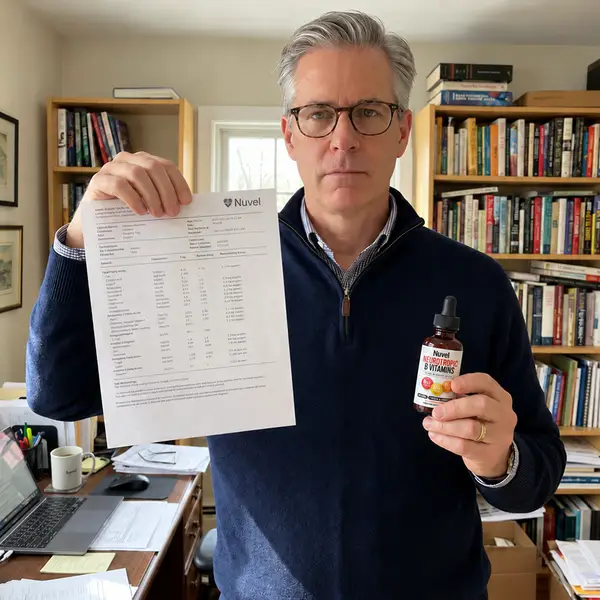
Advertiser

MS support & tips

trynuvel.comMeta Ad Library

4
Running ads
none new in 30 days
Sep 2026
Advertising since
longest ad 2 months
—
Reach
running ads, summed
0% video
Formats
0 video · 1 image
1
Products advertised
1 shop

My hunting buddy of 28 years did everything his neurologist told him. This October we had to carry him to the fire pit.

My hunting buddy of twenty-eight years did every single thing his neurologist told him to do. This October, we had to carry him from the truck to the fire pit. It was the last time he came to camp. I'm writing this on my back porch at 11 PM the night before opening weekend. There are going to be four chairs around the fire at deer camp this year instead of five. Jim's stand is still strapped to the white oak on the north ridge. Nobody has hunted it. Nobody's going to. If you're a man with MS who's been told your scans are stable, or you sit around a fire every fall with a man who is, please read this whole thing. I know it's long. I know your phone is buzzing. I know there's other things to do. A year ago I would have torn apart every magazine and inbox I had to find what I'm about to tell you. Jim Kessler was my hunting buddy for twenty-eight years. We met at a gun show in Indianapolis in 1996, arguing over the same used Remington. Neither of us bought it. From that fall on, we drove up to a cabin in northern Wisconsin every opening weekend with three other guys. Twenty-eight Novembers. Same five chairs around the same fire pit. Same routine. Rifles cleaned and locked up, then Jim's bottle of Wild Turkey came out and we'd pass it around till the fire burned down. Jim was diagnosed with MS when he was 44. For a long time you'd never have known. He had a flare, got on his medication, and went right back to being Jim. He still dragged his own deer out. He still climbed into that stand on the north ridge in the dark. He was the one who got the fire going every morning at 4:30 while the rest of us were still in our bags. About four years ago, things started to change. He started using a walking stick on the trail. Said it was for the mud. Then he stopped doing the deer drives with us. Said he'd rather sit. Then the walk up to his stand got too long, and he started hunting a ground blind twenty yards from the truck. Last spring he went to his neurologist and told him the truth. His legs were getting worse every year. He was exhausted by noon. His feet burned at night. The neurologist pulled up his MRI. "Stable," he said. "No new lesions. Your medication is working." Then he switched Jim to a stronger infusion anyway, just to be safe. Jim called me from his truck in the parking lot. I was the first person he told. "Doc says my scans are fine, Rich. Says keep doing what I'm doing. So I'm going to do all of it." "All of what?" "Everything, brother. Everything they say." And he did. He never missed an infusion. Not one. He quit drinking, because he read alcohol was bad for MS. The Wild Turkey stayed in his cabinet. He cut out sugar. He cut out bread. He walked every morning, a mile with his cane, around the block and back before he opened his hardware store. He bought a stationary bike and rode it every night in front of the news. His wife told me later she found him at the kitchen table one night at midnight reading about MS diets on his phone with his reading glasses on. He bought a juicer. Jim. With a juicer. I still can't picture it. And on the windowsill above his kitchen sink, lined up next to his multivitamin, he had a big bottle of drugstore B-complex, a bottle of vitamin D, and a bottle of fish oil. His neurologist had told him B vitamins were good for nerves. He took them every morning with his coffee. He did every single thing he was told. He stopped going to the Friday fish fry at the VFW because standing in line hurt too much. He stopped coaching the youth trap team he'd coached for eleven years. He told me on the phone in September he felt like he was watching himself disappear one piece at a time. In early October, he had his follow-up. MRI: stable. No new lesions. His timed walk at physical therapy: 11.4 seconds. Up from 9.8 in the spring. He'd done everything. Every infusion. Every walk. Every vitamin on that windowsill. Six months of giving up the things he loved. And his legs were worse. He called me from the parking lot that afternoon. He said he'd been sitting there for forty minutes. "Rich, I did everything. Everything. And it didn't work." I told him to give it time. I told him the stronger medication needed a few more months. I told him to keep walking, keep juicing, keep at it. I told him I'd see him at camp. November 14th. Camp weekend. The four of us drove up Friday. Jim drove up Saturday, because he'd had to open the store. He pulled in around 3 PM. From where we park to the fire pit is about sixty yards. Across the yard, over the roots, past the woodpile. Jim had walked it every November for twenty-seven years. He made it about twenty yards. I watched his right leg just stop listening to him. His cane went sideways and he went down on one knee in the leaves. He laughed. Said he tripped on a root. He tried to get up and couldn't. Stan and I got under his arms. Mike went and got Jim's camp chair from the fire pit and brought it over. And we carried Jim the last forty yards to the fire. In his chair. Like a king, Stan said, trying to make him laugh. Jim didn't laugh. That night he couldn't make it to the outhouse by himself. I walked him. He didn't say one word the whole way there or back. Sunday morning, before any of us were up, Jim had the fire going. Same as always. I don't know how he did it. When I came out, he was sitting in his chair with a cup of coffee, looking up at the north ridge where his stand was. "Take me home, boys," he said. He never came back. The next six months were the part I didn't know about MS. November, he started using a walker in the house. December, he fell in his garage going for the trash cans. He lay there for almost an hour before his wife got home. January, he got a wheelchair for anything outside the house. February, he couldn't do the three steps up from his garage into his kitchen anymore. His wife couldn't lift him. She's five-foot-two. March, they put the house up for sale. The house he built with his own two hands in 1991. They moved into his daughter's ranch house in Peoria so there'd be no stairs and somebody home all day. The week before they moved, Jim asked me to come over. He gave me his .30-06. The rifle he'd killed his first buck with at fourteen. "I'm not going to need it, Rich," he said. I told him to stop talking like that. He said, "Somebody should hunt it." It's in my safe. I haven't taken it out. When I helped them pack the kitchen, the drugstore B vitamins were still on the windowsill above the sink. Half full. Right next to the vitamin D and the fish oil. The juicer was in a box by the door. The Wild Turkey, the bottle he always brought to camp, is still sitting on the cooler in the cabin where he left it last November. I went up in the spring to open the place up and I left it right where it was. It's still there. After he moved, I tried to go back to normal. I couldn't. Because every time I opened my phone I saw guys my age posting the same things in the hunting groups and the MS groups my brother had me join. "Neuro says my scans are stable, just tired all the time." "Legs getting heavier but MRI looks good, anybody else?" "Started a B vitamin, bloodwork says my levels are great." And I knew some of them were doing exactly what Jim did. Every infusion. Every walk. Every vitamin on the windowsill. And losing ground anyway. One of those guys was my own brother. Danny's 54. He was diagnosed with MS five years ago. Last summer, at our family reunion, I watched his right foot catch on the edge of the patio. Twice. The same foot. The same way Jim's used to. I couldn't just sit there. So I started reading. Not because I wanted to. Because if Jim did everything right and still ended up in a wheelchair in his daughter's spare room, and I can't keep that from happening to my own brother, I can't live with that. I read for three weeks. Medical articles I could barely follow. MS forums. Anything I could find. And one thing kept coming up that nobody had ever explained to Jim. His medication stopped the attacks. It was never built to repair what was already damaged. Here's the simplest way I can say it. MS strips the protective coating off your nerves. That coating is what lets the signal get from your brain to your legs, fast and clean. When it's damaged, the signal slows down. That's the heavy legs. That's the foot that catches. That's the exhaustion by noon. Jim's medication was doing its job. It was stopping new attacks. That's why his scans said stable. But stopping the attacks is like putting out a house fire. It doesn't rebuild the house. The damage that was already there stayed there. And his nerves needed something specific to repair it. They needed B vitamins. His scans didn't change. His nerves did. And here's what made me want to throw my phone across the room. Jim was taking B vitamins. Every single morning. They were right there on his windowsill. They just weren't going to his nerves. I sat with that for a long time. The weekend after Thanksgiving I drove up to the cabin by myself. I sat by the fire pit with Jim's Wild Turkey on the cooler in front of me and read on my phone until the battery died. When I got home, I called my own doctor. She's been my family doctor for twelve years. I trust her. I told her the whole story. The infusions. The walking. The juicer. The windowsill. I asked her about the B vitamins. She asked what kind. I said the big bottle from the drugstore. She was quiet for a second. Then she said: "Rich, the B vitamins at the drugstore go into your blood. Not your nerves. That's why a blood test comes back looking great. The levels in the blood are fine. It doesn't mean the vitamin ever got to where Jim needed it." Then she said it again, slower. "Good blood work doesn't mean fed nerves." I asked her why nobody had told Jim that. She was quiet for a long time. "Because neurologists don't prescribe supplements," she said. "And the kind that actually reaches the nerve isn't a prescription." I drove from her office straight to the Walgreens on the way home. I stood in the vitamin aisle for almost an hour. B-complex in five different brands. B12 gummies. A "nerve support" bottle with a lightning bolt on it. Something called "neuro energy" in a can. I bought the most expensive B-complex on the shelf and mailed it to Danny. He took it for two months. His blood work came back. B levels high end of normal. His foot still caught on the stairs. So I started reading again. And what I found made me throw the rest of that bottle in the trash. A pill you swallow goes into your blood. Your blood carries it around. Your blood test looks great. And almost none of it ever gets inside the nerve. It wasn't just the wrong bottle. It was the wrong way in. I had been doing the right thing in the wrong form. I was furious. I'm still furious. About three weeks later I was scrolling Facebook on a Saturday morning. I'm in a private group for guys over 50 who hunt the upper Midwest. One of the guys had posted something his wife wrote. Her husband has MS. He'd been going downhill on stable scans for years, same as Jim. Same drugstore vitamins. Same good blood work. Then he'd switched to something different. Kept his medication exactly the same. And three months later he walked his daughter down the aisle without his cane. I read that post six times. I started looking into what he'd switched to. What I learned is there are two things that have to be true at the same time, or you're wasting your money. One. It has to be the right B vitamins. There's a kind called neurotropic B vitamins. Neuro means nerve. They're the B vitamins your nerves actually use. Regular B vitamins feed your blood. Neurotropic B vitamins feed your nerves. Two. It has to get past the blood and into the nerve. That's something called liposomal delivery. The vitamins ride inside a tiny bubble made of the same stuff your own cells are made of. The bubble blends right into the nerve cell and drops the vitamins off inside. Right vitamins. Right way in. Both. At the same time. I went back through every bottle I'd looked at in that Walgreens aisle. Not one had both. Most had neither. The expensive ones had the right words on the front and the regular drugstore stuff on the back. The one I found that had both is called Nuvel. Neurotropic B vitamins in a real liposomal delivery. One drop under the tongue in the morning. Tested by an outside lab. Every dose on the label. Made in the USA in small batches. They put a 90-day money-back guarantee on it. If nothing changes, you get every penny back. I almost didn't order it. After everything. After the Walgreens aisle. After the windowsill. After watching what happened to a man who did every single thing right. But then I thought about Danny's foot catching on that patio. Twice. I ordered four bottles. Two for Danny. One for Jim. One for a guy at church whose wife has MS. I mailed Danny his without asking. Wrote a note. "Take this every morning. Keep your medication exactly the same. Don't argue with me." Danny didn't argue. He's not stubborn the way Jim was. He's scared the way Jim should have been. He kept his infusion exactly the same. Didn't change his diet. Didn't start any new exercise. Just one drop under his tongue every morning. Two weeks in, he called me and said he'd slept through the night for the first time in over a year. His feet didn't wake him up. Five weeks in, he said he wasn't lying down after lunch anymore. Eight weeks in, his wife texted me a video of him carrying a full laundry basket up their basement stairs. No hand on the rail. His PT appointment was last month. Timed walk: 7.4 seconds. Down from 8.9 in the spring. The first time it's gone down since he was diagnosed. He called me from his truck in the parking lot. My little brother. 54 years old. He said, "Rich, I think Jim would still be walking if somebody had told him about this." I had to hang up. Jim's been taking it since April. I want to be honest here, because Jim would want me to be. He's not walking. He's still in the chair. There's a lot of ground you can't get back after four years of losing it. But three weeks after he started, he called me. He said he'd slept through the night. He said his hands were steadier. That he'd tied his own boots for the first time since Christmas. He said, "Rich, I think I waited too long." I didn't know what to say to that. The guy at church, his wife is doing the stairs at their house again. She'd stopped going to the second floor two years ago. Stan's brother-in-law takes it now. Mike ordered some for his sister. I'm not a doctor. I'm not a scientist. I'm a 57-year-old man who owns a tool and die shop in central Illinois and watched his best friend do everything right and lose anyway. I'm not getting a dime from this. I have no relationship with the company. They don't know I exist. I'm writing this at 11 PM on the porch because camp opens in eight hours and there's going to be four chairs again, and I can't stop thinking about my brother, and whether he would have been the next chair if he hadn't gotten that bottle when he did. Here's what I know, because I watched it. MS medication stops the attacks. It was never built to repair what's already been damaged. The drugstore B vitamins go into your blood. Not your nerves. Good blood work doesn't mean fed nerves. A pill you swallow stays in the blood. Liposomal delivery gets past it, into the nerve. Jim gave up everything he loved for six months and did every single thing he was told, and it didn't save his legs, because nobody told him what was actually going on. If you have MS, keep taking your medication. It's doing important work. Don't stop it. Jim never did. But don't do what Jim did and assume that's the whole plan. Not just stopping. Repairing. That's the line that finally made it click for me. Read the page. Not for me. For whoever's going to be sitting around the fire with you next November. https://trynuvel.com/products/vitamin-b-complex-liposomal Jim used to say, when one of us missed an easy shot, "You can't call back a bullet. But you can aim the next one better." You can aim the next one better. Rich Novak, age 57 Central Illinois P.S. The Wild Turkey is still on the cooler at the cabin. None of us can bring ourselves to open it, and none of us can bring ourselves to throw it out. Tomorrow the four of us will sit around the fire pit with Jim's chair folded against the woodpile, and we'll say his name when we pour the first round. He's not gone. He's in Peoria, in a wheelchair, in his daughter's spare room, texting us to ask who's hunting his stand. That's almost worse. A house he built with his own hands, sold. Eleven years of coaching kids, done. A .30-06 in my safe that he'll never shoot again. And one drop in the morning that might have changed all of it if somebody had told him in time. Please. Don't let your buddy's chair be folded against the woodpile next year. https://trynuvel.com/products/vitamin-b-complex-liposomal P.P.S. I don't work for Nuvel. I'm writing this at 11 PM because I'm leaving for camp at 5 AM and I can't sleep. Danny's meeting me at the cabin tomorrow. He's bringing his PT printout in his back pocket to show the guys. He's going to walk from the truck to the fire pit on his own. Send this to whoever you sit around a fire with in November. Send it to your hunting buddy. Your brother. Your father. The guy in your MS group who says he's "just tired." Even if his scans say stable.

Loading the ad's image


MS support & tips — My hunting buddy of 28 years did everything his neurologist told him. This October we had to carry him to the fire pit.
Promising

My hunting buddy of 28 years did everything his neurologist told him. This October we had to carry him to the fire pit.

My hunting buddy of twenty-eight years did every single thing his neurologist told him to do. This October, we had to carry him from the truck to the fire pit. It was the last time he came to camp. I'm writing this on my back porch at 11 PM the night before opening weekend. There are going to be four chairs around the fire at deer camp this year instead of five. Jim's stand is still strapped to the white oak on the north ridge. Nobody has hunted it. Nobody's going to. If you're a man with MS who's been told your scans are stable, or you sit around a fire every fall with a man who is, please read this whole thing. I know it's long. I know your phone is buzzing. I know there's other things to do. A year ago I would have torn apart every magazine and inbox I had to find what I'm about to tell you. Jim Kessler was my hunting buddy for twenty-eight years. We met at a gun show in Indianapolis in 1996, arguing over the same used Remington. Neither of us bought it. From that fall on, we drove up to a cabin in northern Wisconsin every opening weekend with three other guys. Twenty-eight Novembers. Same five chairs around the same fire pit. Same routine. Rifles cleaned and locked up, then Jim's bottle of Wild Turkey came out and we'd pass it around till the fire burned down. Jim was diagnosed with MS when he was 44. For a long time you'd never have known. He had a flare, got on his medication, and went right back to being Jim. He still dragged his own deer out. He still climbed into that stand on the north ridge in the dark. He was the one who got the fire going every morning at 4:30 while the rest of us were still in our bags. About four years ago, things started to change. He started using a walking stick on the trail. Said it was for the mud. Then he stopped doing the deer drives with us. Said he'd rather sit. Then the walk up to his stand got too long, and he started hunting a ground blind twenty yards from the truck. Last spring he went to his neurologist and told him the truth. His legs were getting worse every year. He was exhausted by noon. His feet burned at night. The neurologist pulled up his MRI. "Stable," he said. "No new lesions. Your medication is working." Then he switched Jim to a stronger infusion anyway, just to be safe. Jim called me from his truck in the parking lot. I was the first person he told. "Doc says my scans are fine, Rich. Says keep doing what I'm doing. So I'm going to do all of it." "All of what?" "Everything, brother. Everything they say." And he did. He never missed an infusion. Not one. He quit drinking, because he read alcohol was bad for MS. The Wild Turkey stayed in his cabinet. He cut out sugar. He cut out bread. He walked every morning, a mile with his cane, around the block and back before he opened his hardware store. He bought a stationary bike and rode it every night in front of the news. His wife told me later she found him at the kitchen table one night at midnight reading about MS diets on his phone with his reading glasses on. He bought a juicer. Jim. With a juicer. I still can't picture it. And on the windowsill above his kitchen sink, lined up next to his multivitamin, he had a big bottle of drugstore B-complex, a bottle of vitamin D, and a bottle of fish oil. His neurologist had told him B vitamins were good for nerves. He took them every morning with his coffee. He did every single thing he was told. He stopped going to the Friday fish fry at the VFW because standing in line hurt too much. He stopped coaching the youth trap team he'd coached for eleven years. He told me on the phone in September he felt like he was watching himself disappear one piece at a time. In early October, he had his follow-up. MRI: stable. No new lesions. His timed walk at physical therapy: 11.4 seconds. Up from 9.8 in the spring. He'd done everything. Every infusion. Every walk. Every vitamin on that windowsill. Six months of giving up the things he loved. And his legs were worse. He called me from the parking lot that afternoon. He said he'd been sitting there for forty minutes. "Rich, I did everything. Everything. And it didn't work." I told him to give it time. I told him the stronger medication needed a few more months. I told him to keep walking, keep juicing, keep at it. I told him I'd see him at camp. November 14th. Camp weekend. The four of us drove up Friday. Jim drove up Saturday, because he'd had to open the store. He pulled in around 3 PM. From where we park to the fire pit is about sixty yards. Across the yard, over the roots, past the woodpile. Jim had walked it every November for twenty-seven years. He made it about twenty yards. I watched his right leg just stop listening to him. His cane went sideways and he went down on one knee in the leaves. He laughed. Said he tripped on a root. He tried to get up and couldn't. Stan and I got under his arms. Mike went and got Jim's camp chair from the fire pit and brought it over. And we carried Jim the last forty yards to the fire. In his chair. Like a king, Stan said, trying to make him laugh. Jim didn't laugh. That night he couldn't make it to the outhouse by himself. I walked him. He didn't say one word the whole way there or back. Sunday morning, before any of us were up, Jim had the fire going. Same as always. I don't know how he did it. When I came out, he was sitting in his chair with a cup of coffee, looking up at the north ridge where his stand was. "Take me home, boys," he said. He never came back. The next six months were the part I didn't know about MS. November, he started using a walker in the house. December, he fell in his garage going for the trash cans. He lay there for almost an hour before his wife got home. January, he got a wheelchair for anything outside the house. February, he couldn't do the three steps up from his garage into his kitchen anymore. His wife couldn't lift him. She's five-foot-two. March, they put the house up for sale. The house he built with his own two hands in 1991. They moved into his daughter's ranch house in Peoria so there'd be no stairs and somebody home all day. The week before they moved, Jim asked me to come over. He gave me his .30-06. The rifle he'd killed his first buck with at fourteen. "I'm not going to need it, Rich," he said. I told him to stop talking like that. He said, "Somebody should hunt it." It's in my safe. I haven't taken it out. When I helped them pack the kitchen, the drugstore B vitamins were still on the windowsill above the sink. Half full. Right next to the vitamin D and the fish oil. The juicer was in a box by the door. The Wild Turkey, the bottle he always brought to camp, is still sitting on the cooler in the cabin where he left it last November. I went up in the spring to open the place up and I left it right where it was. It's still there. After he moved, I tried to go back to normal. I couldn't. Because every time I opened my phone I saw guys my age posting the same things in the hunting groups and the MS groups my brother had me join. "Neuro says my scans are stable, just tired all the time." "Legs getting heavier but MRI looks good, anybody else?" "Started a B vitamin, bloodwork says my levels are great." And I knew some of them were doing exactly what Jim did. Every infusion. Every walk. Every vitamin on the windowsill. And losing ground anyway. One of those guys was my own brother. Danny's 54. He was diagnosed with MS five years ago. Last summer, at our family reunion, I watched his right foot catch on the edge of the patio. Twice. The same foot. The same way Jim's used to. I couldn't just sit there. So I started reading. Not because I wanted to. Because if Jim did everything right and still ended up in a wheelchair in his daughter's spare room, and I can't keep that from happening to my own brother, I can't live with that. I read for three weeks. Medical articles I could barely follow. MS forums. Anything I could find. And one thing kept coming up that nobody had ever explained to Jim. His medication stopped the attacks. It was never built to repair what was already damaged. Here's the simplest way I can say it. MS strips the protective coating off your nerves. That coating is what lets the signal get from your brain to your legs, fast and clean. When it's damaged, the signal slows down. That's the heavy legs. That's the foot that catches. That's the exhaustion by noon. Jim's medication was doing its job. It was stopping new attacks. That's why his scans said stable. But stopping the attacks is like putting out a house fire. It doesn't rebuild the house. The damage that was already there stayed there. And his nerves needed something specific to repair it. They needed B vitamins. His scans didn't change. His nerves did. And here's what made me want to throw my phone across the room. Jim was taking B vitamins. Every single morning. They were right there on his windowsill. They just weren't going to his nerves. I sat with that for a long time. The weekend after Thanksgiving I drove up to the cabin by myself. I sat by the fire pit with Jim's Wild Turkey on the cooler in front of me and read on my phone until the battery died. When I got home, I called my own doctor. She's been my family doctor for twelve years. I trust her. I told her the whole story. The infusions. The walking. The juicer. The windowsill. I asked her about the B vitamins. She asked what kind. I said the big bottle from the drugstore. She was quiet for a second. Then she said: "Rich, the B vitamins at the drugstore go into your blood. Not your nerves. That's why a blood test comes back looking great. The levels in the blood are fine. It doesn't mean the vitamin ever got to where Jim needed it." Then she said it again, slower. "Good blood work doesn't mean fed nerves." I asked her why nobody had told Jim that. She was quiet for a long time. "Because neurologists don't prescribe supplements," she said. "And the kind that actually reaches the nerve isn't a prescription." I drove from her office straight to the Walgreens on the way home. I stood in the vitamin aisle for almost an hour. B-complex in five different brands. B12 gummies. A "nerve support" bottle with a lightning bolt on it. Something called "neuro energy" in a can. I bought the most expensive B-complex on the shelf and mailed it to Danny. He took it for two months. His blood work came back. B levels high end of normal. His foot still caught on the stairs. So I started reading again. And what I found made me throw the rest of that bottle in the trash. A pill you swallow goes into your blood. Your blood carries it around. Your blood test looks great. And almost none of it ever gets inside the nerve. It wasn't just the wrong bottle. It was the wrong way in. I had been doing the right thing in the wrong form. I was furious. I'm still furious. About three weeks later I was scrolling Facebook on a Saturday morning. I'm in a private group for guys over 50 who hunt the upper Midwest. One of the guys had posted something his wife wrote. Her husband has MS. He'd been going downhill on stable scans for years, same as Jim. Same drugstore vitamins. Same good blood work. Then he'd switched to something different. Kept his medication exactly the same. And three months later he walked his daughter down the aisle without his cane. I read that post six times. I started looking into what he'd switched to. What I learned is there are two things that have to be true at the same time, or you're wasting your money. One. It has to be the right B vitamins. There's a kind called neurotropic B vitamins. Neuro means nerve. They're the B vitamins your nerves actually use. Regular B vitamins feed your blood. Neurotropic B vitamins feed your nerves. Two. It has to get past the blood and into the nerve. That's something called liposomal delivery. The vitamins ride inside a tiny bubble made of the same stuff your own cells are made of. The bubble blends right into the nerve cell and drops the vitamins off inside. Right vitamins. Right way in. Both. At the same time. I went back through every bottle I'd looked at in that Walgreens aisle. Not one had both. Most had neither. The expensive ones had the right words on the front and the regular drugstore stuff on the back. The one I found that had both is called Nuvel. Neurotropic B vitamins in a real liposomal delivery. One drop under the tongue in the morning. Tested by an outside lab. Every dose on the label. Made in the USA in small batches. They put a 90-day money-back guarantee on it. If nothing changes, you get every penny back. I almost didn't order it. After everything. After the Walgreens aisle. After the windowsill. After watching what happened to a man who did every single thing right. But then I thought about Danny's foot catching on that patio. Twice. I ordered four bottles. Two for Danny. One for Jim. One for a guy at church whose wife has MS. I mailed Danny his without asking. Wrote a note. "Take this every morning. Keep your medication exactly the same. Don't argue with me." Danny didn't argue. He's not stubborn the way Jim was. He's scared the way Jim should have been. He kept his infusion exactly the same. Didn't change his diet. Didn't start any new exercise. Just one drop under his tongue every morning. Two weeks in, he called me and said he'd slept through the night for the first time in over a year. His feet didn't wake him up. Five weeks in, he said he wasn't lying down after lunch anymore. Eight weeks in, his wife texted me a video of him carrying a full laundry basket up their basement stairs. No hand on the rail. His PT appointment was last month. Timed walk: 7.4 seconds. Down from 8.9 in the spring. The first time it's gone down since he was diagnosed. He called me from his truck in the parking lot. My little brother. 54 years old. He said, "Rich, I think Jim would still be walking if somebody had told him about this." I had to hang up. Jim's been taking it since April. I want to be honest here, because Jim would want me to be. He's not walking. He's still in the chair. There's a lot of ground you can't get back after four years of losing it. But three weeks after he started, he called me. He said he'd slept through the night. He said his hands were steadier. That he'd tied his own boots for the first time since Christmas. He said, "Rich, I think I waited too long." I didn't know what to say to that. The guy at church, his wife is doing the stairs at their house again. She'd stopped going to the second floor two years ago. Stan's brother-in-law takes it now. Mike ordered some for his sister. I'm not a doctor. I'm not a scientist. I'm a 57-year-old man who owns a tool and die shop in central Illinois and watched his best friend do everything right and lose anyway. I'm not getting a dime from this. I have no relationship with the company. They don't know I exist. I'm writing this at 11 PM on the porch because camp opens in eight hours and there's going to be four chairs again, and I can't stop thinking about my brother, and whether he would have been the next chair if he hadn't gotten that bottle when he did. Here's what I know, because I watched it. MS medication stops the attacks. It was never built to repair what's already been damaged. The drugstore B vitamins go into your blood. Not your nerves. Good blood work doesn't mean fed nerves. A pill you swallow stays in the blood. Liposomal delivery gets past it, into the nerve. Jim gave up everything he loved for six months and did every single thing he was told, and it didn't save his legs, because nobody told him what was actually going on. If you have MS, keep taking your medication. It's doing important work. Don't stop it. Jim never did. But don't do what Jim did and assume that's the whole plan. Not just stopping. Repairing. That's the line that finally made it click for me. Read the page. Not for me. For whoever's going to be sitting around the fire with you next November. https://trynuvel.com/pages/ms-news Jim used to say, when one of us missed an easy shot, "You can't call back a bullet. But you can aim the next one better." You can aim the next one better. Rich Novak, age 57 Central Illinois P.S. The Wild Turkey is still on the cooler at the cabin. None of us can bring ourselves to open it, and none of us can bring ourselves to throw it out. Tomorrow the four of us will sit around the fire pit with Jim's chair folded against the woodpile, and we'll say his name when we pour the first round. He's not gone. He's in Peoria, in a wheelchair, in his daughter's spare room, texting us to ask who's hunting his stand. That's almost worse. A house he built with his own hands, sold. Eleven years of coaching kids, done. A .30-06 in my safe that he'll never shoot again. And one drop in the morning that might have changed all of it if somebody had told him in time. Please. Don't let your buddy's chair be folded against the woodpile next year. https://trynuvel.com/pages/ms-news P.P.S. I don't work for Nuvel. I'm writing this at 11 PM because I'm leaving for camp at 5 AM and I can't sleep. Danny's meeting me at the cabin tomorrow. He's bringing his PT printout in his back pocket to show the guys. He's going to walk from the truck to the fire pit on his own. Send this to whoever you sit around a fire with in November. Send it to your hunting buddy. Your brother. Your father. The guy in your MS group who says he's "just tired." Even if his scans say stable.

Loading the ad's image

MS support & tips — My hunting buddy of 28 years did everything his neurologist told him. This October we had to carry him to the fire pit.
Promising

Feel Like Yourself Again

F*ck what RRMS did to my myelin. And f*ck the nine years of appointments where nobody explained it to me. I'm 49. I was diagnosed at 40. And I'm going to explain this the way I wish someone had explained it to me, on a napkin, the first week. Every nerve in your body has a coating around it. It's called myelin. Picture the rubber around a phone charger cord. It's what keeps the signal moving from your brain to your hand, your brain to your foot, fast and clean. With the coating on, the signal barely has to work. It skips along the nerve in little jumps. That's why you can decide to pick up a cup and your hand is already moving. MS strips that coating off. Not all at once. In patches, here and there, for years. Where the coating's gone, the signal can't skip anymore. It has to drag itself down the bare part of the nerve, every inch, every single time. It shows up late. It shows up weak. Sometimes it doesn't show up at all. Here's the part that made me want to throw my phone across the room. Your body knows how to fix this. It rebuilds that coating all the time. It has repair cells whose whole job is wrapping bare nerve back up. But rebuilding takes two things. Material to build the coating out of, and energy to do the work. And with MS, you're short on both. A bare nerve burns through so much energy just trying to send a normal signal that there's nothing left over for repairs. So the repair never finishes. The coating gets a little thinner every year. And if a bare spot waits long enough, it stops being a bare spot. It turns into scar, and scar doesn't come back. And none of that shows up on your MRI. The scan looks for new lesions. New attacks. It can't see old damage quietly getting worse because nobody's fixing it. That's why they kept telling me stable. My DMT was doing its job the whole time. It stops new attacks, and I'm still on it. But it was never built to rebuild anything. Neither was anything else anyone ever handed me. Nine years. Stable, stable, stable. While the rubber on my cords wore through one patch at a time. I want to tell you where I finally learned all of that, because it wasn't from anyone I pay a copay to. And it wasn't on a napkin. It was on a trifold board. It was at my daughter's seventh grade science fair. Lily told me in January she wanted to do her project on MS. Not volcanoes. Not which paper towel soaks up the most water. MS. I asked her why, and she shrugged the way thirteen year olds do. "Because nobody in my class knows what it is," she said. "Jaden said his aunt has it and she's fine, so it's probably not a big deal." I didn't say anything. But I thought about it the whole rest of the night. Because from the outside, I am fine. I drive her to school. I go to work. I show up. What nobody sees is me sitting in the car for ten minutes in the school parking lot before I walk into anything, because my right leg needs a minute to decide whether it's coming with me. Lily sees it, apparently. I didn't know that until the project. She started by interviewing me at the kitchen table with a notebook, like a little reporter. What does it feel like when your leg doesn't work? What do you wish people knew? How would you explain it to someone who doesn't have it? I told her the truth, maybe for the first time. That by four in the afternoon my legs feel like I'm dragging them through wet cement. That sometimes I know exactly the word I want and it just doesn't arrive. That I look normal, and I'm not. Then she asked if she could post the same questions in one of my MS groups on Facebook. I said yes, mostly because I didn't think anyone would bother answering a middle schooler. Over a hundred people answered. She read them out loud to me while I made dinner. One woman said her brain is trying, but it short circuits and just doesn't do what she asks it to. A man said his legs feel like elephant legs, big and heavy and not his. Someone described it like bad wifi. The brain sends the command, lift your leg, but the signal is fuzzy, so the leg doesn't quite hear it. Somebody else wrote, we may look normal, but we are definitely not. Lily stopped reading at that one and looked at me. I had my back to her at the stove, and I didn't turn around for a while. She printed the answers and glued them down the side of her board under a heading that said Patient Perspectives. Participant 1. Participant 2. All the way down to Participant 14. Then she built the model. It took her three weekends at our kitchen table. She got two lengths of copper wire from the hardware store, two little light bulbs, a battery pack, and a plastic tray she filled with salt water. One wire she wrapped in black electrical tape from end to end. Careful, no gaps. That one was the healthy nerve. The other one she wrapped the same way. Then she took my kitchen scissors and scraped the tape off in patches. Here, and here, and a long stretch near the end. That one was mine. I watched her do it and didn't say a word. It's a strange thing, watching your kid carefully take the coating off a wire and knowing she's doing it because she's been paying attention to you. She laid both wires in the salt water and flipped the switch. The taped wire lit its bulb bright and steady. The scraped one flickered. Went dim. Came back. Went dim again. Everywhere the tape was gone, the electricity was leaking out into the water instead of making it to the bulb. "That's what it's like," she said. "Right?" I told her yes. That's exactly what it's like. She wrote the title across the top in purple marker. Brain Glitch: Modeling Signal Loss in MS. The fair was on a Thursday night in the school gym. By six my legs were doing what they always do by evening. I sat on the bottom row of the bleachers while parents wandered past the tables, and I watched Lily explain her board to anyone who'd stop. Most people looked, said that's so cool, and moved on to the kid with the baking soda volcano. Then one of the judges stopped. A woman about my age with a clipboard and a lanyard. She watched Lily flip the switch. She watched the bulb flicker. And instead of moving on, she crouched down so she was eye level with the tray. She stayed a long time. Longer than any judge had stayed at any table all night. I could see Lily talking with her hands. I could see the judge asking questions, nodding, asking more. Then Lily turned around and pointed at the bleachers. At me. The judge walked over and sat down next to me. "I'm Ellen," she said. "Your daughter tells me you're Participant 1." I laughed. I didn't know that. She told me she was a neurologist. MS was her specialty, twenty two years of it. She volunteered to judge the fair every spring because her own kids had gone to that school. "I've taught this to medical residents with slides and diagrams for two decades," she said. "Your daughter just explained demyelination better with electrical tape than most of them could on their final exam." I told her the truth. That I'd had MS for nine years, and that board was the first time I'd actually understood what was happening inside me. That nobody had ever shown me. I'd gotten scans, and the word stable, and a new prescription, and that was it. She didn't defend anybody. She just nodded slowly, like she'd heard that sentence before. Lily had followed her over. She was standing in front of us with her hands shoved in her hoodie pocket, and she asked the question she'd been saving. "Can the body put the tape back on?" Ellen looked at her like it was the best question she'd heard all night. "Yes," she said. "It tries to, every single day. There are cells whose whole job is wrapping that tape back on. The problem is they run out of supplies." She held up two fingers. "To put the tape back, you need the tape itself. That's the material. And you need someone with enough energy to do the wrapping. With MS, a bare wire is burning so much power just trying to light the bulb that there's nothing left over to fix itself. So the wrapping never gets finished." Lily thought about that. "So what gives it the supplies?" Ellen smiled. "Three vitamins. B12, B1, and B6. In my field we call them neurotropics, because they act on nerve tissue specifically." She pointed across the gym at Lily's scraped wire. "B12 is the tape. It's what the coating is actually built out of. B1 is the power, the energy for whoever's doing the wrapping. And B6 helps the signal get through clean once the tape is back, so the bulb stops flickering." Tape. Power. A bulb that stays on. She said there's a study where all three together did twenty six times more for damaged nerve cells than B12 by itself. Twenty six times, not twenty six percent. And that in Japan, neurotropics have been used for nerve damage for decades. I asked her the obvious question. Why had none of my doctors ever mentioned this? "Because we're trained to stop the attack," she said. "Your DMT does that, and you should stay on it. But nobody trains us on the repair. There's no drug for it, so nobody ever comes to our office to talk about it." I asked her what brand I should buy. She shook her head. "I'm here to judge science projects, not to sell you anything," she said. "What I'll tell you is what to look for. All three together. The active forms. Made so they get inside the nerve cell, not just into your blood. Then do what your daughter did. Test it." Then she stood up, wrote something on her clipboard, and went to look at the volcano. Lily got second place. She was annoyed about that for a week. In the car, she was quiet for a while. Then she said, "Are you going to try it?" I didn't answer right away. I've tried a lot of things. Vitamin D. No gluten. A cooling vest. A diet out of a book that cost me two years and most of my relationship with bread. Every time I got my hopes up, and every time nothing moved. "You always tell me a science project isn't done until you test it," Lily said. So we made it one. That night I sat at the kitchen table after she went to bed and read everything I could find about neurotropics and myelin repair. It was all there. Published. Nothing hidden. Just sitting somewhere nobody had ever pointed me. By one in the morning I'd found a formula that matched everything Ellen described. All three neurotropics together, in the active forms, liposomal so it gets inside the nerve cell. Nuvel. I ordered it before I went to bed. The next morning Lily got a new notebook and wrote Experiment 2 on the cover. Before I took the first dose, she made me walk from the front door to the end of the hallway while she timed me on her phone. 9.8 seconds. She wrote it down. Then she made me rate my legs at four in the afternoon, one to ten, ten being the worst. I said seven. She wrote that down too. Week one. Nothing. Lily wrote No change in careful handwriting and underlined it. I thought, here we go again. Week two. I slept through the night twice. Lily wrote it down with a question mark next to it, like a real scientist. Week four. The four o'clock cement moved closer to six. Some days it didn't come at all. Week six. I finished a whole sentence at dinner that I would have lost a month earlier, and Lily didn't have to fill in the word for me. I hadn't realized she'd been doing that until she stopped. Week eight. Front door to the end of the hallway. 8.1 seconds. Week ten. I went up the stairs at her band concert without stopping on the landing. She saw it from the stage. Week twelve. 7.3 seconds. She wrote it in marker and circled it three times. It didn't fix everything. My legs still get heavy on hot days. There's a numb spot on the outside of my left foot that's been there six years, and it's still exactly where it's always been. Ellen had warned me about that part. Some spots where the tape comes off turn to scar, and nothing puts tape back on scar. But everything that wasn't scar yet came back some. Not all the way. Enough that a thirteen year old with a stopwatch could measure it. Here's what I keep coming back to since that night in the gym. Every symptom I'd been living with for nine years was a flickering bulb. I'd just never seen the wire. Maybe you'll recognize some of yours. Legs that feel like wet cement by late afternoon. That's the signal to your leg muscles leaking out of bare spots on the way down and arriving too weak to do what you asked. Your muscles aren't the problem. The message is. Catching your toe on a rug, or a step, or the edge of a curb you've walked over a thousand times. The instruction to lift your foot got there a beat too late. Burning or buzzing in your feet at two in the morning. A bare wire doesn't just leak. It sparks on its own. Your brain reads those sparks as pain, or pins and needles, or feet that feel like they're on fire under the covers. The crash in the afternoon, no matter how you slept. Every bare wire in your body is burning extra power just to light its bulb, all day long. By mid afternoon there's nothing left. Losing a word halfway through a sentence. Your brain runs on the same wiring. When the coating thins there, the word is still in there. It just shows up late, or not at all. Needing a bathroom right now, or waking up three times a night to go. Those signals travel the same kind of wire, and they leak the same way. Heat that wipes you out. A hot shower, a July afternoon, a car that's been sitting in the sun. A bare wire is already barely getting the signal through. Heat makes it worse, and for a while the bulb just goes out. Dropping things. Your coffee mug, your keys, your phone. Your fingers stop reporting back what they're holding. I used to think these were eight different problems, eight different things to bring up at eight different appointments. They're one problem. Wire that lost its tape and never got it put back. And every one of them can get worse for years while your scan says stable, because none of them is a new lesion. They're old damage waiting on a repair that never shows up. Some of that damage is already scar. Some of it isn't yet. The part that isn't yet is the part that's still flickering. Which means it's still worth fighting for. I'm still angry about the nine years. I think I'll always be a little angry about them. But I'm not angry about not knowing anymore, because now I know. And now you do too. So here's what I'd tell you if you were sitting next to me on those bleachers. Stay on your DMT. It's stopping new attacks, and that's what keeps more of your tape from coming off. I'm still on mine. Then give your body the supplies to put the tape back on the wires that are still flickering. That's the part nobody hands you. What I take is Nuvel Liposomal Neurotropic B Vitamins. All three of the neurotropics Ellen talked about, B12, B1, and B6, in their active forms, in one bottle. It's liposomal, which means it's made to get inside the nerve cell where the repair actually happens. A few drops under my tongue every morning. That's it. It won't touch the scar. Nothing will. And it doesn't replace anything your neurologist has you on. It's the other half, the repair half, the part your DMT was never built to do. And do what Ellen told me. Test it. Before your first dose, have someone time you walking from your front door to the end of your hallway. Write down how your legs feel at four in the afternoon. Put the date on it. Then check again at week twelve. It comes with a 90 day money back guarantee, so if your numbers don't move, you don't pay for it. Right now they're also running buy two, get one free. https://trynuvel.com/products/vitamin-b-complex-limposal P.S. Lily already picked her project for next year. Same wires, same salt water, same purple marker. This time she's going to scrape the tape off both wires and then try to put it back. She's calling it Brain Glitch Part 2: Can You Put the Tape Back On? I'm Participant 1 again. She already has my numbers. P.P.S. If you know someone with MS who's been told stable for years while she keeps getting a little worse, send her this. Nobody explained it to me for nine years. It took a seventh grader. She shouldn't have to wait for one.

Loading the ad's image
MS support & tips — Feel Like Yourself Again
Promising

Watch Out For Scams

My mom spent $30 on "neurotropic vitamins" off Facebook, and I was ready to report it as a scam. For 3 years she's been holding onto the walls, catching her foot on every rug, and taking falls, and I wasn't going to let some internet company rob her too. Then I read the ingredients. Before you scroll past this thinking it's another ad, hear me out. I'm not here to talk you into buying anything. Honestly, I'd rather you didn't take my word for it at all. I'm writing this because when I was trying to prove these vitamins were garbage, I found a whole lot of people online who were exactly like me. Sons. Daughters. Husbands. Skeptics. People who'd been burned and were ready to be burned again. And I figure some of you are reading this right now with your arms crossed, looking for the catch. Good. Keep them crossed. Read the whole thing. Then go do your own digging. And if I'm wrong, come back here and tell me in the comments. I don't think I am. But I'll be waiting either way. My name is Greg. I'm 49. I've been an insurance claims investigator for 21 years. My entire job is catching people who are lying. Staged accidents. Padded invoices. Fake injuries. I've seen every trick in the book, and I can smell a scam from across a parking lot. So when it comes to my mom and her MS, I'm the one in the family who says no. My mom's name is Diane. She's 71. Retired school crossing guard. For 26 years she stood in the middle of Maple Avenue in front of Roosevelt Elementary with a stop sign, rain or snow. She knew every kid's name, every car that rolled through her stop sign, and exactly which dad drove too fast. She still walks two miles every morning. Or she did. She's had MS for years. Three years ago, her walking and balance started getting worse. Her neurologist has her on an infusion every six months. At the appointments, the doctor says she's doing well. "No new lesions. The infusion is working." That's the part the doctor saw. Here's the part I saw. She started holding onto things. She'd get up from the kitchen table to get the coffee pot and put her hand on the counter. Then the next counter. Then the fridge. She crossed her own kitchen hand over hand. Once, at Thanksgiving, her foot caught the edge of the dining room rug and she went down. My son asked, "Is Grandma okay?" and the whole table went quiet. She said, "I'm fine, I just tripped." She didn't just trip. Her foot didn't lift. Then the curbs. My mother, who stood in the middle of Maple Avenue for 26 years, would stop at every curb. She'd stand there and stare down at it, working out how to step off. And then the walks. Two miles every morning, her whole adult life. By last year, she'd stopped. She'd sit on the porch with her coffee and watch the neighbors go by. She bought a cane and hated it. At the grocery store, she started leaning on the cart like a walker. One morning she let go of the counter to reach for a coffee mug, lost her balance, and dropped it. She stood there looking at the pieces like she didn't know how it happened. Every year, my sister takes her for her MRI. Every year, it says stable. And every year, the doctor says her walking and balance are "part of the progression" and brings up a walker. And every year, Mom goes out a little less. Now here's where I have to tell you the ugly part about me. When Mom's walking and balance started getting worse, the vultures came out. You wouldn't believe what's out there. Or maybe you would, if you're reading this. The ads started showing up on her phone, on her Facebook, in her email. "Reverse MS in 30 days." "The secret neurologists don't want you to know." "Doctors are FURIOUS about this." And my mom, God love her, fell for a lot of it. She's scared. Her whole day is the porch now. And somebody on the internet is promising her a way out. Turmeric capsules, $49 a month. A "remyelination" formula, $89 a bottle, sold to rebuild her myelin. Some mushroom powder that was supposed to "regrow your nerves." An online diet program. A copper bracelet, I'm not kidding. A "detox foot pad" that turned black overnight, which I later found out turns black if you just breathe on it. I added it up once. Over two years, close to $1,800. Not one bit of it did anything. Not one. Every single time, I was the one who had to be the bad guy. I'd find the bottle on her counter. I'd pull up the company. Half the time they didn't even have a real address. No testing. No ingredients list that made sense. Reviews that were obviously fake. I'd call her and say, "Mom, they're robbing you." And she'd get quiet on the phone. And I'd feel like the worst son in the world, but I'd rather feel like that than watch her get robbed. So three months ago, when my sister called and said, "Mom ordered some kind of neurotropic vitamins off Facebook," I didn't even let her finish the sentence. "How much?" "Like thirty bucks, I think." "I'm handling it." I drove over that Saturday with the full intention of getting her a refund, finding the company, and reporting them. I'd done it before. I was good at it. Mom was on the porch when I pulled up. Sitting. Watching the street she used to walk. The package was on the kitchen counter, still in the mailer. Nuvel Liposomal Neurotropic Vitamins. I sat down at her kitchen table with my laptop, the way I sit down with a suspicious claim at work, and I started pulling it apart. First thing I check with any company is whether they'll show you what's actually in the product. The scams never do. They hide behind "proprietary blend" and "secret formula." Their page listed every vitamin and the exact form of each one. It said the vitamins were third-party tested. No blend. Nothing hidden. I read the whole thing. That bugged me. Scams don't usually show their work. Second thing I check is the ingredients. Do they make sense? Is it just sugar and wishful thinking? B1. B6. B9 as methylfolate, which I looked up. It's a form your body can use without changing it first. And B12, in its active form. And that's where I actually stopped and sat back in my chair. Active neurotropic vitamins are the same forms doctors in Japan prescribe for nerve support. Same forms. In a bottle she bought off Facebook. Now, a scam wouldn't care about that. A scam would be happy to sell her anything. But it told me something important. This wasn't a bottle of nothing. This had something real in it. Which meant I wasn't going to let her touch it until her neurologist saw it. I printed the ingredient list right there. Third thing I check is the reviews. Not the five-star ones on their site. Those can be anything. I went looking everywhere else. MS forums. Caregiver groups. Facebook comment sections. Reddit. And this is where it got weird. I kept finding people like me. A daughter in Ohio who wrote that she bought it for her dad fully expecting to return it, and the refund was already written up in her head. A husband who said he'd "seen every snake oil on the planet" and told his wife she was throwing money away. A son in Arizona whose comment started with, "I came here to warn people." It ended with, "I was wrong, and I'm glad I was." Skeptic after skeptic. People who'd been burned just like my mom. People who went in looking for the catch. And one after another, they were saying the same thing. Not "cured." Not "miracle." Nobody said that, which honestly made me trust it more. They said things like, "She stopped holding the walls first." "He walked to the mailbox." "She's back to her Saturday walks." "My mom seems like herself again." I spent four hours on it. By the end I had two pages of notes and a lot less certainty than when I walked in. So I did the thing I do at work when a claim doesn't break the way I expected. I went back to the root of it and asked why. Why would these vitamins do anything that the other $1,800 of stuff didn't? Here's what I figured out, in plain English, because that's how I needed it explained to me. Mom's infusion does one job. It stops new attacks. That's when immune cells come in from her blood and damage her nerves. That's what her MRI checks for. No new lesions means no new attacks. And by that measure, she was "stable." But that isn't the only thing happening in MS. Immune cells that already live inside her brain and spinal cord stay active for years. Every day, they put out free radicals that damage the part of the nerve cell that makes energy. Without that energy, the nerve can't keep its myelin repaired. And without myelin, the signal from her brain to her feet shows up late and weak. That's the foot that doesn't lift. That's the hand on the counter. What those immune cells are doing has a name. Neuroinflammation. And here's what got me. It doesn't show up on her MRI. It's too small and too spread out to make a lesion. In three years, not one person said the word to my mom. So there are two jobs. Her infusion does the first one: stopping new attacks. Nobody was doing the second one: protecting her nerves from the neuroinflammation and rebuilding the myelin that was damaged. That explained a lot. It explained why her MRI said "stable" and she was still holding the walls. So what do nerves need to protect themselves from neuroinflammation and rebuild? I looked it up the way I'd look up anything at work. Three specific vitamins, which are B6, B1, and B12. Together, these are called the neurotropic vitamins because they support nerve health specifically. All three were on Mom's label. B6 neutralizes the free radicals. B1 starts the process that makes energy. B12 is what the body uses to make myelin. And B12 needs B9 to do that job, which is why the methylfolate is in there. Each step depends on the one before it, so all three have to be there. Then I understood why the turmeric and the mushroom powder and the "remyelination" pills never did anything. Most of that stuff never gets where it needs to go. You swallow it, and very little of it ever gets inside a nerve cell. What makes Nuvel different, from what I could find, is the delivery. The vitamins are enclosed in a tiny sphere made of the same kind of fat as your cell membranes, so it can carry them inside the cell. You take it under your tongue, so there's no pill to swallow. The right vitamins and a way to get them inside, in one. Okay. That made sense. It was a real idea with a real reason behind it. That's more than I could say for the foot pads. But making sense isn't proof. At work, I don't close a claim because the story sounds good. So I made my mom a deal. She'd take the ingredient list to her neurologist first. If he said no, the bottle was going in the trash, no argument. And if he said yes, she'd take Nuvel every morning, for 90 days, alongside her infusions. No changes to anything else. And I'd keep notes. Honest notes. If I didn't see anything by the end, we'd use the 90-day money-back guarantee, and she'd promise me she was done with internet supplements for good. She agreed. I think she was just happy I wasn't yelling. My sister took the ingredient list to the neurologist that Tuesday. He read it, said the vitamins were fine alongside her infusions, and told her to keep him posted. Mom started the next morning. Under her tongue, before her coffee. Here's what I wrote down. Week one: Nothing. Saturday, she held the counter all the way to the coffee pot. Told my sister, "See? Thirty bucks down the drain." I felt smug. Week two: My sister called me on a Thursday. "Mom was at the mailbox when I pulled up." She hadn't walked to the mailbox on her own in a year. I said, "Could be anything. Could be a good day." It was. It was also a good day the next Thursday, and the Thursday after. Week four: I went over on Sunday. Mom was coming back up the driveway with the paper. No cane. She looked at me and said, "You can put the claim form away, Greg." Then she laughed at her own joke. I didn't even know she'd been paying attention to how I felt about this. Week six: She walked me out to my car. Down the porch steps, across the gravel. She didn't take my arm. For two years, I was the one walking her to the car. Now she was walking me to mine. I stopped writing notes after that for a few days, because honestly, I didn't know what to write. Week eight: Sunday dinner at my place. My son, who's 11, asked if Grandma would walk him to the park after dinner. When he was little, she used to walk him across the street to that park. She said yes. Then she stood up to help clear the plates. She pushed back her chair and got up. No grabbing the table. No hand on the wall. Just stood up, picked up two plates, and walked them to the sink. My wife looked at me across the table. I had to go to the bathroom and run the water for a minute. After dinner, she walked him to the park. At the curb, she looked both ways and stepped down, the way she used to. Week ten: She carried the coffee pot across the dining room rug. Her foot cleared the edge. That Thursday was her neurologist appointment. My sister went. Mom walked from the waiting room to the exam room without touching the wall. My sister told me afterward that the doctor watched her walk, looked at his notes, and said, "Well, whatever you're doing, keep doing it." Week twelve: She walked around the block with my sister. The whole way. I stopped keeping notes after that. I didn't need to anymore. Now let me be as straight with you as I'd want someone to be with me. My mom still has MS. She still gets every infusion. She still has bad days, especially when it's hot or she's worn out. The cane still sits by the front door for long days. She's 71. This didn't cure anything. Nothing does. And if anyone ever tells you something cures MS, that's your red flag. Walk away. What I'm telling you is that my mom is steadier on her feet than she's been in two years. She hasn't fallen once since she started. She's walking to the mailbox. She's crossing her kitchen without the counter. She walked my son to the park and stood at the curb with him, the way she used to. And after 21 years of catching liars for a living, I know the difference between a good story and a real result. I've watched this one with my own eyes, every Sunday, for three months. So here's why I'm writing this. When I was looking for the catch, I found a lot of people online just like me. Skeptics. Sons and daughters and husbands who'd been burned. Some of them had tried Nuvel and come back to say they were wrong. Some of them were still standing at the edge, arms crossed, trying to decide. This is for the ones still standing at the edge. I'm not asking you to trust me. I wouldn't trust me either. I'm asking you to do exactly what I did. Go read their page. Read the ingredients one by one and look each of them up. Take the list to the neurologist before anybody takes a single dose. That part's not optional. Go find the reviews that aren't on their website. Read the forums. Read the skeptics. Then, if you try Nuvel, give it the full 90 days alongside the MS medication, like we did. Keep notes. Honest ones. If it doesn't do anything, send it back. The guarantee is real. I read the terms. I'm a claims investigator. I read the terms on everything. And then come back here and comment. If I'm wrong, tell me. I mean that. Tell everybody reading this. I'll leave it up. But I've looked at this from every angle I know how to look at something. And I'm pretty sure you're going to find the same thing I did. I'll be waiting for your comment. I'm betting it's going to be a testimonial. Here's where it is, so you can start your own digging: https://trynuvel.com/products/vitamin-b-complex-liposomal Everything I checked is on that page. The full ingredients. The form of every vitamin. The 90-day guarantee. Fair warning: their page talks a lot about burning and tingling. Mom's problem was her walking and balance. It's the same vitamins either way. P.S. Mom found out I was writing this. She read it over my shoulder at her kitchen table. When she got to the part about the foot pads, she smacked my arm and said, "You didn't have to tell them about the foot pads, Greg." Then she read the rest. When she finished, she didn't say anything for a minute. Then she said, "Tell them to take the ingredient list to their doctor first. You told them, but tell them again." So. Mom says take the list to your doctor first. P.P.S. If you're the skeptic in your family, the one who always has to be the bad guy, I know that job. It's lonely. You're not wrong for being careful. Just make sure you're careful in both directions. I almost threw away the vitamins that gave my mom her walks back because I was so sure I already knew the answer. ~ Greg, 49, Dayton, OH

Loading the ad's image
MS support & tips — Watch Out For Scams
PromisingImage

From the ads Sniped has collected from this page (4 so far, first seen Nov 2026). Reach is what Meta reports; no spend or sales estimates.