Everyone with a cherry bottle in the cupboard needs to see this ☝️
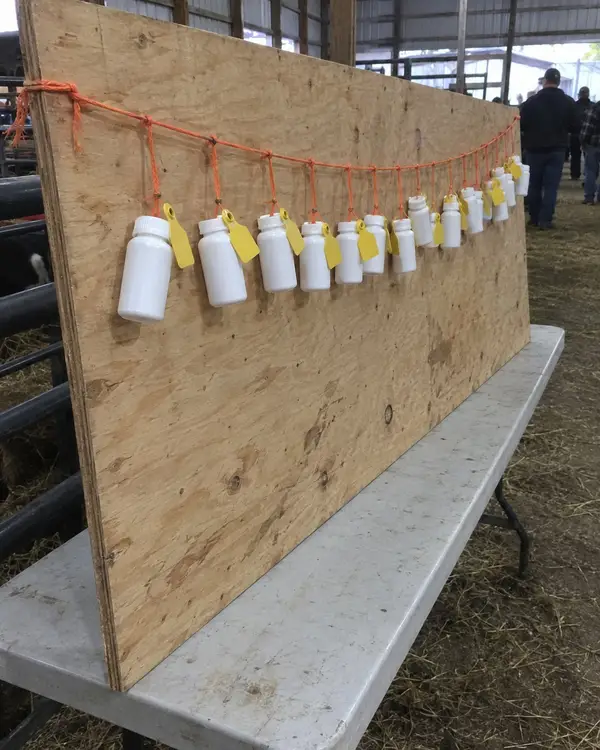
My husband walked into the 4-H barn at the fair and found his own bottle hanging on our 12-year-old grandson's display. It was clothespinned to a strand of baling twine, right at eye level, with a yellow ear tag on it and a card underneath in red marker. The card said what was really inside it. Hank read it. Then he sat down on a hay bale and didn't say a word for about ten minutes. I've been married to that man for 46 years, and he has had an opinion about every weather report since 1972. Ten minutes is a long time. Sharon told me I ought to write this down for her page. She says there are a lot of Hanks out there. She's right. So here it is. ======== I'm Linda. I'm 67. I was the secretary at our little Methodist church for 24 years, which means I know everybody's business and keep most of it to myself. Hank milked cows for 45 years. Holsteins, sixty head at the most. Twice a day, 4:30 in the morning and 4:30 in the afternoon, Christmas included. He sold the herd when he turned 68. He still wakes up at 4:30. He stands at the kitchen window with his coffee and looks at the empty barn. Our grandson Caleb is 12. He's our daughter's boy and he lives a mile down the road, which means he lives at our house. Caleb is in 4-H. He shows a Holstein heifer named Pancake, because when he was eight he thought that was the funniest name in the world, and he still does. He's the kind of boy who reads the back of the cereal box. The whole thing. Then he tells you the sodium. And he thinks his Grandpa Hank hung the moon. That's how all of this started. ======== Hank's knees went the way a lot of dairymen's knees go. Forty-five years of concrete. Squatting down beside a cow, standing up, walking to the next one, squatting down again. Sixty cows, twice a day. About eight years ago Hank's doctor sent him for X-rays. "Some wear and tear," he said. "That's a farmer's knee. We'll keep an eye on it." He put Hank on a daily pill for the ache. Hank took it every morning with his coffee. Still does. The stiffness he blamed on the cold. Taking the stairs one at a time he blamed on the stairs. He built them himself in 1981 and now he says they're too steep. Letting our son-in-law back the stock trailer he blamed on his neck. Every checkup was the same. "Still some wear. Keep taking it." About two years ago a fella at the feed store told Hank tart cherry was supposed to be good for joints. Hank stopped at the farm supply on the way home and bought the biggest bottle on the shelf. Red label. "3,600 MG" across the front in numbers you could read from the tractor seat. He took it every single day for two years. Hank doesn't skip things. I'd been taking cherry capsules for my own hands about a year by then, the kind Sharon takes. I'm part of the same commune she is. When I mentioned it at Sunday dinner, Hank laughed at me. "Linda, I take the strongest one they make. Five times more than yours. Look at the number. They don't do a thing for me. Cherries don't work." Caleb was sitting right there with mashed potatoes on his fork. He looked at Grandpa's bottle on the windowsill. Then he looked at mine. I could see the gears turning. I didn't think a thing about it. ======== The fall before last, Hank went up in the haymow to throw down bales for Pancake. He's done it ten thousand times. Up the wooden ladder nailed to the barn wall, through the hole in the floor, toss the bales down, back down the ladder. He got up there fine. He threw down six bales. Then he went to come down, and his knees wouldn't take the first rung. He sat on the edge of that hole with his boots hanging, trying. He'd get one foot on the rung and his knee would start shaking and he'd pull it back up. Fourteen feet to a concrete floor. He sat up there almost an hour. In the dust and the cold, with the barn cats watching him. Caleb found him. He'd come over after school to brush Pancake. I was in the kitchen, and I heard Caleb's voice out in the barn. Calm as anything. The way you talk to a calf that's spooked. "Left foot, Grandpa. It's right under you. Okay. Now the right one. I've got the ladder." I ran out in my slippers. My 12-year-old grandson was standing at the bottom of that ladder with both hands on the rails, talking his grandpa down one rung at a time. Hank's face was gray. His knuckles were white on the wood. When his boots hit the floor he stood there holding on to the ladder. He didn't let go for a while. Then he said, "Don't tell your grandma." I was standing in the barn door. Caleb looked right at me. ======== That night Hank went to bed at seven-thirty. Caleb sat at my kitchen table and didn't touch his pie. "Grandma," he said. "Grandpa takes the strongest one there is. Right?" "That's what the bottle says, honey." "Then if his doesn't work, none of them work." He said it like it was a sad fact he'd have to live with. Then he sat up straighter. "I'm doing my 4-H project on it. I'm going to prove Grandpa's is the strongest." I want you to know that part. He was on his grandpa's side. He set out to prove Hank right. ======== Caleb's project went in the Science Discovery division. You ask a question, you test it, you show your work, and then you sit down at a table with a judge and explain it to her face. Hank cut him a big sheet of plywood in the shop for the display. Caleb painted his question across the top in red barn paint: "ARE ALL CHERRY PILLS THE SAME?" Hank was tickled. He took the bottle off the windowsill and handed it over himself. "Here," he said. "Show 'em what strong looks like." Caleb worked on it all winter at my kitchen table. First he wanted to know what part of a cherry even matters. So he read. He found where researchers measured anthocyanins in Montmorency tart cherries, the stuff that makes them red, and nearly all of it was in the skin. The flesh had about none. The pit, next to nothing. He didn't take their word for it. That's Caleb. He got a pound of pie cherries out of my freezer, off the old tree by our mailbox, and set my baking scale on the table. He pitted every one with a straightened paperclip. Then he sat there with my paring knife and peeled the skins off, one cherry at a time. It took him two evenings and most of a Sunday afternoon. Three saucers. Pits. Flesh. Skins. He held each one up to the kitchen window. The pits were tan. The flesh was pale pink, almost see-through. The skins were so dark red they looked black at the edges. And the skins were the smallest pile by a mile. They barely covered the bottom of the saucer. "Grandma," he said. "A whole pound of cherries, and that's all the skin there is?" He wrote it in his notebook in capital letters. "THE RED IS IN THE SKIN. THERE IS NOT MUCH SKIN." Then he found a study where researchers gave adults 65 to 80 tart cherry juice every day for twelve weeks. At the end, a blood marker of inflammation was lower than in the people who didn't get it. "Grandpa's 70," he said, and wrote that down too. ======== Then the bottles. He spent his own prize money from last year's fair on four more bottles of cherry pills. One from the farm supply, one from the drugstore, two online. With Grandpa's and mine, that made six. He didn't want anybody picking on a brand by name. So he went out to the barn and got Pancake's leftover ear tags, the yellow plastic ones, and hung one on every bottle so it covered the label. Then he numbered them with a livestock marker. "At the sale barn," he told me, "they don't call the animals by name. They call the lot number." Lot 1 through Lot 6. Then he read every label, front and back, with Hank's reading glasses pushed down his nose. He made a chart. Big number on the front. Small words on the back. On some of those bottles, the big number on the front had a little word after it. "Equivalent." Caleb looked that word up. Then he came out to the garden where I was pulling carrots and stood there with his hands on his hips. "Grandma. They're counting the whole cherry. Pulp and pit and everything. Then they multiply it." Lot 3 was Grandpa's. On the front: 3,600 MG. On the back, in print so small he needed the glasses and the lamp: a 10:1 extract. Caleb did the math in red marker on a card. 3,600 ÷ 10 = 360. Then he sat at my table a long time without saying anything. That's not like him. ======== That same week he went digging in the old milk house for baling twine and found Hank's coffee can. Hank kept every milk check stub for 45 years in a coffee can on the shelf above the bulk tank. I didn't even know about it. Caleb brought the can in and sat down across from me and read them. I watched him figure it out. Every check listed how many pounds of milk Hank shipped. And then, right under it, the butterfat. And the protein. The co-op tested every load. Hank got paid on what was actually in the milk. "Grandma," Caleb said. "Grandpa never got paid for water." "No, honey. He'd have run them off the farm." He picked out one stub from the year he was born and took it to the plywood. ======== Lot 6 was mine. Hippie Farms. Montmorency cherry skin, gently freeze-dried. 750 milligrams per serving. No "equivalent" anywhere on it. Caleb emailed the company with eleven questions. All by himself. They wrote back and told him it takes about fifty pounds of cherries to make one pound of that powder. He looked at his little saucer of skins for a long time after he read that. "That makes sense," he said. "Fifty pounds. I peeled one." So he did the math on that one too. 750 times 50. "Lot 6 could print 37,500 on the front," he wrote. "It prints 750. That's what's in it." ======== The night before the fair, he didn't come in for supper. I found him in the barn, sitting on an overturned bucket next to Pancake, scratching her neck. "I can't show Grandpa," he said. He'd changed his conclusion card that afternoon. The old one said "LOT 3 IS THE STRONGEST." He'd painted over it. "I'm no
Loading the ad's image