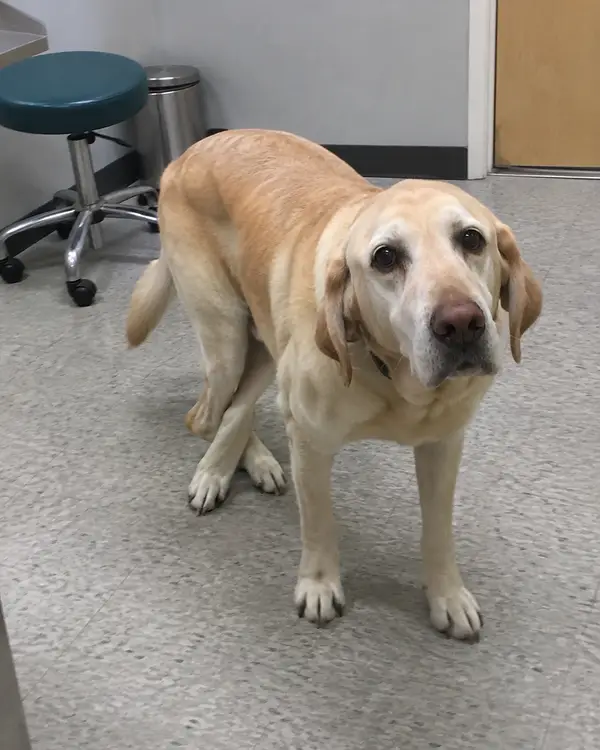
I Just Wanted To Give Him More Time
I've been a general practice vet for seventeen years. I've signed more gabapentin prescriptions for arthritic dogs than I can count. I'd write almost all of them differently if I could go back. I'm writing this because I can't keep doing it the same way. And by the time you finish reading, you'll understand why. There are three things you need to see clearly about how arthritis in dogs is treated. The first: painkillers and anti-inflammatories have been the go-to in general practice for twenty years. When you walk out of the clinic with a gabapentin prescription, you're not walking out with the latest in veterinary medicine. You're walking out with what we have on the shelf. The second: those medications have side effects we know about, that we explain to you and that we prescribe anyway. Gabapentin can weaken the back legs. Anti-inflammatories are hard on the liver and stomach. And they're still the most prescribed, because in a twelve-minute appointment it's what we can give you that same day. The third: the tissues that make a joint work, the cartilage that cushions it, the ligaments and the tendons, are made of collagen. Over the years a dog makes less and less of it, and that's the root of the wear. And not one of those pills gives back a single gram. I want to tell you about a dog named Bear. Because what happened to him is the reason I'm writing this tonight. Bear was a yellow Lab. I'd known him since his first puppy visit. Big head, broad chest. His owner was a widow in her sixties. Her husband had died two years before Bear came home, and at that first appointment, with her hand on his head while he tried to chew my stethoscope, she told me that puppy was the reason she got up every morning. I treated him for eight years. Checkups, vaccines, an ear infection at three, a broken nail at five. The usual. At nine he started lifting his right back leg when he walked. She brought him in worried. I examined him and ordered X-rays. They came out the way you'd expect in a nine-year-old Lab: hip dysplasia, which we'd been watching for years, and arthritis in both hips. Textbook. I told her what I tell everyone at that point. We'd start with the basics: glucosamine and chondroitin, omega-3s, weight control, short walks, a ramp for the car. And come back in three months. She did all of it. She was that kind of owner. Three months later she came back. He was worse, not better. And I prescribed gabapentin. Three hundred milligrams three times a day. I told her it would take away the pain in his hips, and that some dogs get drowsy at first but they adjust. I told her exactly what I'd been taught to say. Two weeks later she called the clinic: Bear was sleeping eighteen hours a day and she was worried. I told her over the phone that the drowsiness was normal, that he'd adjust, and that if he seemed more comfortable when he was awake, the medication was doing its job. At four weeks she brought him in. He walked into the exam room and his back legs crossed. Both of them, under his body, while his front legs tried to keep going. He looked up at me from the floor with his ears down, and I saw a Lab who'd been the smartest dog in any room he walked into trying to understand why his back legs wouldn't do what his head told them. That was the side effect we warn about. We lowered the dose. The wobbling improved a little and the pain came back. So we added Galliprant. It brought down the inflammation in his hips and upset his stomach. He stopped eating, then ate too fast and threw up. Six months after that first prescription, Bear had spent more of what was left of his life drowsy and wobbling than pain-free. His owner sat in my exam room with him lying at her feet and asked me if there was anything else. And all I had to offer was a higher dose, or a third pill on top of the two he was already taking. She put him to sleep on a Tuesday morning. I came in early to do it, because I didn't want her to wait in the lobby. She held his head in her lap, told him he'd been a very good boy, and then she looked at me and said something I haven't been able to get out of my head. "I just wanted to give him more time." That night I sat in my car for forty-five minutes, in the dark, in my driveway, before I could go inside. Because I'd done everything right inside a system that had given me the wrong tools. And the next thing on the shelf had stolen his last six months, drowsy, wobbling and with an upset stomach. That night I started asking myself a different question. Not what other pill I could give him, but what those hips were really missing that made everything I prescribed just a patch. The answer was in my first-year anatomy textbook. The cartilage that cushions the bones is made of collagen. The ligaments and tendons that hold the hip together are too. Over the years, a dog makes less and less collagen, the cushion thins, the bones grind and it hurts. The pills shut off the pain from that grinding. But nobody was giving back the material. So I started recommending collagen to my arthritis patients. And not just any collagen: chews get baked and the heat damages the collagen, and almost none of them have the type II collagen in cartilage. The one I recommend is Canbloom liquid collagen: Type I and III collagen, 900 mg per serving, for ligaments and tendons. UC-II, the type II collagen in cartilage. Hyaluronic acid, so the joint moves smoothly. MSM, for inflammation. Vitamin C, so their body can make its own collagen. One serving over their food, bacon-flavored. Nothing that hits the bloodstream like a drug, nothing that makes them drowsy. Let me tell you what I've seen since then. In almost every dog who comes in before the pain is severe and starts collagen alongside a low dose of gabapentin or an anti-inflammatory, their vet tapers the medication over two or three months, and in many it ends up stopped. Their bloodwork stays clean. The wobbling goes away, because the gabapentin goes away. Their stomach settles, because the anti-inflammatory is gone. They're more comfortable, not less. In the ones who come in late, already on high doses of several pills, the medication almost always gets reduced: half a dose, or one pill instead of two. And their owners tell me they're more alert and more like themselves. There's one case I want to tell you about, because it's the one that fully convinced me. A twelve-year-old Golden mix. Moderate to severe arthritis in both hips. She'd been on gabapentin and Galliprant for eighteen months. Drowsy, wobbling and with an upset stomach for almost a whole year. Her owner looked at me the same way Bear's owner had, asking me if there was anything else. This time I had something. She started the collagen the following week. At six weeks we cut the gabapentin in half. Within a week the wobbling was gone. She started eating her food again. She started greeting her owner at the door again, something she hadn't done in almost a year. At twelve weeks, the gabapentin was gone. Clean bloodwork. Low-dose Galliprant on bad days and nothing on good ones. Her owner sent me a video of her walking to the end of the driveway and back. Slowly, but steady. Without anyone carrying her and without stopping. Three months later she's still here. No gabapentin. It's not a cure for arthritis. Anyone who sells you a cure is lying to you. What it is, is the only thing I've seen that gives the joint the material it's missing, at home and without putting more drugs into a dog who's already struggling. I still prescribe when a dog needs it. I'm a vet. I'm not telling you not to give what's been prescribed. I'm telling you that, in most of the dogs I see, the prescription doesn't have to be the plan forever. It can be the bridge while the collagen starts doing its job. And then it can come down, and a lot of the time come off. If your dog struggles to get up in the mornings, lifts a back leg when walking, hesitates at the bottom of the stairs, doesn't get up on the bed anymore, sleeps more and plays less… Or if your vet has talked about starting gabapentin or Librela, or they're already on it and you're seeing the drowsiness, the wobbling, the upset stomach and a dog you don't quite recognize… This is the moment. Not six months from now, when the doses have gone up and the side effects have piled on. Now. Right now there's an early Black Friday sale: up to 70% off, and if you buy 3 bottles they give you 2 more free. That's what I tell my clients to get, because you notice collagen when you give it every day without a break. And the guarantee is honestly impressive: the brand is so sure of what it does that if you don't see your dog moving better in 60 days, you can simply ask for a refund. Give them the rest of their good years being themselves, not a dog held together by a prescription. You can thank me later. canbloomstore.com/products/hip-and-joints
Loading the ad's image