Advertiser

Sophie Clarke

primeprometics.comMeta Ad Library

2
Running ads
2 new in 30 days
Nov 2026
Advertising since
longest ad under a month
—
Reach
running ads, summed
0% video
Formats
0 video · 1 image
1
Products advertised
1 shop

Her outer lashes were gone. My fault.

Every Thursday at 10 a.m., a woman named Ruth lies down in my chair for a lash lift. She's 71. She's been coming for four years. And every single time, before she closes her eyes, she asks me the same thing. "Which mascara should I wear after this, Sophie?" For most of those four years, I gave her the wrong answer. I've been a lash technician for sixteen years. I have a small studio in a strip mall between a nail salon and a sandwich shop. About half my clients are over fifty, and a lot of them are over sixty-five. Lash lifts, tints, and a few extensions for women whose own lashes can still hold them. My job happens under a magnifying lamp. Ten times. When you lie down in my chair, I see your lashes the way nobody else does, not even you in your mirror. And I'd like to tell you what I see, because I think it would change what you buy. When a woman over sixty lies down, the first thing I usually see is clumps. Three or four lashes glued together into a single spike with old mascara, then another spike, then a gap. Under the lamp it looks like a broken fan. From across a room it looks like "a bit thin." Up close, the mascara is doing the opposite of what she bought it for. The second thing is flakes. Little black crumbs sitting along the lash line and on the skin under the eye. Those end up in the eye too. A lot of my older clients tell me their eyes feel gritty by the afternoon and they think it's age. Some of it is mascara. The third thing is the one I feel worst about. Broken lashes. Short stubs where a lash snapped off partway, and gaps at the outer corners, where women rub hardest when they take their makeup off. That's waterproof mascara. Here's my confession. For eleven years, I sold waterproof mascara at my front desk. It was a good brand, and it held up beautifully after a lift, and clients loved that it didn't smudge. I recommended it to Ruth. I recommended it to almost everyone. What I didn't think about was the end of the day. Waterproof doesn't come off with water. You need remover and rubbing. Young, thick lashes can take that. After fifty, lashes get finer and shorter, and finer lashes don't survive being scrubbed every night. It took a client named Marlene to make me see it. Marlene is 66. She went on a two-week cruise last spring and wore waterproof mascara every day, my waterproof, because of the pool and the humidity. When she came back and lay down in my chair, I turned on the lamp and went quiet. The outer third of her top lashes on both eyes were nearly gone. Broken stubs. A gap you could see without the lamp once I pointed to it. She asked me what had happened. I knew. Two weeks of waterproof, scrubbed off every night in a cruise ship bathroom. The next week I took the waterproof off my front desk. But I didn't have a better answer. I tried what was on the shelves. Most mascaras are designed for younger lashes. They get their look from a heavy load of pigment and a big brush. On finer, shorter lashes, the bristles are too far apart to grab them, so women add more coats, and more coats is how you get the broken fan and the flakes. What I wanted didn't seem to exist. Not waterproof, so it would come off with warm water and no rubbing. A slim brush with bristles close enough together to catch short, fine lashes, including the tiny ones at the inner corners. A formula that coated each lash once without piling up. Gentle enough for eyes that already run dry. For a while my answer to Ruth's question was, "Honestly, a little brown one, very lightly." That isn't really an answer. Ruth is the one who ended up answering it. One Thursday last fall, she lay down in my chair and handed me a tube before I'd turned the lamp on. "My granddaughter bought me this," she said. "She says it's made for old ladies. Tell me if it's any good." It was called PrimeLash, from a company called Prime Prometics that makes products only for women over fifty. I almost put it aside. I'd heard "made for mature skin" on a lot of labels. Then I looked at the wand under the lamp. Slim, slightly tapered, with the bristles packed close together. It was built to catch exactly the short, fine lashes that a regular brush skips. The label said water-based, not waterproof, but water-resistant, and hypoallergenic. So I did what I'd do with any new product in my studio. I tested it on a client who'd said yes. After Ruth's lift, I put her old drugstore mascara on her left eye, the way she normally would. On her right eye, I used PrimeLash. Two coats each. Then I turned the lamp back on. Left eye: four clumps, a few lashes the brush had missed entirely at the inner corner, and the first crumbs already sitting on the lash line. Right eye: every lash separated, coated once, each one on its own. The tiny inner-corner lashes were coated too. From a normal distance, the right eye looked like it had more lashes. It didn't. It was just using all of the ones she had. I handed Ruth the mirror. She looked from one eye to the other and said, "Well, take that one off," pointing at the left. The following Thursday, I asked her how it came off. Warm water and a cotton pad, she said. Two passes. No remover. I looked at her lash line under the lamp. No crumbs. No residue. Nothing in the corners of her eyes. I want to be clear about the one thing it doesn't do, because I'd rather you hear it from me. It's water-resistant, not waterproof. It held up for Ruth through a hot afternoon and a sad movie. If you want something for swimming, it isn't that. After what I saw on Marlene, I don't think you should be swimming in mascara anyway. Here's what I tell every client over fifty now, the way I'd tell my own mother. If you're wearing waterproof mascara every day and scrubbing it off every night, you can keep doing that, and one day you'll lie down in a chair like mine and someone will go quiet when they turn the lamp on. Or you can switch to something made for the lashes you have now, that washes off with warm water. It's a small change, and your lashes will show the difference. Ruth still comes every Thursday at 10. She doesn't ask which mascara anymore. Last month she brought her granddaughter in for her first lash tint and told her, from the chair, "Don't you ever wear the waterproof." It's called PrimeLash Mascara, and they'll refund you if you don't like it. This is the one Ruth brought in. The link is below. P.S. Do my test at home. Put on your mascara, then hold a magnifying mirror close in good light. If you see lashes stuck together in spikes, or crumbs on the lash line by mid-afternoon, it isn't made for the lashes you have now.

Loading the ad's image
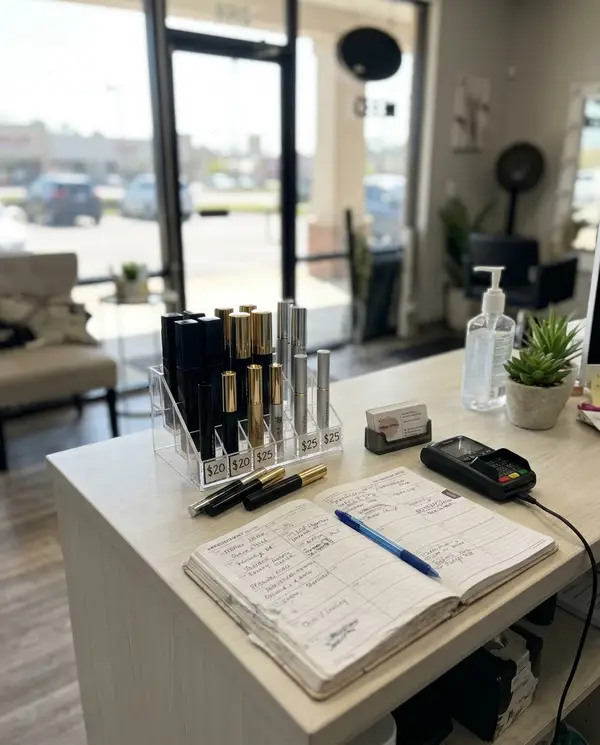
Sophie Clarke — Her outer lashes were gone. My fault.
TestingImage

"Sophie, you've got a line."

I've worked the paint counter at the same hardware store for twenty-two years. People bring me a chip of their grandmother's kitchen cabinet, or a corner of a wall cut out with a utility knife, and I match it. By eye first, then with the machine. I'm good at it. Contractors ask for me by name. I have never once matched my own face. I know that sounds dramatic, so here's the evidence. There's a shoebox under my bathroom sink with nine foundations in it. Nine. Some barely used. Every one of them was supposed to be my shade. It started at a wedding, like a lot of things do. My nephew got married two summers ago. I'd bought a new foundation for it, from the department store, matched by a very nice young woman at the counter. She tried three shades on my jaw under those bright white store lights, picked the middle one, and I paid $52. At the reception, my sister pulled me aside near the dessert table and said, quietly, "Sophie, you've got a line." I went to the ladies' room. Under the yellow lights, my face was a shade of orange that does not occur in nature. And it stopped at my jaw, like the edge of a wall where somebody didn't cut in properly. My neck was one color. My face was another. I spend all day telling customers their wall will look different under their kitchen lights than under our store lights. I fell for it at a makeup counter. So I did what I'd do at work. I started over and tried to do it properly. First, I went lighter. If orange was the problem, go paler. That one looked fine in the bathroom mirror at home. Then my granddaughter took a photo of me at her softball game, outside, in the afternoon, and I looked grey. Like a ghost who'd come to watch the game. Second, I tried mixing. Two bottles, a little of each in my palm, the way I'd tint a base. I'm good at mixing. But my skin wasn't the same color in January as in July, and it wasn't even the same at 7 a.m. as at 4 p.m. I'd get it right on Monday and it would be wrong by Thursday. Third, I tried one of those tinted creams that claim to suit everyone. It suited everyone by barely covering anything. My dark spots and the redness around my nose came right through. Fourth, I saw a color-changing foundation advertised on TV. Cheap. Goes on white, turns into your color. I thought that was clever. It went on white, and on me, it mostly stayed white. My husband asked if I'd been baking. And there was a fifth problem underneath all of them. Whatever shade they were, the heavier ones settled into the lines around my eyes and mouth by lunchtime. I'd look in the rearview mirror at a red light and see every crease drawn in, like the cracks in old paint. Every Saturday I'd stand in the bathroom, open the shoebox, and pick the one that seemed least wrong for that day's weather. The worst part was the feeling of being bad at something I'm supposed to be good at. Matching color is my job. I just couldn't do it to myself. What finally explained it was a customer. She came in on a Tuesday afternoon in March. Mid-seventies, white hair cut short, a navy raincoat. She had a paint chip from her front door and wanted the same red. I matched her door. And while the machine was running, I kept looking at her face. Her skin looked like skin. Even, a bit of a glow, no line at the jaw, nothing sitting in the lines around her eyes, and she had plenty of lines. Under our store lights, which are terrible, she looked like she'd been out for a walk. I don't usually do this. But I asked her what foundation she wore. She laughed. "Isn't it funny? I gave up on shades years ago." Then she said the thing I'd been missing for two years. She'd had the same problem I had, buying bottle after bottle, and her daughter-in-law had told her the trouble wasn't that she kept picking the wrong shade. It was that any single shade is fixed, and her skin wasn't. It changes with the light, the season, the time of day. You can't match a moving target with a color that never moves. I stood there holding her paint can, because that's the first thing I teach new hires. There's a word for it in my trade. Metamerism. Two colors that match perfectly under one light and don't match at all under another. It's why customers come back saying the paint is wrong when the paint is fine and the light changed. I've explained it maybe five thousand times. I'd never applied it to my face. A bottle of foundation is one fixed color. My face is under a different light every hour. What she used was a foundation that goes on white and changes as you blend it. I told her I'd tried one and it stayed white. She said hers was different, made for older skin, and that I should blend it longer than I thought. It was called Prime Prometics Color Changing Foundation. I ordered it that night, mostly to prove a customer wrong. It came on a Thursday. I put a little on my fingertips. It really is white, and I'll admit my heart sank. Then I started blending it on my cheek, and I watched it change color under my fingers, white to a soft beige to something that, by the time I stopped, I couldn't find the edge of. The company says it has tiny beads of pigment that break open as you blend and mix into your own tone. To me it looked like watching base and tint come together in the shaker, except on my face. It covered the redness by my nose and most of my dark spots with one layer. It felt light. It didn't feel like a coat. Then I did what I'd do with any color match. I checked it under every light I could find. Bathroom mirror. Fine. Kitchen window at 8 a.m. Fine. The store's fluorescent lights at noon, which have made a liar out of every foundation I've owned. Fine. The parking lot at 5 p.m. Fine. No line at my jaw in any of them. At 4 in the afternoon I checked the lines around my eyes in the car mirror. Nothing had settled into them. That had never happened before, with any of the nine. One thing I'll be honest about, because it's what I'd want to know. It's made for fair, medium and tan skin tones. If your skin is deeper than that, it isn't the right match for you, and I'd rather tell you here than have you find out in your bathroom. The customer with the red door came back three weeks later for a second gallon. I was at the counter. She looked at me for a second and said, "There you are." I knew what she meant. The shoebox is in the garage now. I'm going to use the bottles to touch up a cabinet somebody brought in, which is the most useful they've ever been. My granddaughter's softball season starts again in April. I'm going to every game, and she can take as many photos as she wants. If you've got a box of your own under the sink, I understand. It's called the Prime Prometics Color Changing Foundation. They'll give you a full refund if it doesn't match you. Here's the one I ordered. The link is below. P.S. Do the paint-counter test. Put it on in the morning, then check it under three different lights during the day: a window, your kitchen, and the car mirror late afternoon. A foundation that matches you should hold up in all three. Mine never did until this one.

Loading the ad's image
Sophie Clarke — "Sophie, you've got a line."
Testing

From the ads Sniped has collected from this page (2 so far, first seen Nov 2026). Reach is what Meta reports; no spend or sales estimates.