Advertiser

Recipes From The Bible

noverly.shopMeta Ad Library

10
Running ads
9 new in 30 days
Oct 2026
Advertising since
longest ad 1 month
—
Reach
running ads, summed
0% video
Formats
0 video · 1 image
1
Products advertised
1 shop

My grandkids can't eat at my house

"Because Grandma's has wheat in it, honey." My daughter-in-law said it gently, at my son's birthday lunch, steering my gluten-free granddaughter away from my pancakes and over to the fruit tray. Nine people heard it. Two weeks later, my son Mike sat at my kitchen table on a Saturday in October with his jacket still zipped, turning his coffee cup around and around. "Jess would rather the kids eat before they come over," he said. "Just for a while. It's not about you, Mom." "For a while," I said. By Christmas, Jess was standing at her own stove reading Psalm 128:3 off the lid of my baking dish, and both grandkids were back round about my table, eating out of one pan. I'm writing this for whoever just got told "for a while." I know that feeling in your stomach. I know how it ends now. Nobody told me. That's the part nobody warns you about, being a grandmother. Nobody takes the kids away. They just start sending them over full. My name is Barbara. I'm 67. I've made Saturday pancakes in this kitchen since 1983. First for Mike and his sister. For the last eleven years, for Mike's two, Ellie and Sam. It started with a dish. Every Saturday for eleven years I sent the kids home with my blue dish of Grandma's pancakes. The kids called them Grandma's pancakes because they came out of Grandma's dish, and I let them. I'd stack the extras in that dish, write PANCAKES on a strip of masking tape, and send it home in a grocery bag. I never told anyone it was Bisquick. Nobody ever asked. In September the dish came back empty, with a note taped to the lid. "Please don't refill this. Ellie can't have gluten anymore. Not even crumbs." She wasn't wrong. Before I say anything else: Jess is a good mother. She reads every label in the grocery store. I've watched her put a box of crackers back on the shelf over one word she didn't like. She's raising those kids on less sleep than I ever got by on. Here's the part I'm not proud of. I tried to fix it with a better box. I drove to the fancy grocery store and bought the gluten-free pancake mix. $6.99 a box. It had a red barn on the front. Jess turned it around and read the back. "Made in a facility that also processes wheat." I tried the rice flour kind. The almond flour kind. The one with a chef on the front. Every one crumbled. Four boxes in four weeks. Four for four. Then came Mike's birthday lunch. I brought a plate of pancakes for the kids, the way I always do. Jess steered Ellie over to the fruit tray. Ellie asked why she couldn't have Grandma's pancakes. "Because Grandma's has wheat in it, honey." She said it gently. Nine people heard it. Ellie looked at me like I'd been caught at something. I suppose I had. Two weeks later, Mike was sitting at my kitchen table with his jacket zipped. After he left, I sat down in Ellie's chair. The one with the booster cushion she's too old for and won't give up. No more Saturday pancakes. Not the Mickey Mouse ones. Not the chocolate chip smiley faces. Not the ones Sam eats with his fingers because he says forks slow him down. Eleven years of Saturdays, and I'd been told, very kindly, to stop. Then I got up, opened my pantry, and counted. Pancake mix. Biscuit mix. Two boxes of cornbread. Brownie mix. Six taco seasoning packets. Two packets of gravy. Eleven boxes and packets, and wheat in every one. The same eleven I've been buying since my kids were in grade school. I'm not a bad cook. I've fed this family through forty-four Thanksgivings. I can roast a turkey without a thermometer. And I couldn't put one thing on my table my own granddaughter could eat. If you're a grandmother, you know the dish I'm talking about. Maybe yours is the cookie tin. Maybe it's the Saturday pancakes. It's the thing that makes your house Grandma's house. And somebody just told you your grandbaby can't eat it. I didn't tell anybody about any of it. I just prayed about it. But the next Tuesday at church, Ruth asked me what was wrong before I'd even taken my coat off. Ruth is 71. She has run our Wednesday night supper for twenty-two years. Two hundred people in one night, and she's the one at the stove. If anybody in this town knows how to feed a table, it's Ruth. So I told her. The dish. The note. The four boxes. "Because Grandma's has wheat in it." The jacket zipped. Ruth didn't laugh. She thought about it for a second. "Barb. It's not the pancakes she minds." "Then what is it?" "It's that you can't name one thing on your table Ellie can eat." I opened my mouth, and I shut it again. Because I couldn't. "Nobody at that supper has eaten off a separate plate in years," Ruth said. I figured she was pulling my leg. She wasn't. Her grandson can't eat wheat either. She cooks the supper now out of a spiral book her sister sent her. What Would Jesus Eat? "You've been trying to fix the flour," she said. "Fix the table. Bread was on Jesus' table, Barb. Almost everything else on it never touched flour. 'And they gave him a piece of a broiled fish, and of an honeycomb.' Luke 24:42. You've been paying a box double to pretend it's wheat." I told her I was sixty-seven and not about to start cooking like it's Bible times. "Nobody's asking you to. It's chicken and potatoes. The book just marks which recipes never had wheat." "I could look it up on my phone." "And stand there every Saturday with grease on your phone, scrolling past a stranger's vacation pictures to see if the soy sauce has wheat? I did that for a month. Never again." Then she said the thing that stopped me. "Psalm 128:3, Barb. 'Thy children like olive plants round about thy table.' Round about it. Not fed at home first." It isn't only Saturdays. More than half the dinners in it never needed wheat, and they're marked. My whole table, basically. She had a second copy in her car, meant for her daughter's kitchen. "Take it," she said. "Just do Saturday first." I made the fig cakes that Thursday. It took me longer to find my good measuring cups than to make them. Figs, honey, almonds, and the rest of what the page said, pressed together in my big yellow bowl and packed into the same blue dish. Jess's note was still on the lid. I peeled it off and put it in the drawer by the phone. On a fresh strip of masking tape I wrote FIG CAKES, and under that, every single thing that was in it. And at the bottom, Psalm 128:3. I knew why every one of them was there. I called Mike that night. "Bring them hungry on Saturday. Show Jess the lid first." He took a picture of the lid and sent it to her. Thursday night went by. All of Friday went by. At 9:40 Friday night my phone buzzed. One word. "OK." Saturday the kids came at eight. I didn't say a word. One pan of eggs baked in tomatoes and olive oil, crispy potatoes, and the fig cakes. Sam ate four, with his fingers. Ellie had three and asked for the honey twice. Nobody asked where they came from. Every grandchild ate out of the one pan. By Thanksgiving I'd made the lamb stew and the roast chicken with garlic and lemon. The taco packets were gone from my pantry before Christmas. Mike noticed on taco night. He asked if I'd changed something, because it tasted better. I had. Spice packets are on the book's hidden-gluten list. When you mix it yourself, you know there's no wheat in it. Christmas morning was at Mike and Jess's this year. I brought the dish. Jess saw it on the counter and got a look on her face, and I could see her deciding whether to say something. Instead she picked it up and read the lid. She read it twice. "You made this?" "This morning." "What's in it?" "It's all on the lid." She stood at her stove holding my dish and didn't say anything for a while. Then she said, "Could you write it down for me? The kids keep asking why ours never taste like yours." I didn't have to write anything down. I went out to the car and got the second copy I'd brought for her. I'd ordered two in November. One stays in my kitchen. The other one was for Jess, so Ellie eats the same food at both our tables. She opened it at the kitchen island. Ellie climbed up on the stool next to her and started pointing at pages. In January, the dish came back. Full. Jess's handwriting on the tape. A cookbook didn't fix my family. Nothing was broken. Jess was right to read the labels. She was only wrong that Grandma's table had to have wheat on it. What the book gave me back was the one thing I'd been praying for since September. Every grandchild round about my table. So if you just got told "for a while," here's what I wish somebody had told me. It isn't about you. It's about the table. And you can fix the table. Paul's rule in Romans 15:1 is that the strong "ought to bear" and "not to please ourselves." So my table bends for the one who can't eat wheat. If your grandkids called it Grandma's recipe and now one of them can't eat it. If someone in your own family has said "Grandma's has wheat in it" in front of everybody. If you've been buying gluten-free boxes at double the price and nobody ever showed you a table without them. What Would Jesus Eat? is one spiral-bound book: 100 large-print recipes, a verse beside every one, and a 30-day plan with a gluten-free path through it, with a 90-day money-back guarantee. If nobody asks for seconds, send it back. Keep one for your kitchen. The second one is for whoever in your family reads the labels. Start with the Saturday you miss most. https://noverly.shop/products/what-would-jesus-eat-bible-food-guide

Loading the ad's image
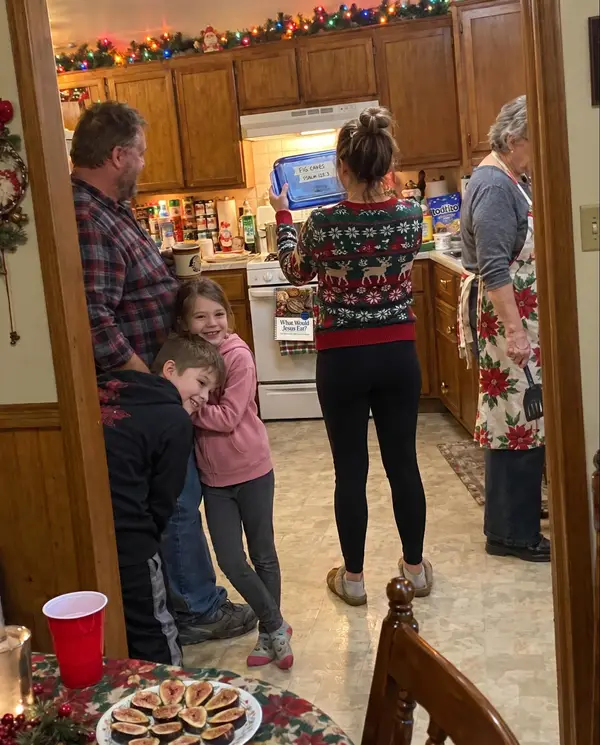
Recipes From The Bible — My grandkids can't eat at my house
PromisingImage

“She put my presents online.”

Last Christmas Eve, the same girl who once put my Christmas presents on the internet with three little laughing faces picked up a pint jar from under my tree and read the verse on its tag out loud to the whole room: "Every good gift and every perfect gift is from above." Before we sat down to eat, my niece had the picture in the family group chat, and fourteen phones went off all over my house again, on the night before Jesus's birthday. Nobody laughed. My son's name was the first one under it. Two years before, it had been the first one under the other one. I'm Lucille. I'm 65. For twenty-six years I ran the photo counter at the drugstore in Shawnee, Oklahoma. I printed half this town's Christmases, four by six, glossy or matte, and I can tell you what every family in Pottawatomie County puts under its tree. At mine, since 1984, Christmas Eve, the night before His birthday, has been two things. Lucille's chili, and a present under the tree for every soul who walks in the door. If you're the one with a present for everybody on the list, stay with me. This goes from one Christmas Eve to the next, and I'm going to tell you all of it. I started the presents the first Christmas Leon and I were married. He worked nights at the power plant then, and Christmas Eve was a shift like any other, so I needed a present that would wait for him under the tree. A present waits. I bought it the way my mother bought everything: off the shelf at the store, a box, a bow, a little tag. A gift card in an envelope for his brother. By the time our kids were grown it was fourteen people, and a stack under the tree so tall I top it off from a step stool Leon cut out of a cedar board. Three candles, six lotion sets, the boxes of chocolates lined up on the counter. Two gift cards, then four. People count on it. Leon's brother shakes his box every year and calls it "the only reason I come." Kevin, my oldest, had been divorced three years. Two Christmas Eves ago was the first time he brought anybody home. Her name is Brooke. She was thirty-four, she did the social media for a car dealership in Oklahoma City, and she'd sent me a friend request the week before. I accepted it. I wanted her to like us. I spent two days cleaning. I ironed the tablecloth with the poinsettias on it. I got the pot going at noon like always. Usually Leon carries the store bags and receipts out to the bin in the garage before anybody comes. That year the bin was full of wrapping paper, so I'd stacked them by the stove to deal with later. One receipt, as long as my arm. Two gift-card holders, torn open and flat, with the price still stuck on. Brooke came in the kitchen around four and asked if she could help. She was nice about it. She stirred once. Then she picked up the receipt and unrolled it. And she read it out loud. All of it. Every line. The prices slow, the way you'd sound out a word for a first grader, with a little look over her shoulder at the living room after each one. Lotion set. Candle. Box of chocolates. Gift card. Gift card. Gift card. Things nobody had asked for. Then she picked up a gift-card holder and did that one too. Kevin's boys came to the doorway to see what was funny. Leon's brother came up behind them with his beer. "Oh my gosh," Brooke said. "The famous Lucille Christmas is a receipt." Then she held up her phone, stood on her tiptoes to get the tree and the receipt in the same picture, and that was that. I've printed thousands of other people's Christmas pictures. I know what a picture is for. It's so the people who weren't there can see. By supper, everybody who wasn't in my kitchen could see. My face burned. Forty-one years of people calling it Lucille's Christmas, and I'd let them. On His birthday, of all nights. Nobody said a word about it at the table. They opened every one. Leon's brother thanked me twice. Nobody said "the only reason I come." I'd rather they had laughed. At eleven that night, after everybody left, I sat on the edge of the bed and made myself look at it. Sixty-some laughing faces. Comments from people I'd never met. Then one from a woman named Faye Colton, with no profile picture, just the little gray outline of a head. "Brooke Ann. Take this down." And under that, a photo. A pint jar with a red ribbon around the neck and a strip of masking tape across the lid, written in pencil: BROWNIES. 2 eggs, melted butter, a little honey. James 1:17. Ninety people had liked her comment. More than liked the post. I didn't know which one I hated more. Brooke took the post down Christmas morning. It didn't matter. My niece had already saved it, and I worked a photo counter for twenty-six years. Nobody knows better than I do that you can't take a picture back. In January I set out to fix it myself. First I went to the gift shop on Main whose window has won the downtown Christmas contest six years running, and I asked the owner, one counter to another, where she gets her presents. She laughed and took me in the back. Cartons of the same candles and lotion sets off the wholesale truck, with a price gun on top. Presents nobody needs, by the case. Then I found a gift-jar recipe on the computer and got down every baking jar I owned. Some of them I'd bought when Kevin was in high school. The recipe made one small jar and didn't say a thing about making more or keeping it. I guessed. Too much flour. The test pan came out dry as a cracker. The grandsons drank a gallon of milk between them and asked for store cookies. I was standing at my stove with eight jars open on the counter, starting from nothing every single time, and getting it wrong. By the end of January I knew what it had to be, because I'd failed every way there was. My own pantry, not a stranger's carton. Amounts somebody had already gotten right for a jar that bakes a whole pan, because my guessing wasn't going to. Made ahead, so Christmas Eve wasn't a mall and a full house. Something that said whose birthday it was. And nothing under my tree anybody could take a picture of and laugh at. I had no idea where to get any of it. The first Saturday in February the phone rang. A number I didn't know. "This is Faye Colton. I'm Brooke's grandmother." I almost hung up. "I owe you an apology," she said. "Brooke owes you one too, and she's going to make it. But mine first. I put my two cents under something that wasn't mine to put it under. That's my side of the family. We've all got the mouth. Now. Would you drive down here Saturday? There's something I should have shown you instead of a picture." Faye lives on a hundred and sixty acres outside Okemah, the last mailbox on a red-dirt road. She was 84. She met me on the porch in a barn coat and house slippers and walked me straight through the kitchen to what used to be the back porch, closed in years ago. Shelves on three walls, floor to ceiling. Pint jars and quart jars, a few old pickle jars, a ribbon on every neck and a strip of masking tape across every lid, in pencil, with a verse under the name. BROWNIE. SPICE CAKE. FIG CAKE. GRANOLA. NUTS. I stood in the doorway and I knew that room. At the photo counter, people used to bring in their mothers' old pictures to be copied. Christmas on the farm in 1957. Somebody's grandma at the stove in 1946. Fifty years of kitchens went through my hands, and in the old ones there's never a store box under the tree. There's jars. I must have printed that shelf a thousand times and never once asked what was in them. "My mother kept this," Faye said. "So did her mother, and both her sisters. The store was twelve miles of red dirt. You didn't drive that for a present. Jacob sent his gift in vessels. Mama sent hers in jars." She took eight canisters off the back of her counter and set them in a row. Flour. Sugar. Cocoa. Chopped dates. Figs. Almonds. Chocolate. Salt. "How many of these did you get down when you tried to fix it?" "All of them," I said. "Every time." "Every time," she said. "That's the part that wears you out, and it's the part you get wrong with a house full of people. Eight jars down, eight measures, eight jars back. So my mother did eight to one." She took a clean pint jar and measured all eight into it, one after another, packed it firm, then screwed on the lid and tied a ribbon around the neck. "Once, in the fall, she got the eight down and made them into one. Then she put the eight back. All December, a present was one jar and a ribbon. That box of chocolates you've been buying is the same thing. It's somebody else's eight to one, done in a factory a year before you ever picked it up." I sat down at her table. "You didn't buy those presents because you don't care, honey. You bought them because nobody ever showed you how to do the eight once." "So it's the same as a present from the store," I said. "Just in a jar." "It's the same idea," she said. "It isn't the same present." She had me dig one of my leftover gift cards out of my purse, where I'd brought it like evidence, and read her the back. I got about four words in. "None of those words are there for the person you give it to," she said. "They're there for the store." There was a little date printed along the bottom. It was good through the Christmas after next. That card could have sat in somebody's drawer through two of my Christmas Eves, and nobody at the table would have known. Then she asked what I paid for the chocolates. I didn't know. I ran a register for twenty-six years and I didn't know. I found the receipt in my purse. Fifty-five dollars for the big box of fancy chocolates. "Four of these for less than that one box," Faye said. "And not one of them ends up in a drawer." I sat there doing the arithmetic I'd never done. Fifty-five dollars of chocolates every Christmas Eve for forty-one years, and the gift cards besides. Plus every birthday and every hostess present in between. All because it said "the perfect gift" on the front. Her jars had everything on my January list but one. The amounts were in her head. "How do you keep it all straight?" I asked. She reached up to the top shelf and took down a spiral book. There was cocoa dust down in the wire. "My mother did it by the look of it," she said. "I'm 84. I don't trust the look of anything anymore. Brooke gave me this for my birthday two years ago. Said it looked like my porch." What Would Jesus Eat? A hundred recipes from the table Jesus ate at, a verse beside every one, and a whole section called Gifts From God's Pantry, where every page is the same three things: the jar, what to add when you bake it, and a tag printed right in the book with the oven time and a verse. Brownies, Jacob's spice cake, Abigail's raisin-and-fig cake, granola, spiced nuts. And the rest of the book is supper the whole year after: a 30-day plan, slow-cooked lamb stew, garlic and lemon roast chicken, bread warm from the oven. It opens on a page called Why the Bible's gifts were food. Faye read it to me. "Carry down the man a present, a little balm, and a little honey, spices, and myrrh, nuts, and almonds." Genesis 43:11. And God's people keeping a feast by "sending presents of food to one another." Esther 9:22. The brownie page was the jar she'd just made me. Flour, sugar and cocoa, chopped dates and figs dusted in the flour so they don't clump, almonds, good chocolate, a pinch of salt. One batch fills four pint jars, packed firm. To bake it, empty the jar in a bowl, add the eggs and melted butter on the tag and a little honey, spread it in an 8x8 pan, and bake it till the middle is just set. Fudgy, with the chocolate gone soft around the dates. One jar, one pan. For Christmas Eve, I'd fill fourteen. The Jacob's Gift page: a honey-almond spice cake, the almonds and spices in the jar and a little honey on the tag. Leon's brother was going to eat a whole pan by himself. I ordered it on my phone at her kitchen table. "Get Brooke one too," Faye said. "She bought me mine. It's about time she read it." When the box came, I did what I do with everything. I took a picture first. I emptied my gift closet onto the bed and stood on a chair to get it all in. Two lotion sets left over from last year. Four candles still in the cellophane. Gift cards bought ahead for birthdays. A box of chocolates for the mail carrier. A mug for the neighbor girl. Three more boxes of chocolates for the office. Envelope. Envelope. Box. Cellophane. That was my whole year of giving, laid out on one bed. Every person they were for had a jar in that book. Forty-one years of that wasn't because I didn't care. I'd been shopping for all fourteen every time, or paying somebody else to do the thinking. The first pan was the last Saturday in February, just Leon and me. He had two pieces and said it was the best thing I'd ever made. Leon would eat a brownie off a shingle, so his vote didn't count. So I kept going, and I kept taking pictures. Week one, the brownie jar. Week two, Jacob's spice cake in a pint jar, honey on the tag. Week three, Abigail's raisin-and-fig cake, and the grandsons ate it without asking for store cookies. In March I took two pans of brownies from the jars to the church pie supper. Both pans were gone before the pie was. The pastor's wife asked me which bakery. "No bakery," I said. I'd been waiting since Christmas to say it. In June Kevin called from the lake and asked if I'd make him a jar of the spiced nuts to take camping. Kevin has never once asked me for anything to take anywhere. By August there were eleven jars on the shelf Leon put up over the washer. I have a picture of that shelf every month, January through December, because that's how I'm made. Leon went through the receipts in his desk and figured the store presents had been running us thirty-some dollars a month. He started to multiply it by forty-one years out loud, and I told him not to. In October, Brooke texted me. "Grandma says you've got the brownie page down. Would you show me?" She came on a Saturday. She doesn't bake. She measured the cocoa like it might go off. We filled two jars and she wrote the tag herself, verse and all. She apologized standing at my sink. I won't put what she said here. It was hers to say, and she said it well. Last Christmas Eve it was fourteen at the table again. Kevin and Brooke, engaged since Thanksgiving. Faye in the good chair by the stove, because Brooke drove her up. Fourteen jars under my tree where the gift cards used to be, a ribbon and a verse on every one. Two jars of Jacob's spice cake. Not one receipt in the house. Around four, Brooke came in to help. She knelt by the tree, picked up one of the jars, turned it so she could read the tag, and read it out loud to the whole room, the way she had the first time. "BROWNIES. 2 eggs, melted butter, a little honey. Every good gift and every perfect gift is from above. James 1:17." Kevin's boys stood in the doorway, waiting for the joke. There wasn't one. Then she held up her phone and stood on her tiptoes to get the tree and the jars in the same picture. The first picture said "Lucille's famous 'thoughtful' Christmas," with "thoughtful" in quotation marks, and three laughing faces. That's what I'd been carrying around all year. The new one said, "Lucille's Christmas. Thoughtful." No quotation marks. My niece put it in the group chat before we sat down. My sister asked for the brownie page before the bowls were cleared. Leon's brother opened his jar, read the verse out loud, and said "the only reason I come," and this time he looked at me when he said it. Kevin's name was the first one under the picture again. Then he got up from the table, came in the kitchen, and kissed the top of my head. He hasn't done that since he was fifteen. Faye tasted a brownie and said it was a little heavy on the almonds. Brooke wrote that down. If you've ever stood at your own tree hoping nobody looks at the receipts. If somebody's phone has ever come out in your kitchen at the wrong moment. If Christmas Eve at your house is a present for everybody who walks in, and you're the one who buys them, and not one of them says whose birthday it is. What Would Jesus Eat? is a spiral-bound, large-print book of 100 recipes, with a whole section of gift jars from God's own pantry and a verse printed on every tag. It comes with a 90-day money-back guarantee. "It is more blessed to give than to receive." Fill the jars. Tie one on for whoever laughed. P.S. You can start tonight without me. Next time you bake brownies, get the eight jars down once and measure enough for three pans into one bowl. Bake a third. Put the rest in two jars and write on the lids: 2 eggs, melted butter, 8x8 pan, and a verse. Then see how giving the next one feels. The book is just the amounts, tested, and a verse for every tag. P.P.S. I printed both of Brooke's pictures, four by six, glossy. The first one is taped inside my spice cupboard door. The second one is in a frame on the piano. https://noverly.shop/products/what-would-jesus-eat-bible-food-guide

Loading the ad's image
Recipes From The Bible — “She put my presents online.”
Testing

“She read my ranch packet out loud.”

A ninety-two-year-old farm girl sat at the end of the counter on Thanksgiving morning and watched my son's mother-in-law lift the ranch packet that says The Original out of my grocery bag, read the back of it out loud to all eleven of us, and ask if I'd like her to "just handle the sides this year." My son opened the oven and checked on a turkey that didn't need checking. He didn't come out of that oven until she was done. The farm girl didn't say a word. A week later she had her Bible open to Proverbs 11:1 at her own kitchen table, and me across from her. Brian said one sentence at Christmas dinner, in that same dining room, in front of the same eleven people. That sentence, and one verse in Proverbs, is why I'm writing any of this down. If you're the one who brings the dish your family expects every year, get a cup of coffee and sit with me a while. My name is Linda. I'm 67. For twenty-six years I worked the night desk at a grocery warehouse in Cedar Rapids, Iowa, sending trailers of boxes and cans out to sixty stores a night. I know what's on a truck. My husband Harlan passed four years ago this February. For thirty-nine Thanksgivings I made the same dip. The packet that says The Original, doctored. I stirred two packets into a tub of sour cream, chopped in fresh dill and a little onion, and set it in the middle of the relish tray. Harlan called it the best part of the whole table, and he said it every year like he'd just thought of it. My grandkids call it Grandma's dill dip. Since Harlan died, Thanksgiving has been at Brian and Allison's, in their new house in Ankeny, two hours west. I don't mind. It's their turn. I bring the dip. Allison's family comes too. Her mother Diane ran an elementary school for twenty years and still talks like she's on the intercom. Diane's mother, Lou, is ninety-two. She grew up on a farm outside Boone and walks with a cane she mostly uses to point. Eleven at the table, counting my grandkids, Mallory, who is eight, and Cole, who is five. I got there at nine, the way I always do, with my grocery bag on one arm and my good glass bowl on the other. Two packets, a tub of sour cream, a bunch of dill, an onion. Diane was already in Allison's kitchen in an apron, with a covered roaster on the counter. She said good morning. Then she reached into my bag like it was hers, took out the first packet, and held it up by one corner, out where the living room could see. "Oh, Linda," she said. "Have you ever actually read this?" And she read it. Out loud, in her intercom voice, while Brian's father-in-law muted the parade. Maltodextrin, first. A word nobody in that house could have pronounced. Monosodium glutamate. Artificial flavor. And not one drop of buttermilk. "Buttermilk," Diane said, to the room. "In ranch. There isn't any." Then she put the packet down on the counter and smiled at me. "Allison and I are doing everything from scratch this year. Would you like me to just handle the sides?" Allison was looking at the floor. So she'd known. I said that would be fine. I put the dill back in my bag. I set the bag by the front door with my coat, and I sat down in the living room with a cup of coffee I didn't want, and I watched a balloon go down Sixth Avenue for what felt like an hour. I felt like a girl sent out to the hall. Diane's dip came out of a quart mason jar with masking tape on the lid. "DRESSING. Buttermilk, dill, garlic." The pencil was shaky. I took it for the jar's age. Five minutes in a bowl and it was done. It smelled like fresh dill and garlic. The whole kitchen did. Brian went back for thirds. He hasn't gone back for thirds of anything of mine since high school. Cole asked where Grandma's dill dip was. Nobody answered him. I left after pie. I forgot the packet on Allison's counter, and I didn't go back for it. Brian texted me when I was halfway home. "Drive safe, Mom." That was all. The Monday after, Allison sent me a text. "For Christmas could you just bring rolls? Mom has the sides covered." Rolls. I read that text maybe forty times. So I decided I'd show them. I'd make the dip the real way, from nothing, and bring it at Christmas whether anybody asked or not. Tuesday night I bought a carton of buttermilk and shook in dried dill from the back of the spice rack. The jar said best by 2014. It came out thin as milk and tasted like the jar, and I poured it down the sink. Wednesday I looked it up on my phone. Nine copycat recipes. One wanted mayonnaise, one wanted sour cream, one wanted a packet of dry mix, and not one said how long it would keep. Thursday I got down the cookbook from my old church, the one the Altar Society put out in 1988. Four dressing recipes from four women I'd known all my life. Three of them started with "1 packet ranch dip mix." The fourth said "enough buttermilk," and Mrs. Lindqvist, who wrote it, died in 1996, so there was nobody left to ask how much enough was. Three nights. I was going to bring rolls. Friday night my phone rang. It was a number I didn't know. "Linda, this is Louise. Diane's mother. Lou." I didn't say anything. I didn't know what to say. "You left your packet on Allison's counter," she said. "I took it home with me. I've got it in my bag." "You can throw it out," I said. "I'm not throwing it out. Allison told Diane you're bringing rolls for Christmas, and Diane told me like it was good news. I raised her better than that. Come get your packet tomorrow. I'll make coffee. I owe you something I should have said at that table." So on Saturday I drove two hours to a little white house in Ankeny with a ramp on the front. Lou let me in, poured two coffees, and then she took me down the hall with her cane and opened the hall closet. It wasn't coats. It was shelves, floor to ceiling, and every shelf was quart jars. Every lid had masking tape on it, in that same shaky pencil. DILL. GARLIC. ONION. SAGE. HONEY. And on the bottom shelf, four jars together, with a second word on the tape. DILL, DIANE. "I fill hers every November," Lou said. "Thirty years. Diane has never dried an herb in her life. She tells people the dressing is her mother's recipe. Which is true." I didn't laugh. I wanted to. "Sit down," Lou said. "I'll tell you how my mother did it." Lou grew up on a farm outside Boone in the forties. Nine kids. Her mother kept a crock of buttermilk on the cellar step, what the churn left behind after the butter came. Dill and garlic from the garden hung in bundles in the attic. "Mother never bought dressing," Lou said. "She made it every week, a little at a time. 'Surely the churning of milk bringeth forth butter,' she used to say. Proverbs. "The dill and the garlic can wait all year. The buttermilk can't wait more than a week. Mother got the dry part done whenever she had a minute. On the day, all that was left was the buttermilk, and that takes five minutes." I sat there with my coffee getting cold. For thirty-nine years I'd thought a woman who made real dressing was a better cook than me. Lou's mother wasn't a better cook. She had a crock. "So my packet is the same thing as your jar," I said. "Your packet is somebody else's crock," Lou said. "And they kept the name." She took my packet out of her bag and set it on the table between us. "Diane read you the words," she said. "She didn't tell you why they're there. None of that is for the dip. It's there so a packet they packed last spring can go out on somebody's trailer and wait out the year on a shelf, and still sell to you next Thanksgiving." "I know," I said. "I was the somebody." Twenty-six years on the night desk, I sent trailers of that packet out of our building to sixty stores. Pallets of it sat in Bay 9 for months, waiting on an order. It never went bad, and I never once wondered why. "Then you know the rest," Lou said. "That dressing was a plumber's in the fifties, fresh buttermilk, stirred up for his guests. In October 1972 the company that makes Clorox bleach bought it and built it for a shelf. The food left. The name stayed." She turned the packet so I could read the front. The Original. "Diane read you the back. She didn't read you this." Lou opened the Bible she keeps on that table to a page worn soft. "'A false balance is abomination to the LORD: but a just weight is his delight.' Proverbs 11:1. A label is a weight, Linda. It tells you what you're getting." I ran it the way I used to run tonnage on a load. Two packets a November for thirty-nine years is seventy-eight packets, and every one of them said Original on the front over a starch filler on the back. Seventy-eight times I set that name in the middle of my family's table. "Mother had four rules for anything she put on the table," Lou said. "Your own buttermilk, not somebody else's. Write it down where you'll see it in November. Make it fresh, and eat it inside a week. And make it so the day itself takes five minutes, because on the day you've got a bird." She tapped the packet with her cane. "Yours keeps, and it's quick. It was never once your buttermilk." Then she got up, went down the hall to the closet and came back with a spiral book with dill in the wire. "I broke the second rule myself," she said. "I had Mother's in my head until I was ninety. Then this fall I put sage in the dressing and nobody had the heart to tell me. Allison ordered me this." What Would Jesus Eat? It's a spiral-bound book of a hundred recipes and a 30-day meal plan. Every page is the same: the recipe, step by step, and a verse from Scripture beside it. She opened it to a section called the Real Pantry, to the dressing page. It was her mother's crock, written down. Fresh buttermilk or plain yogurt, fresh dill, garlic, a little onion, pepper, all in one bowl. To make it, whisk it, jar it, and keep it in the refrigerator. It's good for about a week. Proverbs 11:1 printed right beside it. "That's Diane's jar," I said. "That's Diane's jar." She turned the pages for me. A garlic-dill yogurt sauce for slow-cooked lamb. Za'atar, from hyssop, stirred into olive oil for dipping. Honey butter. Roast chicken with garlic and lemon. Warm bread, from scratch. Bread. I almost laughed out loud. There was even a short passage called Reading the Label Like Proverbs 11:1, and Lou said that was the one Diane should have read out loud. "There's no packet page," Lou said, before I could ask. "There doesn't need to be. Dressing comes out of a bowl. It always did." "Take it home," Lou said. "Bring it back when yours comes." On the drive home I did what I'd done every night for twenty-six years. I ran my own manifest. Thanksgiving: two packets that say The Original, a tub of sour cream to hide them in, the bottle of the same for the salad. The rest of the year: the bottle in the refrigerator door for the grandkids' carrots, the packet for Harlan's wings, the seasoning packet in the pot roast. A whole year of loads, and every one of them was somebody else's crock. The truth is I could always cook. What I couldn't do was keep a crock of buttermilk going after a ten-hour shift. A packet was the only dip a night shift had room for. And it said The Original, and I trusted the word. I ordered my own book that night at my kitchen table, and a copy for Brian. "Your boy," Lou had said at the door. "He's the one who'll want your dip when you're gone." Sunday I did my dressing at my own counter, with Lou's book propped against the toaster. A quart of it, and a jar of the garlic-dill yogurt sauce. Masking tape on every lid, my own handwriting, which is a dispatcher's and not pretty. Monday night I had the dressing for myself, on roast chicken with garlic and lemon. My kitchen smelled the way it used to on Thanksgiving morning when Harlan came in from shoveling, and I had to set the fork down for a minute. Liking it in my own kitchen didn't count for much. I'd liked my own dip for thirty-nine years. What counted was that table in Ankeny. Tuesday I spooned the yogurt sauce over a lamb stew, for no reason at all. Friday I took a bowl of the dressing and a plate of carrot sticks to my neighbor Gloria, who is eighty and honest. She asked me for the jar. I gave her the jar. The next Sunday I took a loaf of the bread and a crock of honey butter to the church potluck. The plate came home empty. Pastor Dan asked if I'd bought the bread at the bakery. The Monday before Christmas I held my December grocery receipt next to last December's, the way I used to check a manifest against a load. No packets. No bottle for the door. A quart of buttermilk, a tub of plain yogurt, two bunches of fresh dill, a bulb of garlic, and a jar of dried dill that wasn't from 2014. That same day Allison texted me. "Grandma Lou says you're bringing the dip too?" I wrote back, "If that's all right." "Please," she wrote. "Grandma says she's done filling Mom's jars. And the rolls." Christmas was at Brian and Allison's. Same dining room. Same eleven people. I brought two jars of the dressing and a loaf of bread, packed in dish towels in a cooler. Fresh dill. My good glass bowl. And one present wrapped in brown paper. Diane was in the kitchen in her apron with a vegetable tray. She watched me whisk. She watched me pour in the jar. She read the tape on the lid. For once she didn't have anything to read out loud. The bread came out of Allison's oven at twenty after four. Cole asked for Grandma's dill dip and got it. Brian went back for seconds. Then thirds. I didn't say anything. Diane took a little. Then she took a little more, and put her fork down. "Whose recipe is that, Linda?" I looked down the table at Lou. Lou was studying her plate like it had the crossword on it. "Mine," I said. Then Brian, from the head of the table, with his mouth full, to the whole room: "Mom's doing the dressing from now on." I'd waited a month for that sentence. Nobody made a joke of it this time. Allison nodded. Diane passed me the bread. And Lou lifted her coffee cup down the table at me and said the line the ruler of the feast said at Cana: "Thou hast kept the good wine until now." John 2:10. After dinner Brian unwrapped the brown paper. It was his copy. Across the cover I'd put a strip of masking tape, in my ugly dispatcher's hand: "BRIAN. Buttermilk first. Fresh dill. Keeps a week." He read it twice and set it beside his plate, where his phone usually goes. On the way out, Lou caught my sleeve with the end of her cane. "Your tape's crooked," she said. If you've brought the same packet to the same table for so many years that you forgot it was ever a packet. If someone at a holiday table has ever made your cooking the entertainment. If you're the one your grandchildren still expect to bring something, and you'd like it to be yours. What Would Jesus Eat? is a spiral-bound book of a hundred recipes, with the real dressing in its Real Pantry and a verse beside every one. It comes with a 90-day money-back guarantee. Keep one. Wrap the other for whoever's table you eat at now. P.S. Here's Lou's mother's idea for free. Stir a cup of fresh buttermilk with a spoon of plain yogurt, a handful of chopped fresh dill, a little garlic and a little onion. Put it in a quart jar in the refrigerator and tape the lid: keeps a week. Next Thanksgiving will be five minutes. P.P.S. My packet is still in Lou's hall closet, on the bottom shelf, next to Diane's jars. Lou says it stays there until Diane makes her own. https://noverly.shop/products/what-would-jesus-eat-bible-food-guide

Loading the ad's image
Recipes From The Bible — “She read my ranch packet out loud.”
Testing

“She read my ranch packet out loud.”

On Thanksgiving morning my son's mother-in-law lifted the ranch packet that says The Original out of my grocery bag, read the back of it out loud to all eleven of us, and asked if I'd like her to "just handle the sides this year." My son opened the oven and checked on a turkey that didn't need checking. He didn't come out of that oven until she was done. Brian said one sentence at Christmas dinner, in that same dining room, in front of the same eleven people. That sentence, and one verse in Proverbs, is why I'm writing any of this down. If you're the one who brings the dish your family expects every year, get a cup of coffee and sit with me a while. My name is Linda. I'm 67. For twenty-six years I worked the night desk at a grocery warehouse in Cedar Rapids, Iowa, sending trailers of boxes and cans out to sixty stores a night. I know what's on a truck. My husband Harlan passed four years ago this February. For thirty-nine Thanksgivings I made the same dip. The packet that says The Original, doctored. I stirred two packets into a tub of sour cream, chopped in fresh dill and a little onion, and set it in the middle of the relish tray. Harlan called it the best part of the whole table, and he said it every year like he'd just thought of it. My grandkids call it Grandma's dill dip. Since Harlan died, Thanksgiving has been at Brian and Allison's, in their new house in Ankeny, two hours west. I don't mind. It's their turn. I bring the dip. Allison's family comes too. Her mother Diane ran an elementary school for twenty years and still talks like she's on the intercom. Diane's mother, Lou, is ninety-two. She grew up on a farm outside Boone and walks with a cane she mostly uses to point. Eleven at the table, counting my grandkids, Mallory, who is eight, and Cole, who is five. I got there at nine, the way I always do, with my grocery bag on one arm and my good glass bowl on the other. Two packets, a tub of sour cream, a bunch of dill, an onion. Diane was already in Allison's kitchen in an apron, with a covered roaster on the counter. She said good morning. Then she reached into my bag like it was hers, took out the first packet, and held it up by one corner, out where the living room could see. "Oh, Linda," she said. "Have you ever actually read this?" And she read it. Out loud, in her intercom voice, while Brian's father-in-law muted the parade. Maltodextrin, first. A word nobody in that house could have pronounced. Monosodium glutamate. Artificial flavor. And not one drop of buttermilk. "Buttermilk," Diane said, to the room. "In ranch. There isn't any." Then she put the packet down on the counter and smiled at me. "Allison and I are doing everything from scratch this year. Would you like me to just handle the sides?" Allison was looking at the floor. So she'd known. I said that would be fine. I put the dill back in my bag. I set the bag by the front door with my coat, and I sat down in the living room with a cup of coffee I didn't want, and I watched a balloon go down Sixth Avenue for what felt like an hour. I felt like a girl sent out to the hall. Diane's dip came out of a quart mason jar with masking tape on the lid. "DRESSING. Buttermilk, dill, garlic." The pencil was shaky. I took it for the jar's age. Five minutes in a bowl and it was done. It smelled like fresh dill and garlic. The whole kitchen did. Brian went back for thirds. He hasn't gone back for thirds of anything of mine since high school. Cole asked where Grandma's dill dip was. Nobody answered him. I left after pie. I forgot the packet on Allison's counter, and I didn't go back for it. Brian texted me when I was halfway home. "Drive safe, Mom." That was all. The Monday after, Allison sent me a text. "For Christmas could you just bring rolls? Mom has the sides covered." Rolls. I read that text maybe forty times. So I decided I'd show them. I'd make the dip the real way, from nothing, and bring it at Christmas whether anybody asked or not. Tuesday night I bought a carton of buttermilk and shook in dried dill from the back of the spice rack. The jar said best by 2014. It came out thin as milk and tasted like the jar, and I poured it down the sink. Wednesday I looked it up on my phone. Nine copycat recipes. One wanted mayonnaise, one wanted sour cream, one wanted a packet of dry mix, and not one said how long it would keep. Thursday I got down the cookbook from my old church, the one the Altar Society put out in 1988. Four dressing recipes from four women I'd known all my life. Three of them started with "1 packet ranch dip mix." The fourth said "enough buttermilk," and Mrs. Lindqvist, who wrote it, died in 1996, so there was nobody left to ask how much enough was. Three nights. I was going to bring rolls. Friday night my phone rang. It was a number I didn't know. "Linda, this is Louise. Diane's mother. Lou." I didn't say anything. I didn't know what to say. "You left your packet on Allison's counter," she said. "I took it home with me. I've got it in my bag." "You can throw it out," I said. "I'm not throwing it out. Allison told Diane you're bringing rolls for Christmas, and Diane told me like it was good news. I raised her better than that. Come get your packet tomorrow. I'll make coffee. I owe you something I should have said at that table." So on Saturday I drove two hours to a little white house in Ankeny with a ramp on the front. Lou let me in, poured two coffees, and then she took me down the hall with her cane and opened the hall closet. It wasn't coats. It was shelves, floor to ceiling, and every shelf was quart jars. Every lid had masking tape on it, in that same shaky pencil. DILL. GARLIC. ONION. SAGE. HONEY. And on the bottom shelf, four jars together, with a second word on the tape. DILL, DIANE. "I fill hers every November," Lou said. "Thirty years. Diane has never dried an herb in her life. She tells people the dressing is her mother's recipe. Which is true." I didn't laugh. I wanted to. "Sit down," Lou said. "I'll tell you how my mother did it." Lou grew up on a farm outside Boone in the forties. Nine kids. Her mother kept a crock of buttermilk on the cellar step, what the churn left behind after the butter came. Dill and garlic from the garden hung in bundles in the attic. "Mother never bought dressing," Lou said. "She made it every week, a little at a time. 'Surely the churning of milk bringeth forth butter,' she used to say. Proverbs. "The dill and the garlic can wait all year. The buttermilk can't wait more than a week. Mother got the dry part done whenever she had a minute. On the day, all that was left was the buttermilk, and that takes five minutes." I sat there with my coffee getting cold. For thirty-nine years I'd thought a woman who made real dressing was a better cook than me. Lou's mother wasn't a better cook. She had a crock. "So my packet is the same thing as your jar," I said. "Your packet is somebody else's crock," Lou said. "And they kept the name." She took my packet out of her bag and set it on the table between us. "Diane read you the words," she said. "She didn't tell you why they're there. None of that is for the dip. It's there so a packet they packed last spring can go out on somebody's trailer and wait out the year on a shelf, and still sell to you next Thanksgiving." "I know," I said. "I was the somebody." Twenty-six years on the night desk, I sent trailers of that packet out of our building to sixty stores. Pallets of it sat in Bay 9 for months, waiting on an order. It never went bad, and I never once wondered why. "Then you know the rest," Lou said. "That dressing was a plumber's in the fifties, fresh buttermilk, stirred up for his guests. In October 1972 the company that makes Clorox bleach bought it and built it for a shelf. The food left. The name stayed." She turned the packet so I could read the front. The Original. "Diane read you the back. She didn't read you this." Lou opened the Bible she keeps on that table to a page worn soft. "'A false balance is abomination to the LORD: but a just weight is his delight.' Proverbs 11:1. A label is a weight, Linda. It tells you what you're getting." I ran it the way I used to run tonnage on a load. Two packets a November for thirty-nine years is seventy-eight packets, and every one of them said Original on the front over a starch filler on the back. Seventy-eight times I set that name in the middle of my family's table. "Mother had four rules for anything she put on the table," Lou said. "Your own buttermilk, not somebody else's. Write it down where you'll see it in November. Make it fresh, and eat it inside a week. And make it so the day itself takes five minutes, because on the day you've got a bird." She tapped the packet with her cane. "Yours keeps, and it's quick. It was never once your buttermilk." Then she got up, went down the hall to the closet and came back with a spiral book with dill in the wire. "I broke the second rule myself," she said. "I had Mother's in my head until I was ninety. Then this fall I put sage in the dressing and nobody had the heart to tell me. Allison ordered me this." What Would Jesus Eat? It's a spiral-bound book of a hundred recipes and a 30-day meal plan. Every page is the same: the recipe, step by step, and a verse from Scripture beside it. She opened it to a section called the Real Pantry, to the dressing page. It was her mother's crock, written down. Fresh buttermilk or plain yogurt, fresh dill, garlic, a little onion, pepper, all in one bowl. To make it, whisk it, jar it, and keep it in the refrigerator. It's good for about a week. Proverbs 11:1 printed right beside it. "That's Diane's jar," I said. "That's Diane's jar." She turned the pages for me. A garlic-dill yogurt sauce for slow-cooked lamb. Za'atar, from hyssop, stirred into olive oil for dipping. Honey butter. Roast chicken with garlic and lemon. Warm bread, from scratch. Bread. I almost laughed out loud. There was even a short passage called Reading the Label Like Proverbs 11:1, and Lou said that was the one Diane should have read out loud. "There's no packet page," Lou said, before I could ask. "There doesn't need to be. Dressing comes out of a bowl. It always did." "Take it home," Lou said. "Bring it back when yours comes." On the drive home I did what I'd done every night for twenty-six years. I ran my own manifest. Thanksgiving: two packets that say The Original, a tub of sour cream to hide them in, the bottle of the same for the salad. The rest of the year: the bottle in the refrigerator door for the grandkids' carrots, the packet for Harlan's wings, the seasoning packet in the pot roast. A whole year of loads, and every one of them was somebody else's crock. The truth is I could always cook. What I couldn't do was keep a crock of buttermilk going after a ten-hour shift. A packet was the only dip a night shift had room for. And it said The Original, and I trusted the word. I ordered my own book that night at my kitchen table, and a copy for Brian. "Your boy," Lou had said at the door. "He's the one who'll want your dip when you're gone." Sunday I did my dressing at my own counter, with Lou's book propped against the toaster. A quart of it, and a jar of the garlic-dill yogurt sauce. Masking tape on every lid, my own handwriting, which is a dispatcher's and not pretty. Monday night I had the dressing for myself, on roast chicken with garlic and lemon. My kitchen smelled the way it used to on Thanksgiving morning when Harlan came in from shoveling, and I had to set the fork down for a minute. Liking it in my own kitchen didn't count for much. I'd liked my own dip for thirty-nine years. What counted was that table in Ankeny. Tuesday I spooned the yogurt sauce over a lamb stew, for no reason at all. Friday I took a bowl of the dressing and a plate of carrot sticks to my neighbor Gloria, who is eighty and honest. She asked me for the jar. I gave her the jar. The next Sunday I took a loaf of the bread and a crock of honey butter to the church potluck. The plate came home empty. Pastor Dan asked if I'd bought the bread at the bakery. The Monday before Christmas I held my December grocery receipt next to last December's, the way I used to check a manifest against a load. No packets. No bottle for the door. A quart of buttermilk, a tub of plain yogurt, two bunches of fresh dill, a bulb of garlic, and a jar of dried dill that wasn't from 2014. That same day Allison texted me. "Grandma Lou says you're bringing the dip too?" I wrote back, "If that's all right." "Please," she wrote. "Grandma says she's done filling Mom's jars. And the rolls." Christmas was at Brian and Allison's. Same dining room. Same eleven people. I brought two jars of the dressing and a loaf of bread, packed in dish towels in a cooler. Fresh dill. My good glass bowl. And one present wrapped in brown paper. Diane was in the kitchen in her apron with a vegetable tray. She watched me whisk. She watched me pour in the jar. She read the tape on the lid. For once she didn't have anything to read out loud. The bread came out of Allison's oven at twenty after four. Cole asked for Grandma's dill dip and got it. Brian went back for seconds. Then thirds. I didn't say anything. Diane took a little. Then she took a little more, and put her fork down. "Whose recipe is that, Linda?" I looked down the table at Lou. Lou was studying her plate like it had the crossword on it. "Mine," I said. Then Brian, from the head of the table, with his mouth full, to the whole room: "Mom's doing the dressing from now on." I'd waited a month for that sentence. Nobody made a joke of it this time. Allison nodded. Diane passed me the bread. And Lou lifted her coffee cup down the table at me and said the line the ruler of the feast said at Cana: "Thou hast kept the good wine until now." John 2:10. After dinner Brian unwrapped the brown paper. It was his copy. Across the cover I'd put a strip of masking tape, in my ugly dispatcher's hand: "BRIAN. Buttermilk first. Fresh dill. Keeps a week." He read it twice and set it beside his plate, where his phone usually goes. On the way out, Lou caught my sleeve with the end of her cane. "Your tape's crooked," she said. If you've brought the same packet to the same table for so many years that you forgot it was ever a packet. If someone at a holiday table has ever made your cooking the entertainment. If you're the one your grandchildren still expect to bring something, and you'd like it to be yours. What Would Jesus Eat? is a spiral-bound book of a hundred recipes, with the real dressing in its Real Pantry and a verse beside every one. It comes with a 90-day money-back guarantee. Keep one. Wrap the other for whoever's table you eat at now. P.S. Here's Lou's mother's idea for free. Stir a cup of fresh buttermilk with a spoon of plain yogurt, a handful of chopped fresh dill, a little garlic and a little onion. Put it in a quart jar in the refrigerator and tape the lid: keeps a week. Next Thanksgiving will be five minutes. P.P.S. My packet is still in Lou's hall closet, on the bottom shelf, next to Diane's jars. Lou says it stays there until Diane makes her own. https://noverly.shop/products/what-would-jesus-eat-bible-food-guide

Loading the ad's image
Recipes From The Bible — “She read my ranch packet out loud.”
Testing

“She read my ranch packet out loud.”

For twenty-six years I sent trailers of the ranch packet that says The Original out to sixty stores a night, and I never once turned one over. On Thanksgiving morning my son's mother-in-law lifted one out of my grocery bag, read the back of it out loud to all eleven of us, and asked if I'd like her to "just handle the sides this year." My son opened the oven and checked on a turkey that didn't need checking. He didn't come out of that oven until she was done. Brian said one sentence at Christmas dinner, in that same dining room, in front of the same eleven people. That sentence, and one verse in Proverbs, is why I'm writing any of this down. If you're the one who brings the dish your family expects every year, get a cup of coffee and sit with me a while. My name is Linda. I'm 67. For twenty-six years I worked the night desk at a grocery warehouse in Cedar Rapids, Iowa, sending trailers of boxes and cans out to sixty stores a night. I know what's on a truck. My husband Harlan passed four years ago this February. For thirty-nine Thanksgivings I made the same dip. The packet that says The Original, doctored. I stirred two packets into a tub of sour cream, chopped in fresh dill and a little onion, and set it in the middle of the relish tray. Harlan called it the best part of the whole table, and he said it every year like he'd just thought of it. My grandkids call it Grandma's dill dip. Since Harlan died, Thanksgiving has been at Brian and Allison's, in their new house in Ankeny, two hours west. I don't mind. It's their turn. I bring the dip. Allison's family comes too. Her mother Diane ran an elementary school for twenty years and still talks like she's on the intercom. Diane's mother, Lou, is ninety-two. She grew up on a farm outside Boone and walks with a cane she mostly uses to point. Eleven at the table, counting my grandkids, Mallory, who is eight, and Cole, who is five. I got there at nine, the way I always do, with my grocery bag on one arm and my good glass bowl on the other. Two packets, a tub of sour cream, a bunch of dill, an onion. Diane was already in Allison's kitchen in an apron, with a covered roaster on the counter. She said good morning. Then she reached into my bag like it was hers, took out the first packet, and held it up by one corner, out where the living room could see. "Oh, Linda," she said. "Have you ever actually read this?" And she read it. Out loud, in her intercom voice, while Brian's father-in-law muted the parade. Maltodextrin, first. A word nobody in that house could have pronounced. Monosodium glutamate. Artificial flavor. And not one drop of buttermilk. "Buttermilk," Diane said, to the room. "In ranch. There isn't any." Then she put the packet down on the counter and smiled at me. "Allison and I are doing everything from scratch this year. Would you like me to just handle the sides?" Allison was looking at the floor. So she'd known. I said that would be fine. I put the dill back in my bag. I set the bag by the front door with my coat, and I sat down in the living room with a cup of coffee I didn't want, and I watched a balloon go down Sixth Avenue for what felt like an hour. I felt like a girl sent out to the hall. Diane's dip came out of a quart mason jar with masking tape on the lid. "DRESSING. Buttermilk, dill, garlic." The pencil was shaky. I took it for the jar's age. Five minutes in a bowl and it was done. It smelled like fresh dill and garlic. The whole kitchen did. Brian went back for thirds. He hasn't gone back for thirds of anything of mine since high school. Cole asked where Grandma's dill dip was. Nobody answered him. I left after pie. I forgot the packet on Allison's counter, and I didn't go back for it. Brian texted me when I was halfway home. "Drive safe, Mom." That was all. The Monday after, Allison sent me a text. "For Christmas could you just bring rolls? Mom has the sides covered." Rolls. I read that text maybe forty times. So I decided I'd show them. I'd make the dip the real way, from nothing, and bring it at Christmas whether anybody asked or not. Tuesday night I bought a carton of buttermilk and shook in dried dill from the back of the spice rack. The jar said best by 2014. It came out thin as milk and tasted like the jar, and I poured it down the sink. Wednesday I looked it up on my phone. Nine copycat recipes. One wanted mayonnaise, one wanted sour cream, one wanted a packet of dry mix, and not one said how long it would keep. Thursday I got down the cookbook from my old church, the one the Altar Society put out in 1988. Four dressing recipes from four women I'd known all my life. Three of them started with "1 packet ranch dip mix." The fourth said "enough buttermilk," and Mrs. Lindqvist, who wrote it, died in 1996, so there was nobody left to ask how much enough was. Three nights. I was going to bring rolls. Friday night my phone rang. It was a number I didn't know. "Linda, this is Louise. Diane's mother. Lou." I didn't say anything. I didn't know what to say. "You left your packet on Allison's counter," she said. "I took it home with me. I've got it in my bag." "You can throw it out," I said. "I'm not throwing it out. Allison told Diane you're bringing rolls for Christmas, and Diane told me like it was good news. I raised her better than that. Come get your packet tomorrow. I'll make coffee. I owe you something I should have said at that table." So on Saturday I drove two hours to a little white house in Ankeny with a ramp on the front. Lou let me in, poured two coffees, and then she took me down the hall with her cane and opened the hall closet. It wasn't coats. It was shelves, floor to ceiling, and every shelf was quart jars. Every lid had masking tape on it, in that same shaky pencil. DILL. GARLIC. ONION. SAGE. HONEY. And on the bottom shelf, four jars together, with a second word on the tape. DILL, DIANE. "I fill hers every November," Lou said. "Thirty years. Diane has never dried an herb in her life. She tells people the dressing is her mother's recipe. Which is true." I didn't laugh. I wanted to. "Sit down," Lou said. "I'll tell you how my mother did it." Lou grew up on a farm outside Boone in the forties. Nine kids. Her mother kept a crock of buttermilk on the cellar step, what the churn left behind after the butter came. Dill and garlic from the garden hung in bundles in the attic. "Mother never bought dressing," Lou said. "She made it every week, a little at a time. 'Surely the churning of milk bringeth forth butter,' she used to say. Proverbs. "The dill and the garlic can wait all year. The buttermilk can't wait more than a week. Mother got the dry part done whenever she had a minute. On the day, all that was left was the buttermilk, and that takes five minutes." I sat there with my coffee getting cold. For thirty-nine years I'd thought a woman who made real dressing was a better cook than me. Lou's mother wasn't a better cook. She had a crock. "So my packet is the same thing as your jar," I said. "Your packet is somebody else's crock," Lou said. "And they kept the name." She took my packet out of her bag and set it on the table between us. "Diane read you the words," she said. "She didn't tell you why they're there. None of that is for the dip. It's there so a packet they packed last spring can go out on somebody's trailer and wait out the year on a shelf, and still sell to you next Thanksgiving." "I know," I said. "I was the somebody." Twenty-six years on the night desk, I sent trailers of that packet out of our building to sixty stores. Pallets of it sat in Bay 9 for months, waiting on an order. It never went bad, and I never once wondered why. "Then you know the rest," Lou said. "That dressing was a plumber's in the fifties, fresh buttermilk, stirred up for his guests. In October 1972 the company that makes Clorox bleach bought it and built it for a shelf. The food left. The name stayed." She turned the packet so I could read the front. The Original. "Diane read you the back. She didn't read you this." Lou opened the Bible she keeps on that table to a page worn soft. "'A false balance is abomination to the LORD: but a just weight is his delight.' Proverbs 11:1. A label is a weight, Linda. It tells you what you're getting." I ran it the way I used to run tonnage on a load. Two packets a November for thirty-nine years is seventy-eight packets, and every one of them said Original on the front over a starch filler on the back. Seventy-eight times I set that name in the middle of my family's table. "Mother had four rules for anything she put on the table," Lou said. "Your own buttermilk, not somebody else's. Write it down where you'll see it in November. Make it fresh, and eat it inside a week. And make it so the day itself takes five minutes, because on the day you've got a bird." She tapped the packet with her cane. "Yours keeps, and it's quick. It was never once your buttermilk." Then she got up, went down the hall to the closet and came back with a spiral book with dill in the wire. "I broke the second rule myself," she said. "I had Mother's in my head until I was ninety. Then this fall I put sage in the dressing and nobody had the heart to tell me. Allison ordered me this." What Would Jesus Eat? It's a spiral-bound book of a hundred recipes and a 30-day meal plan. Every page is the same: the recipe, step by step, and a verse from Scripture beside it. She opened it to a section called the Real Pantry, to the dressing page. It was her mother's crock, written down. Fresh buttermilk or plain yogurt, fresh dill, garlic, a little onion, pepper, all in one bowl. To make it, whisk it, jar it, and keep it in the refrigerator. It's good for about a week. Proverbs 11:1 printed right beside it. "That's Diane's jar," I said. "That's Diane's jar." She turned the pages for me. A garlic-dill yogurt sauce for slow-cooked lamb. Za'atar, from hyssop, stirred into olive oil for dipping. Honey butter. Roast chicken with garlic and lemon. Warm bread, from scratch. Bread. I almost laughed out loud. There was even a short passage called Reading the Label Like Proverbs 11:1, and Lou said that was the one Diane should have read out loud. "There's no packet page," Lou said, before I could ask. "There doesn't need to be. Dressing comes out of a bowl. It always did." "Take it home," Lou said. "Bring it back when yours comes." On the drive home I did what I'd done every night for twenty-six years. I ran my own manifest. Thanksgiving: two packets that say The Original, a tub of sour cream to hide them in, the bottle of the same for the salad. The rest of the year: the bottle in the refrigerator door for the grandkids' carrots, the packet for Harlan's wings, the seasoning packet in the pot roast. A whole year of loads, and every one of them was somebody else's crock. The truth is I could always cook. What I couldn't do was keep a crock of buttermilk going after a ten-hour shift. A packet was the only dip a night shift had room for. And it said The Original, and I trusted the word. I ordered my own book that night at my kitchen table, and a copy for Brian. "Your boy," Lou had said at the door. "He's the one who'll want your dip when you're gone." Sunday I did my dressing at my own counter, with Lou's book propped against the toaster. A quart of it, and a jar of the garlic-dill yogurt sauce. Masking tape on every lid, my own handwriting, which is a dispatcher's and not pretty. Monday night I had the dressing for myself, on roast chicken with garlic and lemon. My kitchen smelled the way it used to on Thanksgiving morning when Harlan came in from shoveling, and I had to set the fork down for a minute. Liking it in my own kitchen didn't count for much. I'd liked my own dip for thirty-nine years. What counted was that table in Ankeny. Tuesday I spooned the yogurt sauce over a lamb stew, for no reason at all. Friday I took a bowl of the dressing and a plate of carrot sticks to my neighbor Gloria, who is eighty and honest. She asked me for the jar. I gave her the jar. The next Sunday I took a loaf of the bread and a crock of honey butter to the church potluck. The plate came home empty. Pastor Dan asked if I'd bought the bread at the bakery. The Monday before Christmas I held my December grocery receipt next to last December's, the way I used to check a manifest against a load. No packets. No bottle for the door. A quart of buttermilk, a tub of plain yogurt, two bunches of fresh dill, a bulb of garlic, and a jar of dried dill that wasn't from 2014. That same day Allison texted me. "Grandma Lou says you're bringing the dip too?" I wrote back, "If that's all right." "Please," she wrote. "Grandma says she's done filling Mom's jars. And the rolls." Christmas was at Brian and Allison's. Same dining room. Same eleven people. I brought two jars of the dressing and a loaf of bread, packed in dish towels in a cooler. Fresh dill. My good glass bowl. And one present wrapped in brown paper. Diane was in the kitchen in her apron with a vegetable tray. She watched me whisk. She watched me pour in the jar. She read the tape on the lid. For once she didn't have anything to read out loud. The bread came out of Allison's oven at twenty after four. Cole asked for Grandma's dill dip and got it. Brian went back for seconds. Then thirds. I didn't say anything. Diane took a little. Then she took a little more, and put her fork down. "Whose recipe is that, Linda?" I looked down the table at Lou. Lou was studying her plate like it had the crossword on it. "Mine," I said. Then Brian, from the head of the table, with his mouth full, to the whole room: "Mom's doing the dressing from now on." I'd waited a month for that sentence. Nobody made a joke of it this time. Allison nodded. Diane passed me the bread. And Lou lifted her coffee cup down the table at me and said the line the ruler of the feast said at Cana: "Thou hast kept the good wine until now." John 2:10. After dinner Brian unwrapped the brown paper. It was his copy. Across the cover I'd put a strip of masking tape, in my ugly dispatcher's hand: "BRIAN. Buttermilk first. Fresh dill. Keeps a week." He read it twice and set it beside his plate, where his phone usually goes. On the way out, Lou caught my sleeve with the end of her cane. "Your tape's crooked," she said. If you've brought the same packet to the same table for so many years that you forgot it was ever a packet. If someone at a holiday table has ever made your cooking the entertainment. If you're the one your grandchildren still expect to bring something, and you'd like it to be yours. What Would Jesus Eat? is a spiral-bound book of a hundred recipes, with the real dressing in its Real Pantry and a verse beside every one. It comes with a 90-day money-back guarantee. Keep one. Wrap the other for whoever's table you eat at now. P.S. Here's Lou's mother's idea for free. Stir a cup of fresh buttermilk with a spoon of plain yogurt, a handful of chopped fresh dill, a little garlic and a little onion. Put it in a quart jar in the refrigerator and tape the lid: keeps a week. Next Thanksgiving will be five minutes. P.P.S. My packet is still in Lou's hall closet, on the bottom shelf, next to Diane's jars. Lou says it stays there until Diane makes her own. https://noverly.shop/products/what-would-jesus-eat-bible-food-guide

Loading the ad's image
Testing

Why Her Stomach Swelled Every Afternoon

"Sabbatical" comes from the word Sabbath. God's day of rest. I used it to tell 11 piano students a lie. That's the word I used. Sabbatical. Like I was a college professor flying off to research medieval pottery in Italy, and not a woman whose stomach swelled up tight by every supper and woke her at 3 in the morning itching, while her doctor called it nerves and told her to pray about it. The truth is I couldn't get through a lesson anymore, and the answer had been sitting in Leviticus 11 the whole time, in the Bible on my own piano. I couldn't bring myself to look those children in the face and explain that the woman who had been teaching them piano for the last 18 years was now afraid to sit through a 45-minute lesson. So I lied. I told their parents I needed some time. I told them I'd be back in the spring. I told my husband, Paul, that I was just tired and needed a break from the schedule. And then I sat at the bench in our front room, with my Bible open on the music rest, and I cried for 6 days in a row. I'm 63 years old. My name is Margaret, but everyone has called me Maggie since I was little. I live in Burlington with my husband of 38 years. Paul is a retired math teacher from Burlington High. He spends most days in the garage doing something with old radios I don't fully understand. We have one son, Andrew, who lives in Portland, Maine with his wife and our two grandkids. I have been teaching piano in my home since 1996. The same yellow house on Loomis Street. Three afternoons a week and Saturday mornings. I have taught some of these children's parents. I have taught their aunts and uncles. I taught the woman who works at the post office and the man who fixes our roof. Burlington is a small town when you've been in it long enough. And I taught myself, in the years after my own mother died, that the piano was the one place where I was completely, fully, only me. Not someone's wife. Not someone's mother. Not somebody's piano teacher. Just me and a keyboard and whatever was inside me that day. I started losing it slowly. That's the cruel thing. If my stomach had just stopped working one Tuesday morning, I could have a moment with it. I could go to the doctor, find out what was wrong, and deal with it. But mine changed in pieces, over years, so quietly that I kept telling myself it wasn't happening. It started with the bloating. Flat at breakfast, tight by supper here and there. I was 56 at the time and I figured I hadn't been eating enough vegetables that week. I drank more water. I bought some fiber. I kept going. Then it was tight by supper every day. Then swollen by the afternoon. Then the bloating started after dinner and never completely went away. Then I began waking at 3 in the morning itching, and dragging through the next day like I hadn't slept at all. I went to my doctor. He asked about my diet. He examined me. He ran the tests and every one came back normal. He said bloating was common in women my age. He talked about nerves, suggested something for gas, and told me to pray about it. Pray about it. I sat in his office and nodded politely. I drove home and parked in the driveway and sat in the car and cried for 25 minutes before I went inside. How do you modify your whole life around a stomach that won't behave, when your whole life has been built around sitting at a piano and teaching children? That was 6 years ago. I kept teaching through it. I started taking gas pills in the evenings. I switched to smaller meals before lessons. I stopped drinking coffee on teaching days. I told my students to practice their scales while I stepped into the kitchen for another glass of water. Most of them didn't notice. The ones who did were too kind to say anything. But the lying got harder. I'd come home from running errands and Paul would ask if I wanted to go out for dinner and I couldn't. I'd be standing in the kitchen with my coat still on, one hand pressed against my stomach, and I'd tell him I wasn't hungry, and he'd put away the restaurant menu without saying anything, and we'd pretend that was a normal thing for me. I stopped going out to breakfast. I stopped taking the long walks by the lake that I used to love. I stopped wearing the skirts I'd worn for years and started buying loose dresses that didn't press against my stomach. And the piano, slowly, slowly, became something I dreaded. The thing I had loved more than anything in my adult life had become a place where I sat worrying about whether my stomach would let me finish what I'd started. The recital was supposed to be in May. We do one every year. The kids prepare for months. The parents bring flowers. I always close the program with something of my own. A piece I love. Something I've worked on all year. It's my one indulgence as the teacher. I had chosen the Chopin Nocturne in E flat. Opus 9. The famous one. The one that sounds like a candle in a dark room. I'd been working on it since September. In late January, I sat down at the bench on a Wednesday afternoon to practice it before my 4:00 PM student arrived. I got 14 measures in and a cramp seized my swollen stomach. Not the ordinary tightness I'd learned to ignore. A real cramp. I doubled over and pressed both hands against my abdomen. I sat there and tried to breathe through it for 9 minutes and it wouldn't release. When my student rang the doorbell, I sent her home. I told her I had a migraine. I sat at that bench for another hour after she left. I tried to play the opening of the Nocturne. I tried to concentrate on the notes instead of the pressure in my stomach. I tried to imagine teaching the kids the recital without worrying about whether I'd make it through the afternoon. And I broke. Not loud. Quiet. The way you break when you're alone in a house and there's no one to hear you. That's when I told myself the word sabbatical. That's when I started writing the emails. Paul came in from the garage around 8:00 PM and found me at the kitchen table with my laptop and 11 unsent drafts. He read one over my shoulder. He didn't say anything. He just put his hand on my shoulder and stood there for a long time. He said, "Maggie, are you sure?" I said, "I can't pretend anymore, Paul. I can't sit there with my stomach swollen and cramping and have them all see what I've become." He said, "Honey. They love you. They don't care if you need to take a break during a lesson." I said, "I care." He went back to the garage and I sent the emails. For 5 weeks I didn't touch the piano. I closed the lid. I put the bench against the wall. Paul covered the whole thing with a quilt my mother had made me. I walked past it every day and pretended it wasn't there. I started sleeping until 9:30 in the morning, after lying awake since 3 scratching. I'd never done that in my whole life. I'd wake up and I wouldn't know what to do with myself. I'd make coffee and stand at the kitchen window looking at the cardinals on the bird feeder and I'd feel like a ghost in my own house. This is the part where my sister enters the story. My sister Eleanor lives in Asheville, North Carolina. She's 4 years younger than me. She's a retired nurse. She used to work in oncology. She has the kind of personality that fills a room from across a parking lot. She is, in the kindest possible way, the opposite of me. She called me at the end of March and I let it go to voicemail. She called again the next day. I let that go too. She called Paul on his cell phone. Two days later she was standing in my front hallway with a duffel bag. She didn't ask permission. She didn't ask if it was a good time. She just showed up. Paul had told her something was wrong. She'd looked at flights and decided it would be cheaper to drive. She'd driven 14 hours from Asheville to Burlington with a thermos of coffee and a bag of homemade cookies for Paul. She walked into our front room and saw the piano covered in the quilt and she stopped. She didn't say anything for a long moment. Then she pulled the quilt off and folded it and laid it on the bench. She said, "Maggie. Come sit." I sat. Not on the bench. On the chair by the window where my students' parents wait sometimes. She sat on the bench. She didn't touch the keys. She turned to face me. She said, "Tell me what's going on." And I did. I told her about the swelling 6 years ago. I told her about the doctor. I told her about the Chopin. I told her about the 11 emails. I told her about the quilt. She listened the whole time. She didn't interrupt. She didn't try to fix anything. When I was done she sat there for a minute, looking at the ceiling. Then she said, "Mags. I know you. You're not done. You think you're done. You're not done." I said, "I can't teach, Eleanor. My stomach won't let me." She said, "Tell me what you've tried." And I went through the list. Gas pills. Modified diet. Probiotics. Digestive enzymes from the health food store. A fiber supplement every morning for 3 months. Peppermint tea. Activated charcoal. Acupuncture once. A low-FODMAP diet for 6 weeks that ended when I cried halfway through a grocery-shopping trip because I couldn't remember what I was allowed to eat anymore. And prayer, every night, for 6 years. When I was done she nodded slowly. She said, "Okay. I want you to listen to me about something. And I want you to not make a face." I told her I would try. She said she had a patient years ago. An older woman in her late 60s. Severe digestive issues. The woman had been a choir director her whole adult life and had been forced to stop leading rehearsals 4 years before. Then one day Eleanor saw her at a follow-up appointment and the woman was conducting again. Not at the church, but at home. Small groups. For hours at a time. Without spending the whole afternoon worrying about her stomach. Eleanor had asked her what changed. The woman told her about Leviticus 11. Her daughter-in-law had been reading about the bitter herbs of the Passover table and had shown her some old Bible references. After some discussion, the woman had decided to change what was on her plate instead of buying separate bottles of wormwood, black walnut, clove, and pumpkin seed. Eleanor had been a nurse for 36 years at that point. She knew better than most that one anecdote isn't science. But it stuck with her. She started reading about it after work that week. She kept reading for years. She became interested in how the animals Leviticus called unclean had carried worms into people's kitchens, and how much of that history had actually been tested. I made a face anyway. I couldn't help it. She laughed. She said, "I told you not to make a face." I said, "Eleanor. I have tried so many things. So many things. I cannot do another false hope." She said, "Maggie. I am not going to tell you this is going to fix everything. I am telling you it is one thing worth understanding. And I am telling you because I am your sister, and I am a nurse, and I am not in the business of selling you anything." She pulled a spiral-bound book out of her duffel bag. She set it on the piano bench next to her. She said, "I brought you one. It's called What Would Jesus Eat? It's the table the Bible set, bitter herbs and all. I want you to read the chapter on clean and unclean, look at the 30-day plan, and decide whether it's something you want to try. Don't stop investigating your symptoms." I looked at the book. I looked at her. I looked at the piano. I said, "What does it actually do? Explain it to me like I'm one of my students." So she did. She lifted my Bible off the music rest, turned to Leviticus 11, and read it out loud. "And the swine, though he divide the hoof, and be clovenfooted, yet he cheweth not the cud; he is unclean to you. Of their flesh shall ye not eat, and their carcase shall ye not touch; they are unclean to you." She said, "Mags. Unclean was never about your soul. It was about your gut." She told me that the pig is a scavenger with a long history of carrying intestinal worms, and that God walled it off from His people's table before anyone owned a microscope. She told me that bitter herbs, garlic, leeks, onions, and pumpkin seeds have also appeared on the Bible's table and have attracted scientific interest because of the natural compounds they contain. She told me that a stomach that swells by dinner doesn't always have one simple cause, no matter how much a doctor wants it to be nerves. The digestive tract is constantly moving food, absorbing nutrients, and passing waste. And when something interferes with those processes, the symptoms can build until everyday activities become exhausting. Certain intestinal parasites, she said, can cause digestive illness. Some infections can interfere with nutrient absorption. Others can contribute to anemia. But the swelling by dinner and the itch at 3 in the morning by themselves don't get anyone tested for parasites, and neither does a doctor who has already written down "nerves." Then she asked me what Paul and I had eaten that week. Bacon. Ham and beans. Sausage. Lobster rolls in August. Not one bitter thing on the plate in years. I said, "Eleanor, Jesus made all foods clean. Mark 7." She said, "He made you clean, Mags. He never changed the pig." She said God gave His people a wall and a table. The wall kept the unclean out. The table opened bitter: "and with bitter herbs they shall eat it" (Exodus 12:8). She said that bitter table is the one they can't live on. It drives them out. She said, "Maggie. Your stomach has been giving you trouble for six years. That doesn't mean it's broken. But it does mean you deserve a clear explanation. 'What? know ye not that your body is the temple of the Holy Ghost which is in you.' Paul wrote that. Not your Paul. The other one. Most things you've tried have been about making the symptoms easier to live with. We need to make sure the cause has been properly investigated too." She said that taking another gas pill without understanding why my stomach swelled up every night was like putting a piece of duct tape over a check-engine light. Sometimes you need the tool that gets things moving. But you still need to know why the light came on. I sat in that chair for a long time after she said all that. I asked her how long it took to feel anything. She said it was different for everyone. Some people notice changes in their digestion over a few weeks when they adjust their routines. Other problems take longer to understand. What mattered was tracking what actually changed, rather than deciding in advance that a particular herb would fix everything. I said, "And what if nothing changes?" She said, "Maggie. Three months from now you can either be three months further into having quit, or you can be three months into taking your health seriously again. The clock is going to move either way." That landed in a place I didn't know was open. That night, Eleanor cooked Lamb with Bitter Herbs out of the book, and Roasted Endive & Chicory with Honey & Walnuts beside it. The endive came out sweet and nutty. Paul went back for seconds. Then he made a big show of us having a plan. He put two glasses of water on the kitchen table and said, "To Eleanor showing up." We all clinked glasses. Eleanor stayed for 5 days. She made me sit at the piano every morning. Not to play. Just to sit. She said I needed to stop being scared of the room. She'd sit on the floor next to the bench and we'd talk. About mom. About her own retirement. About Andrew's kids. About a man she'd met at her church who she might or might not be interested in. The day she left she made me promise two things. Cook from the book for 30 days, the full season, nothing Leviticus called unclean and a bitter herb beside every supper, until I understood what was happening. And sit at the bench for at least 10 minutes every day. Not to play. Just to sit. I promised. She drove back to Asheville on a Tuesday. I cried in the driveway when she pulled away. Then I went inside and I sat at the bench for 10 minutes. The first week, nothing. I sat at the bench. I cooked from the book. I kept notes on my digestion. I felt nothing. The second week, I noticed I could finish supper without immediately worrying about what my stomach might do afterward. It was small. I almost didn't register it. I came back from the grocery store and Paul was outside and I was making myself a sandwich and I reached for a jar of dill spears and realized I hadn't woken at 3 to scratch in four nights. I stood there in the kitchen with the open jar in my hand and I stared at it. I called Eleanor that night. She said, "Don't make a big thing of it yet. Just notice it. Keep going." The third week, I started playing for myself again. Just simple things. Scales. The first 8 measures of a Bach prelude. "It Is Well with My Soul." My stomach was still uncomfortable some days but I was no longer letting every sensation interrupt me. I could sit at the bench and concentrate on the music again. The fourth week, my skirt was still buttoned at 4:00. I played the opening of the Chopin Nocturne. I sobbed at the bench. Paul came in from the garage and found me there with my hands still on the keys and my face wet. He said, "Maggie?" I said, "Paul. I played the first page." He didn't know what to say. He pulled up the chair from the corner and sat next to me and held my hand on top of the bench and we sat there for a long time. By week 8, I was playing the entire Nocturne again. Slowly. Sometimes I had to stop and rest. But I could play it. By week 12, I was playing it at tempo. I emailed all 11 students in May. I told them my sabbatical was ending early. I asked them if they wanted to do a small recital in June, just for fun, no pressure, in our front room with cookies after. 8 of them said yes. The other 3 had moved on, which was fair. I had told them I was gone. The recital was on a Saturday in June. The 8 kids played. The parents brought flowers. And at the end, I sat down at the bench and I told them I had a piece I had been working on for almost a year and I would like to play it for them. I played the Chopin Nocturne in E flat. All of it. Every measure. The way I had been hearing it in my head for 9 months. When I finished there was a silence. Then the youngest student in the room, a 7 year old boy named Owen with two missing front teeth, said, very loudly, "That was the best song I ever heard." The room laughed. Then they clapped. The mothers were crying. I was crying. Paul was standing in the doorway to the kitchen. He gave me a small nod. I am now 64. I have been eating from the Bible's table for 14 months. My stomach isn't the stomach I had at 25. It never will be. I still have difficult days. I still need to watch what I eat and follow the recommendations that help me. But I can teach. I can sit at the piano. I can do the thing that makes me feel like myself. I teach 13 students now. I added two new ones in September. The new piece I'm learning is a Debussy that I never thought I'd be able to play. I've told my doctor about the table Eleanor introduced me to. I wanted to make sure there were no concerns about combining it with my medications or about overlooking another condition. Eleanor said I should mention everything I was eating. She was right. If you're reading this and you've quit something you love because your digestive problems have made ordinary life unbearable, I want you to do me a favor. Don't quit. Pause. Pause is different from quitting. Look into the causes of a stomach that swells by dinner, especially if you've been struggling for years. Open Leviticus 11 again tonight. And if you're interested in the Bible's own table, you can look into What Would Jesus Eat? and review its chapters, recipes, and 90-Day Money-Back Guarantee. The book is spiral-bound, so it lies flat on the counter. It contains a short guide to eating the way the Bible describes, a 30-day meal plan with a bitter herb beside every supper, and hearty recipes like Jacob's Red Lentil Stew, with a verse beside every one. Follow the plan for the full 30 days rather than assuming it replaces medical care. I sat at a piano bench last winter and thought my life as a musician was over. I was wrong. I needed my health to be taken seriously, I needed to read Leviticus 11 like God meant every word of it, and I needed to stop letting the fear of another bad afternoon decide what the rest of my life would look like. Eleanor was right. The clock was going to move either way. I'm so glad I let it move in this direction. P.S. Eleanor is coming back to visit next week. I'm going to play the Debussy for her. She doesn't know yet. She's going to cry and pretend she's not crying and tell me I look tired and that I need to drink more water. That is who she is. P.P.S. If you're not sure whether the Bible's table is for you, that's a good reason to read Leviticus 11 and Exodus 12:8 again before starting. I almost didn't investigate another option because I was so tired of being disappointed. Eleanor was the reason I started asking questions again. If you're reading this and you don't have a sister like Eleanor, let this be your Eleanor showing up at your front door with a duffel bag. P.P.P.S. To the parents of my 11 original students who got my "sabbatical" email last winter, I'm sorry I lied. I wasn't on sabbatical. I was scared. I'm back. Bring your kids by on Saturday mornings. I have room. https://noverly.shop/products/what-would-jesus-eat-bible-food-guide?view=parasites

Loading the ad's image
Testing

Why Her Stomach Swelled Every Afternoon

My husband found 11 unsent emails on my laptop, and every one of them said the same word: "sabbatical." That's the word I used. Sabbatical. Like I was a college professor flying off to research medieval pottery in Italy. Like there was anywhere to fly to from Burlington, Vermont in February. The truth is my stomach was flat at breakfast and swollen tight by my 4:00 student, and I couldn't bring myself to look 11 children in the face and explain that the woman who had been teaching them piano for the last 18 years was now afraid to sit through a 45-minute lesson. My doctor had called it nerves. I had prayed about it every night for 6 years, on my knees beside the bed my husband was sleeping in. So I lied. I told their parents I needed some time. I told them I'd be back in the spring. I told my husband, Paul, that I was just tired and needed a break from the schedule. And then I sat at the bench in our front room, with my Bible open on the music rest, and I cried for 6 days in a row. I'm 63 years old. My name is Margaret, but everyone has called me Maggie since I was little. I live in Burlington with my husband of 38 years. Paul is a retired math teacher from Burlington High. He spends most days in the garage doing something with old radios I don't fully understand. We have one son, Andrew, who lives in Portland, Maine with his wife and our two grandkids. I have been teaching piano in my home since 1996. The same yellow house on Loomis Street. Three afternoons a week and Saturday mornings. I have taught some of these children's parents. I have taught their aunts and uncles. I taught the woman who works at the post office and the man who fixes our roof. Burlington is a small town when you've been in it long enough. And I taught myself, in the years after my own mother died, that the piano was the one place where I was completely, fully, only me. Not someone's wife. Not someone's mother. Not somebody's piano teacher. Just me and a keyboard and whatever was inside me that day. I started losing it slowly. That's the cruel thing. If my stomach had just stopped working one Tuesday morning, I could have a moment with it. I could go to the doctor, find out what was wrong, and deal with it. But mine changed in pieces, over years, so quietly that I kept telling myself it wasn't happening. It started with the bloating. Flat at breakfast, tight by supper here and there. I was 56 at the time and I figured I hadn't been eating enough vegetables that week. I drank more water. I bought some fiber. I kept going. Then it was tight by supper every day. Then swollen by the afternoon. Then the bloating started after dinner and never completely went away. Then I began waking at 3 in the morning itching, and dragging through the next day like I hadn't slept at all. I went to my doctor. He asked about my diet. He examined me. He ran the tests and every one came back normal. He said bloating was common in women my age. He talked about nerves, suggested something for gas, and told me to pray about it. Pray about it. I sat in his office and nodded politely. I drove home and parked in the driveway and sat in the car and cried for 25 minutes before I went inside. How do you modify your whole life around a stomach that won't behave, when your whole life has been built around sitting at a piano and teaching children? That was 6 years ago. I kept teaching through it. I started taking gas pills in the evenings. I switched to smaller meals before lessons. I stopped drinking coffee on teaching days. I told my students to practice their scales while I stepped into the kitchen for another glass of water. Most of them didn't notice. The ones who did were too kind to say anything. But the lying got harder. I'd come home from running errands and Paul would ask if I wanted to go out for dinner and I couldn't. I'd be standing in the kitchen with my coat still on, one hand pressed against my stomach, and I'd tell him I wasn't hungry, and he'd put away the restaurant menu without saying anything, and we'd pretend that was a normal thing for me. I stopped going out to breakfast. I stopped taking the long walks by the lake that I used to love. I stopped wearing the skirts I'd worn for years and started buying loose dresses that didn't press against my stomach. And the piano, slowly, slowly, became something I dreaded. The thing I had loved more than anything in my adult life had become a place where I sat worrying about whether my stomach would let me finish what I'd started. The recital was supposed to be in May. We do one every year. The kids prepare for months. The parents bring flowers. I always close the program with something of my own. A piece I love. Something I've worked on all year. It's my one indulgence as the teacher. I had chosen the Chopin Nocturne in E flat. Opus 9. The famous one. The one that sounds like a candle in a dark room. I'd been working on it since September. In late January, I sat down at the bench on a Wednesday afternoon to practice it before my 4:00 PM student arrived. I got 14 measures in and a cramp seized my swollen stomach. Not the ordinary tightness I'd learned to ignore. A real cramp. I doubled over and pressed both hands against my abdomen. I sat there and tried to breathe through it for 9 minutes and it wouldn't release. When my student rang the doorbell, I sent her home. I told her I had a migraine. I sat at that bench for another hour after she left. I tried to play the opening of the Nocturne. I tried to concentrate on the notes instead of the pressure in my stomach. I tried to imagine teaching the kids the recital without worrying about whether I'd make it through the afternoon. And I broke. Not loud. Quiet. The way you break when you're alone in a house and there's no one to hear you. That's when I told myself the word sabbatical. That's when I started writing the emails. Paul came in from the garage around 8:00 PM and found me at the kitchen table with my laptop and 11 unsent drafts. He read one over my shoulder. He didn't say anything. He just put his hand on my shoulder and stood there for a long time. He said, "Maggie, are you sure?" I said, "I can't pretend anymore, Paul. I can't sit there with my stomach swollen and cramping and have them all see what I've become." He said, "Honey. They love you. They don't care if you need to take a break during a lesson." I said, "I care." He went back to the garage and I sent the emails. For 5 weeks I didn't touch the piano. I closed the lid. I put the bench against the wall. Paul covered the whole thing with a quilt my mother had made me. I walked past it every day and pretended it wasn't there. I started sleeping until 9:30 in the morning, after lying awake since 3 scratching. I'd never done that in my whole life. I'd wake up and I wouldn't know what to do with myself. I'd make coffee and stand at the kitchen window looking at the cardinals on the bird feeder and I'd feel like a ghost in my own house. This is the part where my sister enters the story. My sister Eleanor lives in Asheville, North Carolina. She's 4 years younger than me. She's a retired nurse. She used to work in oncology. She has the kind of personality that fills a room from across a parking lot. She is, in the kindest possible way, the opposite of me. She called me at the end of March and I let it go to voicemail. She called again the next day. I let that go too. She called Paul on his cell phone. Two days later she was standing in my front hallway with a duffel bag. She didn't ask permission. She didn't ask if it was a good time. She just showed up. Paul had told her something was wrong. She'd looked at flights and decided it would be cheaper to drive. She'd driven 14 hours from Asheville to Burlington with a thermos of coffee and a bag of homemade cookies for Paul. She walked into our front room and saw the piano covered in the quilt and she stopped. She didn't say anything for a long moment. Then she pulled the quilt off and folded it and laid it on the bench. She said, "Maggie. Come sit." I sat. Not on the bench. On the chair by the window where my students' parents wait sometimes. She sat on the bench. She didn't touch the keys. She turned to face me. She said, "Tell me what's going on." And I did. I told her about the swelling 6 years ago. I told her about the doctor. I told her about the Chopin. I told her about the 11 emails. I told her about the quilt. She listened the whole time. She didn't interrupt. She didn't try to fix anything. When I was done she sat there for a minute, looking at the ceiling. Then she said, "Mags. I know you. You're not done. You think you're done. You're not done." I said, "I can't teach, Eleanor. My stomach won't let me." She said, "Tell me what you've tried." And I went through the list. Gas pills. Modified diet. Probiotics. Digestive enzymes from the health food store. A fiber supplement every morning for 3 months. Peppermint tea. Activated charcoal. Acupuncture once. A low-FODMAP diet for 6 weeks that ended when I cried halfway through a grocery-shopping trip because I couldn't remember what I was allowed to eat anymore. And prayer, every night, for 6 years. When I was done she nodded slowly. She said, "Okay. I want you to listen to me about something. And I want you to not make a face." I told her I would try. She said she had a patient years ago. An older woman in her late 60s. Severe digestive issues. The woman had been a choir director her whole adult life and had been forced to stop leading rehearsals 4 years before. Then one day Eleanor saw her at a follow-up appointment and the woman was conducting again. Not at the church, but at home. Small groups. For hours at a time. Without spending the whole afternoon worrying about her stomach. Eleanor had asked her what changed. The woman told her about Leviticus 11. Her daughter-in-law had been reading about the bitter herbs of the Passover table and had shown her some old Bible references. After some discussion, the woman had decided to change what was on her plate instead of buying separate bottles of wormwood, black walnut, clove, and pumpkin seed. Eleanor had been a nurse for 36 years at that point. She knew better than most that one anecdote isn't science. But it stuck with her. She started reading about it after work that week. She kept reading for years. She became interested in how the animals Leviticus called unclean had carried worms into people's kitchens, and how much of that history had actually been tested. I made a face anyway. I couldn't help it. She laughed. She said, "I told you not to make a face." I said, "Eleanor. I have tried so many things. So many things. I cannot do another false hope." She said, "Maggie. I am not going to tell you this is going to fix everything. I am telling you it is one thing worth understanding. And I am telling you because I am your sister, and I am a nurse, and I am not in the business of selling you anything." She pulled a spiral-bound book out of her duffel bag. She set it on the piano bench next to her. She said, "I brought you one. It's called What Would Jesus Eat? It's the table the Bible set, bitter herbs and all. I want you to read the chapter on clean and unclean, look at the 30-day plan, and decide whether it's something you want to try. Don't stop investigating your symptoms." I looked at the book. I looked at her. I looked at the piano. I said, "What does it actually do? Explain it to me like I'm one of my students." So she did. She lifted my Bible off the music rest, turned to Leviticus 11, and read it out loud. "And the swine, though he divide the hoof, and be clovenfooted, yet he cheweth not the cud; he is unclean to you. Of their flesh shall ye not eat, and their carcase shall ye not touch; they are unclean to you." She said, "Mags. Unclean was never about your soul. It was about your gut." She told me that the pig is a scavenger with a long history of carrying intestinal worms, and that God walled it off from His people's table before anyone owned a microscope. She told me that bitter herbs, garlic, leeks, onions, and pumpkin seeds have also appeared on the Bible's table and have attracted scientific interest because of the natural compounds they contain. She told me that a stomach that swells by dinner doesn't always have one simple cause, no matter how much a doctor wants it to be nerves. The digestive tract is constantly moving food, absorbing nutrients, and passing waste. And when something interferes with those processes, the symptoms can build until everyday activities become exhausting. Certain intestinal parasites, she said, can cause digestive illness. Some infections can interfere with nutrient absorption. Others can contribute to anemia. But the swelling by dinner and the itch at 3 in the morning by themselves don't get anyone tested for parasites, and neither does a doctor who has already written down "nerves." Then she asked me what Paul and I had eaten that week. Bacon. Ham and beans. Sausage. Lobster rolls in August. Not one bitter thing on the plate in years. I said, "Eleanor, Jesus made all foods clean. Mark 7." She said, "He made you clean, Mags. He never changed the pig." She said God gave His people a wall and a table. The wall kept the unclean out. The table opened bitter: "and with bitter herbs they shall eat it" (Exodus 12:8). She said that bitter table is the one they can't live on. It drives them out. She said, "Maggie. Your stomach has been giving you trouble for six years. That doesn't mean it's broken. But it does mean you deserve a clear explanation. 'What? know ye not that your body is the temple of the Holy Ghost which is in you.' Paul wrote that. Not your Paul. The other one. Most things you've tried have been about making the symptoms easier to live with. We need to make sure the cause has been properly investigated too." She said that taking another gas pill without understanding why my stomach swelled up every night was like putting a piece of duct tape over a check-engine light. Sometimes you need the tool that gets things moving. But you still need to know why the light came on. I sat in that chair for a long time after she said all that. I asked her how long it took to feel anything. She said it was different for everyone. Some people notice changes in their digestion over a few weeks when they adjust their routines. Other problems take longer to understand. What mattered was tracking what actually changed, rather than deciding in advance that a particular herb would fix everything. I said, "And what if nothing changes?" She said, "Maggie. Three months from now you can either be three months further into having quit, or you can be three months into taking your health seriously again. The clock is going to move either way." That landed in a place I didn't know was open. That night, Eleanor cooked Lamb with Bitter Herbs out of the book, and Roasted Endive & Chicory with Honey & Walnuts beside it. The endive came out sweet and nutty. Paul went back for seconds. Then he made a big show of us having a plan. He put two glasses of water on the kitchen table and said, "To Eleanor showing up." We all clinked glasses. Eleanor stayed for 5 days. She made me sit at the piano every morning. Not to play. Just to sit. She said I needed to stop being scared of the room. She'd sit on the floor next to the bench and we'd talk. About mom. About her own retirement. About Andrew's kids. About a man she'd met at her church who she might or might not be interested in. The day she left she made me promise two things. Cook from the book for 30 days, the full season, nothing Leviticus called unclean and a bitter herb beside every supper, until I understood what was happening. And sit at the bench for at least 10 minutes every day. Not to play. Just to sit. I promised. She drove back to Asheville on a Tuesday. I cried in the driveway when she pulled away. Then I went inside and I sat at the bench for 10 minutes. The first week, nothing. I sat at the bench. I cooked from the book. I kept notes on my digestion. I felt nothing. The second week, I noticed I could finish supper without immediately worrying about what my stomach might do afterward. It was small. I almost didn't register it. I came back from the grocery store and Paul was outside and I was making myself a sandwich and I reached for a jar of dill spears and realized I hadn't woken at 3 to scratch in four nights. I stood there in the kitchen with the open jar in my hand and I stared at it. I called Eleanor that night. She said, "Don't make a big thing of it yet. Just notice it. Keep going." The third week, I started playing for myself again. Just simple things. Scales. The first 8 measures of a Bach prelude. "It Is Well with My Soul." My stomach was still uncomfortable some days but I was no longer letting every sensation interrupt me. I could sit at the bench and concentrate on the music again. The fourth week, my skirt was still buttoned at 4:00. I played the opening of the Chopin Nocturne. I sobbed at the bench. Paul came in from the garage and found me there with my hands still on the keys and my face wet. He said, "Maggie?" I said, "Paul. I played the first page." He didn't know what to say. He pulled up the chair from the corner and sat next to me and held my hand on top of the bench and we sat there for a long time. By week 8, I was playing the entire Nocturne again. Slowly. Sometimes I had to stop and rest. But I could play it. By week 12, I was playing it at tempo. I emailed all 11 students in May. I told them my sabbatical was ending early. I asked them if they wanted to do a small recital in June, just for fun, no pressure, in our front room with cookies after. 8 of them said yes. The other 3 had moved on, which was fair. I had told them I was gone. The recital was on a Saturday in June. The 8 kids played. The parents brought flowers. And at the end, I sat down at the bench and I told them I had a piece I had been working on for almost a year and I would like to play it for them. I played the Chopin Nocturne in E flat. All of it. Every measure. The way I had been hearing it in my head for 9 months. When I finished there was a silence. Then the youngest student in the room, a 7 year old boy named Owen with two missing front teeth, said, very loudly, "That was the best song I ever heard." The room laughed. Then they clapped. The mothers were crying. I was crying. Paul was standing in the doorway to the kitchen. He gave me a small nod. I am now 64. I have been eating from the Bible's table for 14 months. My stomach isn't the stomach I had at 25. It never will be. I still have difficult days. I still need to watch what I eat and follow the recommendations that help me. But I can teach. I can sit at the piano. I can do the thing that makes me feel like myself. I teach 13 students now. I added two new ones in September. The new piece I'm learning is a Debussy that I never thought I'd be able to play. I've told my doctor about the table Eleanor introduced me to. I wanted to make sure there were no concerns about combining it with my medications or about overlooking another condition. Eleanor said I should mention everything I was eating. She was right. If you're reading this and you've quit something you love because your digestive problems have made ordinary life unbearable, I want you to do me a favor. Don't quit. Pause. Pause is different from quitting. Look into the causes of a stomach that swells by dinner, especially if you've been struggling for years. Open Leviticus 11 again tonight. And if you're interested in the Bible's own table, you can look into What Would Jesus Eat? and review its chapters, recipes, and 90-Day Money-Back Guarantee. The book is spiral-bound, so it lies flat on the counter. It contains a short guide to eating the way the Bible describes, a 30-day meal plan with a bitter herb beside every supper, and hearty recipes like Jacob's Red Lentil Stew, with a verse beside every one. Follow the plan for the full 30 days rather than assuming it replaces medical care. I sat at a piano bench last winter and thought my life as a musician was over. I was wrong. I needed my health to be taken seriously, I needed to read Leviticus 11 like God meant every word of it, and I needed to stop letting the fear of another bad afternoon decide what the rest of my life would look like. Eleanor was right. The clock was going to move either way. I'm so glad I let it move in this direction. P.S. Eleanor is coming back to visit next week. I'm going to play the Debussy for her. She doesn't know yet. She's going to cry and pretend she's not crying and tell me I look tired and that I need to drink more water. That is who she is. P.P.S. If you're not sure whether the Bible's table is for you, that's a good reason to read Leviticus 11 and Exodus 12:8 again before starting. I almost didn't investigate another option because I was so tired of being disappointed. Eleanor was the reason I started asking questions again. If you're reading this and you don't have a sister like Eleanor, let this be your Eleanor showing up at your front door with a duffel bag. P.P.P.S. To the parents of my 11 original students who got my "sabbatical" email last winter, I'm sorry I lied. I wasn't on sabbatical. I was scared. I'm back. Bring your kids by on Saturday mornings. I have room. https://noverly.shop/products/what-would-jesus-eat-bible-food-guide?view=parasites

Loading the ad's image
Testing

“She scraped my pans into the trash.”

"Let your speech be alway with grace, seasoned with salt." Colossians 4:6. It hangs over the sink in our church kitchen. At my best friend's funeral lunch, the 88-year-old woman who runs that kitchen picked up my red can of cream soup, read the side of it out loud to the women at the sink, and scraped both my pans into the trash, right under that verse. My daughter was drying dishes three feet away. She didn't say a word. I'm Elaine. I'm 64. I kept the front office at Moberg Funeral Home for twenty-four years. And for forty years, when somebody at Zion Lutheran died, I brought the chicken and rice. That was my job. Myrna did the ham buns. The Olson sisters did the scalloped potatoes. I did two pans of chicken and rice, two red cans of cream soup in each, on the end of the hot table by the rolls. Lorraine used to say people came to our funerals for my chicken and rice and stayed for the Lord. I started in 1986, the week Pastor Lindahl's wife died. The hot table was nothing but ham buns, and I thought a widower ought to have something warm. After that nobody asked. The chicken and rice was just mine, the way the ham buns were Myrna's. Lorraine and I sat side by side in the alto section for thirty years. We raised our kids two streets apart. We had coffee every Thursday for forty-six years, and if one of us missed, the other one called to see who'd died. The last Sunday I sat with her on her porch, she patted my hand and said, "You'll do the chicken and rice." She didn't say for what. She didn't have to. She died the last Tuesday in August. The funeral was Friday at eleven. I got to church at nine with four red cans of cream soup, a bag of rice and the chicken I'd cooked the night before in my tote bag. Same as always. Our church ovens bake better than mine, so I make them there, during the service, with the kitchen door propped so I can hear. I stirred them during "Abide with Me." They went in during the sermon. I took them out while the cars were at the cemetery, thirty-two helpings, and set the empty cans on the counter to rinse later. Myrna was in her folding chair by the coffee urn. Myrna Pettibone has run the kitchen at Zion since 1971. She has fed this church through four pastors, two floods and most of the choir's funerals. She wears an apron over her black dress and keeps her cane hooked on the counter. When she says the ham buns go out at a quarter after twelve, they go out at a quarter after twelve. She got up. It takes her a while. She picked up one of my cans, held it out at arm's length, and turned it to the side. Not the front, with the name. The side. Then she read it to the kitchen. She skipped to one line. Sodium. Then the number, slow, the way you'd read names off a war memorial. The milligrams she said slowest. "About 2,000 mg of sodium in one can," she finished. She set the can down and looked at me over her glasses. "Not at Lorraine's lunch." She put on the oven mitts, carried my pans to the big gray trash can by the back door, and scraped them in with a spatula. Both pans. Thirty-two helpings I'd made myself. My daughter Lacey dried the same plate the whole time. I went out the side door and sat in my car with the engine off. I sat there in my good black dress and couldn't make my hands hold still long enough to find the keys. I didn't need the keys. I wasn't going anywhere. Forty years I'd carried those pans in. Forty years nobody said one thing. Sitting in that parking lot, I didn't know anymore if that was because they liked them or because they were being nice to me. That's the part I couldn't stand. There were six more red cans in my cupboard at home, waiting for whoever was next. And my husband, the man I'd been opening them for, was still inside at the second table. In June, at a check-up, Gene's doctor told him to watch his salt. Gene told me he wasn't eating hospital food. So I quit asking. I took the shaker off our table and kept the cans. Lacey came out after a while and leaned in my window. "Mom. She's eighty-eight." That was all she had for me. I went back in for my purse, because I'm not a woman who leaves her purse. Through the pass-through window I saw a quart jar on the counter where my can had been. Masking tape across the lid, in the handwriting everybody at Zion knows from the sign-up sheets. CHICKEN & RICE. 2 spoons in the sauce. Butter, flour, milk, broth. Salt it by hand. 350. And a pan going into the oven. When the cars came back from the cemetery, there was a pan of chicken and rice at the end of the hot table where mine should have been. Harold, Lorraine's husband, took two helpings. So did Gene. I watched them do it from the doorway with my purse in my hand. Monday morning a minivan pulled into my driveway. Myrna's great-niece was driving. Myrna got out in sections. I met her on the step. I didn't ask her in. "I was rude to you Friday," she said. "Lorraine would have skinned me alive, and she'd have been right. Get your coat. I'm going to show you what somebody should have shown you thirty years ago." She took me to the church. Through the kitchen, past the dish room, to a tall gray cabinet I'd walked past ten thousand times and always figured held tablecloths. She found the key on a ring of about twenty. Every shelf, top to bottom, was quart jars. Every lid had a strip of masking tape. CHICKEN & RICE. POT PIE. MEATLOAF. GRAVY. STEW. STUFFING. LENTILS. ROAST CHICKEN. Green and gold and brown. Cumin, coriander, dill, mint, garlic, onion. Not a grain of salt in any of them. "Every funeral lunch at this church since 1958 has come out of this cabinet," she said. "Ida Mae Lund started it. I took it over in '71." "Not my chicken and rice," I said. "No," she said. "Not yours." She sat down on a step stool. "In the winter of '58 the flu went through the county home, and Zion buried nine people in five weeks. Ida Mae fed every one of those lunches. After the fourth, she sat down right here and said never again on the morning of. She started this cabinet that spring. "How much notice do you get for a funeral, Elaine?" "Three days." "If you're lucky. Somebody dies on a Tuesday, and on Friday you feed a hundred and forty people. Nobody can measure seasoning for a hundred and forty people in three days and cry too. So we don't. "Grief doesn't give notice. Cumin doesn't need any. So we get the herbs ready when nobody's dying. The first Saturday of every month this committee sits right here and measures for whoever's next. When the phone tree calls, there's nothing left to do but whisk the sauce and light the oven." I understood her before she finished. Half my work at Moberg's was pre-need papers. People came in while they were still well and picked out the casket, the hymns, even the lunch, so their families wouldn't have to decide one thing the week they died. Every folder in that drawer had a typed tab with a name on it. I looked at the tape on those lids. It was my old file drawer. "So it's seasoning in a jar," I said. "That's all my can is." "It's our seasoning in a jar," Myrna said. "Your can is somebody else's." She picked up a chicken jar and turned it in her hands. "That can has to cross half the country and then wait on a shelf till somebody dies, and it was salted by somebody who never sat at one of our tables. Milk, flour, a little chicken, and about 2,000 mg of sodium in one can. That's about a day's limit for a grown man, before anybody touches a shaker. "Half the men at those tables Friday have been told at a check-up to watch their salt. Harold has. Your Gene has. And every one of them takes seconds at a funeral, because the family is watching. "God asked for salt on every offering. 'Every oblation of thy meat offering shalt thou season with salt.' Leviticus 2:13. He asked the one bringing it to do the seasoning. The Lord made salt. A stranger made that can." She put the jar back. "You've carried four of those cans into this kitchen for every funeral for forty years. You do the arithmetic." I did, in the car, the way I used to add up a family's bill at Moberg's. Zion buries fifteen or so a year. Four cans a funeral, forty years. That's about twenty-four hundred cans, and at about 2,000 mg of sodium a can, better than four million mg of sodium. Forty years I'd been letting a stranger salt for me. And at home, for Gene, every week. "She will do him good and not evil all the days of her life." Proverbs 31:12. It's cross-stitched over my stove. But I'm proud. My mother was proud. So I thanked Myrna, told her I could take it from here, and went home to do it myself. I found a homemade cream of chicken on my phone. Then a second one, because the first one called for a tablespoon of salt and that didn't look right. I made a pan from each and baked Tuesday night. The first pan was dry as sawdust. The second one was glue. Not a casserole. Glue. By Friday the herb jar I'd mixed had gone to one hard lump in the bottom. Neither website said how long it would keep, or what to write on the lid. A jar is only as good as the amounts in it, and mine came off a phone. I'd thrown away a whole jar of cumin finding that out. So I sat at my kitchen table with that lump and figured out what I needed, the way I used to go down a pre-need form with a family, one line at a time. My own salt, and my own hand on it. Amounts somebody had already proven, so the first pan comes out right and so does the hundredth. Herbs that keep in a jar on a shelf, so the measuring happens on a quiet Saturday and not the morning of a funeral. And on the day, nothing but the chicken, the milk and the oven. And food from God's table, not a factory's. Wednesday I called Myrna and ate my crow. "I wondered how long you'd take," she said. She met me at the gray cabinet. On the bottom shelf, behind the cumin, was a spiral-bound book with flour in the wire and pencil in every margin. "Ida Mae had it all in her head," Myrna said. "Then I had it in mine. Mine started slipping this year, so my great-niece found me this. Don't tell the committee. They think it's all still up here." She tapped her temple. What Would Jesus Eat? A hundred recipes and a 30-day meal plan, in large print, lying flat on the counter. Every recipe is set up the same way. The verse, what you need, and the steps. The creamy chicken casserole is butter, flour, milk and homemade broth, garlic and onion, and the salt from the cook's own hand. Myrna had written "x3 for funerals" in the margin. The Read the Can chapter is the sodium line in ten seconds, and a Bible-kitchen swap for every common can and box. Barley pilaf for the boxed rice. Herb-and-bread stuffing for the boxed stuffing. And the Bible's Spice Shelf is salt-free blends from Scripture's herbs, mixed on the weekend for the weeknights. I read it in the church parking lot until it got too dark to see the pencil. That night I counted my own cupboard the same way, one piece at a time. The red can of cream of chicken. The cream of mushroom, for every green bean dish for every graduation and anniversary. The gravy packets. The boxed rice. The boxed stuffing for the men's supper on Wednesdays. The bouillon cubes for the youth group's soup night. The chili packet for chili supper. Can. Can. Packet. Box. Forty years of church suppers, sitting on one shelf. I'd like to say I bought those because I was busy, and I was. I was at Moberg's till five every day, typing up somebody else's funeral. But mostly, nobody ever opened that cabinet for me. Every one of them was in the book. I ordered two that night, and Myrna had already told me where the second one was going. "That one's mine," she said. "Ida Mae's cabinet keeps my old copy, and the new one comes home with me. I'm eighty-eight, and I'd like to cook in my own kitchen once before they bury me out of this one." My first pan from the book was the chicken and rice, the Saturday it came. Creamy all the way through, golden on top, a little garlic when you lift the spoon. I didn't call anybody. I'd had one decent pan off my phone too, and look where that went. So I gave it a month. Gene ate it four Tuesdays running and had thirds every time. He never once asked where the shaker went. The first Saturday in October, I went to jar day with the committee. Myrna sat in her chair and watched every spoon go in. Eight jars of chicken and rice, six of pot pie, four of gravy. My handwriting on half the lids. The third week of October, Arne Olson died. The phone tree called Tuesday at seven in the morning. Arne was the Olson sisters' brother. For the first time since 1980, there was a funeral at Zion where they couldn't make the scalloped potatoes, because it was theirs. Friday I had four pans of chicken and rice out of the oven by ten, and a pot pie for the family table. For the first time in forty years, I sat in the pew for the whole service. Afterward Arne's older sister ate a plate in the kitchen with her coat still on. "Since when do you make it like this?" she said. Last Sunday was the harvest supper. Same fellowship hall. Same women at the sink. Same gray trash can by the back door. My chicken and rice went on the end of the hot table, and I stood in the kitchen and didn't watch it, which is a lie. Myrna came through the line with her cane. She took a spoonful. She ate it standing at the pass-through window, the whole thing, and every woman in that kitchen dried the same dish while she did it. Then she looked at me over her glasses and nodded. Once. Harold came back for seconds and stopped at my elbow. "Lorraine would've had two," he said. Gene was already back for thirds. Lacey picked the empty chicken jar up off the counter and read the lid out loud to the women at the sink, every word, the same way Myrna had read my can. Then she asked if she could take the next one home. "I should have said something at Lorraine's," she said, low, so only I could hear. "Yes," I said. Then I got her a full one out of the cabinet. When the last pan was washed, Myrna worked a key off her ring, the one for the gray cabinet, and dropped it in my apron pocket. She didn't say anything, and neither did I. That key has been on her ring since 1971. If you're the one who brings the same pan to every funeral, and nobody has ever asked where the salt in it came from. If someone has ever read your can out loud in front of people you love, and you had to go sit in your car. If his doctor told him to watch his salt, and you quit asking. If you're the one the phone tree calls first. What Would Jesus Eat? is a spiral-bound book of 100 recipes cooked the way God's table cooked, a verse beside every one. It comes with a 90-day money-back guarantee. If he doesn't ask for seconds, send it back. Order two. Keep one. Give the other to your church kitchen, before the phone tree calls again. P.S. To try it before you buy anything: turn the red can in your cupboard to the side and read the sodium line out loud. Then the next time you make a pan from scratch for somebody's funeral, set four jars on the counter before you get out the bowl. Every spoon of cumin that goes in the sauce, put one in each jar too. Same with the coriander, the garlic and the onion. Make your sauce, salt it with your own hand, tape the jars, and write on each lid what's left to add. That's your next four phone-tree calls, ready. The book is only there so you don't have to guess amounts the way I did with my phone. P.P.S. Myrna called Thursday from her own kitchen. She'd made Jacob's red lentil stew. She said it was too thin. It wasn't. P.P.P.S. If a church kitchen came into your head while you read this, or the woman who runs it, that's where the second copy goes. https://noverly.shop/products/what-would-jesus-eat-bible-food-guide

Loading the ad's image
Testing

Why Her Stomach Swelled Every Afternoon

I told my students I was "taking a sabbatical." That's the word I used. Sabbatical. Like I was a college professor flying off to research medieval pottery in Italy. Like there was anywhere to fly to from Burlington, Vermont in February. The truth is I couldn't get through a lesson anymore. My stomach had finally made teaching unbearable, and I couldn't bring myself to look 11 children in the face and explain that the woman who had been teaching them piano for the last 18 years was now afraid to sit through a 45-minute lesson with her stomach swelling tight. My doctor had called it nerves and told me to pray about it. So I lied. I told their parents I needed some time. I told them I'd be back in the spring. I told my husband, Paul, that I was just tired and needed a break from the schedule. And then I sat at the bench in our front room, with my Bible open on the music rest, and I cried for 6 days in a row. I'm 63 years old. My name is Margaret, but everyone has called me Maggie since I was little. I live in Burlington with my husband of 38 years. Paul is a retired math teacher from Burlington High. He spends most days in the garage doing something with old radios I don't fully understand. We have one son, Andrew, who lives in Portland, Maine with his wife and our two grandkids. I have been teaching piano in my home since 1996. The same yellow house on Loomis Street. Three afternoons a week and Saturday mornings. I have taught some of these children's parents. I have taught their aunts and uncles. I taught the woman who works at the post office and the man who fixes our roof. Burlington is a small town when you've been in it long enough. And I taught myself, in the years after my own mother died, that the piano was the one place where I was completely, fully, only me. Not someone's wife. Not someone's mother. Not somebody's piano teacher. Just me and a keyboard and whatever was inside me that day. I started losing it slowly. That's the cruel thing. If my stomach had just stopped working one Tuesday morning, I could have a moment with it. I could go to the doctor, find out what was wrong, and deal with it. But mine changed in pieces, over years, so quietly that I kept telling myself it wasn't happening. It started with the bloating. Flat at breakfast, tight by supper here and there. I was 56 at the time and I figured I hadn't been eating enough vegetables that week. I drank more water. I bought some fiber. I kept going. Then it was tight by supper every day. Then swollen by the afternoon. Then the bloating started after dinner and never completely went away. Then I began waking at 3 in the morning itching, and dragging through the next day like I hadn't slept at all. I went to my doctor. He asked about my diet. He examined me. He ran the tests and every one came back normal. He said bloating was common in women my age. He talked about nerves, suggested something for gas, and told me to pray about it. Pray about it. I sat in his office and nodded politely. I drove home and parked in the driveway and sat in the car and cried for 25 minutes before I went inside. How do you modify your whole life around a stomach that won't behave, when your whole life has been built around sitting at a piano and teaching children? That was 6 years ago. I kept teaching through it. I started taking gas pills in the evenings. I switched to smaller meals before lessons. I stopped drinking coffee on teaching days. I told my students to practice their scales while I stepped into the kitchen for another glass of water. Most of them didn't notice. The ones who did were too kind to say anything. But the lying got harder. I'd come home from running errands and Paul would ask if I wanted to go out for dinner and I couldn't. I'd be standing in the kitchen with my coat still on, one hand pressed against my stomach, and I'd tell him I wasn't hungry, and he'd put away the restaurant menu without saying anything, and we'd pretend that was a normal thing for me. I stopped going out to breakfast. I stopped taking the long walks by the lake that I used to love. I stopped wearing the skirts I'd worn for years and started buying loose dresses that didn't press against my stomach. And the piano, slowly, slowly, became something I dreaded. The thing I had loved more than anything in my adult life had become a place where I sat worrying about whether my stomach would let me finish what I'd started. The recital was supposed to be in May. We do one every year. The kids prepare for months. The parents bring flowers. I always close the program with something of my own. A piece I love. Something I've worked on all year. It's my one indulgence as the teacher. I had chosen the Chopin Nocturne in E flat. Opus 9. The famous one. The one that sounds like a candle in a dark room. I'd been working on it since September. In late January, I sat down at the bench on a Wednesday afternoon to practice it before my 4:00 PM student arrived. I got 14 measures in and a cramp seized my swollen stomach. Not the ordinary tightness I'd learned to ignore. A real cramp. I doubled over and pressed both hands against my abdomen. I sat there and tried to breathe through it for 9 minutes and it wouldn't release. When my student rang the doorbell, I sent her home. I told her I had a migraine. I sat at that bench for another hour after she left. I tried to play the opening of the Nocturne. I tried to concentrate on the notes instead of the pressure in my stomach. I tried to imagine teaching the kids the recital without worrying about whether I'd make it through the afternoon. And I broke. Not loud. Quiet. The way you break when you're alone in a house and there's no one to hear you. That's when I told myself the word sabbatical. That's when I started writing the emails. Paul came in from the garage around 8:00 PM and found me at the kitchen table with my laptop and 11 unsent drafts. He read one over my shoulder. He didn't say anything. He just put his hand on my shoulder and stood there for a long time. He said, "Maggie, are you sure?" I said, "I can't pretend anymore, Paul. I can't sit there with my stomach swollen and cramping and have them all see what I've become." He said, "Honey. They love you. They don't care if you need to take a break during a lesson." I said, "I care." He went back to the garage and I sent the emails. For 5 weeks I didn't touch the piano. I closed the lid. I put the bench against the wall. Paul covered the whole thing with a quilt my mother had made me. I walked past it every day and pretended it wasn't there. I started sleeping until 9:30 in the morning, after lying awake since 3 scratching. I'd never done that in my whole life. I'd wake up and I wouldn't know what to do with myself. I'd make coffee and stand at the kitchen window looking at the cardinals on the bird feeder and I'd feel like a ghost in my own house. This is the part where my sister enters the story. My sister Eleanor lives in Asheville, North Carolina. She's 4 years younger than me. She's a retired nurse. She used to work in oncology. She has the kind of personality that fills a room from across a parking lot. She is, in the kindest possible way, the opposite of me. She called me at the end of March and I let it go to voicemail. She called again the next day. I let that go too. She called Paul on his cell phone. Two days later she was standing in my front hallway with a duffel bag. She didn't ask permission. She didn't ask if it was a good time. She just showed up. Paul had told her something was wrong. She'd looked at flights and decided it would be cheaper to drive. She'd driven 14 hours from Asheville to Burlington with a thermos of coffee and a bag of homemade cookies for Paul. She walked into our front room and saw the piano covered in the quilt and she stopped. She didn't say anything for a long moment. Then she pulled the quilt off and folded it and laid it on the bench. She said, "Maggie. Come sit." I sat. Not on the bench. On the chair by the window where my students' parents wait sometimes. She sat on the bench. She didn't touch the keys. She turned to face me. She said, "Tell me what's going on." And I did. I told her about the swelling 6 years ago. I told her about the doctor. I told her about the Chopin. I told her about the 11 emails. I told her about the quilt. She listened the whole time. She didn't interrupt. She didn't try to fix anything. When I was done she sat there for a minute, looking at the ceiling. Then she said, "Mags. I know you. You're not done. You think you're done. You're not done." I said, "I can't teach, Eleanor. My stomach won't let me." She said, "Tell me what you've tried." And I went through the list. Gas pills. Modified diet. Probiotics. Digestive enzymes from the health food store. A fiber supplement every morning for 3 months. Peppermint tea. Activated charcoal. Acupuncture once. A low-FODMAP diet for 6 weeks that ended when I cried halfway through a grocery-shopping trip because I couldn't remember what I was allowed to eat anymore. And prayer, every night, for 6 years. When I was done she nodded slowly. She said, "Okay. I want you to listen to me about something. And I want you to not make a face." I told her I would try. She said she had a patient years ago. An older woman in her late 60s. Severe digestive issues. The woman had been a choir director her whole adult life and had been forced to stop leading rehearsals 4 years before. Then one day Eleanor saw her at a follow-up appointment and the woman was conducting again. Not at the church, but at home. Small groups. For hours at a time. Without spending the whole afternoon worrying about her stomach. Eleanor had asked her what changed. The woman told her about Leviticus 11. Her daughter-in-law had been reading about the bitter herbs of the Passover table and had shown her some old Bible references. After some discussion, the woman had decided to change what was on her plate instead of buying separate bottles of wormwood, black walnut, clove, and pumpkin seed. Eleanor had been a nurse for 36 years at that point. She knew better than most that one anecdote isn't science. But it stuck with her. She started reading about it after work that week. She kept reading for years. She became interested in how the animals Leviticus called unclean had carried worms into people's kitchens, and how much of that history had actually been tested. I made a face anyway. I couldn't help it. She laughed. She said, "I told you not to make a face." I said, "Eleanor. I have tried so many things. So many things. I cannot do another false hope." She said, "Maggie. I am not going to tell you this is going to fix everything. I am telling you it is one thing worth understanding. And I am telling you because I am your sister, and I am a nurse, and I am not in the business of selling you anything." She pulled a spiral-bound book out of her duffel bag. She set it on the piano bench next to her. She said, "I brought you one. It's called What Would Jesus Eat? It's the table the Bible set, bitter herbs and all. I want you to read the chapter on clean and unclean, look at the 30-day plan, and decide whether it's something you want to try. Don't stop investigating your symptoms." I looked at the book. I looked at her. I looked at the piano. I said, "What does it actually do? Explain it to me like I'm one of my students." So she did. She lifted my Bible off the music rest, turned to Leviticus 11, and read it out loud. "And the swine, though he divide the hoof, and be clovenfooted, yet he cheweth not the cud; he is unclean to you. Of their flesh shall ye not eat, and their carcase shall ye not touch; they are unclean to you." She said, "Mags. Unclean was never about your soul. It was about your gut." She told me that the pig is a scavenger with a long history of carrying intestinal worms, and that God walled it off from His people's table before anyone owned a microscope. She told me that bitter herbs, garlic, leeks, onions, and pumpkin seeds have also appeared on the Bible's table and have attracted scientific interest because of the natural compounds they contain. She told me that a stomach that swells by dinner doesn't always have one simple cause, no matter how much a doctor wants it to be nerves. The digestive tract is constantly moving food, absorbing nutrients, and passing waste. And when something interferes with those processes, the symptoms can build until everyday activities become exhausting. Certain intestinal parasites, she said, can cause digestive illness. Some infections can interfere with nutrient absorption. Others can contribute to anemia. But the swelling by dinner and the itch at 3 in the morning by themselves don't get anyone tested for parasites, and neither does a doctor who has already written down "nerves." Then she asked me what Paul and I had eaten that week. Bacon. Ham and beans. Sausage. Lobster rolls in August. Not one bitter thing on the plate in years. I said, "Eleanor, Jesus made all foods clean. Mark 7." She said, "He made you clean, Mags. He never changed the pig." She said God gave His people a wall and a table. The wall kept the unclean out. The table opened bitter: "and with bitter herbs they shall eat it" (Exodus 12:8). She said that bitter table is the one they can't live on. It drives them out. She said, "Maggie. Your stomach has been giving you trouble for six years. That doesn't mean it's broken. But it does mean you deserve a clear explanation. 'What? know ye not that your body is the temple of the Holy Ghost which is in you.' Paul wrote that. Not your Paul. The other one. Most things you've tried have been about making the symptoms easier to live with. We need to make sure the cause has been properly investigated too." She said that taking another gas pill without understanding why my stomach swelled up every night was like putting a piece of duct tape over a check-engine light. Sometimes you need the tool that gets things moving. But you still need to know why the light came on. I sat in that chair for a long time after she said all that. I asked her how long it took to feel anything. She said it was different for everyone. Some people notice changes in their digestion over a few weeks when they adjust their routines. Other problems take longer to understand. What mattered was tracking what actually changed, rather than deciding in advance that a particular herb would fix everything. I said, "And what if nothing changes?" She said, "Maggie. Three months from now you can either be three months further into having quit, or you can be three months into taking your health seriously again. The clock is going to move either way." That landed in a place I didn't know was open. That night, Eleanor cooked Lamb with Bitter Herbs out of the book, and Roasted Endive & Chicory with Honey & Walnuts beside it. The endive came out sweet and nutty. Paul went back for seconds. Then he made a big show of us having a plan. He put two glasses of water on the kitchen table and said, "To Eleanor showing up." We all clinked glasses. Eleanor stayed for 5 days. She made me sit at the piano every morning. Not to play. Just to sit. She said I needed to stop being scared of the room. She'd sit on the floor next to the bench and we'd talk. About mom. About her own retirement. About Andrew's kids. About a man she'd met at her church who she might or might not be interested in. The day she left she made me promise two things. Cook from the book for 30 days, the full season, nothing Leviticus called unclean and a bitter herb beside every supper, until I understood what was happening. And sit at the bench for at least 10 minutes every day. Not to play. Just to sit. I promised. She drove back to Asheville on a Tuesday. I cried in the driveway when she pulled away. Then I went inside and I sat at the bench for 10 minutes. The first week, nothing. I sat at the bench. I cooked from the book. I kept notes on my digestion. I felt nothing. The second week, I noticed I could finish supper without immediately worrying about what my stomach might do afterward. It was small. I almost didn't register it. I came back from the grocery store and Paul was outside and I was making myself a sandwich and I reached for a jar of dill spears and realized I hadn't woken at 3 to scratch in four nights. I stood there in the kitchen with the open jar in my hand and I stared at it. I called Eleanor that night. She said, "Don't make a big thing of it yet. Just notice it. Keep going." The third week, I started playing for myself again. Just simple things. Scales. The first 8 measures of a Bach prelude. "It Is Well with My Soul." My stomach was still uncomfortable some days but I was no longer letting every sensation interrupt me. I could sit at the bench and concentrate on the music again. The fourth week, my skirt was still buttoned at 4:00. I played the opening of the Chopin Nocturne. I sobbed at the bench. Paul came in from the garage and found me there with my hands still on the keys and my face wet. He said, "Maggie?" I said, "Paul. I played the first page." He didn't know what to say. He pulled up the chair from the corner and sat next to me and held my hand on top of the bench and we sat there for a long time. By week 8, I was playing the entire Nocturne again. Slowly. Sometimes I had to stop and rest. But I could play it. By week 12, I was playing it at tempo. I emailed all 11 students in May. I told them my sabbatical was ending early. I asked them if they wanted to do a small recital in June, just for fun, no pressure, in our front room with cookies after. 8 of them said yes. The other 3 had moved on, which was fair. I had told them I was gone. The recital was on a Saturday in June. The 8 kids played. The parents brought flowers. And at the end, I sat down at the bench and I told them I had a piece I had been working on for almost a year and I would like to play it for them. I played the Chopin Nocturne in E flat. All of it. Every measure. The way I had been hearing it in my head for 9 months. When I finished there was a silence. Then the youngest student in the room, a 7 year old boy named Owen with two missing front teeth, said, very loudly, "That was the best song I ever heard." The room laughed. Then they clapped. The mothers were crying. I was crying. Paul was standing in the doorway to the kitchen. He gave me a small nod. I am now 64. I have been eating from the Bible's table for 14 months. My stomach isn't the stomach I had at 25. It never will be. I still have difficult days. I still need to watch what I eat and follow the recommendations that help me. But I can teach. I can sit at the piano. I can do the thing that makes me feel like myself. I teach 13 students now. I added two new ones in September. The new piece I'm learning is a Debussy that I never thought I'd be able to play. I've told my doctor about the table Eleanor introduced me to. I wanted to make sure there were no concerns about combining it with my medications or about overlooking another condition. Eleanor said I should mention everything I was eating. She was right. If you're reading this and you've quit something you love because your digestive problems have made ordinary life unbearable, I want you to do me a favor. Don't quit. Pause. Pause is different from quitting. Look into the causes of a stomach that swells by dinner, especially if you've been struggling for years. Open Leviticus 11 again tonight. And if you're interested in the Bible's own table, you can look into What Would Jesus Eat? and review its chapters, recipes, and 90-Day Money-Back Guarantee. The book is spiral-bound, so it lies flat on the counter. It contains a short guide to eating the way the Bible describes, a 30-day meal plan with a bitter herb beside every supper, and hearty recipes like Jacob's Red Lentil Stew, with a verse beside every one. Follow the plan for the full 30 days rather than assuming it replaces medical care. I sat at a piano bench last winter and thought my life as a musician was over. I was wrong. I needed my health to be taken seriously, I needed to read Leviticus 11 like God meant every word of it, and I needed to stop letting the fear of another bad afternoon decide what the rest of my life would look like. Eleanor was right. The clock was going to move either way. I'm so glad I let it move in this direction. P.S. Eleanor is coming back to visit next week. I'm going to play the Debussy for her. She doesn't know yet. She's going to cry and pretend she's not crying and tell me I look tired and that I need to drink more water. That is who she is. P.P.S. If you're not sure whether the Bible's table is for you, that's a good reason to read Leviticus 11 and Exodus 12:8 again before starting. I almost didn't investigate another option because I was so tired of being disappointed. Eleanor was the reason I started asking questions again. If you're reading this and you don't have a sister like Eleanor, let this be your Eleanor showing up at your front door with a duffel bag. P.P.P.S. To the parents of my 11 original students who got my "sabbatical" email last winter, I'm sorry I lied. I wasn't on sabbatical. I was scared. I'm back. Bring your kids by on Saturday mornings. I have room. https://noverly.shop/products/what-would-jesus-eat-bible-food-guide?view=parasites

Loading the ad's image
Testing

A hundred dollars for a jar with a verse

I put a cooler at the end of my driveway with jars of powder in it, "God loveth a cheerful giver" taped on every lid, and a coffee can for money. The first week, somebody left a hundred-dollar bill. The jars were four dollars. Folded inside the hundred was the back of a gas receipt, and on it, in pencil: Is there more? Please don't stop. I'm Wanda. I'm 66. I ran the counter at a farm supply store for thirty-one years. I can find a man his fence staples from the noise he makes describing them, and I know exactly what people mean when they say "just a little." I live at the end of a gravel road with more walnut trees than neighbors. The cooler is the old red one my husband, Hal, used to take fishing. The coffee can is a coffee can. My granddaughter painted HONOR BOX on the lid in nail polish. Here's what was in those jars. Pint jars of a light tan powder, flecked with almonds, that smelled like Christmas morning the second you opened one. A strip of tape across every lid, in my writing: JACOB'S GIFT. All of this. 1/4 cup honey. 2 eggs. 1/2 cup melted butter. 1/2 cup milk. 350, about half an hour. GOD LOVETH A CHEERFUL GIVER. That's all. You bring the honey and the eggs. The jar brings everything else. I left the hundred in the coffee can a whole day. I thought whoever it was would come back for the change. Nobody did. The next Saturday two more jars were gone, and there was another hundred, and another receipt. Same pencil. Same as last time. Thank you. I watched out the kitchen window the whole next week. Hal brought me coffee there like I was on duty. Before I tell you who it was, I have to tell you how those jars got started. Two years ago I'd have laughed at anybody who paid four dollars for one. Every Christmas of my married life, I made pumpkin bread. Eight loaves. For the store, the neighbors, Hal's sisters, the man who plows our road. My mother's card. It took a whole Saturday. Every canister down. Flour, sugar, baking powder, baking soda, and the four spices, measured out eight times, and something always run short by loaf five. The last year I did it from the card, I was sixty-four with a bad shoulder. By two in the afternoon I had three loaves out, flour up to my elbows, and a jar of cloves I'm fairly sure I bought in a different decade. I sat down on the kitchen stool and cried. Not a lot. Enough. The next Christmas I bought presents. A candle, a box of chocolates, a gift card, eight of them, a bow on each. They were fine. The neighbors said thank you. Nobody asked for the recipe, because there wasn't one. And not one of them said a word about whose birthday it was. Then Hal's sister Dottie came by, seventy-four and never once in her life done anything the long way. She set a pint jar on my counter. Tape on the lid: JACOB'S GIFT. All of it. 1/4 cup honey. 2 eggs. 1/2 cup butter. 1/2 cup milk. 350. TO EVERY ONE A CAKE OF BREAD. "Make one on a weeknight," she said. "Then tell me about your Saturdays." I opened it and smelled it. Cinnamon first, then nutmeg and ginger, and the cloves underneath. I tasted a pinch off my finger. Sugar, flour, almonds, warm spice. Tuesday night I made a cake. Ten minutes of work. Half an hour in the oven while I watched the news. Hal ate the corner standing at the counter before it had cooled, which he knows better than to do. It was my mother's spices. Better than my mother's bread, if I'm honest, and I don't say that lightly. I sat with that for a while. My mother's card was two jobs written as one. The measuring and the baking. The baking is the honey, the eggs and the oven, and that has to be fresh. The measuring is the flour and sugar and the spices, and that keeps. For forty years I'd done both jobs eight times on the same Saturday. Dottie did the measuring once in November and left the baking to whoever she gave it to. The store had been doing my giving too. That's all a store present is: a stranger's warehouse, sold back to me every December. And thirty-one years behind a farm store counter teaches you to read the fine print. That candle had a sticker on the bottom. A factory, a lot number, a warning about open flame, and a line about where it was made. None of it was for the person. It was for the shelf. Mostly I was paying for wax and cellophane, at a price I'd never pay for wax off a pallet. Not one word on it about Jesus. I asked Dottie for her amounts. She went out to her car and came back with a spiral book with a cinnamon thumbprint on the cover. "I didn't invent a thing, Wanda. Every bit of it is out of here." She opened it to Second Samuel. King David gave the whole crowd, "as well to the women as men, to every one a cake of bread." "That's my Christmas list," Dottie said. "I just do mine in jars." What Would Jesus Eat? A hundred recipes, a verse beside every one, the guide, a 30-day meal plan, and a section called Gifts From God's Pantry. Every jar page the same way: the mix, what to add when you make it, and a gift tag with a verse. The Jacob's Gift page: flour, brown sugar, sliced almonds, chopped walnuts, cinnamon, nutmeg, ginger, a little clove, baking powder and salt, layered in a pint jar so the almonds show through the glass. It's named for Genesis 43:11. To make a cake: the whole jar, a quarter cup of honey, two eggs, half a cup of melted butter, half a cup of milk. A greased 8-by-8 pan, 350 degrees, 30 to 35 minutes. The gift tag is printed in the book, verse and all. One batch fills four pint jars. Eight presents is two bowls and one afternoon. I ordered the book that night. Then a second copy, and it sat in my kitchen drawer for a year, because I didn't know yet whose it was. Then I made jars like a woman possessed. Jacob's Gift. Fudgy date brownies. Abigail's raisin-and-fig cake. Cinnamon-honey granola. Every Christmas present on my list came out of one Sunday afternoon in November, a verse on every lid. And I made too many. That's the whole reason for the cooler. The third Saturday, a little after six in the morning, a gray pickup stopped at the end of the drive, and a man got out and bent over the coffee can. I was down that gravel in my housecoat and Hal's barn coat before he got his door shut. His name is Curtis. Fifty-eight. Runs a milk route, up at three every morning. He had flour on the knee of his jeans. His mother, Mavis, made a spice cake every Christmas for fifty years, one for every house on her road. She's eighty-nine and in a care home in town, and her hands won't do it anymore. Curtis had never baked a thing in his life. He saw the cooler, figured four dollars wasn't much to lose, and followed the lid. "I took it to her on Sunday," he said. "She read the verse off the lid out loud, the way she used to read us the Christmas story. She ate two slices and told me I'd finally learned something. I didn't have the heart to tell her a stranger did the hard part." "The hundred was for her saying that." I tried to give him his money back. He wouldn't take it. So I went up to the house and came back down with the second book. There's a strip of tape across the cover now, in my writing: CURTIS. Jacob's Gift. If you've got a Christmas list in your family that takes a whole Saturday at the store. If you've stopped making the thing everybody waits for, because your hands or your back said so. If you'd pay a stranger a hundred dollars to taste your mother's kitchen one more time. What Would Jesus Eat? is a spiral-bound book of a hundred recipes, a verse beside every one, with a whole section of Christmas gifts from God's own pantry. It comes with a 90-day money-back guarantee. Keep one. Leave the other where somebody who needs it will find it. P.S. If there's an honor box on a road near you, leave a little more than it asks. And here's Dottie's idea for nothing: the next time you bake from scratch, measure the dry part three times. Use one. Jar the other two, and write on the lid what to add, and a verse. God loveth a cheerful giver. https://noverly.shop/products/what-would-jesus-eat-bible-food-guide

Loading the ad's image
Testing

From the ads Sniped has collected from this page (10 so far, first seen Nov 2026). Reach is what Meta reports; no spend or sales estimates.