Advertiser

Jessica Bennett

auniva.coMeta Ad Library

9
Running ads
none new in 30 days
Sep 2026
Advertising since
longest ad 2 months
—
Reach
running ads, summed
33% video
Formats
3 video · 5 image
1
Products advertised
1 shop

Feel Like Yourself Again

I almost went down in front of the whole congregation on Easter Sunday. Right there in the center aisle. Third pew from the front. Communion tray in my hands. I remember the moment my knees started to buckle. The way the sanctuary tilted just a little to the left, like somebody had bumped the whole building. The stained glass window behind the pulpit went from a bright red cross to a smear of pink. I heard Pastor Whitfield say something about the blood of the lamb but his voice sounded like it was coming from under water. I gripped the back of the pew. Real tight. My knuckles went ashy. Sister Loretta was next to me. She grabbed my elbow without even looking at me, the way women in that church have been catching each other for 60 years. Nobody else saw. Or if they did, they had the grace to pretend they didn't. I sat down. Passed the tray on. Kept my head bowed like I was praying so nobody would see the sweat on my upper lip. I got through the rest of the service. I got through the potluck in the fellowship hall. I got in my car in the parking lot behind the church and I sat there for 20 minutes before I could trust myself to drive home. That was seven months ago. The christening is in four weeks. My granddaughter Amara. Six months old. My daughter Jasmine's first baby. First grandbaby on both sides of the family. And Jasmine has been planning this christening since before Amara was born, picking out the little white dress, ordering the programs, telling everybody in Tuscaloosa to save the date. And I have been laying awake at night trying to figure out how to tell my only daughter that I can't stand up in front of that congregation and hold her baby over the baptismal font without going down. My name is DeShawna. I'm 54 years old. I've been the church secretary at First African Baptist here in Tuscaloosa for 16 years. That means I know every family in that congregation. I know whose grandmama is in hospice. I know who just made deacon. I know which teenagers are on the prayer list and which ones we're just praying about quietly. I type the bulletins on Thursday nights. I put the flowers on the altar Saturday mornings. I unlock the office at 7:30 AM Monday through Friday and I lock it back up at 4:30. That church is my second home. My husband Marcus says it's my first home and our house on 22nd Avenue is my second, and he's not exactly wrong. Marcus works at the construction supply place off McFarland Boulevard. Has for 31 years. We raised two kids in a three bedroom brick ranch. Jasmine is 27, works for the school system, just had Amara last April. Our son Kendrick is 24 and lives out in Birmingham working for a bank. I have been blessed. I know that. I say that every morning before my feet hit the floor. But two years ago something started going wrong with my body and I have not been able to figure out how to fix it. It started with the dizziness. Just here and there at first. I'd stand up too fast from my desk and I'd have to grab the file cabinet. I'd bend down to pick up a bulletin somebody dropped and when I stood back up the room would swim for a second. I told my doctor. Dr. Patel over at the medical office on Hackberry Lane. Sweet man. Kind eyes. Been my doctor for 12 years. He took my blood pressure. Frowned. Took it again. Frowned deeper. "DeShawna. This is 168 over 102. When did this start?" I told him I didn't know. I hadn't been checking. I thought high blood pressure was something old people had. I was 52. He put me on a pill. Little white one. Take one every morning with breakfast. I took it. Every morning. With breakfast. Three months later my pressure was 162 over 98. He added a second pill. Slightly bigger. Take it at night. I took it. Every night. Three months after that my pressure was 156 over 96. He increased the dose on the first one. Told me to cut out salt. Told me to lose 20 pounds. Told me stress was probably part of it and had I thought about maybe doing yoga. I did not do yoga. I did not have time to do yoga. I was working 40 hours a week at the church and helping Jasmine set up her nursery and my mother in Bessemer had just been diagnosed with something the doctors couldn't quite name yet. But I cut the salt. I stopped putting it on my eggs. I stopped adding it to my greens. Marcus complained about the greens. I told Marcus to hush. I lost 8 pounds. My pressure came down 4 points. The dizziness kept getting worse. Then came the headaches. The kind that start at the base of your skull and creep up over the top of your head like a hot washcloth being pulled tight. I'd get them at my desk around 2 in the afternoon. I'd get them driving home. I'd get them in the middle of the night and wake up with my pillow damp from the sweat. I started keeping a bottle of Tylenol in my purse. Then one in my desk drawer. Then one in the glove box. Marcus noticed. He notices everything, even when he pretends he doesn't. One night he came into the bathroom while I was shaking two more tablets into my palm and he said, "Baby. That's the fourth time today." I said I was fine. He said, "You're not fine." I said, "I said I'm fine, Marcus." He didn't push. That's not his way. But I saw him put the bottle back in the cabinet slow, the way you handle a thing you're worried about. The Easter Sunday thing was the worst of it. But it wasn't the only time. I nearly went down again at the Piggly Wiggly reaching for a bag of rice on the bottom shelf. I nearly went down in the church office standing up from my chair to answer the door. I nearly went down at my mother's bedside in Bessemer trying to help her get to the bathroom. Every time, I'd catch myself. Grab something. Sit down. Breathe. Every time, I'd tell myself it was fine. Every time, I'd think about the fact that both my grandmothers had strokes. My daddy's mama died of one at 61. My mama's mama had one at 66 and lived another eight years but never walked right again. I'm 54. I did the math on the drive to work every morning. I did it while I was making Marcus's coffee. I did it while I was sitting at the church office typing up the visitation list. Every prayer I said started the same way. Please Lord. Just let me get to Amara's christening. Just let me hold that baby over the water. That's all I want. Jasmine called me on a Wednesday night about three months after Amara was born. She was crying. Not sad crying. Happy crying. The kind of crying my daughter does when she's got something big to tell you and she can't get the words out. "Mama. Mama, listen. Pastor Whitfield said yes. October 18th. We can do it October 18th." The christening. She'd been going back and forth with the church about the date for weeks. October 18th was 10 weeks away. She kept talking. About the dress. About the reception at her house after. About whether I thought Aunt Regina would fly in from Detroit or if we should Facetime her in. About whether Marcus wanted to read a scripture. About whether I'd hold Amara during the actual ceremony because Jasmine's hands would be shaking too bad. I sat on the edge of my bed with the phone pressed to my ear and I said "of course baby, of course" and I smiled with my voice because that's what mamas do. I hung up. I looked at Marcus. He was in his chair reading the paper. I said, "I don't know if I can do it." He put the paper down. He said, "DeShawna. Come here." I went and sat next to him. He put his arm around me. He smelled like the Old Spice he's been wearing since 1992. He said, "Baby. What's going on." And I told him. The dizziness. The Easter Sunday thing. The Piggly Wiggly. The Tylenol. The math I was doing about my grandmothers. All of it. Everything I'd been carrying by myself for two years because I didn't want him to worry and I didn't want Jasmine to know and I didn't want anybody at the church to see me as anything other than the woman who unlocks the door at 7:30. He held me while I cried. Then he said, "We're going to figure this out. Together. But you have got to stop pretending." I went back to Dr. Patel. He was kind about it. He always is. He looked at my chart. He looked at me over the top of his glasses. He said, "DeShawna, I want to be honest with you. We're doing what we can with these medications. But your numbers aren't where they need to be. We may need to add a third medication. And I need you to understand, at 54, with your family history, this is something we need to take very seriously." He said the word stroke. Right out loud. I heard it and I felt my whole face get hot. He said, "I'm not trying to scare you. I'm trying to be straight with you." I nodded. I told him I appreciated it. I told him I'd do whatever he said. He wrote me a new prescription. Third pill. Take it in the morning with the first one. I filled it at the Walgreens on 15th Street on the way home. I put it in the cabinet with the other two. I stood in front of the bathroom mirror that night and I looked at myself and I thought, I am 54 years old and I am on three blood pressure medications and I still feel like I might drop dead at my granddaughter's christening. Something has to give. The next Sunday after service I stayed behind in the fellowship hall. Everybody else was outside in the parking lot doing what Baptists do after service, which is stand around talking for another 45 minutes when the service already ran long. I told Marcus I'd be out in a minute. I sat down at one of the folding tables with a paper plate of cornbread I wasn't going to eat. Miss Ernestine came and sat next to me. Miss Ernestine is 71. She's been the head deaconess at First African for longer than I've been the secretary. She's got short salt and pepper hair that she keeps in tight curls, and she wears reading glasses on a beaded chain around her neck, and she carries herself like a woman who has seen a whole lot and is not particularly impressed by any of it. Before she retired, she was a labor and delivery nurse at DCH Regional Medical Center for 39 years. She delivered half the babies in this church. She probably delivered me, come to think of it, though I've never asked. She sat down across from me. Didn't say anything for a minute. Just watched me not eat my cornbread. Then she said, "Sister DeShawna. How long?" I said, "How long what?" She said, "How long have you been sitting down at the top of the stairs before you go up. How long have you been holding onto the pew when you stand for the doxology. How long have you been walking to the office instead of driving because you're scared you'll pass out at a red light." I stared at her. She said, "Baby. I was a nurse for 39 years. I see everything." I started crying right there at the table with the cornbread in front of me. Miss Ernestine did not hug me. Miss Ernestine is not a hugger. She reached across the table and put her hand on top of mine. Her hand was warm and dry and covered in fine wrinkles and had two big rings on it, one wedding band and one that used to belong to her mother. She said, "Tell me everything." So I did. Right there in the fellowship hall while the rest of the church was outside. The dizziness. The three medications. Dr. Patel. My grandmothers. The christening. All of it. She listened. Really listened. She did not interrupt. She did not offer solutions. She did not say "I know just how you feel." When I was done she was quiet for a long time. Then she said, "Come to my house Tuesday afternoon. 2 o'clock. I want to talk to you about something." Miss Ernestine lives in a little brick house over in Alberta City. Marcus dropped me off on his way to work on Tuesday and I told him I'd call him when I was done. She had sweet tea and a plate of Nilla wafers on the coffee table. That's Miss Ernestine's way. She feeds you before she talks to you. She sat in her chair. I sat on her couch. Between us on the coffee table she'd laid out three things. A little brown bottle. A book with a green cover. And a printout of some kind, folded in half. She said, "DeShawna. What did Dr. Patel tell you about why your pressure is high?" I said, "He said it's genetic. And that I need to lose weight and reduce salt." She said, "That's what he told you the cause is. But did he ever tell you what's actually happening inside your blood vessels?" I said no. He hadn't. She said, "Let me tell you what I learned in 39 years at DCH. Some of it from the cardiologists. Some of it from paying attention. And some of it from what I started reading after my husband Cleveland passed." She unfolded the printout. It was some kind of article. She didn't hand it to me. She just kept talking. "Your blood vessels aren't just tubes, DeShawna. They're alive. The inside of every artery in your body is lined with a layer of living cells. It's called the endothelium. It's not something they teach you in high school biology. But it's the most important thing in your whole cardiovascular system." "Those cells have a job. Their job is to keep your vessels relaxed and open. They do that by producing a molecule called nitric oxide. When those cells are healthy, they make plenty of nitric oxide, and your vessels stay soft and flexible and open. Blood flows through easy. Pressure stays low." "But those cells get worn down. By years of processed food. By stress. By inflammation. By pollution. By just living a long time in a hard world." "When they get worn down, they can't make as much nitric oxide anymore. And when they can't make nitric oxide, your vessels stay tight. Blood has to force its way through. That's what high pressure is. It's not really a problem of too much blood. It's a problem of tubes that won't open." I was leaning forward on the couch. She said, "Now here's what they don't tell you at the doctor's office. Your medications don't fix the wall. They can't. What they do is force your vessels open from the outside. Which is fine. It brings the number down. But the wall keeps getting worse. Every year that goes by, the cells that line those arteries are more worn down than the year before. Which is why you keep needing more medication. And why the pressure keeps creeping back up." She looked at me over her glasses. "You are not failing your treatment, DeShawna. Your treatment isn't addressing what's actually broken." I sat there with my tea getting warm in my hand. She said, "About four years ago, after Cleveland passed and I retired, I started reading everything I could find on this. I lost him to a stroke, you know. He was 74. His pressure had been managed for 20 years. His numbers looked fine. And he still had a stroke. I could not let that go. I had to understand why." "And what I kept coming back to was this endothelial wall. If you don't support the wall, you're always fighting the symptom and never touching the cause." She picked up the little brown bottle. Handed it to me. I turned it in my hand. The label said Auniva. Underneath that, in smaller letters, it said Amla. I said, "What is this?" She said, "Amla. It's a fruit. Grows on a tree in India. They call it the Indian gooseberry. It's been used in traditional medicine for thousands of years, but that's not why I take it. I take it because of what the research says about a group of compounds in it called emblicanins." "Emblicanins have been studied for what they do to that endothelial wall. They help support those cells. When the wall is better supported, those cells can start producing more nitric oxide on their own. Not from the outside. Not forced. On their own. The way they did when you were younger." "And when the wall makes its own nitric oxide again, vessels can relax more naturally. Blood can flow easier. Pressure can ease. Not because something forced it. Because your body started doing what it already knows how to do." She paused. "You have to support the wall first. Everything else is downstream of that." I sat there for a long minute. I thought about all the money I had spent on medications that were not doing what I needed them to do. I thought about my grandmothers. I thought about Amara. I said, "Miss Ernestine. Can I be honest with you? I've tried supplements before. I took a fish oil for two years. My daughter got me on some magnesium. I did the garlic pills. Nothing did anything." She smiled a small smile. She said, "I know. I did all of those too. And I'll tell you why they didn't do what you needed them to do." "Fish oil is fine. It's got its place. But it doesn't touch the wall. Neither does magnesium. Neither does garlic. Beetroot juice, that's a big one right now, all it does is dump nitric oxide into your system from the outside. Which is like pouring water into a bucket with a hole in it. Your body already knows how to make nitric oxide. That was never the problem. The problem was the wall was too worn out to make it." "Amla is the only thing I've come across that goes to the wall. That's why it made a difference for me when nothing else did." She rolled up her sleeve. She held out her forearm. She said, "Take my pulse." I put two fingers on her wrist the way she taught the deaconess board to do it when we did the CPR training three years ago. Her pulse was slow and steady and even. She said, "I was on two blood pressure medications when Cleveland died. I've been off both of them for two and a half years. My last reading at Dr. Owens's office was 118 over 76. I take this and I take a walk around the block every morning and that is the entire program." I did not decide right there at Miss Ernestine's coffee table. I am not that kind of woman. I sit with things. I went home. I told Marcus. He listened the way he listens, which is with his whole body. He looked at the bottle. He looked at me. He said, "Baby. You've been on three of Dr. Patel's pills for four months and your pressure is still 154 over 92. What is there to lose." I said, "It's $60." He said, "Sixty dollars. DeShawna. We spent 60 dollars on that ridiculous pizza last Friday from that place on Skyland." I laughed. First time I'd laughed in weeks. He said, "It's got a 90 day money back thing. Miss Ernestine told you. If it doesn't do anything you send it back and you get your money. But you don't try, and that christening is going to come and go and you are going to have spent 10 weeks scared out of your mind." I sat with that. I ordered it that night. From the website Miss Ernestine wrote down for me on the back of a church bulletin. Two capsules a day. Free shipping. Made right here in the USA. It came in three days in a plain box on the porch. I started the Wednesday it arrived. Two capsules with breakfast. I didn't stop any of my medications. I wasn't about to do anything stupid. Dr. Patel didn't know I was taking it. Nobody knew except Marcus and Miss Ernestine. The first week I didn't feel anything different. I checked my pressure every morning on the little cuff Marcus bought me from CVS. Same numbers as before. 152 over 91. 155 over 93. 149 over 90. I told Marcus, "I don't know." He said, "Give it time." Week two I was still checking. Numbers were maybe a little lower. Hard to tell. Could have been anything. Week three, on a Tuesday afternoon, I stood up from my desk in the church office to answer the door for the UPS man and I realized something didn't happen. The room didn't tilt. I stood there in the doorway with the package in my hand and I thought about it. I put the package down. I sat back at my desk. I stood up again just to see. Nothing. No swim. No hot flash across my forehead. No grabbing the file cabinet. I sat back down and I put my head in my hands and I cried at my desk with the door open. Week four the headaches started thinning out. I still got them here and there. But they weren't every day anymore. Some days I'd get to 4 o'clock and realize I hadn't reached for the Tylenol once. Week five I checked my pressure and it was 138 over 84. I checked it twice because I didn't believe it. I checked it a third time. 136 over 82. I sat down on the toilet lid in our bathroom holding the cuff. I looked at myself in the mirror. I said out loud, to nobody, "Oh my God." Week six I told Dr. Patel. He looked at the numbers on my chart from his own equipment. He said, "DeShawna. These are the best numbers you've had since I've known you. What are you doing different." I told him about the amla. He didn't roll his eyes. Dr. Patel is not that kind of doctor. He just looked at me thoughtful over his glasses and he said, "I don't know anything about that. But I'm not going to tell you to stop. Your numbers are speaking for themselves." He said we could talk about maybe backing off the third medication in another month if my numbers held. Week eight was the christening. I woke up at 5:47 AM on October 18th and I laid in bed next to Marcus and I did the thing I always do, which is check in with my body before my feet hit the floor. Any dizziness. Any tightness. Any warning sign. Nothing. I got up. I made coffee. I sat on the back porch and watched the sky go from grey to pink to gold over the neighbor's fence. Marcus came out in his robe and stood behind my chair and put his hands on my shoulders. He said, "You ready, baby?" I said, "I'm ready." The church was full. Every pew. Aunt Regina flew in from Detroit. Kendrick drove down from Birmingham. Jasmine's in-laws came up from Selma. Marcus's whole shift from the construction place came in their Sunday clothes and sat in the back three rows. Amara was in the little white dress with the lace at the collar. She had a bow in her hair the size of her whole head. She was smiling at everybody. Six months old and already flirting with the congregation. Pastor Whitfield called Jasmine and Terrell up to the front. Then he called me and Marcus up as the grandparents. I walked up that aisle in my navy blue dress and my sensible shoes and I did not once feel the floor tilt. Jasmine handed me Amara. That baby was heavier than I expected. Warm through the little white dress. Her little hand grabbed a fistful of my necklace and would not let go. Pastor Whitfield said the words. He poured the water over Amara's head. She did not cry, which everybody says is a good sign for the child, though I'm not sure that's in the Bible. I held my granddaughter over the baptismal font of the church where I have worked for 16 years and where my mother was baptized and where my mother's mother was baptized before her. I did not go down. I did not even sway. Miss Ernestine was in the third row on the right side. When I looked up after the water, her eyes met mine across the sanctuary. She did not smile. She just nodded. One small nod. Nurse to nurse. Woman to woman. That was all. It was enough. I am still on two of Dr. Patel's medications. He weaned me off the third one at the four month mark. My last reading was 128 over 79. He is a cautious man and he says we will keep watching. I am fine with that. I am not trying to prove anything. I am trying to get old with my husband and my children and my granddaughter, and if I do that on two pills a day plus Miss Ernestine's fruit from India, I am not going to argue. I am not a doctor. I am a church secretary. I am not telling you what to do with your body. I am telling you what happened to mine. There is something to that endothelial wall. There is something to those cells that make nitric oxide. There is something to a fruit that has been used for 3,000 years that a labor and delivery nurse in Tuscaloosa put in my hand at her coffee table on a Tuesday afternoon. If your blood pressure has been creeping up on you, and your doctor keeps adding medications, and you keep doing everything you're supposed to do and the numbers won't come down, I am asking you to think about that wall. Nobody at the doctor's office is going to tell you about it. I understand why. It is not what they were trained on. It is not what the insurance pays for. That is not a criticism. It is just how the world works. But you are allowed to try something else at the same time. Auniva Amla comes in a little brown bottle. Two capsules a day. They ship it free from right here in the USA. And if you take it for 90 days and nothing happens, you send it back and you get every penny back. You do not lose anything except the postage. The link is at the bottom of this post. That is the same website Miss Ernestine wrote down for me on the back of a church bulletin. P.S. My granddaughter Amara is 11 months old now. She has two teeth. She is standing up holding onto the coffee table. Yesterday I picked her up from Jasmine's house and I carried her out to the car on my hip. I could not have done that a year ago. Not for the weight. For the dizziness. P.P.S. Miss Ernestine and I now walk the Riverwalk together on Saturday mornings at 7 AM. Two miles. Round trip. She sets the pace. I keep up. P.P.P.S. Please. If you are going to try it, do the whole 90 days. That is how long it took me to really feel it settle in. The first three weeks felt like nothing. The change happened slow. It is not one of those things where you take one and feel it that afternoon. It is a slow, steady, quiet coming back to yourself. Give it the time. And if it does not do for you what it did for me, you will not be out one dollar. That is the whole promise. 👉 https://auniva.co/amla/33

Loading the ad's image
Jessica Bennett — Feel Like Yourself Again
PromisingImage

Feel Like Yourself Again

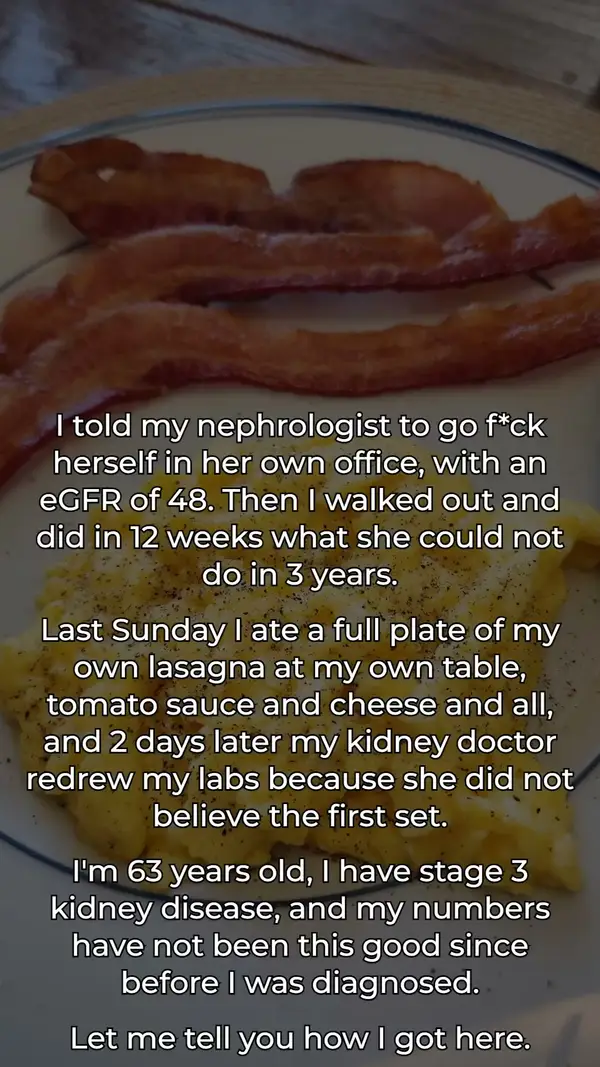
I told my nephrologist to go f*ck herself in her own office, with an eGFR of 48. Then I walked out and did in 12 weeks what she could not do in 3 years. Last Sunday I ate a full plate of my own lasagna at my own table, tomato sauce and cheese and all, and 2 days later my kidney doctor redrew my labs because she did not believe the first set. I'm 63 years old, I have stage 3 kidney disease, and my numbers have not been this good since before I was diagnosed. Let me tell you how I got here. My name is Marjorie and I live in Dayton, Ohio. I was an elementary school librarian for 36 years. I retired 3 years ago, and I still volunteer 2 mornings a week because the third graders still ask for me and the school still can't find anyone who knows where everything is. I've been married to Dale for 38 years. We have 2 daughters, 1 son in law, and 3 grandchildren. I'm telling you this because I want you to understand who I am before I tell you what I did. I am not a woman who talks back to a doctor. I have never cursed at a professional in her own office in my life, and I am not the kind of woman who sits at her kitchen table with a laptop reading medical studies until her eyes hurt. I am the kind of woman who takes her prescription and does what she's told. Or I was, until the day my nephrologist told me that if I didn't do what she said, I would be on a dialysis machine within 5 years. Something in me broke that day. I was diagnosed 3 years ago. My eGFR came back at 52 at a physical I had almost canceled because my youngest granddaughter had a dance recital that afternoon. There was protein in my urine, and my creatinine was up, and my family doctor used the words "kidney disease" for the first time in my life. He sent me to a nephrologist, a woman about my daughters' age with a clean office and framed degrees on every wall. She sat me down and told me how things were going to change. She went down the list. The sour cream coffee cake I bake every Sunday morning for Dale was out, too much phosphorus. The lasagna I've made for my family for 38 years was out, the tomatoes, the cheese, the meat, all of it. My daughter Beth's peach cobbler at the holidays was out, and so were the lemon bars I bring to the school library for the teachers, and potatoes, and bananas, and salt, and pretty much everything I grew up cooking and eating. She handed me a printed list of potassium numbers and told me to tape it inside my cupboard. I want to tell you what that felt like, because unless you have been the woman sitting in that chair for the first time with the word kidney hanging in the air, you can't know. It felt like being told the last third of my life was going to be spent eating things I didn't want, while I watched everyone at my own table enjoy the food I'd made for them. She wrote me a prescription for lisinopril, 10 milligrams every morning, to "protect the kidneys," told me to drink 8 glasses of water a day and walk 30 minutes a day, and told me to come back in 3 months. I walked out of that office and I did every single thing she said. For 3 years I was the most obedient patient she had. I took the lisinopril at 7 every morning with a full glass of water. I set an alarm on my phone. I did not miss a dose in 3 years. I gave up my evening glass of wine. I gave up the half and half in my coffee and drank it black, and I hated it, and I drank it anyway, every morning, for 3 years. I bought a kitchen scale and weighed my chicken. I ate egg whites and 1 slice of dry toast with no butter for breakfast, 3 ounces of plain chicken and steamed cauliflower for lunch, and baked fish with a salad and no dressing and no tomatoes for dinner. I soaked potatoes in water overnight to pull the potassium out, and then I didn't eat them anyway because I was afraid. I walked 40 minutes every morning at 6 AM, in the dark, in the rain, through 3 Ohio winters. On the mornings the sidewalks were iced over I still laced up my shoes and went. I sat through 3 Thanksgivings at Beth's house eating plain turkey and green beans while my family ate stuffing and mashed potatoes and cobbler with ice cream. I sat through 3 Christmases eating a bare salad while everyone else had my sister's ham. I sat through 3 of my granddaughter's birthdays watching her blow out candles while I drank a glass of water. She went from 4 to 7 years old while grandma wasn't allowed to eat cake at her own party. I baked the coffee cake for Dale every Sunday for 3 years and did not eat one slice. I brought lemon bars to the library and watched the teachers eat them while I ate almonds out of a plastic bag I'd brought from home, and then I stopped bringing the almonds because almonds were on the list too. I cooked every holiday dinner. I set the table and served the food, and then I sat down and ate something different from what I'd made for everyone else, every single time, for 3 years. I want you to understand what 3 years of that does to a woman. It doesn't just take your food. It takes your place at your own table. It turns you into a guest in your own kitchen. You become the woman who cooks for everyone and eats nothing, the woman who watches, the woman who says "no thank you" when her own granddaughter offers her a bite of the cake she baked. After 3 years of that, something inside you goes quiet. You stop being angry about it. You stop being sad about it. You just accept it, and the accepting is the worst part, because it means you've given up on ever getting your life back. And the whole time, my body was getting worse. The foam started the first year, a few bubbles on the water in the morning that I told myself were nothing. By the second year it was a layer, like the top of a poured beer, and it sat there after I flushed. By the third year it was every single morning, thick and white like beaten egg whites, and I had stopped looking down because I already knew. My ankles started swelling the first year, just a little by evening. By the second year I was buying shoes a half size bigger. By the third year I was pressing my thumb into my shin at bedtime and watching the dent stay there, and I'd wake up with my eyes so puffy Dale asked me if I'd been crying. I was getting up once a night to use the bathroom the first year, twice the second, and 3 times by the third. Dale slept through it. I hadn't slept more than 4 hours in a row in over a year. And the tiredness after every meal got worse every year. In the first year it was a heaviness in the afternoon. By the third year it was a collapse. I'd eat lunch and by 1 o'clock I'd be in my reading chair with my eyes closing, with a taste in my mouth like I'd been sucking on a penny. My daughter joked that I was turning into her grandmother. I did not think it was funny. I was 63 and falling asleep in the middle of the day like I was 90. I got winded on the 14 stairs up to my bedroom. I used to take them 2 at a time. By the third year I was stopping halfway with my hand on the railing, waiting for my chest to stop pounding. I had gained 11 pounds since my diagnosis while eating like a bird, and every one of them was water. My nephrologist told me to "be more careful with the salt." I wanted to scream at her. And there was one more thing, the one I never told her, the one no woman my age brings up at an appointment. The closeness with Dale had been fading for 3 years. It wasn't just the wanting, it was everything, the response and the warmth and the things that had worked between us for nearly 4 decades. I told myself it was menopause, then age, then stress. It wasn't any of those things. By the third year Dale and I slept in the same bed like 2 polite strangers. He never complained. He just stopped reaching for me, and I stopped wishing he would. That was the loneliest part of all of it, and I never said a word about it to anyone. Over those 3 years my nephrologist changed my prescriptions 9 times. She doubled the lisinopril after my first follow up, because my eGFR had moved from 52 to 50 and she said that wasn't enough. Six months later she added a water pill for the swelling, and my eGFR went to 49, and she said it was progress but not enough. The water pill gave me cramps in my calves at 3 in the morning that made me bite the pillow so I wouldn't wake Dale. A year in she switched me from the lisinopril to losartan because the lisinopril had given me a dry cough that would not stop. I coughed through 2 story times in one morning until a third grader asked me if I was dying. I started keeping cough drops in every pocket. I never told anyone why. At 18 months she added Farxiga. My eGFR went to 47 and then back to 49 and she said we were getting somewhere. I was taking 3 medications, walking every morning, weighing my chicken, and the number had moved 3 points in a year and a half, in the wrong direction. At 2 years she added a phosphate binder, a chalky pill with every meal, and started talking about the vascular surgeon. She said it would be smart to have a fistula placed in my arm "just so it's ready." I said I did not want a surgery for a machine I wasn't on. She said we might not have a choice. At 2 and a half years she signed me up for the dialysis education class. At every appointment she asked the same 3 questions. Are you taking your medication. Are you following the diet. Are you drinking your water. And every time the answer was yes, yes, and yes. My eGFR bounced between 44 and 48 for the last 18 months. It went up one visit and down the next, and it never got back above 50, and it never held. I was taking 4 pills a day, walking in the dark, eating nothing I wanted, and the number would not turn around. Then came the appointment that changed everything. She pulled up my chart. She read it, and then she read it again, and then she looked at me. "Marjorie, your eGFR is 48. We're back where we started, and the protein is up." I didn't say anything. "I have to be direct with you. We've tried lisinopril, we've tried losartan, we've tried Farxiga, we've tried the binder. Your numbers aren't responding. I want the vascular surgeon to see you this week about the fistula, and if we don't see movement in 3 months we're going to start planning for dialysis. We have to be ready. We're running out of runway." I sat in that chair and felt something I had never felt in a doctor's office in my life. I wasn't scared. I was angry. I told her I had done everything she'd asked for 3 years. I'd sat through 3 Thanksgivings and 3 Christmases and 3 birthdays with a glass of water. I'd walked on ice in the dark. I'd given up wine, and tomatoes, and potatoes, and my own cooking at my own table. I'd taken every pill and swallowed every side effect. She looked at me the way you look at a child who isn't getting the lesson. "Marjorie, women your age who fight the protocol end up on the machine before they've made their peace with it. I need you on board. Otherwise you are looking at dialysis in 5 years, maybe a stroke, maybe less." That was the sentence. I sat there for about 10 seconds. I remember the second hand on the clock behind her because I was staring at it. Then I stood up. "Doc, you can go f*ck yourself." She blinked. I said it again, calmer, because I wanted her to hear it. "I have taken your pills every morning for 3 years. Four different medications. I have lived with the cough and the cramps and the chalk in my mouth at every meal. I have weighed my chicken on a kitchen scale like a woman in a prison. I have given up every food I love. And my number is back where it started. Now you want to cut a fistula into my arm on top of 4 pills that didn't work and call it being ready. I am not the problem here. You are. The pills are." She started to say something. I don't remember what. I picked up my coat and I walked out. Dale was in the waiting room and he stood up when he saw my face. I told him in the car. He was quiet for a long time, and then he said, "Marjorie, please go back. See the surgeon. We'll figure the rest out later." I told him no. Whatever the answer to this was, it wasn't in that woman's office. It hadn't been in that office for 3 years. What I did next was not brave. I called my sister in law Joanne, because I didn't know who else to call. Joanne ran the kidney education classes at the hospital in Kettering for 26 years before she retired. She is the person who taught half of Dayton how to read an eGFR and count the potassium in a banana. And she is also, and this is the part that matters, a kidney patient herself, and for years she couldn't get her own numbers to hold with everything she taught. She came over the next morning with 2 coffees and sat down at my kitchen table. I told her the whole thing, the 9 protocol changes, the surgeon, the 5 years, the swearing. She didn't flinch at the swearing. She'd heard worse from her own patients. Then she said something no doctor had said to me in 3 years. "Marjorie, you've been doing everything right. The reason it didn't work is that not one of those pills was aimed at the actual problem." I asked her what the actual problem was. She turned my coffee cup around on the table and said, "Let me tell you what I never got to say in a 20 minute class." Your kidneys have a filtering system that pulls the waste out of your blood and sends clean blood back. When you were younger, it ran on its own. Every drop of blood you had passed through it every day, and you never had to think about it. Your urine was clear, your energy was steady, your ankles were your ankles. That's why your kidneys weren't something you had to think about for the first 50 years of your life. But that system wears down. Stress wears it down. Processed food wears it down. Soil that's been farmed flat for 50 years and grows food with a fraction of what it used to carry wears it down. Add 3 decades of that on top of aging, and your body starts making more and more of something called oxidative stress. Think of it as rust. Tiny particles building up inside the filters, scarring them, stiffening them, clogging them, day after day. And what rust does to a filter is exactly what you'd expect. The filter can't catch what it's supposed to catch anymore, and it can't push out what it's supposed to push out. The first thing it stops catching is protein. Protein is supposed to stay in your blood. It's what your body uses to repair itself. But a scarred filter lets it slip through, and when it hits the water in the toilet, it acts like soap. It foams. That's what you've been looking away from every morning for 3 years. That's your filters leaking. And the waste your filters can't push out anymore backs up inside you. That's the taste of pennies in your mouth. That's the fog at 1 o'clock in your reading chair. That's your ankles, and your eyes in the morning, and the 3 trips a night. And it's in every small vessel in your body, including the ones that carry blood and feeling to the parts of you that make closeness possible, and that was what had gone quiet between Dale and me. The same waste was wearing on my heart, which is exactly where the stroke my nephrologist kept threatening me with was going to come from. And it feeds itself, because more rust means less filtering, less filtering means more waste backing up, and more waste means more rust. That's why my eGFR was 52 three years ago and 48 today, and why she kept calling it stable while it slid. Then Joanne said the thing that made me put my cup down. "Every pill she gave you was aimed at the damage after it happened, and not one of them ever touched the rust." Lisinopril and losartan lower the pressure inside your filters. That helps the number on the cuff. It does nothing about the rust scarring the filters. The water pill pulls fluid off. That's why your ankles went down for a week. It doesn't touch the filters, and it's why your calves cramp at 3 in the morning. Farxiga makes your kidneys dump sugar out through your urine and takes a little of the load off. It doesn't stop the rust. The binder soaks up phosphorus in your stomach so it never reaches your blood. The renal diet gives a failing filter less to filter. Neither one restores the filter. Three years, 4 medications, 9 changes, and every one of them was mopping the floor under a leaking pipe. "So what stops the rust?" I asked her. She smiled, because she'd been waiting 3 years for me to ask. There is a fruit that has been used in Central Asia for over 5,000 years for exactly this. The pomegranate. The healers back then didn't have a word for oxidative stress. They just watched. The people who ate it every day had less swelling, clearer urine, steadier energy as they aged, and they didn't slide into the slow decline everyone else did. They called it the fruit of life. Modern research found the reason. Pomegranate contains a compound called punicalagins, one of the most powerful antioxidants ever found in nature, 3 times the strength of red wine. Your body can't make them. It has to get them from food, and pomegranate is one of the only places on earth they show up in a meaningful amount. When the punicalagins are in your system, they go after the rust directly. They neutralize it before it can keep scarring the filters. The attack stops. The filters get a chance to recover. They start catching protein again, so the leak slows and the foam goes down. They start pushing waste out again, so the taste clears and the fog lifts and the ankles come back. And the number stops sliding, not because a drug forced your kidneys to work, but because they're finally allowed to do what they've always known how to do. I asked her the question every kidney patient asks. "Joanne, pomegranate is on my list. It's full of potassium." She said, "The fruit is. The juice is worse, it's sugar and potassium in a bottle with a pomegranate label. That's why nobody ever told you about it. A standardized extract is a different thing. It concentrates the punicalagins and leaves the sugar and the potassium load behind. The bottle at the store tells you it's for your heart. Nobody tells you what it does for your filters." And then Joanne told me about her own numbers, which is the part I really needed to hear. Her eGFR had sat at 46 for 6 years, on lisinopril, teaching the classes, eating exactly the way she taught. Two years ago she started taking a standardized pomegranate extract every morning next to her lisinopril. Her last eGFR was 55, and there was no protein on the report. Last Thanksgiving she ate mashed potatoes. She had 2 helpings, actually. I asked her why I'd never heard a doctor say the word pomegranate. She said, "Because the juice at the grocery store is sugar water with the potassium your doctor warned you about, and that's all most doctors know about it. The powder on Amazon is cooked dry and there's nothing left in it. It has to be a standardized extract with the punicalagins actually in it, made without heat, or you're paying for red dust." She wrote a name on the back of my grocery list, Auniva's Pomegranate Extract. It's organic, and it's a standardized extract with the punicalagin content printed on the label. It's made without heat or fillers, and it's third party tested here in the USA. They make it in small batches, which means it sells out, which she warned me about. I ordered it from their official site that afternoon, before Dale got home. The bottle came on a Friday. I took 2 capsules the next morning with breakfast and a glass of water, right next to the losartan and the other 3 pills. I want to be clear about that. I did not stop anything. I added. The first week I slept 6 hours straight for the first time in over a year. I got up once instead of 3 times. I hadn't realized how broken my sleep had gotten until I got a whole night of it back. I woke at 6 and I wasn't tired, and I cannot tell you what that felt like after 3 years of exhaustion. It felt like someone had turned the lights on. In the second week the taste of pennies went away. I drank my black coffee one morning and it tasted like coffee, and I stood at the counter and drank a second cup just to be sure. In the third week the crash after meals disappeared. I ate lunch on a Tuesday and stayed awake through the whole afternoon and read 40 pages in my chair, which I had not done in 2 years. In the fourth week I walked up all 14 stairs without stopping. I didn't realize I'd done it until I was at the top. Then I stood there with my hand on the wall and cried, because I'd forgotten what it felt like to just walk up the stairs in my own house. That same week my wedding ring turned on my finger for the first time in a year, and my shoes fit at 6 o'clock at night. In the fifth week the thing I never told my nephrologist about started coming back. The warmth, the response, the closeness with Dale that I'd been grieving in private for 3 years. I'm not going to say more than that. But Dale reached for me for the first time in a very long time, and I was there. In the sixth week I looked down one morning, out of 3 years of habit, and there was nothing on the water, no layer and no bubbles, nothing at all. I flushed and I waited and I looked again like a crazy woman. Clear. In the seventh week it was clear 3 mornings in a row, and then 7. I stood in my bathroom staring at that bowl and I couldn't believe it. Three years of pills had never given me one clear morning. And by the eighth week I started doing something I want to tell you about carefully. I started eating things I hadn't touched in 3 years. I didn't go crazy. I know better. But one Saturday I went to the diner on Wayne Avenue by myself and ordered 2 eggs and bacon and a side of hash browns with a sliced tomato on the plate and a coffee with half and half. I ate every bite, and I sat there for 45 minutes with my hands around the cup, and I was afraid of the next morning. The next morning the water was clear. I sat on the edge of the tub and stared at it. After 3 years of egg whites and dry toast and a potassium list taped inside my cupboard, I'd eaten a diner breakfast with the tomato, and my kidneys hadn't said a word. The next Sunday I baked the coffee cake and I ate a thick warm slice standing at my own counter. Dale walked in and stopped in the doorway. He looked at the cake, and then at the slice in my hand, and then at my face, and he didn't say a word. He just smiled. Monday morning, clear. Which brings me to last Sunday. I made my lasagna for the first time in 3 years and served it at my own table with garlic bread, and Beth brought the cobbler. I ate a full plate in front of my entire family. My granddaughter sat next to me and asked for a bite of my cobbler because hers was already gone. I gave her a bite off my plate. She was 4 when I was diagnosed and she is 7 now, and she does not remember a time when grandma ate what everyone else ate. Three of her birthdays went by while I sat at the table with a glass of water. She never asked why. Children don't ask. They just watch. Dale caught my eye from across the table and smiled the smile he used to smile at me at Sunday dinners before any of this started. I hadn't seen that smile in 3 years. Monday morning I looked down. Clear. I stood at my kitchen sink and cried, not because of the water, but because I'd gotten a piece of my life back that I thought was gone for good. I'd spent 3 years believing I would never eat at my own table again, that the woman I used to be was gone, that the rest of my life would be a kitchen scale and a potassium list and watching. And in 12 weeks, it was over. Two days later I went back to my nephrologist, because my labs were due whether I liked her or not. Same waiting room. Same receptionist, who remembered my name and looked nervous when I signed in. Same doctor. She came in with my chart already on her tablet and she didn't say hello. "Marjorie, your eGFR is 54. Twelve weeks ago it was 48. Your urine protein is negative. I don't see that without a major change in treatment. What are you doing?" I told her. Joanne, the rust, the filters, the punicalagins, and the 3 years of pills that had never once been aimed at the problem. She interrupted me halfway through. "This is anecdotal. You're describing a supplement. There is no way a pomegranate extract moved your eGFR 6 points in 12 weeks when 3 years of medication couldn't." I told her it did. She stared at the chart and said, "I want to redraw the labs today." So she redrew them, and I sat in the exam room for 40 minutes, and she came back in holding the printout. It said 55. Protein negative. She sat down on her stool and didn't say anything for what felt like a very long time. Then she said, in a voice I had not heard her use in 3 years, "Marjorie, I owe you an apology. I don't understand what you're doing, but whatever it is, keep doing it." I let her sit with it. I wanted to say 3 years. I wanted to say I gave you 3 years of my life and my coffee cake and my wine and my sleep and my stairs and my husband because you told me to trust the process. I didn't say any of it. She asked me to write down what I was taking. She folded the paper and put it in the pocket of her white coat. Then she took me off the water pill that day, cut my losartan in half, stopped the binder, and said we'd talk about the Farxiga at the 6 month visit if the numbers held. She did not mention the surgeon. She did not mention the class. She did not mention dialysis. I am 63 years old. I have stage 3 kidney disease and my eGFR is 55 and climbing. In the last month I have eaten hash browns with a tomato and coffee cake with butter and my own lasagna at my own table, and my kidneys held through every one of those meals. I'm writing this for one reason. If you are sitting where I was sitting 3 years ago, or 1 year ago, or last week, scared and cornered by a doctor who wants to add another pill or a surgeon on top of the pills that haven't worked, and you're watching your grandchildren blow out candles from across the room and telling yourself this is just how it has to be now, I'm here to tell you it doesn't. Your filters are being scarred by rust. Every pill your doctor has given you is aimed at the damage, and not one of them is aimed at the rust. There is something that is. Auniva's Pomegranate Extract is organic, it's a standardized extract with the punicalagin content on the label, it's made without heat so the punicalagins survive, it has no fillers, and it's third party tested in the USA in small batches. Just take 2 capsules every morning with breakfast and a glass of water. That is the whole routine. They back it with a 90 day money back guarantee. If your numbers don't move, you send the bottles back, full or empty, and they refund every dollar. Marjorie P.S. My eGFR at the redraw was 55 and the protein was negative. The water is clear every morning. My ankles are my ankles. I sleep until the alarm. I walk 2 miles through the park 3 mornings a week. I bake coffee cake on Sundays again and I eat it. Dale got his wife back, and after 3 years, that is not a small thing. That is everything. P.P.S. Please don't go buy the cheap pomegranate capsules on Amazon and think you've done what I did. Most of them are fruit powder that was cooked dry, and the juice is sugar water carrying the potassium your nephrologist warned you about. What worked for me was a standardized extract with the punicalagins listed on the label and no heat processing. The link above goes straight to Auniva's official site, so you get the one Joanne wrote on my grocery list. P.P.P.S. I did not stop my medications on my own, and please don't stop yours. I took the Pomegranate right next to my pills for 12 weeks, and it was my nephrologist who took me off the water pill and cut the losartan after she saw the numbers. Let your doctor be the one who lowers it. That's how you do this right. P.P.P.P.S. If you're the husband of a woman whose kidney doctor has started using the word dialysis, leave this where she'll find it. On the counter next to her coffee cup on a Saturday morning. She won't ask you for help and she won't tell you she's scared, but if you put this in front of her, she will read it. P.P.P.P.P.S. If you're managing this alone, without a husband or anyone in the house who understands, I see you. This disease is lonelier for us than anyone says. You deserve your energy back. You deserve to bake what you want in your own kitchen and walk up your own stairs without stopping. You deserve to stop being a guest at your own table. Just 2 capsules, every morning. That's all I'm asking you to try. 👉 https://auniva.co/pom/17

Loading the ad's image
Jessica Bennett — Feel Like Yourself Again
PromisingVideo

Feel Like Yourself Again

I told my nephrologist to go f*ck herself in her own office, with an eGFR of 48. Then I walked out and did in 12 weeks what she could not do in 3 years. Last Sunday I ate a full plate of my own lasagna at my own table, tomato sauce and cheese and all, and 2 days later my kidney doctor redrew my labs because she did not believe the first set. I'm 63 years old, I have stage 3 kidney disease, and my numbers have not been this good since before I was diagnosed. Let me tell you how I got here. My name is Marjorie and I live in Dayton, Ohio. I was an elementary school librarian for 36 years. I retired 3 years ago, and I still volunteer 2 mornings a week because the third graders still ask for me and the school still can't find anyone who knows where everything is. I've been married to Dale for 38 years. We have 2 daughters, 1 son in law, and 3 grandchildren. I'm telling you this because I want you to understand who I am before I tell you what I did. I am not a woman who talks back to a doctor. I have never cursed at a professional in her own office in my life, and I am not the kind of woman who sits at her kitchen table with a laptop reading medical studies until her eyes hurt. I am the kind of woman who takes her prescription and does what she's told. Or I was, until the day my nephrologist told me that if I didn't do what she said, I would be on a dialysis machine within 5 years. Something in me broke that day. I was diagnosed 3 years ago. My eGFR came back at 52 at a physical I had almost canceled because my youngest granddaughter had a dance recital that afternoon. There was protein in my urine, and my creatinine was up, and my family doctor used the words "kidney disease" for the first time in my life. He sent me to a nephrologist, a woman about my daughters' age with a clean office and framed degrees on every wall. She sat me down and told me how things were going to change. She went down the list. The sour cream coffee cake I bake every Sunday morning for Dale was out, too much phosphorus. The lasagna I've made for my family for 38 years was out, the tomatoes, the cheese, the meat, all of it. My daughter Beth's peach cobbler at the holidays was out, and so were the lemon bars I bring to the school library for the teachers, and potatoes, and bananas, and salt, and pretty much everything I grew up cooking and eating. She handed me a printed list of potassium numbers and told me to tape it inside my cupboard. I want to tell you what that felt like, because unless you have been the woman sitting in that chair for the first time with the word kidney hanging in the air, you can't know. It felt like being told the last third of my life was going to be spent eating things I didn't want, while I watched everyone at my own table enjoy the food I'd made for them. She wrote me a prescription for lisinopril, 10 milligrams every morning, to "protect the kidneys," told me to drink 8 glasses of water a day and walk 30 minutes a day, and told me to come back in 3 months. I walked out of that office and I did every single thing she said. For 3 years I was the most obedient patient she had. I took the lisinopril at 7 every morning with a full glass of water. I set an alarm on my phone. I did not miss a dose in 3 years. I gave up my evening glass of wine. I gave up the half and half in my coffee and drank it black, and I hated it, and I drank it anyway, every morning, for 3 years. I bought a kitchen scale and weighed my chicken. I ate egg whites and 1 slice of dry toast with no butter for breakfast, 3 ounces of plain chicken and steamed cauliflower for lunch, and baked fish with a salad and no dressing and no tomatoes for dinner. I soaked potatoes in water overnight to pull the potassium out, and then I didn't eat them anyway because I was afraid. I walked 40 minutes every morning at 6 AM, in the dark, in the rain, through 3 Ohio winters. On the mornings the sidewalks were iced over I still laced up my shoes and went. I sat through 3 Thanksgivings at Beth's house eating plain turkey and green beans while my family ate stuffing and mashed potatoes and cobbler with ice cream. I sat through 3 Christmases eating a bare salad while everyone else had my sister's ham. I sat through 3 of my granddaughter's birthdays watching her blow out candles while I drank a glass of water. She went from 4 to 7 years old while grandma wasn't allowed to eat cake at her own party. I baked the coffee cake for Dale every Sunday for 3 years and did not eat one slice. I brought lemon bars to the library and watched the teachers eat them while I ate almonds out of a plastic bag I'd brought from home, and then I stopped bringing the almonds because almonds were on the list too. I cooked every holiday dinner. I set the table and served the food, and then I sat down and ate something different from what I'd made for everyone else, every single time, for 3 years. I want you to understand what 3 years of that does to a woman. It doesn't just take your food. It takes your place at your own table. It turns you into a guest in your own kitchen. You become the woman who cooks for everyone and eats nothing, the woman who watches, the woman who says "no thank you" when her own granddaughter offers her a bite of the cake she baked. After 3 years of that, something inside you goes quiet. You stop being angry about it. You stop being sad about it. You just accept it, and the accepting is the worst part, because it means you've given up on ever getting your life back. And the whole time, my body was getting worse. The foam started the first year, a few bubbles on the water in the morning that I told myself were nothing. By the second year it was a layer, like the top of a poured beer, and it sat there after I flushed. By the third year it was every single morning, thick and white like beaten egg whites, and I had stopped looking down because I already knew. My ankles started swelling the first year, just a little by evening. By the second year I was buying shoes a half size bigger. By the third year I was pressing my thumb into my shin at bedtime and watching the dent stay there, and I'd wake up with my eyes so puffy Dale asked me if I'd been crying. I was getting up once a night to use the bathroom the first year, twice the second, and 3 times by the third. Dale slept through it. I hadn't slept more than 4 hours in a row in over a year. And the tiredness after every meal got worse every year. In the first year it was a heaviness in the afternoon. By the third year it was a collapse. I'd eat lunch and by 1 o'clock I'd be in my reading chair with my eyes closing, with a taste in my mouth like I'd been sucking on a penny. My daughter joked that I was turning into her grandmother. I did not think it was funny. I was 63 and falling asleep in the middle of the day like I was 90. I got winded on the 14 stairs up to my bedroom. I used to take them 2 at a time. By the third year I was stopping halfway with my hand on the railing, waiting for my chest to stop pounding. I had gained 11 pounds since my diagnosis while eating like a bird, and every one of them was water. My nephrologist told me to "be more careful with the salt." I wanted to scream at her. And there was one more thing, the one I never told her, the one no woman my age brings up at an appointment. The closeness with Dale had been fading for 3 years. It wasn't just the wanting, it was everything, the response and the warmth and the things that had worked between us for nearly 4 decades. I told myself it was menopause, then age, then stress. It wasn't any of those things. By the third year Dale and I slept in the same bed like 2 polite strangers. He never complained. He just stopped reaching for me, and I stopped wishing he would. That was the loneliest part of all of it, and I never said a word about it to anyone. Over those 3 years my nephrologist changed my prescriptions 9 times. She doubled the lisinopril after my first follow up, because my eGFR had moved from 52 to 50 and she said that wasn't enough. Six months later she added a water pill for the swelling, and my eGFR went to 49, and she said it was progress but not enough. The water pill gave me cramps in my calves at 3 in the morning that made me bite the pillow so I wouldn't wake Dale. A year in she switched me from the lisinopril to losartan because the lisinopril had given me a dry cough that would not stop. I coughed through 2 story times in one morning until a third grader asked me if I was dying. I started keeping cough drops in every pocket. I never told anyone why. At 18 months she added Farxiga. My eGFR went to 47 and then back to 49 and she said we were getting somewhere. I was taking 3 medications, walking every morning, weighing my chicken, and the number had moved 3 points in a year and a half, in the wrong direction. At 2 years she added a phosphate binder, a chalky pill with every meal, and started talking about the vascular surgeon. She said it would be smart to have a fistula placed in my arm "just so it's ready." I said I did not want a surgery for a machine I wasn't on. She said we might not have a choice. At 2 and a half years she signed me up for the dialysis education class. At every appointment she asked the same 3 questions. Are you taking your medication. Are you following the diet. Are you drinking your water. And every time the answer was yes, yes, and yes. My eGFR bounced between 44 and 48 for the last 18 months. It went up one visit and down the next, and it never got back above 50, and it never held. I was taking 4 pills a day, walking in the dark, eating nothing I wanted, and the number would not turn around. Then came the appointment that changed everything. She pulled up my chart. She read it, and then she read it again, and then she looked at me. "Marjorie, your eGFR is 48. We're back where we started, and the protein is up." I didn't say anything. "I have to be direct with you. We've tried lisinopril, we've tried losartan, we've tried Farxiga, we've tried the binder. Your numbers aren't responding. I want the vascular surgeon to see you this week about the fistula, and if we don't see movement in 3 months we're going to start planning for dialysis. We have to be ready. We're running out of runway." I sat in that chair and felt something I had never felt in a doctor's office in my life. I wasn't scared. I was angry. I told her I had done everything she'd asked for 3 years. I'd sat through 3 Thanksgivings and 3 Christmases and 3 birthdays with a glass of water. I'd walked on ice in the dark. I'd given up wine, and tomatoes, and potatoes, and my own cooking at my own table. I'd taken every pill and swallowed every side effect. She looked at me the way you look at a child who isn't getting the lesson. "Marjorie, women your age who fight the protocol end up on the machine before they've made their peace with it. I need you on board. Otherwise you are looking at dialysis in 5 years, maybe a stroke, maybe less." That was the sentence. I sat there for about 10 seconds. I remember the second hand on the clock behind her because I was staring at it. Then I stood up. "Doc, you can go f*ck yourself." She blinked. I said it again, calmer, because I wanted her to hear it. "I have taken your pills every morning for 3 years. Four different medications. I have lived with the cough and the cramps and the chalk in my mouth at every meal. I have weighed my chicken on a kitchen scale like a woman in a prison. I have given up every food I love. And my number is back where it started. Now you want to cut a fistula into my arm on top of 4 pills that didn't work and call it being ready. I am not the problem here. You are. The pills are." She started to say something. I don't remember what. I picked up my coat and I walked out. Dale was in the waiting room and he stood up when he saw my face. I told him in the car. He was quiet for a long time, and then he said, "Marjorie, please go back. See the surgeon. We'll figure the rest out later." I told him no. Whatever the answer to this was, it wasn't in that woman's office. It hadn't been in that office for 3 years. What I did next was not brave. I called my sister in law Joanne, because I didn't know who else to call. Joanne ran the kidney education classes at the hospital in Kettering for 26 years before she retired. She is the person who taught half of Dayton how to read an eGFR and count the potassium in a banana. And she is also, and this is the part that matters, a kidney patient herself, and for years she couldn't get her own numbers to hold with everything she taught. She came over the next morning with 2 coffees and sat down at my kitchen table. I told her the whole thing, the 9 protocol changes, the surgeon, the 5 years, the swearing. She didn't flinch at the swearing. She'd heard worse from her own patients. Then she said something no doctor had said to me in 3 years. "Marjorie, you've been doing everything right. The reason it didn't work is that not one of those pills was aimed at the actual problem." I asked her what the actual problem was. She turned my coffee cup around on the table and said, "Let me tell you what I never got to say in a 20 minute class." Your kidneys have a filtering system that pulls the waste out of your blood and sends clean blood back. When you were younger, it ran on its own. Every drop of blood you had passed through it every day, and you never had to think about it. Your urine was clear, your energy was steady, your ankles were your ankles. That's why your kidneys weren't something you had to think about for the first 50 years of your life. But that system wears down. Stress wears it down. Processed food wears it down. Soil that's been farmed flat for 50 years and grows food with a fraction of what it used to carry wears it down. Add 3 decades of that on top of aging, and your body starts making more and more of something called oxidative stress. Think of it as rust. Tiny particles building up inside the filters, scarring them, stiffening them, clogging them, day after day. And what rust does to a filter is exactly what you'd expect. The filter can't catch what it's supposed to catch anymore, and it can't push out what it's supposed to push out. The first thing it stops catching is protein. Protein is supposed to stay in your blood. It's what your body uses to repair itself. But a scarred filter lets it slip through, and when it hits the water in the toilet, it acts like soap. It foams. That's what you've been looking away from every morning for 3 years. That's your filters leaking. And the waste your filters can't push out anymore backs up inside you. That's the taste of pennies in your mouth. That's the fog at 1 o'clock in your reading chair. That's your ankles, and your eyes in the morning, and the 3 trips a night. And it's in every small vessel in your body, including the ones that carry blood and feeling to the parts of you that make closeness possible, and that was what had gone quiet between Dale and me. The same waste was wearing on my heart, which is exactly where the stroke my nephrologist kept threatening me with was going to come from. And it feeds itself, because more rust means less filtering, less filtering means more waste backing up, and more waste means more rust. That's why my eGFR was 52 three years ago and 48 today, and why she kept calling it stable while it slid. Then Joanne said the thing that made me put my cup down. "Every pill she gave you was aimed at the damage after it happened, and not one of them ever touched the rust." Lisinopril and losartan lower the pressure inside your filters. That helps the number on the cuff. It does nothing about the rust scarring the filters. The water pill pulls fluid off. That's why your ankles went down for a week. It doesn't touch the filters, and it's why your calves cramp at 3 in the morning. Farxiga makes your kidneys dump sugar out through your urine and takes a little of the load off. It doesn't stop the rust. The binder soaks up phosphorus in your stomach so it never reaches your blood. The renal diet gives a failing filter less to filter. Neither one restores the filter. Three years, 4 medications, 9 changes, and every one of them was mopping the floor under a leaking pipe. "So what stops the rust?" I asked her. She smiled, because she'd been waiting 3 years for me to ask. There is a fruit that has been used in Central Asia for over 5,000 years for exactly this. The pomegranate. The healers back then didn't have a word for oxidative stress. They just watched. The people who ate it every day had less swelling, clearer urine, steadier energy as they aged, and they didn't slide into the slow decline everyone else did. They called it the fruit of life. Modern research found the reason. Pomegranate contains a compound called punicalagins, one of the most powerful antioxidants ever found in nature, 3 times the strength of red wine. Your body can't make them. It has to get them from food, and pomegranate is one of the only places on earth they show up in a meaningful amount. When the punicalagins are in your system, they go after the rust directly. They neutralize it before it can keep scarring the filters. The attack stops. The filters get a chance to recover. They start catching protein again, so the leak slows and the foam goes down. They start pushing waste out again, so the taste clears and the fog lifts and the ankles come back. And the number stops sliding, not because a drug forced your kidneys to work, but because they're finally allowed to do what they've always known how to do. I asked her the question every kidney patient asks. "Joanne, pomegranate is on my list. It's full of potassium." She said, "The fruit is. The juice is worse, it's sugar and potassium in a bottle with a pomegranate label. That's why nobody ever told you about it. A standardized extract is a different thing. It concentrates the punicalagins and leaves the sugar and the potassium load behind. The bottle at the store tells you it's for your heart. Nobody tells you what it does for your filters." And then Joanne told me about her own numbers, which is the part I really needed to hear. Her eGFR had sat at 46 for 6 years, on lisinopril, teaching the classes, eating exactly the way she taught. Two years ago she started taking a standardized pomegranate extract every morning next to her lisinopril. Her last eGFR was 55, and there was no protein on the report. Last Thanksgiving she ate mashed potatoes. She had 2 helpings, actually. I asked her why I'd never heard a doctor say the word pomegranate. She said, "Because the juice at the grocery store is sugar water with the potassium your doctor warned you about, and that's all most doctors know about it. The powder on Amazon is cooked dry and there's nothing left in it. It has to be a standardized extract with the punicalagins actually in it, made without heat, or you're paying for red dust." She wrote a name on the back of my grocery list, Auniva's Pomegranate Extract. It's organic, and it's a standardized extract with the punicalagin content printed on the label. It's made without heat or fillers, and it's third party tested here in the USA. They make it in small batches, which means it sells out, which she warned me about. I ordered it from their official site that afternoon, before Dale got home. 👉 https://auniva.co/pom/17 The bottle came on a Friday. I took 2 capsules the next morning with breakfast and a glass of water, right next to the losartan and the other 3 pills. I want to be clear about that. I did not stop anything. I added. The first week I slept 6 hours straight for the first time in over a year. I got up once instead of 3 times. I hadn't realized how broken my sleep had gotten until I got a whole night of it back. I woke at 6 and I wasn't tired, and I cannot tell you what that felt like after 3 years of exhaustion. It felt like someone had turned the lights on. In the second week the taste of pennies went away. I drank my black coffee one morning and it tasted like coffee, and I stood at the counter and drank a second cup just to be sure. In the third week the crash after meals disappeared. I ate lunch on a Tuesday and stayed awake through the whole afternoon and read 40 pages in my chair, which I had not done in 2 years. In the fourth week I walked up all 14 stairs without stopping. I didn't realize I'd done it until I was at the top. Then I stood there with my hand on the wall and cried, because I'd forgotten what it felt like to just walk up the stairs in my own house. That same week my wedding ring turned on my finger for the first time in a year, and my shoes fit at 6 o'clock at night. In the fifth week the thing I never told my nephrologist about started coming back. The warmth, the response, the closeness with Dale that I'd been grieving in private for 3 years. I'm not going to say more than that. But Dale reached for me for the first time in a very long time, and I was there. In the sixth week I looked down one morning, out of 3 years of habit, and there was nothing on the water, no layer and no bubbles, nothing at all. I flushed and I waited and I looked again like a crazy woman. Clear. In the seventh week it was clear 3 mornings in a row, and then 7. I stood in my bathroom staring at that bowl and I couldn't believe it. Three years of pills had never given me one clear morning. And by the eighth week I started doing something I want to tell you about carefully. I started eating things I hadn't touched in 3 years. I didn't go crazy. I know better. But one Saturday I went to the diner on Wayne Avenue by myself and ordered 2 eggs and bacon and a side of hash browns with a sliced tomato on the plate and a coffee with half and half. I ate every bite, and I sat there for 45 minutes with my hands around the cup, and I was afraid of the next morning. The next morning the water was clear. I sat on the edge of the tub and stared at it. After 3 years of egg whites and dry toast and a potassium list taped inside my cupboard, I'd eaten a diner breakfast with the tomato, and my kidneys hadn't said a word. The next Sunday I baked the coffee cake and I ate a thick warm slice standing at my own counter. Dale walked in and stopped in the doorway. He looked at the cake, and then at the slice in my hand, and then at my face, and he didn't say a word. He just smiled. Monday morning, clear. Which brings me to last Sunday. I made my lasagna for the first time in 3 years and served it at my own table with garlic bread, and Beth brought the cobbler. I ate a full plate in front of my entire family. My granddaughter sat next to me and asked for a bite of my cobbler because hers was already gone. I gave her a bite off my plate. She was 4 when I was diagnosed and she is 7 now, and she does not remember a time when grandma ate what everyone else ate. Three of her birthdays went by while I sat at the table with a glass of water. She never asked why. Children don't ask. They just watch. Dale caught my eye from across the table and smiled the smile he used to smile at me at Sunday dinners before any of this started. I hadn't seen that smile in 3 years. Monday morning I looked down. Clear. I stood at my kitchen sink and cried, not because of the water, but because I'd gotten a piece of my life back that I thought was gone for good. I'd spent 3 years believing I would never eat at my own table again, that the woman I used to be was gone, that the rest of my life would be a kitchen scale and a potassium list and watching. And in 12 weeks, it was over. Two days later I went back to my nephrologist, because my labs were due whether I liked her or not. Same waiting room. Same receptionist, who remembered my name and looked nervous when I signed in. Same doctor. She came in with my chart already on her tablet and she didn't say hello. "Marjorie, your eGFR is 54. Twelve weeks ago it was 48. Your urine protein is negative. I don't see that without a major change in treatment. What are you doing?" I told her. Joanne, the rust, the filters, the punicalagins, and the 3 years of pills that had never once been aimed at the problem. She interrupted me halfway through. "This is anecdotal. You're describing a supplement. There is no way a pomegranate extract moved your eGFR 6 points in 12 weeks when 3 years of medication couldn't." I told her it did. She stared at the chart and said, "I want to redraw the labs today." So she redrew them, and I sat in the exam room for 40 minutes, and she came back in holding the printout. It said 55. Protein negative. She sat down on her stool and didn't say anything for what felt like a very long time. Then she said, in a voice I had not heard her use in 3 years, "Marjorie, I owe you an apology. I don't understand what you're doing, but whatever it is, keep doing it." I let her sit with it. I wanted to say 3 years. I wanted to say I gave you 3 years of my life and my coffee cake and my wine and my sleep and my stairs and my husband because you told me to trust the process. I didn't say any of it. She asked me to write down what I was taking. She folded the paper and put it in the pocket of her white coat. Then she took me off the water pill that day, cut my losartan in half, stopped the binder, and said we'd talk about the Farxiga at the 6 month visit if the numbers held. She did not mention the surgeon. She did not mention the class. She did not mention dialysis. I am 63 years old. I have stage 3 kidney disease and my eGFR is 55 and climbing. In the last month I have eaten hash browns with a tomato and coffee cake with butter and my own lasagna at my own table, and my kidneys held through every one of those meals. I'm writing this for one reason. If you are sitting where I was sitting 3 years ago, or 1 year ago, or last week, scared and cornered by a doctor who wants to add another pill or a surgeon on top of the pills that haven't worked, and you're watching your grandchildren blow out candles from across the room and telling yourself this is just how it has to be now, I'm here to tell you it doesn't. Your filters are being scarred by rust. Every pill your doctor has given you is aimed at the damage, and not one of them is aimed at the rust. There is something that is. Auniva's Pomegranate Extract is organic, it's a standardized extract with the punicalagin content on the label, it's made without heat so the punicalagins survive, it has no fillers, and it's third party tested in the USA in small batches. Just take 2 capsules every morning with breakfast and a glass of water. That is the whole routine. They back it with a 90 day money back guarantee. If your numbers don't move, you send the bottles back, full or empty, and they refund every dollar. 👉 https://auniva.co/pom/17 Marjorie P.S. My eGFR at the redraw was 55 and the protein was negative. The water is clear every morning. My ankles are my ankles. I sleep until the alarm. I walk 2 miles through the park 3 mornings a week. I bake coffee cake on Sundays again and I eat it. Dale got his wife back, and after 3 years, that is not a small thing. That is everything. P.P.S. Please don't go buy the cheap pomegranate capsules on Amazon and think you've done what I did. Most of them are fruit powder that was cooked dry, and the juice is sugar water carrying the potassium your nephrologist warned you about. What worked for me was a standardized extract with the punicalagins listed on the label and no heat processing. The link above goes straight to Auniva's official site, so you get the one Joanne wrote on my grocery list. P.P.P.S. I did not stop my medications on my own, and please don't stop yours. I took the Pomegranate right next to my pills for 12 weeks, and it was my nephrologist who took me off the water pill and cut the losartan after she saw the numbers. Let your doctor be the one who lowers it. That's how you do this right. P.P.P.P.S. If you're the husband of a woman whose kidney doctor has started using the word dialysis, leave this where she'll find it. On the counter next to her coffee cup on a Saturday morning. She won't ask you for help and she won't tell you she's scared, but if you put this in front of her, she will read it. P.P.P.P.P.S. If you're managing this alone, without a husband or anyone in the house who understands, I see you. This disease is lonelier for us than anyone says. You deserve your energy back. You deserve to bake what you want in your own kitchen and walk up your own stairs without stopping. You deserve to stop being a guest at your own table. Just 2 capsules, every morning. That's all I'm asking you to try. 👉 https://auniva.co/pom/17

Loading the ad's image
Jessica Bennett — Feel Like Yourself Again
PromisingImage

Feel Like Yourself Again

I was wearing gloves at a soccer game in 68 degree weather and my daughter saw me and didn't say a word. That's what did it. Not the gloves. Not the cold hands I'd been walking around with for going on 16 years. Not the heated steering wheel in the Toyota that I ran on high even in July. It was the look on my daughter Erin's face when she glanced over at me on the sideline and then looked away again like she hadn't seen anything. She was giving me privacy. That's what it was. She was giving her 57 year old mother privacy about the fact that her hands didn't work right in weather where every other grandmother on that sideline was in short sleeves. My name is Marlene. I live in Bismarck, North Dakota. I worked in the front office of Simle Middle School for 22 years before I retired in the spring, and if you'd asked me in April what I was most looking forward to about retirement, I'd have told you it was being able to go outside without planning around what my hands were going to do. That's not what I told the people at my retirement party. I told them I was going to garden. Read more. Take my granddaughter Emmi to the state fair. And I meant all of that. But underneath, the thing I was really looking forward to was being warm. Because for 16 years I had been cold. Not shivering cold. Not sick cold. Just my hands and my feet. Always. From about mid October to the middle of May in North Dakota, which is most of the year, my hands were the temperature of a countertop. My feet lived in wool socks. I slept in socks. I did dishes in rubber gloves because if I let my hands sit in the warm water and then took them out, the cold air felt like knives on my knuckles. I saw four doctors about it over the years. The first one, back when I was 42, told me it was probably just how my body was and that some people run cold. She said "you're a small woman, you don't have a lot of thermal mass." That was the phrase she used. Thermal mass. Like I was a house. The second one, maybe six years later, told me it was probably my thyroid and ran a panel. My thyroid was fine. The third one, an internist in Mandan I saw for maybe two years before he retired, told me it was Raynaud's and prescribed something I took for three months. It made my hair thin and my hands didn't get any warmer. I stopped taking it. The fourth one, the one I have now, a woman about my age who's been my primary since 2015, told me it was probably just aging and circulation and that my labs looked fine and I should keep moving and stay warm and not worry about it. Not worry about it. I don't think she meant it the way it hit me. She was being kind. She was saying she didn't see anything dangerous going on. But what I heard was: this is the rest of your life. Get used to it. Buy better gloves. So I bought better gloves. I bought glove liners. I bought those little chemical hand warmers you shake and they get hot for 6 hours. I kept a box of them in the trunk. I kept a box of them in my purse. I kept a box of them in the drawer next to the front door. My husband Doug used to joke that if the house ever caught fire I could just throw a hand warmer at it and put it out. Doug's a good man. He's 61, works at the John Deere dealership out on Highway 83 doing parts, and he has never once made me feel bad about my hands. When we got married in 1991 he learned to warm his hands under warm water before he touched me in the winter. He still does. 34 years of marriage and the man still runs his hands under the tap for 30 seconds in December before he takes mine. I don't think most women get that. But there's a difference between a husband being kind about a thing and a thing not being there. Doug never made me feel bad. But I felt bad anyway. Because the cold hands weren't the only thing. The cold feet got worse in the last five years. My toes would go numb in the grocery store parking lot walking from the car to the door. Not the whole foot, just the toes, and it would feel like they were made of wood, like they weren't attached anymore. I'd get inside and stand on the entryway mat feeling my feet come back and think about how strange it was that I had to wait for my feet to remember they were mine. And the fingertips. In the last year, the fingertips of my right hand had started to look different. Not blue. Not white. Just a little pale sometimes, in cold weather, in a way I didn't remember them looking when I was 45. I didn't mention any of this to Doug. What was he going to do. Which brings me back to the soccer game. Emmi is 9. She plays for a rec league team called the Bismarck Blue Jays and she plays goal, which is where they put the kid who isn't scared of the ball. It was Saturday, September 14th, and I had put on a light sweater and a windbreaker because that's what the weather app said to wear, and I had put my navy blue knit gloves in my coat pocket because I always do. By halftime my hands were in the gloves. Emmi's team was up 1 to 0 and she'd made two saves and I was proud of her and I was also standing in a folding camping chair between my daughter Erin and my son in law Marcus with my hands tucked between my thighs and the wool of my gloves warm around my knuckles. The temperature was 68 degrees. There were four other grandmothers on that sideline. Two of them were in T shirts. One was in a light cardigan. One had a beer. And I was in gloves. Erin looked over at me around the 55th minute and I watched her clock the gloves and then look back at the field and not say anything. And that was worse than if she'd asked. Because it meant she'd seen it before and decided not to bring it up. It meant this was a known thing about her mother now. The woman in gloves in September. The woman whose hands don't work right. I sat there for the rest of the game feeling something I hadn't quite felt before. Not embarrassment exactly. Something quieter. Something like the sound a door makes when it closes softly on a room you used to sit in. After the game the parents went out to help pack up the field. Erin and Marcus went to hug Emmi and get the equipment bag. And I walked back toward the parking lot alone, carrying my folding chair, when the woman with the cardigan fell into step next to me. "That your granddaughter in goal?" I said yes. Emmi. Number 6. "She's a good little player. Mine's on the other team. Number 4. The tall one." I said I'd noticed her. Because I had. Number 4 was a foot taller than everyone else. The woman laughed. "That's Poppy. She's built like her dad." We walked another twenty feet toward the cars. And then, without looking at me, she said, "I saw you had gloves on. Are you all right?" I stopped walking. Nobody had ever asked me that. In 16 years. Not a doctor. Not a friend. Not Doug. Everyone had noticed the gloves and either not said anything or made a joke about running cold. Nobody had ever said "are you all right" like it was a question with a real answer. I told her I was fine. Then I told her I wasn't fine, actually, my hands had been like this for a long time. She nodded. And she pulled her right hand out of her cardigan pocket and held it out to me, palm down, in the sun. "Feel it." I touched the back of her hand. It was warm. "I used to be you," she said. Her name was Ruby. She was 65. She'd been a hairdresser at a place called The Wave in downtown Bismarck for 34 years before she retired in 2022. She said her hands had been cold since her late 30s, and by the time she was 55 she couldn't feel the scissors in the winter, she was dropping combs, she was wearing fingerless gloves at the shop and pretending it was a fashion thing. "I was you in gloves at that soccer game," she said. "That was me for 20 years." I asked her what happened. She said her daughter Marisol was a nurse at Sanford Health in Bismarck and had come home one Thanksgiving with a stack of printed articles and made her sit down at the kitchen table and read them. I asked her what the articles said. She said, "Do you have 20 minutes for a coffee at the McDonald's across the road, or do you have to go?" I called Erin from the parking lot and told her I was going to sit with a woman for a few minutes. Erin was quiet for a second and then she said, "Okay Mom. Take your time." And I think she knew, without knowing anything, that something had happened. Ruby and I sat in a booth at that McDonald's for an hour and 40 minutes. She had two coffees. I had one and then a second one because I'd been cold on the sideline and I wanted it wrapped around my hands. And she told me what her daughter Marisol had explained to her at that Thanksgiving kitchen table. She said your body has a whole system for keeping your hands and your feet warm. And it's not about the temperature outside. It's about whether the blood can actually get to your fingers and your toes. She said the vessels in your fingers and your feet are the smallest ones you have. They're at the end of the road. If the delivery system anywhere else in your body is running rough, the last places to get the delivery are the ones farthest from your heart. That's your hands. That's your feet. That's why the doctors kept telling both of us it was "just circulation." Because it was circulation. They just weren't telling us what was actually wrong with the circulation. She said what Marisol had explained to her was that inside your blood vessels, your body makes a molecule called nitric oxide. Its whole job is to tell the vessels to relax and open up. When it's doing its job, the small vessels in your hands and your feet stay open and the warm blood flows out to your fingertips and your toes and everything works the way it did when you were 25. But over the years, that signal gets worn down. Stress wears it down. Processed food wears it down. Environmental toxins, depleted soil, and aging itself wear it down. And as it gets worn down, the body makes more and more of what she called oxidative stress, which she described to me like rust building up on the inside of the vessels. And the rust attacks the nitric oxide the moment your body makes it. The signal gets destroyed before it can do its job. And the small vessels at the ends of your fingers and toes stay tight instead of relaxed. And the blood can't reach the places it used to reach. That's the cold hands. That's the numb toes in the grocery store parking lot. That's the pale fingertips in October. That's the wool socks in bed. She said it wasn't in my head. It wasn't just my thermal mass. It wasn't just aging. It was a real, physical, tissue-level thing happening inside my blood vessels, and my doctors weren't wrong exactly, they just weren't looking at it that way. I don't know if I can explain to you what it felt like to hear that. I want you to imagine the cheapest thing in the world. Someone asking you a question you've been asking yourself for 16 years and getting an answer that fits. I sat in that booth with my hands wrapped around a coffee cup and I felt something come loose in my chest. Then Ruby told me the second half. She said Marisol's articles kept coming back to one thing. A fruit. A specific compound in a specific part of a specific fruit. Pomegranate. Ruby laughed when she said it. She said she'd laughed at Marisol too. She said "the red thing at Thanksgiving with the seeds?" And Marisol had said, "not the seeds. The peel." The peel. Ruby said Marisol had explained that the peel of the pomegranate, which most people throw away, contains compounds called punicalagins. And that punicalagins have been studied for how they support the body's own antioxidant defenses, the ones that protect nitric oxide from getting attacked by oxidative stress before it can do its job. She said Marisol had told her that most of the pomegranate products you see at the store, the juices, the drinks, the fancy little bottles, they're standardized to something called ellagic acid, which is found in a lot of fruits and isn't the same thing at all. And a lot of the extract products on the shelves are the same, standardized to ellagic acid, which doesn't reliably tell you if the punicalagins are actually in there. The punicalagins come from the peel. And most products don't use the peel. Ruby said Marisol had come home a few weeks later with a bottle of one specific product, an organic concentrated pomegranate peel extract, standardized to punicalagins, from a company called Auniva. 2 capsules a day. Made in the USA. Ruby had been taking it for a year and 7 months. I asked her how long it took. She said the first month, nothing. Second month, nothing she could point at. Somewhere in the fourth or fifth week she noticed her right hand felt different when she woke up. Not warmer exactly. Just less like a stone. By week 7 or 8, she said, she was sitting on her front porch in November without gloves for the first time in 20 years. She said she cried when she noticed. She said the changes hadn't been dramatic day to day. That's how she said it. She said it was like watching a tide come in. You don't see it moving, but every hour the line has crept up a little farther. She said her feet took longer than her hands. She said the fingertips came first. Then the palms. Then the toes. She said by month 6 she wasn't sleeping in socks anymore. I asked her if she was sure it was the pomegranate. She said she'd stopped taking it in January of this year because she'd run out and hadn't reordered. And by February her fingertips were pale again in the grocery store parking lot. That was her answer. She said she reordered that afternoon. Then she told me two more things. She said Auniva has a 90 day money back guarantee. If it doesn't work for you in 90 days, you send the bottle back and they refund you. She said "not much to lose." And she said the second thing was the most important thing to her. She said "Marlene, I want to be honest with you, this isn't like taking a pill for a headache. You don't feel it. You just wake up one Tuesday in the middle of a month and realize you're wearing a T shirt and your hands are warm and you can't remember the last time they weren't." I sat there for a minute after she said that. Then I asked her how to spell it. She wrote it on a McDonald's napkin. Auniva. And she wrote auniva.co/pom/5 underneath. She said that was the place she reordered from. I went home and I told Doug what happened. He sat at the kitchen table with me and he read the napkin. And then he said, "Marlene, 90 days. What do we have to lose?" I ordered it that night. The bottle came on a Tuesday. Doug set it next to the coffee maker. 2 capsules a day, one in the morning, that's how the label said to take it. The first month, nothing. I want to be honest with you. Because Ruby was honest with me. The first month I took those capsules and I felt exactly the same. My hands were the same. My toes were the same. Doug caught me one night in October standing at the kitchen sink flexing my fingers under the warm water like I'd always done, and I felt a little foolish. Like I'd bought a magic bean. Somewhere around the middle of week 4 something small happened. I was folding laundry on the bed and I noticed I wasn't wearing socks. I don't know when I'd taken them off. I'd just not put them on when I got up from my afternoon reading chair, and I'd walked to the bedroom on the hardwood floor and my feet hadn't complained. I sat on the bed with a folded pillowcase and I thought about that for a while. Week 5 was the mail. I went out to get the mail from the box at the end of the driveway in a light jacket, no gloves, and I stood there for a minute reading a bill from the electric company before I remembered I wasn't wearing gloves. I looked down at my hands and I flexed my fingers and I couldn't quite believe it. I called Ruby that afternoon. She'd given me her number at the McDonald's. She picked up and I said "the mail." And she laughed. She knew. Week 6, Doug noticed. He reached for my hand across the couch during a rerun of Blue Bloods and he held on longer than usual and he said, "Marlene, when did your hands get warm?" I hadn't told him I was watching for it. He wasn't looking for it either. That's how I knew. By week 7 I was doing dishes without rubber gloves. By week 8 I was walking Emmi from the car to the front door of the school in a light jacket and my hands were in my pockets because I felt like putting them there, not because I had to. I want to be careful about what I'm telling you. I'm not telling you this cured anything. I'm not telling you I'm 25 again. I'm not telling you my doctor pulled me aside and said something changed on my labs. My last visit was in June and my labs looked about like they always do. She's a fine doctor and she's not wrong about anything. What I'm telling you is that on Saturday, October 26th, my granddaughter Emmi had her last soccer game of the fall season. It was 52 degrees. Overcast. Windy. The kind of day that used to end with me in the car with the heat on high and my hands cupped over the vent. I stood on that sideline in a windbreaker and a T shirt underneath. No gloves. I clapped when Emmi made a save in the second half. Both hands. Bare. Cold air on my palms. And I felt the cold, I want to be clear, I felt it, but it was the cold of a fall day in North Dakota. It wasn't the cold of my own body not working. It was just weather. Erin looked over at me around the 55th minute. She saw my hands. And this time she looked at them and she looked up at my face and she smiled at me. And she didn't look away. That's what I'm telling you. If you're the woman in gloves in September, if you've been sleeping in socks for a decade, if you've had a doctor tell you it's just circulation and you're a small woman with not a lot of thermal mass, I want you to know that a woman in Bismarck who was you a year ago is telling you the same thing another woman told her. You're not crazy. It's not in your head. It's a real thing happening in your body, and your body has a system that used to handle it, and there's something specific that has been studied for supporting that system. The company is called Auniva. The product is their organic concentrated pomegranate peel extract, standardized to punicalagins, the compound that comes from the peel, not the seeds and not the juice. 2 capsules a day. Made in the USA. They give you 90 days. If it isn't working for you, you send the bottle back and they refund you every penny. That was the piece Doug and I kept coming back to at the kitchen table. 90 days to find out. You can order it from the same place I did. 👉 https://auniva.co/pom/5 P.S. I want to say one more thing about the peel. Because I almost missed it. When I first read the napkin Ruby wrote for me I thought pomegranate was pomegranate. I would have gone to the grocery store and bought a bottle of pomegranate juice and drunk it every morning and probably nothing would have happened. That's not what this is. The punicalagins are in the peel, not the juice, and most of the products at the store, even the extract ones, are standardized to ellagic acid, which is a different compound found in a lot of fruits. Auniva's is standardized to the punicalagins from the peel. That's the whole difference. It's why I use theirs. P.P.S. About the 90 days. It's not a "try it and keep it" thing. It's a real return guarantee. If it isn't working for you at day 89, you ship the bottle back and they refund you. That was the piece that made me feel safe pressing the order button in October. I didn't know if this was going to work for me. I just knew the risk was 90 days of not knowing, and I'd already spent 16 years not knowing. P.P.P.S. One thing Ruby said to me at the McDonald's has stuck with me for months. She said "you don't feel it working. You just wake up one Tuesday and realize your hands are warm and you can't remember the last time they weren't." That's exactly what happened to me. If you order it, I don't want you sitting there on day 3 waiting to feel something. Take the 2 capsules in the morning. Live your life. And one Tuesday in the middle of a month you'll be at the mailbox in a light jacket with your fingers in your coat pocket because that's where you feel like putting them. 👉 https://auniva.co/pom/5

Loading the ad's image
Jessica Bennett — Feel Like Yourself Again
PromisingImage

From the ads Sniped has collected from this page (9 so far, first seen Nov 2026). Reach is what Meta reports; no spend or sales estimates.