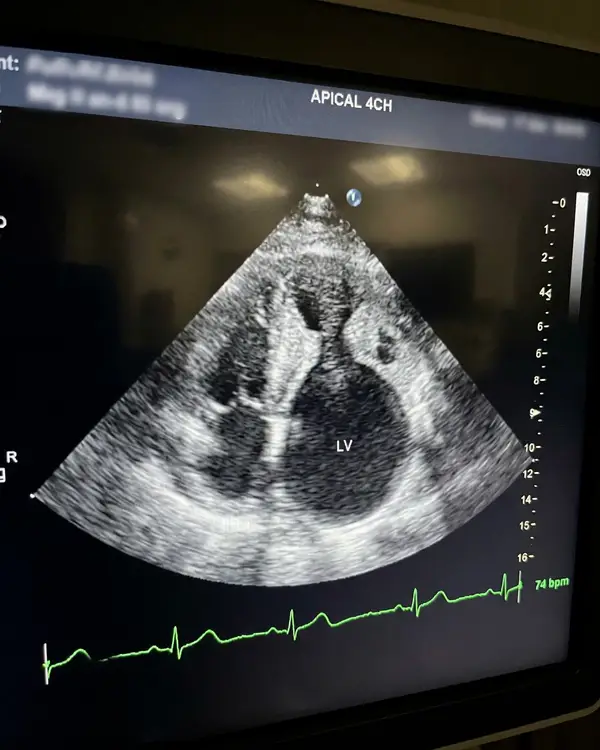
My cardiologist wrote one word on a paper
My gay husband ordered my first vibrator from my ICU bed. He checked twice that it came in a plain box. My name is Denise. I'm 52, a mother of three, and I walk every morning. I don't smoke. I thought I was healthy. In this post I'm going to tell you about the worst conversation of my life... what happened to my heart before my husband even finished talking... and the question a cardiologist asked me in the ICU that I still can't believe came out of her mouth. Nobody had asked me that in 52 years. So let me start from the beginning. Mark and I got married when I was 26. He was funny, kind, the kind of man who remembered things. But we always struggled with intimacy. I mean always. Months would go by without him touching me. Every time I brought it up, same answers. "I'm just tired." "Work is crazy right now." "It's not you." I never believed him. I'd stand in front of the bathroom mirror and go through the list. The wrinkles around my eyes. The belly that never went back after three kids. I convinced myself that was the reason. That I'd let myself go. That I wasn't enough anymore. Once, maybe four years in, I bought lingerie. Came downstairs with my heart pounding. He looked up from the couch, smiled, and said, "You look nice." Then he turned off the lamp. I never tried again. After a while, I just stopped. Stopped reaching for him in the middle of the night. He hadn't touched me in years. And I hadn't touched myself in even longer. I told myself women my age just don't care about that stuff anymore. That desire belonged to your thirties. Meanwhile, I was waking up at 3am every single night. Mind racing. Jaw clenched so tight I'd have a headache before I got out of bed. Shoulders up by my ears from the moment I woke. Snapping at the kids over nothing, then hating myself for it. I thought that was menopause. I thought that was just three kids and a busy life. I had no idea my body was sending up flares. It was a Tuesday in October. I was on the couch with a blanket and a cup of tea, watching Bridgerton. (Funny now, in a dark way. Watching other people's passion while mine had been dead for years.) Mark came down the stairs. Face pale. Hands shaking. He stood in the doorway for a long time without saying anything. Then he said we needed to talk. The way he said it made my stomach drop straight through the floor. I turned off the TV. He sat in the chair across from me. He couldn't look at me. He said our marriage had never been what it should have been. That he'd spent 26 years trying to be someone he wasn't. My mind went everywhere. Another woman? Was he leaving? And then he said it. He was gay. Time stopped. 26 years started playing back like a film. The turned backs. The excuses. The lamp going off. It wasn't about me. It had never been about me. And while he was still talking, something happened in my chest. A crushing pain, like a steel band being tightened around my ribs. I grabbed my chest. I tried to speak. Nothing came out. My vision started to tunnel. I could see Mark jumping up, his mouth moving, shouting my name. His voice sounded like it was coming from underwater. Then everything went black. I woke up in the ICU. Bright lights. Beeping machines. Wires on both arms. Mark in a chair beside me, face swollen from crying. A few minutes later, a woman in a white coat walked in. About 55, reading glasses on a chain, calm voice. She was the cardiologist on call. She pulled a chair close and told me I'd collapsed in my living room. My heart had nearly stopped. Mark called 911, and the paramedics got to me just in time. I told her that couldn't be right. I walk every morning. I'm healthy. She nodded slowly. Then she told me my arteries were clean. Not one blockage. So what happened? She said my heart didn't get blocked. It got stunned. It's called broken heart syndrome. Doctors call it takotsubo, named after a Japanese octopus trap, because the bottom of the heart balloons into that shape. Nine out of ten people it happens to are women past menopause. It can kill about as often as a heart attack does. If Mark had called 911 ten minutes later, we'd be having a very different conversation. Then she said the news wasn't the cause. It was the match. My body had been soaked in gasoline for years. It could have been a car accident. A phone call. A funeral. Anything. She asked me three questions. Do you wake up at 3am? Is your jaw tight when you wake up? When did your shoulders last come down? Yes. Yes. I can't remember. She nodded like she'd heard it a hundred times. "You're not weak, Denise. You're biologically blocked." She said my body had been stuck in survival mode for years. Cortisol and adrenaline, the stress alarm, jammed in the ON position. Like a smoke alarm blaring long after the fire is out. Then menopause took away estrogen, the hormone that used to cushion my heart from that alarm. So when the shock hit, the alarm had no brake. And my heart had no protection. I asked her why nobody had ever told me this. She said most heart research was done on men. And no doctor wants to ask a 52-year-old woman the question she was about to ask me. She looked at me very directly. The machine next to me beeped. "Denise, when did you last have an orgasm?" Mark looked up from his hands. I almost laughed. Then I almost cried. Because I genuinely could not remember. Years. Maybe ten. She didn't flinch. She said an orgasm is the body's built-in off switch. The one moment the body is forced to hit the brake on stress. For 26 years, my body never got to switch off. The stress had nowhere to go. So it went into my jaw. My shoulders. My sleep. And last Tuesday... my heart. Then she said the line I think about almost every day. "An orgasm isn't a luxury. It's recovery." I said the obvious thing. "So I just need to relax? I'll download a meditation app. Take a bath. My sister swears by magnesium." She shook her head. You can't think your way out of this. You can't breathe your way out either. Meditation calms your thoughts for five minutes. But the alarm isn't in your thoughts. It's stored in your body. In your jaw, your shoulders, your pelvis. So it has to go through your body, not your head. Here's what an orgasm actually does. Oxytocin floods your system. It rises 300 to 500 percent, and it blocks cortisol. Like a foot slamming the brake. Endorphins pour in on top of that. Natural painkillers, stronger than morphine. Then dopamine. Then serotonin. An orgasm is the only thing that releases all four at once. I said, "So I just need... an orgasm?" She said, "Not just any orgasm. That's where most women get it wrong." There are two completely separate nerves. The pelvic nerve, connected to the G-spot. The deep line. And the pudendal nerve, connected to the clitoris. The outside line. Most orgasms only touch one. That's pressing the brake halfway. Both nerves have to fire at the same time. Think of a bank vault with two keys. Both have to turn at once, or the door doesn't open. When both fire together, your brain gets flooded with so much sensation it can't hold on to the stress response anymore. It's called a neurological override. Your whole body gets knocked into rest mode. And what you feel is called a Super Climax. A blended orgasm. G-spot and clitoris at the same time. The full-body kind. The kind that actually reaches the stored tension. I said, "Okay. So I need both. Got it." She said, "There's one more thing." At this point I was thinking what you're probably thinking. ANOTHER thing? The rhythm has to be steady. And it has to hold long enough. The second the rhythm breaks, the build breaks with it. Fingers cramp. Wrists give out. A partner can't hold the rhythm long enough. Too much distraction. Too much performance. I glanced at Mark. He studied the floor like it owed him money. And those little bullet vibrators only reach one nerve. They're tickling the surface. It's like jumper cables. If the clamp slips for even a second, the engine never catches. So she counted it off on her fingers. ✅ The deep line: the G-spot ✅ The outside line: the clitoris ✅ Both at the same time, with a rhythm that doesn't break ✅ Until the Super Climax floods you with oxytocin and slams the brake on cortisol Miss one, and the chain breaks. And the alarm stays on. I looked at her and said, "So I need a very patient boyfriend with two hands and no wrist problems?" She laughed. Actually laughed. "No. You need one thing." A company called NUMY built a vibrator for exactly this. Not for fun. For the reset. It's called Bold. The curved end finds the G-spot on its own. The outer end sits right on the clitoris. That's called duo-stimulation. Two motors, two nerves, at the same time. Ten thrusting rhythms. Ten vibrating rhythms. Medical-grade silicone. Whisper quiet. A steady rhythm that doesn't break. "Bold isn't a toy. It's a reset button." Then she said something that made it real. "I'm 56. I own one. So does my sister." 509 clinicians share it on FrontrowMD without being paid a cent. Then she wrote "Bold" on a piece of paper. And handed it to Mark. My gay husband of 26 years. Who had come out to me two days earlier. He took the paper. Looked at it. Pulled out his phone. And ordered my first vibrator from the ICU. He checked twice that it came in a plain box. I don't know whether to laugh or cry about that, so I usually do both. 👇 (If you already know you need this, the link is below. The rest of this post is what happened next.) I was discharged two days later. A few days after that, the box showed up. Plain. No logo. Nothing on the outside to tell you what it was. I sat on the edge of my bed for a long time before I opened it. I hadn't had anything inside me in years. It looked bigger than I expected. I almost put it back in the box. But the curve did the finding. My hand went still. My body took over. And then the Super Climax hit. My whole body shook. I cried. Not from pleasure. From relief. Like something that had been clenched for a decade finally let go. I slept seven hours straight. No 3am wake-up. No racing mind. Just sleep. ✅ Week 1: sleeping through the night, every night. ✅ Week 2: jaw unclenched. Shoulders came down. Stopped snapping at the kids. ✅ Week 3: my daughter looked at me across the kitchen table and said, "Mom, you look different." She couldn't say how. ✅ Week 6: my follow-up. My heart had healed, just like the cardiologist said it would. She asked if I was still switching it off. I said every night. She said, "Good. Keep going." I want to be clear: Bold didn't heal my heart. Time did that. But Bold is why the alarm finally stopped. Mark moved out in January. He sends me pictures now. Crop tops. Dyed hair. Sometimes he texts me, "Did you reset today?" Part of me still resents him. Mostly I want him happy. And I feel more like a woman at 52 than I did at 30. Turns out I'm not special. More than 14,000 women use Bold now. 91% felt relief right away. 89% fall asleep faster. 93% feel calmer after four weeks. I'm telling you this because I don't want you to find out in a hospital bed. If you're over 45... If you can't remember your last orgasm... If your jaw is tight before you even open your eyes... If you're awake at 3am with a mind that won't stop... Your alarm is stuck on. You might not feel it in your heart yet. I didn't either. After I got home, I emailed NUMY and told them my story. They set up a link for the women who read this. For Black Friday, Bold is up to 50% off. The sale ends November 30. It comes with the 14-day guided reset program for free, a step-by-step walkthrough for your first session. No guessing, no pressure. A free satin pouch. A plain box, no logo, anonymous billing. Nobody knows, not even the mailman. And a 30-day money-back guarantee, even if you've already used it. Bold has sold out three times this year. Tap the link below to check if it's still in stock. Don't wait for a hospital bed to find out your body never switched off. I wish someone had asked me that question 20 years ago.
Loading the ad's image