AdvertorialPhotographed Nov 25 at phone size

Women's Wellness Report - Dowager's Hump – Cevera

trycevera.com/pages/adv2-womens-wellness-report
48Ads sending people here
May 2026Oldest running ad started
ShopifyPlatform
Nov 2026In Sniped since

Why “Advertorial”

Read from the page, by rules
A long article (900+ words)Three or fewer buy buttonsSponsored or blog-style page

Ads sending people here

Search these ads

How I discovered my "permanent" neck hump wasn't permanent...

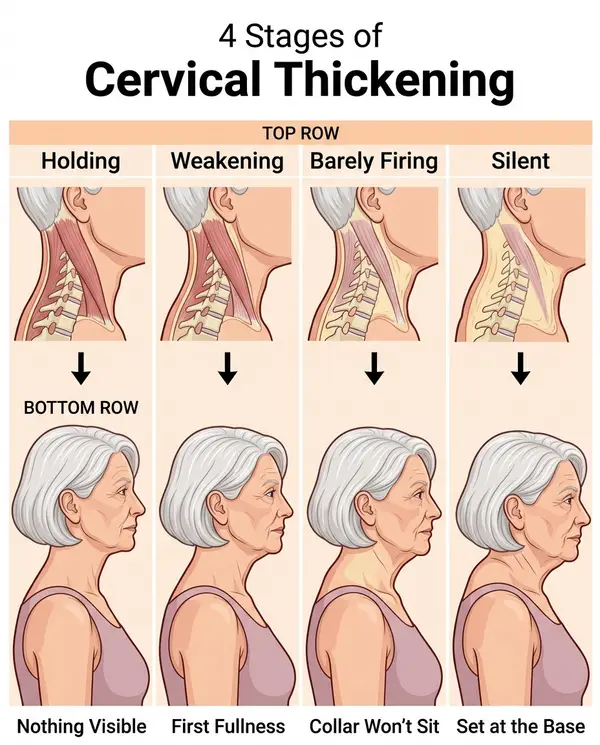
If your chiropractor told you that you have a neck hump and all she said was "keep up the adjustments," I'm writing this for you specifically. Because I was you three years ago and nobody told me what was actually happening inside my cervical structure. My name is Maria. I'm 56. Found out I had a progressing neck hump at a routine posture assessment when I was 53. My forward head position was 2.8cm. My chiropractor said "you have some forward head positioning, let's start twice-weekly adjustments and we'll recheck in six months." That was the whole appointment. So for two years that's all I did. I changed my posture habits. I cut out all unnecessary screen time. I started doing posture exercises four days a week. I lost some weight that wasn't helping matters. Went back for my recheck expecting good news. Forward head position was 2.7cm. I'd spent two years doing everything right and my number barely moved. My chiropractor looked at the chart and said "well, keep doing what you're doing. These things take time." But here's what she didn't tell me. While I was focused on adjustments and exercises, something else was happening inside my cervical structure. Something that posture habits alone can't fix. I didn't find out until much later. And when I did, I was furious. About six months after that appointment, the coverage planning started taking over my mornings. Not dramatic at first. Just a slight hesitation before reaching into my wardrobe. I'd stand there for a few minutes trying to figure out what worked. I'd put something on, turn sideways, take it off. I'd find myself always choosing the same few things. I told my chiropractor. She said it was probably anxiety about the hump. Maybe focus on acceptance alongside the management. Then the wardrobe reorganization. Not overnight. Gradual. The kind where you don't notice until you realize you haven't worn an open neckline in eight months. The kind where your husband asks if you want to take a photo at your granddaughter's birthday and you feel something tighten in your chest before the camera comes out. The kind where you start positioning yourself in group photos without consciously deciding to. I went back again. More assessment. Forward head position was now 2.9cm. Going up, not down. She said "your measurements are slightly elevated but nothing alarming. Let's keep monitoring." Monitoring. That word should have made me angry. It didn't at the time. But it does now. Because here's what monitoring means: we're going to watch this consolidate and do nothing until the tissue is too established to reverse. I started researching on my own. Late at night. Googling things I didn't want to Google. Neck hump stages. Cervical progression. Tissue consolidation. What happens when it's permanent. And I thought about my aunt. She was told she had a progressing neck hump in her late 40s. Same thing I heard. Keep up the adjustments. Watch your posture. Come back next year. She came back every year. She watched her posture. She wore her brace. Year 3: measurements crept up. Chiropractor said keep monitoring. Year 6: an assessment showed the tissue had consolidated significantly. They called it established cervical progression. She was scared but they said it was "manageable." Year 9: the tissue had consolidated further. They used the word "permanent structural change" for the first time. Year 12: she had reorganized her entire life around the hump. She stopped going to events. She stopped appearing in family photos. She wore the same five outfits every week because everything else showed it. She never got her wardrobe back. She is 67 years old and she has not worn an open neckline in nine years. Her forward head position when she was first assessed? 2.6cm. Almost exactly what mine was. I was not going to be my aunt. I refused. I read that millions of women over 50 have progressive neck hump tissue buildup. That most don't fully understand what's driving it. That practitioners call it "age-related postural change" when the real cause has a specific name and a specific address. I read that neck hump tissue builds in a progression. Early forward pull becomes visible tissue. Visible tissue becomes consolidated tissue. Consolidated tissue becomes permanent structural change. And then I read something that changed everything. The real problem isn't the posture. The posture is the visible result of a chain reaction. After decades of accumulated forward load — screens, driving, cooking, looking down — the deep cervical muscles become chronically overloaded. The brain shuts them off to protect them. This is called neuromuscular inhibition. Once those muscles go quiet, the head has nothing holding it back. It drifts forward continuously. The body builds compensatory tissue at the base of the neck to absorb the constant stress. The neuromuscular inhibition is the driver. Without restoring the brain-muscle signal, everything else is just managing the symptom. And here's the part that made me furious. In people with progressing neck humps, the inhibition is chronically established. The accumulated forward load keeps the muscles switched off faster than the body can compensate. The more the tissue builds, the harder the inhibition pulls. The harder the inhibition pulls, the more tissue builds. It's a cycle. And nothing my chiropractor told me to do breaks that cycle. Adjustments help. Exercises help. Posture habits help slow the forward load. But none of those things directly restore the brain-muscle signal. That's why my forward head position didn't move in two years. I was reducing the load but the inhibition was already running. And my cervical structure had nothing to restore the signal with. I felt like I'd been painting over a wall that was still getting wet from behind. I called my chiropractor. I said what about the neuromuscular inhibition? Why aren't we addressing the signal directly? Why are we only talking about adjustment? She said she was "aware of" direct cervical muscle reactivation approaches but there was no standard protocol for it in her practice. I said what about home tools? She said she couldn't recommend anything she hadn't assessed. So I went looking myself. First thing I tried was a foam roller. Because that's what everyone uses for neck and upper back. Amazon, $22. Used it faithfully for five months. Got my assessment done. Forward head position 2.7cm. Five months. No change. Turns out foam rollers apply surface pressure to the surrounding musculature — nowhere near the inhibited deep cervical motor nerves where the signal has been cut. It's like trying to restore a broken electrical connection by polishing the light switch. The switch looks better. The circuit stays broken. Then I tried a cervical contour pillow. Then a traction device. Then one of those multi-function cervical posture tools with six different settings. Forward head position stayed between 2.7cm and 2.9cm the entire time. Bouncing around. Never coming down. I was spending money every month on tools that weren't doing a single thing. That's when I found direct cervical muscle reactivation via EMS. I'd never heard it called that before. But what I read stopped me cold. The deep cervical muscles restore on one specific mechanism that has to be delivered correctly. Electrical muscle stimulation — EMS — bypasses the broken brain-muscle signal entirely. Instead of asking inhibited muscles to respond, EMS sends gentle electrical pulses directly to the inhibited muscle fibers. The muscles are forced to activate regardless of what the brain is or isn't signaling. And the delivery has to be right. The right programs. The right graduated intensity. Enough session time for the motor nerves to register the input and begin restoring the connection. Fall short on any of those — the signal doesn't restore. The inhibition keeps running. The tissue keeps building. And that's why the foam roller wasn't working. It never reached the motor nerves. That's why the cervical pillow wasn't working. No electrical activation. That's why the traction device wasn't working. It decompresses the joint above the inhibited muscles while the signal below keeps failing. Same principle. Same problem: inhibition that never gets the direct electrical input it requires to restore. I ordered Cevera that week. 8 unique massage programs and 19 adjustable intensity levels — engineered specifically for the deep cervical muscles. 15 minutes, whenever it suits me. The clinical input standard, not the broad cervical tool I'd been telling myself was enough. It cost more than the Amazon stuff. But at this point I'd spent over $400 on tools that hadn't done anything. I figured one more try. Week 1: I slept better. Not dramatically. Just deeper. Less waking up with the automatic neck position awareness. Week 2: I noticed I wasn't doing the full coverage calculation at 7am. The morning decision was still there but shorter. Week 3: my husband said something I wasn't expecting. He said "you seem more like yourself lately." I hadn't even told him I was trying something new. Week 4: the wardrobe planning wasn't gone completely but I could feel it thinning. Like a calculation that had been running every morning for years was starting to run quieter. Week 8: I had my assessment scheduled anyway. Almost didn't want to look. Forward head position: 1.9cm. I read it three times. Then I read it again. 1.9cm. Down from 2.8cm. First time under 2.0cm since my diagnosis. I sat in my car in the parking lot and cried. Not because of the number. Because of the three years I wasted not knowing this existed. My chiropractor pulled up the trend line at my next appointment. She looked at the screen for a long time. "What changed?" she asked. I told her everything. The neuromuscular inhibition. The broken brain-muscle signal. The difference between mobilizing the joint above the inhibited muscles and bypassing the signal entirely with EMS. The direct cervical muscle reactivation. The 15-minute protocol. She listened. She wrote it down. She didn't say "you should have told me you were trying something new." She didn't dismiss it. She looked at the numbers and she wrote it down. That was nine months ago. My last forward head position was 1.4cm. Still improving. The coverage calculation is gone. Not reduced. Gone. I get dressed in ten minutes without strategy for the first time in years. My energy around getting dressed is back. I don't spend the first part of my morning calculating anymore. I just choose what I want to wear. I'm in photos. At my granddaughter's last birthday I stood at the front. Didn't position myself. Just stood there. And for the first time since my diagnosis, I'm not afraid of what my next assessment will show. I'm not afraid of the word "permanent" anymore. I'm not Googling "neck hump reversal timeline" at 2am anymore. I understand now what was happening to me. The forward load was creating inhibition. The inhibition was preventing the deep cervical muscles from firing. Without reactivation, my head stayed pulled forward continuously. And everything my chiropractor told me to do addressed the joint above the inhibited muscles but nothing addressed the inhibition itself. It's like telling someone with a circuit breaker that tripped to keep flipping the light switch harder. Yes, flipping the switch helps a little. But until you restore the current, the lights stay off. Direct EMS reactivation restores the current. If you're reading this and you have a progressing neck hump. If your measurements are creeping. If you've been told to keep up the adjustments and come back next year. If you've been using foam rollers and watching your numbers stay the same. If the coverage planning has crept into your mornings. If the wardrobe is reorganizing itself around the same problem. If you're scared of what comes next. Please hear me. Your deep cervical muscles have never been directly reactivated. That's the root cause. And nothing you've been told to do addresses it. EMS is what the inhibited muscles require. Direct electrical activation, graduated intensity, consistent daily input. Cevera delivers all of that in 15 minutes, whenever it suits you. My forward head position went from 2.8cm to 1.4cm in about nine months. The coverage calculation is gone. My chiropractor went from "keep monitoring" to "whatever you're doing, keep doing it." I wish someone had told me this the day I was diagnosed instead of three years later. I can't get those three years back. But I can tell you now so you don't lose yours. 👉 https://trycevera.com/pages/adv2-womens-wellness-report P.S. A few things: 90-day money-back guarantee. If your measurements don't improve, every dollar back. No questions. Cevera is a small company. I've seen them have availability constraints twice this year. I went from 2.8cm forward head position and three years of coverage planning to 1.4cm and getting dressed in ten minutes without strategy. My aunt lost years of her life because nobody told her any of this. You know now. 👉 https://trycevera.com/pages/adv2-womens-wellness-report

Loading the ad's image
Barbara Linfield — How I discovered my "permanent" neck hump wasn't permanent...
WinningImage

How I discovered my "permanent" neck hump wasn't permanent...

If your chiropractor told you that you have a neck hump and all she said was "keep up the adjustments," I'm writing this for you specifically. Because I was you three years ago and nobody told me what was actually happening inside my cervical structure. My name is Maria. I'm 56. Found out I had a progressing neck hump at a routine posture assessment when I was 53. My forward head position was 2.8cm. My chiropractor said "you have some forward head positioning, let's start twice-weekly adjustments and we'll recheck in six months." That was the whole appointment. So for two years that's all I did. I changed my posture habits. I cut out all unnecessary screen time. I started doing posture exercises four days a week. I lost some weight that wasn't helping matters. Went back for my recheck expecting good news. Forward head position was 2.7cm. I'd spent two years doing everything right and my number barely moved. My chiropractor looked at the chart and said "well, keep doing what you're doing. These things take time." But here's what she didn't tell me. While I was focused on adjustments and exercises, something else was happening inside my cervical structure. Something that posture habits alone can't fix. I didn't find out until much later. And when I did, I was furious. About six months after that appointment, the coverage planning started taking over my mornings. Not dramatic at first. Just a slight hesitation before reaching into my wardrobe. I'd stand there for a few minutes trying to figure out what worked. I'd put something on, turn sideways, take it off. I'd find myself always choosing the same few things. I told my chiropractor. She said it was probably anxiety about the hump. Maybe focus on acceptance alongside the management. Then the wardrobe reorganization. Not overnight. Gradual. The kind where you don't notice until you realize you haven't worn an open neckline in eight months. The kind where your husband asks if you want to take a photo at your granddaughter's birthday and you feel something tighten in your chest before the camera comes out. The kind where you start positioning yourself in group photos without consciously deciding to. I went back again. More assessment. Forward head position was now 2.9cm. Going up, not down. She said "your measurements are slightly elevated but nothing alarming. Let's keep monitoring." Monitoring. That word should have made me angry. It didn't at the time. But it does now. Because here's what monitoring means: we're going to watch this consolidate and do nothing until the tissue is too established to reverse. I started researching on my own. Late at night. Googling things I didn't want to Google. Neck hump stages. Cervical progression. Tissue consolidation. What happens when it's permanent. And I thought about my aunt. She was told she had a progressing neck hump in her late 40s. Same thing I heard. Keep up the adjustments. Watch your posture. Come back next year. She came back every year. She watched her posture. She wore her brace. Year 3: measurements crept up. Chiropractor said keep monitoring. Year 6: an assessment showed the tissue had consolidated significantly. They called it established cervical progression. She was scared but they said it was "manageable." Year 9: the tissue had consolidated further. They used the word "permanent structural change" for the first time. Year 12: she had reorganized her entire life around the hump. She stopped going to events. She stopped appearing in family photos. She wore the same five outfits every week because everything else showed it. She never got her wardrobe back. She is 67 years old and she has not worn an open neckline in nine years. Her forward head position when she was first assessed? 2.6cm. Almost exactly what mine was. I was not going to be my aunt. I refused. I read that millions of women over 50 have progressive neck hump tissue buildup. That most don't fully understand what's driving it. That practitioners call it "age-related postural change" when the real cause has a specific name and a specific address. I read that neck hump tissue builds in a progression. Early forward pull becomes visible tissue. Visible tissue becomes consolidated tissue. Consolidated tissue becomes permanent structural change. And then I read something that changed everything. The real problem isn't the posture. The posture is the visible result of a chain reaction. After decades of accumulated forward load — screens, driving, cooking, looking down — the deep cervical muscles become chronically overloaded. The brain shuts them off to protect them. This is called neuromuscular inhibition. Once those muscles go quiet, the head has nothing holding it back. It drifts forward continuously. The body builds compensatory tissue at the base of the neck to absorb the constant stress. The neuromuscular inhibition is the driver. Without restoring the brain-muscle signal, everything else is just managing the symptom. And here's the part that made me furious. In people with progressing neck humps, the inhibition is chronically established. The accumulated forward load keeps the muscles switched off faster than the body can compensate. The more the tissue builds, the harder the inhibition pulls. The harder the inhibition pulls, the more tissue builds. It's a cycle. And nothing my chiropractor told me to do breaks that cycle. Adjustments help. Exercises help. Posture habits help slow the forward load. But none of those things directly restore the brain-muscle signal. That's why my forward head position didn't move in two years. I was reducing the load but the inhibition was already running. And my cervical structure had nothing to restore the signal with. I felt like I'd been painting over a wall that was still getting wet from behind. I called my chiropractor. I said what about the neuromuscular inhibition? Why aren't we addressing the signal directly? Why are we only talking about adjustment? She said she was "aware of" direct cervical muscle reactivation approaches but there was no standard protocol for it in her practice. I said what about home tools? She said she couldn't recommend anything she hadn't assessed. So I went looking myself. First thing I tried was a foam roller. Because that's what everyone uses for neck and upper back. Amazon, $22. Used it faithfully for five months. Got my assessment done. Forward head position 2.7cm. Five months. No change. Turns out foam rollers apply surface pressure to the surrounding musculature — nowhere near the inhibited deep cervical motor nerves where the signal has been cut. It's like trying to restore a broken electrical connection by polishing the light switch. The switch looks better. The circuit stays broken. Then I tried a cervical contour pillow. Then a traction device. Then one of those multi-function cervical posture tools with six different settings. Forward head position stayed between 2.7cm and 2.9cm the entire time. Bouncing around. Never coming down. I was spending money every month on tools that weren't doing a single thing. That's when I found direct cervical muscle reactivation via EMS. I'd never heard it called that before. But what I read stopped me cold. The deep cervical muscles restore on one specific mechanism that has to be delivered correctly. Electrical muscle stimulation — EMS — bypasses the broken brain-muscle signal entirely. Instead of asking inhibited muscles to respond, EMS sends gentle electrical pulses directly to the inhibited muscle fibers. The muscles are forced to activate regardless of what the brain is or isn't signaling. And the delivery has to be right. The right programs. The right graduated intensity. Enough session time for the motor nerves to register the input and begin restoring the connection. Fall short on any of those — the signal doesn't restore. The inhibition keeps running. The tissue keeps building. And that's why the foam roller wasn't working. It never reached the motor nerves. That's why the cervical pillow wasn't working. No electrical activation. That's why the traction device wasn't working. It decompresses the joint above the inhibited muscles while the signal below keeps failing. Same principle. Same problem: inhibition that never gets the direct electrical input it requires to restore. I ordered Cevera that week. 8 unique massage programs and 19 adjustable intensity levels — engineered specifically for the deep cervical muscles. 15 minutes, whenever it suits me. The clinical input standard, not the broad cervical tool I'd been telling myself was enough. It cost more than the Amazon stuff. But at this point I'd spent over $400 on tools that hadn't done anything. I figured one more try. Week 1: I slept better. Not dramatically. Just deeper. Less waking up with the automatic neck position awareness. Week 2: I noticed I wasn't doing the full coverage calculation at 7am. The morning decision was still there but shorter. Week 3: my husband said something I wasn't expecting. He said "you seem more like yourself lately." I hadn't even told him I was trying something new. Week 4: the wardrobe planning wasn't gone completely but I could feel it thinning. Like a calculation that had been running every morning for years was starting to run quieter. Week 8: I had my assessment scheduled anyway. Almost didn't want to look. Forward head position: 1.9cm. I read it three times. Then I read it again. 1.9cm. Down from 2.8cm. First time under 2.0cm since my diagnosis. I sat in my car in the parking lot and cried. Not because of the number. Because of the three years I wasted not knowing this existed. My chiropractor pulled up the trend line at my next appointment. She looked at the screen for a long time. "What changed?" she asked. I told her everything. The neuromuscular inhibition. The broken brain-muscle signal. The difference between mobilizing the joint above the inhibited

Loading the ad's image
Barbara Linfield — How I discovered my "permanent" neck hump wasn't permanent...
WinningImage

Neck Hump? It's Not About Your Posture...

I've watched too many neck hump patients end up in specialist intervention to keep my mouth shut about this. If you've been told "just keep doing your exercises" for your neck hump, I need to tell you something your practitioner isn't telling you. My name is Linda Marsh. I've treated over 200 neck hump patients in 15 years as a manual therapy and cervical rehabilitation specialist. And when a patient walks into my office after their primary care said "do your exercises, we'll recheck in six months," I already know what their assessment will show 5 to 10 years later if nothing changes. Advanced tissue consolidation. The same signal failure driving their forward head progression is quietly building compensatory tissue at the base of their neck right now. And at 51, when my own assessment showed 2.4cm of forward head displacement, I knew exactly what my practitioner was about to tell me. And exactly what she wasn't. Your neck hump isn't a "watch and wait" problem. It's a neuromuscular signal failure happening at the motor nerve level. I've been treating neck hump progression for 15 years. I've seen hundreds of patients dismissed with "keep doing your exercises, we'll recheck in six months." Most of them walked out, Googled the diagnosis on the drive home, and stopped at the wellness store on the way back. Posture braces. Cervical pillows. Foam rollers. One of those 8-in-1 posture correction kits. The tools every neck hump article on the internet eventually recommends. They used them for months. Some for years. Their measurements barely moved. And what's worse, they thought they were doing something about the problem. Because primary care sees you once. Writes the dismissal. Sends you home. They don't see you 5 to 10 years later when you're sitting in my office with tissue that has consolidated past the point of easy reversal and the word "specialist referral" on your chart for the first time. But I do. Margaret's mother. Diagnosed with forward head progression at 49. Same advice. Keep doing your exercises, recheck next year. Year after year. By 62 her tissue had consolidated enough that they finally ordered specialist input. By 65 she had been through three intensive intervention programs. Still progressing. Still managing. Her starting forward head measurement was 2.1cm. Almost exactly what mine was. James — one of my patients, 31. Came to me with forward head displacement of 2.8cm. Normal posture habits. What I'm ashamed to say I didn't recognize quickly enough was that the inhibition was already well established. I gave him the same "exercises and adjustment protocol" speech I'd been giving for years. He came back 18 months later with tissue consolidation at F2-F3 equivalent — visible, measurable, past the window of easy reversal. Still addressable at that stage. But barely. He's the patient I think about at night. They had years. They just didn't know they had them. Because nobody had explained what their assessment was actually pointing at, or what was quietly building underneath those numbers while they waited for the next recheck. The assessment was telling them the truth from the first appointment. The tools they were using didn't change anything. They just made them feel like they were doing something. My symptoms told me I was fine. My assessment said otherwise. I felt fine. A little more careful getting dressed in the morning. A quiet calculation I'd been running for so long it felt normal. My forward head position had crept up but nothing dramatic. Then a routine self-assessment caught it. My practitioner looked at the panel and said what she says to every patient. "Standard plan. Keep doing your exercises, reduce screen time, recheck in six months." I knew it wouldn't work. That's not the point. I'm a cervical rehabilitation specialist. I'd watched over 200 patients try exactly that and watched their measurements stay exactly the same or even progress further. So I ordered my own full cervical assessment. Forward head: 2.4cm. Tissue density at cervicothoracic junction: measurably elevated. Deep cervical muscle activation: 18% of clinical threshold. Because I know what those numbers actually mean. Early inhibition-driven progression. Neuromuscular signal failure at the motor nerve level. The kind of brain-muscle disconnection that exercises and adjustments alone were never going to fix. My forward head progression wasn't a "do more exercises" problem. It was my deep cervical muscles' defense system being switched off faster than any surface protocol could switch them back on. And another six months of "monitoring" would have masked the only early warning sign I had. Here's what primary care doesn't tell you because they don't follow long-term cervical progression outcomes. Your deep cervical muscles don't send obvious pain signals. They don't cramp dramatically. They don't fail suddenly. They don't warn you. By the time your forward head measurement is elevated, the inhibition has been progressing for years. By the time the tissue has consolidated, the signal failure has been running in silence. You're not "just getting older" or "sitting badly" or "stressed." Your deep cervical motor nerves are losing the signal they need to keep the head back. The same process pushing your measurements forward is quietly building compensatory tissue underneath. Right now. Roughly 1 in 4 patients with established neuromuscular inhibition progresses to consolidated tissue within 10 years without signal-level intervention. By the time most neck hump patients seek specialist input, the window for easy reversal has already narrowed significantly. Your neck hump isn't embarrassing. It's your 5 to 10 year early warning system. And exercises silence that alarm while the inhibition advances. So I tried what patients try. Posture habits. Reduced screen time. Ergonomic desk setup. Walking every morning. Improved how I felt a little, but measurements stayed elevated. Tools. Posture brace. Cervical pillow at the clinical dose. Foam roller protocol. A cervical correction kit with 8 components I used religiously. 18 weeks of disciplined use. Assessment came back. Forward head: 2.3cm. I moved one millimeter. 18 weeks of doing exactly what I'd been telling 200 patients to do. Nothing was addressing the signal failure driving the progression. But I kept thinking about something that made no sense. Neuromuscular inhibition IS reversible. The research proves it. The brain-muscle signal CAN be restored. Even established inhibition CAN respond to the right input. So why wasn't mine reversing? And why hadn't my patients' inhibition reversed either? October 8th. Late at night. I was reviewing 18 months of patient outcome data in my home office after a long clinic day. Couldn't sleep. My own assessment had just come back at 2.3cm. I wasn't looking for anything specific. If I'm being honest, I was pretty desperate. I'd compiled outcomes for every patient I'd put on a standard adjustment and exercise protocol for at least six months. Average forward head change at 6 months. Average change at 12 months. Average change at 18 months. The numbers stopped me cold. Patients on standard protocols showed no statistically meaningful improvement compared to patients managing on their own. Eighteen months. 200+ patients. Almost zero meaningful difference. I sat there staring at a spreadsheet I should have run five years earlier. I was the specialist recommending adjustment protocols for 15 years. And I was wrong about the mechanism. Then I pulled up the small subset. The ones who'd done their homework. They'd quietly added something else on their own while I was still recommending exercises. Direct EMS. Electrical muscle stimulation targeted at the deep cervical motor nerves. Some had bought the cheap version after Googling. Generic surface EMS from Amazon. $29.99. Their measurements barely moved either. Maybe a millimeter, then they plateaued. That sent me down another rabbit hole. Generic surface EMS devices have a serious targeting problem. The stimulation frequency and intensity don't reach the deep cervical motor nerves. The signal activates sensory nerves, not motor nerves. Studies show effective motor nerve activation requires specific program parameters — graduated intensity, multiple distinct programs for different stages of inhibition. Most consumer devices deliver fixed surface stimulation. So a generic EMS device? Your deep cervical motor nerves actually receive almost none of the activation required to overcome established inhibition. That's surface stimulation at a fraction of the clinical parameter range, reaching a tenth of the motor nerve depth that matters. No wonder my patients on generic EMS devices saw nothing. But the small group who'd found clinical-grade cervical EMS with 8 unique programs and 19 adjustable intensity levels? Those numbers told a different story. The graduated delivery works past the surface layer and reaches the inhibited motor nerve pathways directly. Same technology basis used in advanced rehabilitation settings. Their forward head measurements were moving. Real movement. The kind of result I'd been promising patients for 15 years but never actually seeing. I'd been a cervical rehabilitation specialist for 15 years. I'd studied neuromuscular inhibition my entire career. And I'd never properly understood why adjustment protocols weren't doing the job. Adjustment protocols work on the joint above the inhibited muscles. That's their mechanism. But they can't give the inhibited motor nerves the direct electrical activation they need to restart the signal. Direct EMS can. It delivers electrical pulses straight to the motor nerve pathway — the one input the inhibited deep cervical muscles need to start activating again regardless of what the brain is or isn't sending. One addresses the joint above. The other restores the signal directly. It's the same mec

Loading the ad's image
Dr. Linda Marsh, DPT — Neck Hump? It's Not About Your Posture...
WinningImage

Read This If You Have A Neck Hump ☝️

I've had three practitioners in the past eight years tell me my neck hump is a posture problem. Not one of them was right. Eight years. Three different specialists. The same wrong explanation every single time. Eight years of posture exercises that left me frustrated when nothing moved. Eight years of adjustment protocols that helped for 48 hours and then reset completely. Eight years of hearing "your body just doesn't respond as well to manual therapy as some patients do." I followed their advice religiously. Posture journal for two full years. I tracked every screen hour, every driving hour, every forward-loaded activity. Logged my measurements month by month. Tried to find a pattern that would explain why I kept progressing despite doing everything right. Posture correction protocol. Twice. Eight weeks of nothing but exercises, chin tucks, and feeling no different while my colleagues sat at their desks without thinking about their necks once. When nothing improved, they ordered more assessments. Cervical range of motion. Normal. Postural analysis. "Mild forward head." Deep cervical muscle strength testing. "Within expected range for age." "Sometimes we just can't get the progression to stop," my third cervical specialist said. "That's why we call it age-related cervical change. Your neck just responds differently than other people's. Here's a referral for ongoing management." I wanted to scream. My neck doesn't "respond differently." Something is wrong, and nobody can tell me what. Every single day followed the same miserable pattern. Morning: fine. Head sitting reasonably back. Manageable. By 11am: the forward pull starts. By 1pm: I'm calculating angles. Which way to turn for the meeting. Which side of the table to sit at. By evening: I'm at home, collar up, too aware of my own neck to sit comfortably in company. Then overnight, everything resets slightly. I wake up and the pull is quieter. And the whole thing starts again. I knew exactly which seats at every meeting table gave me the best angle. Every restaurant, every event, every family gathering. I'd position myself before agreeing to attend anywhere. I stopped accepting certain invitations. How do you explain to someone why you won't be in the group photo? Why you keep drifting to the back of every room? Why you leave events early when the lighting gets too direct? I dressed in layers. Always. Something structured on top to break up the silhouette. That way when the forward pull hit mid-day, I could manage what was visible. Nobody at work needed to know I was calculating my angle every hour. Every practitioner gave me the same speech. "Stress is a major postural trigger. Have you considered that tension might be making this worse?" I tried everything they suggested. I tried meditation. I tried yoga three mornings a week. I tried acupuncture at $120 per session because someone told me it helped their cervical tension. I spent a fortune on tools. Posture braces, cervical pillows, foam rollers, traction devices, ergonomic setups. I had an entire cabinet full of things that did absolutely nothing lasting. I resigned myself to this being permanent. This was just my life now. Managing the angle. Avoiding certain necklines. Missing out on normal moments because my neck was unpredictable. Then my colleague Karen said something that stopped me in my tracks. We were having coffee after a team meeting and I mentioned I'd been to another specialist that week with the same result as always. "Have you ever been tested for neuromuscular inhibition?" she asked. I looked at her like she was asking the wrong question. "I've had assessments. I've been tested for everything." She shook her head. "Not the signal, though. I bet nobody specifically looked at whether your deep cervical motor nerves are actually receiving the activation signal. Most practitioners don't unless you've had a specific neurological event. But it's incredibly common in women our age. The accumulated load over decades just quietly switches the muscles off." I'd been dealing with this for eight years. "You're saying my neck muscles have been switched off?" "I'm saying maybe you don't have a posture problem," Karen said. "My sister had the same thing. Progression every year. Every practitioner telling her to do more exercises. Five years of that. Then she found something that addressed the signal directly and everything stopped. Turned out her deep cervical muscles had been inhibited the whole time and no exercise was ever going to reach them." She kept explaining. "Your deep cervical muscles are supposed to hold your head back against the forward pull of daily life. But that's only possible if the brain-muscle signal is reaching them. When it breaks down — which happens gradually, over years of accumulated forward load — the muscles switch off. The brain stops sending the signal. And once they're switched off, they don't respond to exercises. They can't. The signal isn't reaching them." I'd never thought about it like that. "And the progression?" "Your head has nothing holding it back," she said. "So it drifts forward. And the body builds compensatory tissue at the base of the neck to absorb the constant forward stress. The tissue is just the symptom of the signal failure. It's not the cause." "What about the exercises?" "They're asking inhibited muscles to respond to a signal that isn't reaching them," Karen said. "Your practitioner is working on the joint above the inhibited muscles. But the muscles underneath are still switched off. So the head drifts back within 48 hours every time. Your body is trying to compensate for something it can't fix from the outside." I thought about eight years of 48-hour resets. "Why doesn't anything hold?" "Because nothing is reaching the signal," Karen said. "Everything you've tried is addressing the position. None of it is addressing the inhibition. You need something that bypasses the broken connection entirely and forces the motor nerves to activate directly." I went home that night and immediately started researching. I found published clinical research: neuromuscular inhibition of the deep cervical flexors is documented in the majority of women with progressive neck hump after 45, and most go undiagnosed because standard postural assessment doesn't test for motor nerve activation directly. I found forums full of women describing my exact situation. "Three practitioners. Every exercise protocol. Nothing moved the measurement." Then they found direct cervical EMS. Everything changed. One woman wrote: "I thought I was just someone whose neck didn't respond to treatment. Turns out my deep cervical motor nerves had been inhibited for years. Two weeks into direct EMS and my measurements started moving for the first time." I messaged Karen that night: "Okay. Say you're right. What do I do?" She sent me a voice note the next morning. "Here's what you need to know. Most EMS devices on Amazon are useless for cervical inhibition. They might activate surface muscles, but the deep cervical motor nerves are at a different depth entirely. Most devices can't reach them. So nothing changes. You think the EMS didn't work. But really, you just didn't get the right parameters." "So what actually works?" I wrote back. "My sister used Cevera. It has 8 unique programs targeting different stages of cervical motor nerve inhibition — not one generic frequency for everything. And 19 adjustable intensity levels that build as the signal restores. That's what allows it to reach the deep motor nerve layer that generic devices never touch. Plus it's specifically engineered for the cervical zone, not a repurposed body EMS device." I looked it up immediately. 90-day money-back guarantee. After eight years of failed approaches, I thought, why not? I started using it. 15 minutes in the morning. Day six: the afternoon forward pull was quieter than usual. Not gone. Just quieter. Small thing, but it was the first time in months I hadn't felt the full weight of the drift by early afternoon. Week one: I realized I'd gone four days without calculating my angle before sitting down at a meeting. That hadn't happened in years. Day thirteen: something shifted. I was getting dressed and reached for an open-neck top without thinking. Put it on. Looked in the mirror. And didn't put it back. I wore it to work. For the first time in years, I sat through a full morning meeting without calculating once which direction I was facing. Over the next week, more shifts. Small ones. Then larger ones. The morning reset was lasting further into the day. The calculation was running less automatically. By week three, I woke up and the forward pull was different. Not just quieter — actually different. Like something was holding that hadn't been holding before. No calculation by lunch. No layering by evening. No declining invitations because I didn't know if my neck would cooperate. For the first time in eight years, I went to a family event and stood in the front row of the photo. I don't have a posture problem. I never had a posture problem. I had neuromuscular inhibition. For eight years. And three specialists never checked the signal. I still do my morning routine. I still think about how I sit and how I move. But now I address the actual cause the same way Karen's sister did. Standard preventative care should have included signal restoration years ago. It didn't. Now it does — for me. If you've been told you have a posture problem... If you've tried every exercise and every protocol and nothing has helped... If all your assessments come back "within normal range" but you know something is deeply wrong... If practitioners keep telling you to keep doing the exercises while the measurements keep creeping... I'm not saying you definitely have neuromuscular inhibition. But I spent eight years being told I had a problem I didn't have. Eight years

Loading the ad's image
The Posture Project — Read This If You Have A Neck Hump ☝️
WinningImage

Neck Hump? It's Not About Your Posture...

I've watched too many neck hump patients end up in specialist intervention to keep my mouth shut about this. If you've been told "just keep doing your exercises" for your neck hump, I need to tell you something your practitioner isn't telling you. My name is Linda Marsh. I've treated over 200 neck hump patients in 15 years as a manual therapy and cervical rehabilitation specialist. And when a patient walks into my office after their primary care said "do your exercises, we'll recheck in six months," I already know what their assessment will show 5 to 10 years later if nothing changes. Advanced tissue consolidation. The same signal failure driving their forward head progression is quietly building compensatory tissue at the base of their neck right now. And at 51, when my own assessment showed 2.4cm of forward head displacement, I knew exactly what my practitioner was about to tell me. And exactly what she wasn't. Your neck hump isn't a "watch and wait" problem. It's a neuromuscular signal failure happening at the motor nerve level. I've been treating neck hump progression for 15 years. I've seen hundreds of patients dismissed with "keep doing your exercises, we'll recheck in six months." Most of them walked out, Googled the diagnosis on the drive home, and stopped at the wellness store on the way back. Posture braces. Cervical pillows. Foam rollers. One of those 8-in-1 posture correction kits. The tools every neck hump article on the internet eventually recommends. They used them for months. Some for years. Their measurements barely moved. And what's worse, they thought they were doing something about the problem. Because primary care sees you once. Writes the dismissal. Sends you home. They don't see you 5 to 10 years later when you're sitting in my office with tissue that has consolidated past the point of easy reversal and the word "specialist referral" on your chart for the first time. But I do. Margaret's mother. Diagnosed with forward head progression at 49. Same advice. Keep doing your exercises, recheck next year. Year after year. By 62 her tissue had consolidated enough that they finally ordered specialist input. By 65 she had been through three intensive intervention programs. Still progressing. Still managing. Her starting forward head measurement was 2.1cm. Almost exactly what mine was. James — one of my patients, 31. Came to me with forward head displacement of 2.8cm. Normal posture habits. What I'm ashamed to say I didn't recognize quickly enough was that the inhibition was already well established. I gave him the same "exercises and adjustment protocol" speech I'd been giving for years. He came back 18 months later with tissue consolidation at F2-F3 equivalent — visible, measurable, past the window of easy reversal. Still addressable at that stage. But barely. He's the patient I think about at night. They had years. They just didn't know they had them. Because nobody had explained what their assessment was actually pointing at, or what was quietly building underneath those numbers while they waited for the next recheck. The assessment was telling them the truth from the first appointment. The tools they were using didn't change anything. They just made them feel like they were doing something. My symptoms told me I was fine. My assessment said otherwise. I felt fine. A little more careful getting dressed in the morning. A quiet calculation I'd been running for so long it felt normal. My forward head position had crept up but nothing dramatic. Then a routine self-assessment caught it. My practitioner looked at the panel and said what she says to every patient. "Standard plan. Keep doing your exercises, reduce screen time, recheck in six months." I knew it wouldn't work. That's not the point. I'm a cervical rehabilitation specialist. I'd watched over 200 patients try exactly that and watched their measurements stay exactly the same or even progress further. So I ordered my own full cervical assessment. Forward head: 2.4cm. Tissue density at cervicothoracic junction: measurably elevated. Deep cervical muscle activation: 18% of clinical threshold. Because I know what those numbers actually mean. Early inhibition-driven progression. Neuromuscular signal failure at the motor nerve level. The kind of brain-muscle disconnection that exercises and adjustments alone were never going to fix. My forward head progression wasn't a "do more exercises" problem. It was my deep cervical muscles' defense system being switched off faster than any surface protocol could switch them back on. And another six months of "monitoring" would have masked the only early warning sign I had. Here's what primary care doesn't tell you because they don't follow long-term cervical progression outcomes. Your deep cervical muscles don't send obvious pain signals. They don't cramp dramatically. They don't fail suddenly. They don't warn you. By the time your forward head measurement is elevated, the inhibition has been progressing for years. By the time the tissue has consolidated, the signal failure has been running in silence. You're not "just getting older" or "sitting badly" or "stressed." Your deep cervical motor nerves are losing the signal they need to keep the head back. The same process pushing your measurements forward is quietly building compensatory tissue underneath. Right now. Roughly 1 in 4 patients with established neuromuscular inhibition progresses to consolidated tissue within 10 years without signal-level intervention. By the time most neck hump patients seek specialist input, the window for easy reversal has already narrowed significantly. Your neck hump isn't embarrassing. It's your 5 to 10 year early warning system. And exercises silence that alarm while the inhibition advances. So I tried what patients try. Posture habits. Reduced screen time. Ergonomic desk setup. Walking every morning. Improved how I felt a little, but measurements stayed elevated. Tools. Posture brace. Cervical pillow at the clinical dose. Foam roller protocol. A cervical correction kit with 8 components I used religiously. 18 weeks of disciplined use. Assessment came back. Forward head: 2.3cm. I moved one millimeter. 18 weeks of doing exactly what I'd been telling 200 patients to do. Nothing was addressing the signal failure driving the progression. But I kept thinking about something that made no sense. Neuromuscular inhibition IS reversible. The research proves it. The brain-muscle signal CAN be restored. Even established inhibition CAN respond to the right input. So why wasn't mine reversing? And why hadn't my patients' inhibition reversed either? October 8th. Late at night. I was reviewing 18 months of patient outcome data in my home office after a long clinic day. Couldn't sleep. My own assessment had just come back at 2.3cm. I wasn't looking for anything specific. If I'm being honest, I was pretty desperate. I'd compiled outcomes for every patient I'd put on a standard adjustment and exercise protocol for at least six months. Average forward head change at 6 months. Average change at 12 months. Average change at 18 months. The numbers stopped me cold. Patients on standard protocols showed no statistically meaningful improvement compared to patients managing on their own. Eighteen months. 200+ patients. Almost zero meaningful difference. I sat there staring at a spreadsheet I should have run five years earlier. I was the specialist recommending adjustment protocols for 15 years. And I was wrong about the mechanism. Then I pulled up the small subset. The ones who'd done their homework. They'd quietly added something else on their own while I was still recommending exercises. Direct EMS. Electrical muscle stimulation targeted at the deep cervical motor nerves. Some had bought the cheap version after Googling. Generic surface EMS from Amazon. $29.99. Their measurements barely moved either. Maybe a millimeter, then they plateaued. That sent me down another rabbit hole. Generic surface EMS devices have a serious targeting problem. The stimulation frequency and intensity don't reach the deep cervical motor nerves. The signal activates sensory nerves, not motor nerves. Studies show effective motor nerve activation requires specific program parameters — graduated intensity, multiple distinct programs for different stages of inhibition. Most consumer devices deliver fixed surface stimulation. So a generic EMS device? Your deep cervical motor nerves actually receive almost none of the activation required to overcome established inhibition. That's surface stimulation at a fraction of the clinical parameter range, reaching a tenth of the motor nerve depth that matters. No wonder my patients on generic EMS devices saw nothing. But the small group who'd found clinical-grade cervical EMS with 8 unique programs and 19 adjustable intensity levels? Those numbers told a different story. The graduated delivery works past the surface layer and reaches the inhibited motor nerve pathways directly. Same technology basis used in advanced rehabilitation settings. Their forward head measurements were moving. Real movement. The kind of result I'd been promising patients for 15 years but never actually seeing. I'd been a cervical rehabilitation specialist for 15 years. I'd studied neuromuscular inhibition my entire career. And I'd never properly understood why adjustment protocols weren't doing the job. Adjustment protocols work on the joint above the inhibited muscles. That's their mechanism. But they can't give the inhibited motor nerves the direct electrical activation they need to restart the signal. Direct EMS can. It delivers electrical pulses straight to the motor nerve pathway — the one input the inhibited deep cervical muscles need to start activating again regardless of what the brain is or isn't sending. One addresses the joint above. The other restores the signal directly. It's the same mechanism intensive rehabilitation units use when a patient has severe neuromuscular inhibition after a spinal injury. They don't give them exercise sheets. They don't give them posture braces. They give them direct electrical muscle stimulation. Same mechanism. Same principle. The difference is speed. Acute inhibition from injury happens suddenly. Cervical inhibition from accumulated load takes years. But the root mechanism is essentially identical. A 2025 randomized trial tested direct cervical EMS at clinical parameters head to head against adjustment protocols and exercise-only programs in 135 patients with established neuromuscular inhibition. Direct EMS at clinical parameters was the only intervention that showed significant signal restoration activity. The ONLY one. At 12 AM, I ordered Cevera. 8 unique programs. 19 adjustable intensity levels. The clinical parameter range. Not the generic surface EMS from Amazon I'd watched patients buy and see nothing from. I didn't expect miracles. But for the first time in 15 years, the mechanism was sound. The device arrived three days later. I started October 12th. 15 minutes in the morning. 10 days in, I noticed the morning calculation wasn't there. I'd just gotten dressed for a 12-hour clinic day and realized I hadn't checked the angle in the mirror once. First time in months. Three weeks in, my husband Jim noticed before I told him. "You're carrying yourself differently," he said over breakfast. "What changed?" I hadn't told him I was using anything. "Different approach," I said. "Whatever you're doing, keep doing it." Eight weeks in, I ran my full self-assessment. When the numbers came up, I stared at the screen for almost one minute. Forward head: 1.3cm. Down from 2.4cm. Nearly 50% reduction in 8 weeks. Deep cervical muscle activation: 41% of clinical threshold. Up from 18%. Tissue at cervicothoracic junction: visibly and measurably reduced. The drop wasn't subtle. It was the kind of movement I'd been promising patients for 15 years and never seeing. My forward head progression was resolving because my deep cervical motor nerves were being directly activated. I printed both assessment panels. Walked them down to the next clinical review meeting. Dr. Patel looked at the panels. Looked at me. Looked back at the panels. "Linda, what protocol did you put yourself on? Forward head doesn't drop this fast on adjustment protocols alone." I explained the neuromuscular inhibition. The motor nerve activation mechanism. The graduated delivery. The 8-program clinical parameter range vs the generic fixed-frequency devices most of our patients were buying. He studied the numbers for another minute. "And you said your muscle activation improved too?" "From 18% to 41% of threshold in eight weeks." He was quiet for a moment. "I need to start asking my cervical patients whether they've ever tried direct EMS at clinical parameters." I cancelled my specialist referral. But I started telling patients something primary care doesn't. I started with Margaret. 54. Three years of doing everything her practitioners told her. Cut screen time. Ergonomic setup. Walked every morning. Lost 22 pounds of body weight that nobody had connected to forward load reduction. Used posture brace twice a day for eight months. Tried a cervical traction device her sister found online. Her forward head when she started? 2.9cm. Her forward head after three years of all of that? 2.7cm. Two millimeters. Three years. That was her reward for doing everything right. Margaret sat across from my desk and said, "I'm not going to be my mother. But nobody will tell me what to do besides more exercises." So I told her what I'd just figured out. 10 weeks on the same protocol I'd put myself on. Cevera. 8 unique programs. 19 adjustable intensity levels. 15 minutes in the morning. Her forward head at 10 weeks: 1.6cm. Down from 2.9cm. At her 8-week follow-up, her husband pulled me aside in the hallway. He said, "I don't know what you gave her, but she's getting dressed in the morning in five minutes instead of thirty. Whatever you're doing, keep doing it." I'm not telling you this because I'm against adjustment protocols. Adjustment protocols have a place. They're a legitimate intervention for joint mobility and surface tissue management. But they don't restore the inhibited signal. They don't address the neuromuscular mechanism causing neck hump progression. They don't move forward head measurements meaningfully in the patients who need it most. They temporarily address the joint above the inhibited muscles while the signal failure progresses inside. Your elevated forward head measurement is warning you. The same signal failure driving your forward head progression is quietly building tissue at the base of your neck underneath. And you have two choices. Address the joint above the inhibited muscles with adjustment protocols while the signal failure progresses below. Or restore the signal directly and let your deep cervical muscles do the job they were designed to do. I think about what I almost did. I almost wasted years the way my own patients had wasted theirs. I almost let my own progression advance on an adjustment protocol I'd already proven didn't work on my own data. I almost became the patient I see in my office 5 to 10 years later, wishing someone had told them their forward head measurement isn't the full picture. Because once the tissue consolidates past F2-F3 equivalent, your treatment options narrow. Once specialist intervention is on your chart, the window has already closed significantly. Once you need intensive clinical management to reverse what built up while you were "monitoring," your timeline changes forever. There's a new pharmaceutical approach to advanced cervical fibrosis intervention. It costs thousands per treatment course and only addresses consolidation after it's already developed. Direct EMS has been used in clinical rehabilitation for over 60 years. It costs about the price of one clinical session per month. And it addresses the signal failure before consolidation develops. You don't get a second warning. Your elevated forward head measurement is your first warning. The only warning you can still act on. Your progressive forward head measurement is your check engine light. Standard adjustment protocols are tape over the warning indicator. The signal is still failing. You just can't see the light anymore. But I see it every day in 200 patients' assessment results. Every single one of them says the same thing. "I wish someone had told me neck hump progression was actually addressable at the signal level." Someone just told you. You can't unhear it. The choice is yours. Restore your signal, and you potentially reverse the progression before it becomes consolidated tissue. Or address the joint above with adjustment protocols, and risk everything underneath. I'm a cervical rehabilitation specialist. I understand neuromuscular inhibition at a mechanistic level. And I chose to restore my own signal before it progressed further. That's all I'm asking you to consider. Give your deep cervical muscles a chance to reactivate before you accept "monitoring" or risk a specialist referral. Your forward head measurement is giving you years of advance warning. Use them. Eight weeks. That's all it took my forward head to drop from 2.4cm to 1.3cm and start reversing established inhibition. Eight weeks of restoring the signal instead of adjusting the joint above it. 👉 Try Cevera Risk-Free: https://trycevera.com/pages/adv2-womens-wellness-report P.S. The direct EMS protocol I used is Cevera. 8 unique programs. 19 adjustable intensity levels. The clinical parameter range, not the fixed-frequency under-powered devices most patients are buying on Amazon. Graduated delivery so the signal reaches the inhibited motor nerve pathway and actually activates the deep cervical muscles (generic EMS devices have motor nerve penetration equivalent to a fraction of what's needed, so most of the activation never reaches the right layer). If you've been told "just do your exercises" for your neck hump, and you've been using adjustment protocols and posture tools, and your measurements have barely moved — get a baseline forward head assessment. Use Cevera at the clinical program range for 8 to 12 weeks. Get follow-up measurements. Compare your numbers. Cevera backs the protocol with a 90-day money-back guarantee. If your measurements don't move on the 90-day protocol, you get every dollar back. No questions. 15 minutes a day. That's the protocol. Cevera is small. They've had limited availability twice this year already. If your device ships, use it. If it's already out of stock, check back before the next batch. You can always go back to adjustment protocols if it doesn't work. But you can't undo consolidated tissue if your forward head measurement tried to warn you and you silenced it with a protocol that wasn't reaching the signal. I wish someone had told me this 15 years ago when I started telling patients to just do their exercises and try posture braces. I can't get those years back. But I can tell you now. Don't waste the time you have. 👉 https://trycevera.com/pages/adv2-womens-wellness-report — Linda Marsh, Manual Therapy Specialist

Loading the ad's image
Dr. Linda Marsh, DPT — Neck Hump? It's Not About Your Posture...
WinningImage

She sent me a posture guide...

My ex-husband's new wife and I ended up at the same family gathering for my daughter's thirtieth birthday weekend. She didn't know I was coming. I did. Sophie turned thirty in September. She'd been planning the weekend for almost a year. Four days, close family, a nice venue upstate. She asked me months in advance. I told her I'd be there. What I didn't know was that David had also been invited. With Melissa. I found out seven weeks before the weekend when Sophie called me. "Mom. I need to tell you something." "Okay." "Dad's coming. With Melissa." A pause. "And Melissa offered to send you some posture recommendations for the weekend. She said Dad mentioned your neck has been looking a bit prominent lately, and she wanted to help make sure you felt confident for all the photos." Dad mentioned your neck has been looking a bit prominent lately. David had commented on my appearance for twenty-two years. Every outfit, every effort I made, every attempt to manage. Not because I asked him to. Because control was how he expressed love — or what he called love. I had a career in finance, ran our household accounts, raised two kids mostly alone while he traveled for work. I was not a woman who had let herself go. But I'd let his opinions land. And somewhere in those twenty-two years, hearing them became believing them, at least in the story he told. And now he'd given that story to Melissa. And Melissa had given it to Sophie. "I'm fine," I told her. "I'll handle my own posture." A day later, Melissa texted me directly. "Hi Susan! Sophie shared your number — hope that's okay. I've been putting together a little posture guide for the weekend since photos can be so unforgiving for neck issues in mature women. Happy to send it over if useful?" A posture guide. She'd made me a posture guide. "Thank you, I'm all sorted," I replied. "Of course! Let me know if anything comes up. I've been doing a ten-step cervical routine for years so happy to be a resource 😊" For years. She needed me to know it was years. A few nights later, she texted again. "Just checking in — have you packed enough support? The weekend schedule looks quite active and your neck might need proper preparation." "I'm covered, Melissa." "Wonderful! And just so you know, the event venue has quite specific lighting for photos — you might want to think about your positioning strategy for dinners." "I'll manage." "Of course you will!" That warmth again. Endless, weaponized warmth. "See you there, Susan." I hung up and called Karen. Karen is a corporate attorney. She travels four days a week, sometimes five. She has the ease of someone who stopped fussing with ten-product management routines long ago and still carries herself a decade younger than her age. I told her everything. The posture guide. The text about support. Sophie's message about David and looking prominent. "She made you a posture guide," Karen said flatly. "Unprompted." A short silence. "How many management products are you packing for the weekend?" "My usual. Brace, pillow, exercise sheet, foam roller — maybe six or seven items." "No. You show up present. One device. One step. Cervical holding that means you're fully there before she's finished her morning routine." "I can't fix my signal in six weeks with one device." "You can with the right one." She sent me a link. "Cevera. I've been using mine for two months. It replaces everything — brace protocol, exercise sheet, traction device, foam roller, session attendance. I walked into a client dinner in the city and the opposing counsel asked if I'd had something done. One device. That's it." I looked at the page. Clinical. Eight programs. Simpler than I expected. "Use it for 15 minutes every morning," Karen said. "Order tonight." "What if Melissa notices?" Karen didn't hesitate. "That's the whole point," she said. The device arrived four days later. I started using it that night. 15 minutes. Program one. Morning and evening for the first week. By week one my cervical zone felt different. Less managed. Like something underneath had quietly woken up. By week three the forward pull I'd been managing every morning — the one I'd been compensating for with collar choices for two years — had softened to almost nothing. The tissue at the base of my neck was visibly reduced. My morning management sequence shortened. By week five I stopped running the routine entirely. The morning of the drive up I got ready in four minutes. No sequence. No calculation. No checking the mirror twice. One device. Fifteen minutes the night before. Out the door. David and Melissa were already in the venue lobby when I arrived. I could see Melissa's clear management bag practically bursting at the seams — at least eight products visible through the plastic. A separate support pouch in her tote. David was holding her overflowing morning kit and frowning at the luggage. I walked past with my single overnight bag. "Susan!" She came over, arms slightly open. "You look — " She stopped. Looked at my neck properly. "You look wonderful. Have you done something different?" "Sleep," I said. "And one good device." She looked at my neck. Then at my posture. "Your cervical zone is — I mean, you look completely present. What are you using?" "Something simple." Behind her I could hear David. "Melissa, we can't fit this bag if your whole management kit is in there too." "That's everything I need for the weekend, David." Melissa glanced back briefly. Then smiled at me. "Safe drive." I walked to the check-in desk. At the venue bar that first evening, the woman next to me turned. Early 50s. Linen dress. Beautiful jewelry. Immaculate posture. She looked at my neck. "Can I ask you something personal?" "Of course." She closed her eyes for a second. "I spend four hundred dollars a month on cervical management. I have a specialist, a physiotherapist, a whole kit full of protocols. And my holding does not look like yours." She shook her head. "What are you using?" "A direct cervical EMS device," I said. "One device. That's it." "One device," she repeated. "Four hundred dollars a month." She looked at me properly. "What's it called?" "Cevera." "I'm ordering it tonight." She shook her head again. "Enjoy your weekend." Melissa came into the bar ten minutes later. She'd clearly just finished her routine — brace marks still visible at the collar line, something about her positioning catching the light wrong, a faint managed quality that comes from too many external corrections applied too carefully. I was already on my second glass of wine. My phone buzzed. A text from David. "Melissa's been in the bathroom for forty minutes. Getting ready took longer than the drive. Weekend already going great." He'd meant it as a joke between old companions. I put my phone away and opened my book. The venue was everything a thirtieth birthday promises. Views. Morning light. Long breakfasts. I woke each morning and used my device for 15 minutes. By the time Melissa had finished her morning management routine, I'd already been downstairs for coffee. Melissa arrived at breakfast forty minutes after me every single morning. She looked fine. Managed. Effortful. Like a woman working very hard at something that shouldn't require that much work. I was already checked in to the day when she came through the lobby. Sophie's birthday dinner was the second night. Long table, candles, the whole group. I wore a wrap dress. And nothing managing my neck but the signal restoration I'd been building for six weeks. Sophie's friend Priya was seated across from me. She runs a wellness content account — around 300,000 followers on Instagram. She'd been talking about posture health for most of dinner when she stopped mid-sentence. "Susan. What is going on with your cervical zone right now?" "What do you mean?" She put both hands flat on the table. "I have been making cervical health content for three years. Three years. I have tested hundreds of protocols and spent thousands of dollars and I cannot get my holding to look like that." She leaned forward. "What are you using? I need to know." "One device. Cevera. 15 minutes a day. That's it." "Can I photograph you? My followers ask about effortless upright presence constantly. They are going to lose their minds." She took four photos in the candlelight. Posted one to her story immediately. Melissa was four seats down the table. She watched all of it. Sophie caught my eye across the candles. She said nothing. But she was smiling in a way she hadn't smiled at me in a long time. Melissa found me at the departure point on the way home. She sat down. We waited in silence for a moment. "David said I'm spending too much on cervical management," she said. "He counted twelve items on the bathroom counter this morning. Said it was ridiculous." "That's a lot of items." She looked at my neck — bare of any device, no brace, still fully present and upright. "Priya posted about you this morning. Her comments were—" She shook her head slightly. "She said she's doing a full video about whatever you're using." "She mentioned that." Silence. "What is it?" I looked at her. "It's called Cevera," I said. "8 unique programs. 19 graduated intensity levels. Bilateral cervical delivery. 15 minutes a day. 90-day money-back guarantee." She pulled out her phone. "Where?" "I'll send you the link." They called the first group to leave. I picked up my bag. "Safe drive, Melissa." I walked out without looking back. Here's what I learned. David spent twenty-two years commenting on everything about me. Then he left and handed his version of me to someone new. She texted me a posture guide. Texted me about support. Warned me the photo lighting would be unforgiving. She showed up to my daughter's thirtieth birthday with twelve management items and a forty-minute routine and the quiet confidence of a woman who'd been told she was th

Loading the ad's image
The Posture Project — She sent me a posture guide...
WinningImage

Neck humps CAN get better, just not how you think…

I am going to say something that nobody with a neck hump wants to hear and I genuinely do not care if it upsets you… The posture corrector is not going to fix this. Not the brace. Not the wedge pillow. Not the physio every three months. Not the $58 collagen everyone in your Facebook group swears by. NONE OF IT IS GOING TO STOP THIS. I know because I tried ALL of it. Every brace. Every pillow. Every gadget. For six years. And my neck went so far forward that a specialist told me he could not help me. Because I spent six years working the surface of a problem that nobody ever bothered to explain to me. And the worst part? My sister started showing the exact same signs. Same age. Same spot. I am done being polite about this. If your neck is getting thicker at the back and you are in here asking whether to switch braces or get a wedge pillow or go in every three months instead of six, you are wasting money and time your neck does not have. Read this whole post. Every word. Because the answer is in here and it is not another strap of anything. I live outside Springfield, Missouri, with my husband Ray. My sister Joanne lives twenty minutes away. She is four years younger than me. I am the quiet one. I take the photographs at family things. I always have. Joanne is the loud one. She stands in the middle of every group shot. Head back, chin up, no thought about it at all. Two completely different women. But we have the same neck. Our mother's neck. Narrow shoulders. Long neck. She stopped standing side-on for a photograph at 71 and stopped going to anything at 78. Mine started at 55. The base of the neck first. Then it spread up toward the skull. Then across the shoulders. Then everywhere. I would stand at the bathroom mirror and turn side-on and look over my shoulder, the way everybody does and nobody admits. Every few weeks. Then every week. Then most mornings. I went to my doctor. "That is forward head position. Very common at your age. Let's get you a corrector and keep an eye on it." $12 for the first one. And it worked. For about five months it was brilliant. The heaviness went. The dragging in my shoulders by the evening slowed right down. I stopped checking the mirror every morning. I thought that was that. Then it started coming back. Not all at once. Slowly. Like somebody turning up the volume one notch at a time. A bit more fullness at the base. Then a bit more. Then a gap opening up between my collar and my neck that had not been there before. I told my doctor and her reply was: "Let's get you in every four months instead of six." $180 a visit for the two my insurance did not cover. Helped for maybe five months. Then it crept back. "Let's do a course of manual therapy." $1,700. Twelve sessions, sore for three days after each one. Then a prescribed exercise programme on top of that. On top of the corrector. On top of the extra visits. Monthly spend: $310. And my neck was still going forward. Still getting fuller in the mirror. Still opening up gaps at the collar. Still catching my eye in shop windows in ways it never used to. $310 a month for a neck that was getting worse every single year. So I posted in a Facebook group. "My neck keeps getting worse even with manual therapy and I'm doing everything right. Has anybody dealt with this?" Everybody had suggestions. "Wall angels. Twenty minutes every morning." "Foam rolling. Look up the McKenzie method." "Chin tucks. Old school but they work." "Switch to a memory foam pillow, the feather ones are too soft." "Collagen powder in your coffee." So I tried. I tried every single thing they told me to try. Wall angels. Twenty minutes every morning for seven months. My shoulders ached by week three. My neck did not move a millimetre. Chin tucks. Twice a day for a year. I did them every morning. They felt like something. That is all they did. Foam rolling twice a day. Free, at least, after the roller. A memory foam pillow, then a contoured one, then a cervical one, then a traction device and the replacement straps. My wardrobe would not shut. A special posture shirt from the sports shop. My shoulders felt lovely for about four hours. Then they did not. I stopped adding it up because the number made me physically sick. And my neck kept going. By 59 you could see it from either side. Not a hint of it… The actual shape, standing out from the line of my neck, like a different part of me. The gap between my collar and my neck had a second one below it. Necklaces sat in places they never used to. I kept scarves in my handbag, the car, my coat pocket, a drawer at work. A cold morning made the whole thing ache across the shoulders. And I stopped standing side-on. I want to be clear that nobody decides to do that. There is no day you decide it. It happens one photograph at a time until it is just how you stand. My hand started going up. Anybody pointed a camera and my hand went up to the back of my neck. Not a decision. Not a thought. My hand just went up, every time, like a shutter coming down. Ray noticed it before I told him anything. He never said a word about my neck. He just started standing on my left in photographs so I had somewhere to turn. My own husband quietly rearranging himself so I would be comfortable. At my niece's wedding I sat at a table of eleven people for four hours and did not once turn my head properly. Then I saw a photo from that night. Somebody caught me mid-laugh at the table. My hand was already up. Before the shutter. It had beaten the camera. That photo is what broke me. So I did something I have not told anybody except Ray. I priced surgery. $28,000. To cut it out. Not fix it. Cut it out. I am not proud of that. I sat at the kitchen table at eleven at night with a calculator working out whether we could do it if we did not replace the car. I went as far as a consultation. He looked at my side profile for about ninety seconds and said he could not do it. He said the muscle would not hold it afterwards. He said the word was "unsupported" and then he said, kindly, that this was becoming a rehabilitation problem and I needed someone else, not him. I was not even eligible for the vanity option. I sat in the car in his car park and cried for twenty minutes and then drove home and made dinner. That was a Tuesday. I remember because the next day, Wednesday, Joanne came round. She was standing in my kitchen and she put down her tea and turned side-on to the window, exactly the way I do it, and said, "Does this look bigger to you?" She was 56. The base of the neck first. Then spreading up. The exact same progression. The exact same age. The exact same spot. I knew what was coming. I had lived every month of the last six years. I knew exactly what her next six looked like. Six years of correctors that work and then stop. Six years of therapy that works the surface and changes nothing. Six years of things off the internet aimed at the wrong target. Six years of the neck going one direction while she pays for it. And somebody telling her at the end of it that she is not even eligible. I could not do it again. I could not watch my sister stop standing in the middle of the photograph. I could not watch her hand start going up. I could not watch her turn into me, and I could not watch us both turn into our mother. I needed to understand WHY. Not what to try next. WHY. Why did the corrector work and then stop? Why did the manual therapy hold for a year and then not? Why did every stretch and exercise and powder make zero difference? Why did the extra appointments change nothing? Why did it get worse every single year no matter what I threw at it? Three professionals in six years. Not one of them answered WHY. They all answered WHAT. What to buy. What to switch to. What to book next. Not one of them told me why everything kept failing. I spent two weeks reading. Every night after Ray went to bed. Reddit. Facebook groups. Anything I could find. And at two in the morning on a Tuesday I found a post from a woman who had gone to see a rehabilitation specialist about her neck. A rehab specialist. About a neck hump. The specialist had explained something no physiotherapist had ever told her. And when I read it I felt like the floor opened up underneath me. Because it explained everything. Why the corrector faded. Why the manual therapy did not hold. Why nothing I bought made any difference. Why it got worse every year no matter what I did. And it was so simple. So obvious once somebody explains it. That I wanted to throw my phone at the wall, because three professionals had charged me $310 a month for six years without ever mentioning it. Here is what nobody told me for six years. Your head sits on a layer. A real layer of muscle, underneath the ones you can feel. The same kind of muscle that holds a knee steady after surgery without you thinking about it. That layer is what holds your head back over your shoulders. It is the only thing holding it there. After about 50, and after enough years of your head sitting forward, your brain starts calling on that layer less and less. Every year it answers a little slower. Every year the holding gets weaker. And a head that has lost its holding does what anything unheld does. It drifts forward. It sags. It does not tear. It does not die. It does not go anywhere. It sags. Exactly like a muscle sags when nothing switches it on. Same material. Same failure. That is the fullness at the base. That is the head sitting ahead of the shoulders. That is the collar standing away from your neck. That is the necklace sitting wrong. That is the shoulders aching by four in the afternoon. That is the heaviness. That is the tissue settling in. That is a shape that stops moving at the end of it. All of it. Every single symptom. One layer letting go in different places at different speeds. And here is the par

Loading the ad's image
Barbara Linfield — Neck humps CAN get better, just not how you think…
WinningImage

Support Your Neck's Natural Hold

I drove myself to the consultation where they were going to talk about cutting it out of the back of my neck. I was alone in the car. I'm alone in the house, too. My husband Ed passed five years ago. So when I sat in that parking lot and couldn't make myself open the door, and the whole thing finally landed on me, the thought I had wasn't "help me." It was: nobody even knows I'm here. Nobody would know for hours. I'm 71 years old. And I nearly lost my own neck for good over something I'd been told my whole life was no big deal. A dowager's hump. I'm writing this tonight because three days later, sitting in a hospital office, a doctor finally told me the truth about my own body. A truth that nineteen years of braces and three specialists never once mentioned. If you're a woman past sixty, and you need a brace, a corrector, a pillow, a scarf, anything, to feel alright about the back of your neck, I am begging you to read this before your body does to you what mine did to me. Let me start at the beginning. My name is Barbara. I live alone in a small town outside Boston. I've had this since I was fifty-two. It started right around the change, the way it does for so many of us. My OB said it was posture and handed me a printout of exercises I could do as long as I needed. I did them for nineteen years. By 55, it was every single morning. By 60, I'd added a corrector under my clothes. By 65, a cervical pillow and a wedge on top of that. Then Ed died. I was 66. I think the grief did something to me. I'd sit at the kitchen table at night and not really look up. Dressing for one didn't feel like dressing at all. By 67, I was reaching for a scarf before I left the house every single time. By 70, I had a whole system. A wide scarf by the front door. A backup in the hall closet. Two in the car. A high-collared cardigan hanging at the library where I volunteer. Turtlenecks in July. Nothing in the wardrobe with a neckline. I was 71 years old, and I had not let anyone photograph me from the side in fifteen years. Every morning I'd stand at that mirror for thirty minutes, forty, sometimes an hour. Turning. Adjusting. Gripping the edge of the counter and pulling my chin back until my shoulders ached. And after all of that, after everything I'd put on the night before, what looked back at me wasn't anything you'd call normal. That shape at the base. A shelf. Hard as a knuckle when I pressed on it. Or the way my collar stood a full inch off my skin no matter what I bought. The kind of shape that doesn't move when you straighten up, because there's nothing left underneath holding anything. I'd pull my chin in and it would almost go, and then I'd let go and it would come straight back. It felt like watching myself disappear. Any woman who's lived this knows I am not being dramatic. And the cruelest part, every single day: I never once felt held. I'd stand up from that mirror carrying exactly as much weight in my shoulders as when I started. I could feel it if I reached back with my hand. A firm pad that wouldn't budge. Like something packed in there that just would not come off. And the heaviness. Lord, the heaviness. All day, every day. By three in the afternoon I'd want to sit down. Weight across my shoulders that would fold me over some afternoons until I had to stop and wait for it to pass. I couldn't sit through a church service, or a meeting at the library, or a lunch in a quiet room, without angling my chair the whole time and praying nobody ended up behind me. That's the part nobody warns you about. It isn't only the shape. It's the shame. I never told a soul. Not my daughter. Not my friends. Not even, all the way, the specialists I was paying to fix it. And slowly, the way it does, it took my whole life. I stopped my morning walk, because the shop windows on the east side were the wrong way round. I stopped having the girls over for lunch, because somebody always sat behind me. I stopped driving down to Connecticut for my granddaughter's school plays, because there would be photographs and I couldn't face it. I stopped taking the little weekend trips with Janet, my friend who lost her husband the same year I lost Ed. My whole world had shrunk down to my house and the one mirror in it I could stand. I felt old. I felt anxious every morning I got dressed. I felt gone in a way that had nothing to do with the number. Mostly I felt defeated. I used to be somebody. By 71 I was a woman organizing her entire life around the back of her own neck, alone, in a quiet house. I wanted to feel like myself again. I was so tired. And I figured, like everyone told me, that my posture had simply gone. Worn out. That the muscles had quit and the shape just built up. Postural kyphosis, one specialist called it. Age-related change, said another. Your age, said all of them. I'd even started to feel like the brace was making me weaker. Like the more I leaned on it, the less my body could do on its own. Because I had tried everything else. Chin tucks every day for two years. They only made my shoulders ache. Four different pillows. Not one of them did a thing. Wall angels every morning for a year and a half. A foam roller. Kinesiology tape. Collagen powder. Traction straps. Massage guns. A $99 posture programme from some man on the internet. Three specialists. The first told me postural kyphosis. Keep doing the exercises. The second told me my spine was "just built that way" and there was nothing to be done. The third gave me a rigid corrector. It looked better for two months and then it quit on me too. None of it ever worked. And the whole time, I kept climbing the ladder. More hours. Stiffer brace. Needing a little more every year just to look how a normal woman looks without a thought. Until the week it nearly took it for good. It started on a Sunday. I realised, getting dressed for church, that my top button hadn't done up in two years. Two years. So I did what I always did. Wore the corrector longer that day. Slept in the wedge. By Tuesday I'd worn it eleven hours. Added the pillow. By Friday I was wearing it under everything, and my shoulders had gone soft. By Sunday, my head dropped forward the second I took it off and I couldn't hold it up through a conversation. I'd been doing the only thing I knew. Pushing the hours. Adding to the pile. Telling myself it would take eventually. It didn't take. By that evening, I couldn't look up at the television without my neck giving. I couldn't sit at the table. My head hung forward the moment I stopped thinking about it. So I sat in Ed's old recliner in the dark, all evening, with my head against the wing of it. At quarter to five the next morning I got up and tried one more time in the mirror. Nothing. And my head dropped so fast when I let go that I put a hand out. I knew something was very wrong. I pulled a sweater on over my nightgown. I picked up the keys. I sat in the car in the dark garage for two whole minutes telling myself I should call Karen instead. I didn't. I'm the kind of woman who drives herself. So I drove, at five in the morning, with my hands shaking on the wheel, to the same hospital where Ed spent his last week. The waiting room was nearly empty. I told the woman at the desk I'd been in a brace for four years and couldn't hold my own head up anymore. She didn't ask me a single other question. She put my file on top of the pile and took me straight back through the doors. By half past five I'd been measured against the wall twice. By half past six, an X-ray. By eight, a doctor was standing at the foot of the table telling me the tissue at the base of my neck had been settling for years and was close to permanent. She said the good news was it hadn't set. The bad news was they wanted to book a surgical consultation, cut the pad out, and that if I waited another year it might not respond to anything at all. I called my daughter Karen from the hospital phone. She lives ninety minutes away. Two kids in middle school. Her own whole life. She was there by eleven. The measurements went on all afternoon. A therapist held a tape from the wall to the back of my head and told me to relax when she said relax. I couldn't. I cried. It took an hour and a half to get a number they trusted. Karen held my hand through all of it. And the whole time, all I could think about was Ed. Ed would have known to stand where I could see him. Ed would have held my hand the way Karen was holding it. Ed would have driven me, so I didn't have to drive myself. I missed him more in those three days than I had in the five years since I lost him. Those were the worst three days of my life. Turning. Measuring. Photographs from the side under a light. A tape against the wall every few hours. The hospitalist came by twice a day. Dr. Lindgren. About my age. Nearly thirty years at that hospital. On the third day, when they'd finished measuring and were putting the tape away, he pulled a chair up next to me. He said, "Mrs. Linfield. I want to talk to you about what put you in here." I asked him if I was going to be okay. He said yes. Then he said, "But if you go home and keep doing exactly what you've been doing, you'll be back in this department within a year. And next time it may not be close to permanent. It may be permanent. And that one needs surgery." I felt Karen's hand tighten on my arm. "How long have you been wearing a corrector every day?" he asked. Nineteen years of one thing or another, I told him. He nodded, slow. "I see one or two women your age in this department every single month with exactly what you came in with. Every one of them has been in a brace for years. And every one of them was told by her own specialist that they were safe to wear forever." "They are not." He took out a notepad. "Let me show you what's actually been happening inside you for nineteen years. Because nobody has t

Loading the ad's image
Barbara Linfield — Support Your Neck's Natural Hold
WinningImage

Read this if you have a neck hump 👆

Please STOP correcting your neck hump the way I did. It's the reason it never got better I am going to say something that nobody who has spent years hunting for the cause of their neck hump wants to hear, and I genuinely do not care if it upsets you. Your posture is not the problem. Not your desk. Not your phone. Not your pillow, your driving, your reading, your slouching. NONE OF IT IS THE PROBLEM. I know because I eliminated all of it. Every habit. Every product. Every possible cause I could think of. For three years. And my neck kept getting worse anyway. Every morning I'd turn side-on in the mirror and the shape at the base was a little fuller than the week before. Collars that stood off my skin. My head sitting further forward every year. And right when I convinced myself I'd caught it, another photograph would land and it would start all over again. I was going insane between the checking and the hiding. Three years of that. I'm done being quiet about this. If your neck hump keeps getting worse and you're still stuck in that cycle, trying everything and going back to square one, you are wasting time your neck does not have. Read every word of this. Because the answer is in here, and it is NOT another habit to eliminate. My name is Barbara. I'm 62. I live outside Denver with my husband, and my grandchildren are round most weekends. Three years ago, my neck was just a neck. Not perfect. Just normal. The kind you never once think about. Then one spring, March to June, the back of my neck went from something I never noticed to something I could not stop noticing. A small fullness first. Then a collar that wouldn't sit flat. Then a photograph from my niece's wedding where I looked like my own mother. My tops stopped fitting the way they had. So I decided to take it to my doctor. She glanced at my neck for a few seconds. "That's a dowager's hump. Very common at your age. Here's a corrector. Wear it and work on your posture." For the first few weeks it seemed to help. My shoulders sat back. Less noticeable in the mornings. I thought I was free from it. Then I stopped wearing it and it came back. Worse than before. A few weeks of this and I realized the corrector wasn't actually fixing anything. It would just hold it for a little bit. But the shape was so obvious I had no other choice. So I posted in a posture group. "Wearing a corrector and my head goes straight back forward the second I take it off. Has anyone found what's actually causing it?" Everyone had an answer. "It's your pillow. Switch to a cervical one." "It's your desk setup. Raise your monitor." "Stress is your cause. You need to manage your stress." "Try the McKenzie exercises." "Chin tucks twice a day." So I tried everything they told me to try. Chin tucks, three full months. Nothing. McKenzie exercises on top of that, two more months. Nothing. New desk, new monitor height, new chair. Still came back. Stronger rigid corrector from my specialist, worn six hours a day for four months. Looked better for a week. Came back harder than before it started. Cervical pillow, every night for six weeks. Nothing. Traction device. Three weeks. Nothing. Every collagen and bone supplement out there. Nothing. A full postural assessment at a private clinic. $340. Confirmed I had a forward head position I already knew about. Nothing changed. I stopped adding up what I'd spent because the number made me feel sick. (I added it up eventually. It's at the bottom of this post. It's worse than you think.) I was at a dead end. I was miserable. I felt like my own body had decided to change without asking me. I had tried everything and I was starting to wonder if I was just supposed to accept that my neck was going to be like this forever. Then my sister called and told me she had just been told the same thing at her checkup. I knew exactly the nightmare that was coming for her. The correctors. The habit lists. The trying every product. I had lived every step of it and gotten nowhere. I was not going to let her waste years of her life going through the same thing I did. So I decided I was going to spend the next weeks of my life doing nothing but research. I started looking to understand WHY. Not which habit to eliminate next. WHY. Why did the corrector work and then stop. Why did fixing my desk change nothing. Why did eliminating every habit I could find leave me exactly where I started. Why did my neck keep getting worse no matter what I did. Three years of specialist visits and asking hundreds of people and trying hundreds of things. Not one person answered WHY this was actually happening to me. They all answered WHAT. What to eliminate. What to try next. Not one of them told me the reason everything kept failing. And that was what I was looking for. So I spent weeks researching. Every night after my husband went to bed I would spend hours going through forums, studies, anything I could find. And then late on a Wednesday night, everything changed. I found a long post from a woman describing a consultation she had with a physical therapist named Dr. Wheeler. Nineteen years working specifically with neck patients whose conditions weren't responding to standard treatment. He had started doing online consultations for people who had run out of options locally. What that woman wrote down from her consultation explained everything. And it was so simple, so obvious once someone explained it, that I sat there staring at my phone for a long time. Because I had spent years trying everything, seeing specialist after specialist, and not one of them had ever said it. I booked a consultation with Dr. Wheeler for the following week. Before he said anything else, he asked me to describe exactly how it behaved. When it got worse. How fast my head came forward after taking the corrector off. Whether eliminating habits had ever truly stopped it or only slowed it briefly. I told him the same thing every time. The corrector would help for a few hours. Then I took it off and my head came forward. Everything was just a temporary hold. "That pattern," he said, "is your answer. Now let me tell you what nobody has told you." "Your posture isn't the problem," he said. "What's happening underneath your neck is." I didn't know what he meant. But after he explained it to me, everything clicked. "Your head is held up by a layer of muscle sitting underneath the ones you can feel. A deep layer your brain recruits automatically, without you ever being aware of it. Sitting below the surface, this layer does one specific job: it holds your head over your shoulders, all day, every day," he said. "When that layer is working, the everyday things that put your head forward — a desk, a phone, a book, whatever you've decided is causing it — cost you nothing. Your head goes forward, and it comes back. Nothing settles. Nothing builds," he said. "But when that layer has stopped being called, which it always has if you have a neck hump, those everyday things stop costing you nothing. Your head goes forward and stays there. And once it stays there, the tissue behind it settles around the position. That settling is the shape. The fullness. The collar. The photograph," he said. "And this is exactly why the habit confusion happens. You eliminated your desk setup, your pillow, certain positions, everything you thought was causing it. And it kept getting worse anyway. So you kept looking for the habit you hadn't found yet," he said. "It wasn't that you hadn't found your habit. It was that the habit was never really the problem," he said. "Whether sitting at a desk costs you anything doesn't come down to how you sit. It comes down to whether that layer is holding on the day you sit there." "A working deep layer can shrug off a desk, a phone, a long drive, all of it. A silent one lets almost anything move your head. It doesn't matter what you call the cause. If that layer isn't holding, any of it moves you," he said. "You spent years trying to remove everything that pushed your head forward. But there's an easier way. You put the holding back, so nothing that pushes it forward matters in the first place," he said. "That's why you can eliminate every habit on your list, one at a time, for years, and it still gets worse. You weren't missing a habit. You were missing the one thing that determines whether any habit matters at all: a layer strong enough to bring your head back," he said. Three years of having this and that was the first explanation I'd ever heard that actually made sense. He wasn't finished. "You know why the correctors stopped working?" he said. I told him I assumed my body had just gotten used to them. "A corrector holds your shoulders in the position the deep layer is supposed to hold. The head sits back. The shape looks less obvious. But the corrector does nothing to call the layer underneath it, because it's not designed to. That layer stays exactly as silent as it was before you started," he said. "So the moment you take it off, your head sits forward again, and the settling continues. Often faster. Because when something else does the holding, your brain calls that layer even less, which makes it quieter still, which means the next hour at a desk moves your head even further. That's why the corrector stops working, and when it comes back, it comes back worse," he said. I sat there for a moment. Every failed device. Every failed exercise. Every specialist who handed me a stiffer corrector. They were all aiming at the wrong thing. "To actually change a neck hump, the deep layer has to be recruited again. And for that to happen, there have to be three things happening at once. Not one. Not two. All three, simultaneously," he said. "First, the signal has to actually arrive. Not near the layer. At it. There's one specific point on each side of your neck where a signal enters and reaches past the surface muscles. Miss it by an inch a

Loading the ad's image
Posture After 60 — Read this if you have a neck hump 👆
WinningImage

Fight Back Against Your Neck Hump!

I'm a cervical specialist. I bought 9 neck hump products and tested every one of them on real patients with before and after measurements. What I found explains why the shape at the back of your neck keeps building no matter what you buy, and why most women over 55 are wasting their money. After 19 years treating this, I finally asked a patient a question nobody else had. She was 64. Her name was Dottie. She'd been sent to me after running through two clinicians and a posture clinic, all with the same answer: this is what happens, start getting used to it. She'd watched her own mother spend her last years hidden. A woman who stopped going to things. Who sat where nobody could see her. Who stepped out of every photograph. Her mother listening to Christmas dinner from the end of the table with a scarf on in a warm house, because she could not stand being looked at. She died at 74, quiet and shut in, behind a shape that was supposed to have been managed. Dottie was not going down that road. She came to me with a folder. Assessment printouts. Receipts. A log going back two years. Two years of doing everything right. She'd raised her monitor. Done the exercises. Worn the corrector religiously. A drawer of products that had cost her $90 a month. Her head position: climbing. Her holding time: unchanged or worse. Hadn't budged in eighteen months. "My mother did her exercises the whole time," she told me. "And she still ended up hiding at the end of the table. So what exactly am I doing here?" I didn't have a good answer for her. But then I asked her something that changed both our lives. "Has anybody ever checked whether the layer that actually holds your head up is being recruited, instead of just measuring where your head is sitting today?" She looked at me like I'd started speaking another language. Nobody had. I'm a board-certified physical therapist, and I've spent 19 years treating cervical posture at one of the busiest clinics in the Southeast. What I'm about to tell you is something I wish I'd understood my first year out of training. And something the product industry has a financial incentive to keep complicated. Standard assessments measure change that's already happened. Wall measurement. Imaging. Range of motion. What they don't measure is whether the layer that holds your head up is still firing at all. Here's what most specialists know but almost never explain to a patient. Your head — eleven pounds of it — sits on the smallest, most mobile part of your spine. There is no bone locking it in place. Nothing holding it there but muscle. So your body built a system. A deep layer of muscle, sitting underneath the ones you can feel, holds your head over your shoulders every waking hour. Your brain recruits it automatically. You have never once felt it working, and that is exactly how it is supposed to be. When that layer is being called, your head stays back and the shape never forms. But you cannot contract it on purpose. Your brain calls it or it doesn't. And modern life gives it almost no reason to. Think about it… That layer holds your head every waking hour of every single day of your life. For 300,000 years, humans looked ahead. Horizon level. Head over shoulders. All day. Today — phones, laptops, tablets, reading, driving — 8 to 10 hours a day looking down. Head out in front. Your brain reads that as the position being handled by something else. And every single day, it calls that layer a little less. One day is nothing. One month is nothing. But ten, twenty, thirty years of the head out in front with almost nothing asking that layer to work? Decades of accumulated recruitment loss. The holding thins. Thins. Thins. Until the surface muscles are carrying eleven pounds on their own. They were built for movement, not for holding. They start giving out — by four in the afternoon, then by two, then before lunch. And your body compensates. It settles soft tissue in behind wherever your head has ended up — a pad, firm and permanent, filling the space where the taper used to be. That's the neck hump. That's the shape. No corrector recruits a layer that has stopped being called on the inside. Exercises work the muscles you can already contract, which were never the problem, and the moment you stop concentrating your head goes straight back forward. A brace manages the position. It never once touches the layer where it counts. So your measurements sit at borderline, then concerning, then advanced, then set. And one day the specialist's face changes during the assessment. You already know what that means. Excision. A scar across the back of your neck. Watching it come back within four years. This is why women who were doing "everything right" still end up there. Not because they weren't trying. Because they were handed products that were never designed to recruit the layer. And the worst part is... Almost no clinician explains the deep layer mechanism to a patient. They don't even spend enough time on it in training. Mainly because recruitment loss is silent — no sensation, no early warning… And by the time it shows on a measurement, it's already been fading for years. That's why so many women who did everything right still watch this build. The system just isn't set up to address the actual problem. So I stopped looking for a better corrector. I started looking for something with real documented ability to reach past the surface muscles, recruit the layer underneath, and rebuild the holding session by session. But first I wanted to know exactly why everything my patients had already bought had failed. So I bought nine of them. Every category a woman with this ends up buying. And I ran a proper trial — nine patients, one product each, eight weeks, with head position and deep holding time measured before and after by someone who didn't know which product anyone had. Here's what came back. Product 1. The bestselling posture corrector on Amazon. Thousands of reviews, figure-eight straps, "instant results." Head position improved by half an inch — while she was wearing it. Off, it was exactly where it started. Holding time had dropped by two seconds over eight weeks. The brace had been doing the job, so her brain had called the layer even less. It made her measurably worse. Product 2. A rigid cervical brace, prescribed, the serious one. Same result, larger. Position looked excellent in the brace. Holding time down four seconds in eight weeks. The stronger the support, the faster the layer went quiet. Product 3. A contoured cervical pillow, sixty dollars, "clinically designed." No change in either measurement. It manages seven hours of a twenty-four hour problem. Nothing at all for the other seventeen. Product 4. An inflatable cervical traction device. Pump it up, it stretches the neck. Position unchanged. Holding time unchanged. It separates the vertebrae for fifteen minutes. It has no mechanism whatsoever for asking a muscle to fire. Product 5. A percussion massage gun with a neck attachment. Patient reported it felt wonderful. Position unchanged. Holding time unchanged. Percussion works the muscles you can feel — the ones that were never the problem — and stops at the surface every time. Product 6. A wearable heated neck massager, the one all over Facebook. Same as product 5, with warmth. Comfort, no recruitment. Position unchanged at eight weeks. Product 7. Generic stimulation pads from the pharmacy. Two squares and a wire, $14.99. This one was the closest to a real mechanism and the most frustrating result. Position improved a tenth of an inch. Holding time up one second. The principle is right. But a square pad placed where the box shows puts the signal into the surface muscles, and a single flat intensity is a level a dormant muscle tunes out inside a minute. Right idea, wrong placement, wrong setting. Product 8. A collagen and bone support supplement, $70 a month. No change in either measurement. Not one thing you swallow recruits a muscle. The layer isn't undernourished. It's uncalled. Product 9. A foam roller with a printed exercise programme. Position unchanged. Holding time up half a second. The programme trains the muscles you can already contract, which is the entire problem with all of it. But here's the thing every single one of them had in common. Not one of them reached past the muscles you can already feel. Every one worked on the surface, or on the position, or on comfort. The layer underneath — the one that stopped being called, the one actually driving all of this — was untouched by nine products out of nine. And two of them made it measurably worse. You could buy every item on that list and use them perfectly and the layer stays exactly as quiet as it was. Every product my patients had ever tried was working on the wrong muscle. Some were making it worse. No wonder this category has a reputation for not working. Every woman who tried one and saw nothing change had been running the wrong experiment. Wrong muscle. Wrong depth. Wrong mechanism. I almost gave up. Then a colleague at a conference mentioned a device she'd been quietly recommending, one that had come up repeatedly in the deep cervical recruitment research. I was skeptical. After nine failures, I was skeptical of everything. But I got one, and I ran it through the exact same eight-week protocol I'd used on the other nine. The results came back, and I read them twice. ✓ Shaped pads placed at the exact entry point on each side. Not squares stuck near it. ✓ Bilateral delivery, both sides recruited together, because the layer works as a pair. ✓ Progressive escalation that climbs until the muscle actually fires, rather than a level it can ignore. ✓ Daily twenty-minute sessions at home, so the holding builds instead of fading between appointments. It was the only one out of all of them that passed every single box. Position down 0.9 inches i

Loading the ad's image
Dr. Linda Marsh, DPT — Fight Back Against Your Neck Hump!
PromisingImage

Read this if your neck hump is getting worse 👆

If your head sits between 2 and 3 inches forward of your shoulders and you don't want to end up in a surgeon's chair having the pad cut out, here's what I would do as a physical therapist. A cervical specialist. I would stop pretending that a re-measurement every six months is a plan. That is not a plan. That is a schedule for watching the shape build while you pay $400 a fitting to slow something that never actually slows. I'm Dr. Carol Bennett. I've been a board-certified physical therapist for 21 years. I've watched this move through women's necks the way a slow leak moves through a basement, invisible until the damage is done. I've sat across from patients and explained what an excision means. Cutting the tissue out of the back of your neck. The scar from one side to the other. The numbness. The $2,400 to $8,000 price tag. The weeks of sleeping propped up. And I've watched women come into my clinic who did everything right. Raised the monitor. Did the chin tucks every night. Never missed an appointment. Switched to the cervical pillow when they were told to. Tried the traction strap they saw in an ad. And still ended up with a bigger number every time I measured. 2 inches. Then 2.5. Then 3. When I tell you that monitoring head position is not the same as stopping what is happening underneath it, I need you to understand exactly what I mean. Here is what your measurement is not showing you. Your head is not drifting forward because your posture is bad. It is not building at the base because of how you sit. And it is not failing because of your spine. Your head is not held up by the muscles you can feel. It is held by a deep layer sitting underneath them, recruited by your brain automatically, all day, without you ever being aware of it. When that layer is being called, it holds your head over your shoulders. Your measurement stays at half an inch. Nothing moves. But after 40, your body stops keeping up. Recruitment of that layer drops every year, and by 60 your brain is calling it around 70% less than it did at 35. That's the baseline. Then five other things pull it down faster. Menopause. Oestrogen collapses and the maintenance of automatic recruitment goes with it, the same decline you already see in your skin and feel in your joints, except nobody looks for it in your neck. Hours with your head forward. Desks, phones, reading, driving. Every hour your head sits out in front, your brain calls that layer less, because something else has already taken the position. External support. Every hour in a corrector is an hour something else does the holding, and a brain that sees the job being done stops asking the muscle to do it. Reduced movement. That layer is recruited through varied, unconscious movement across a full day. A life spent mostly seated calls it a fraction as often. And sleep position. Seven or eight hours a night with your head pushed forward on the wrong pillow is a third of your life spent teaching the layer it is not needed. Your dermatologist knows about age-related decline. Your rheumatologist knows about it. Your therapist measures the damage every six months and tells you to sit up straighter. When the recruitment runs down, the surface muscles take over a job they were never built for. Your head sits further out in front. And the space that opens up between where your head is and where it belongs, that space is your measurement. That is what the tape is recording. The soft tissue settles in behind it. First it is visible in photographs. Then it is firm under your hand. Then it does not move at all. That is a neck hump. That is why your numbers keep climbing. Not posture. Not weak muscles. A recruitment failure in a system that runs entirely on recruitment. Your correctors hold your shoulders back from the outside. They do not call back one fibre of the layer that stopped, so the head goes forward the moment you take it off. Your cervical pillow supports your head for seven hours. It does not change a thing about the other seventeen. Your chin tucks work the muscles you can already contract. Those muscles are not the thing that stopped. The layer underneath them is. And you hold the position for ten seconds and let go, so the moment you stop concentrating you are back where you started. Exercises build muscles you control. The deep layer is not one you control. No exercise on earth recruits a muscle your brain has stopped calling. And here is what stopped me cold, reading at midnight with 21 years of cervical work behind me. The research on how to call that layer back exists. It has been published. Peer-reviewed. Sitting in journals that a 20-minute patient appointment leaves no time to read. There is a specific way of delivering a signal to the exact place that layer sits, past the muscles you can feel, that is precise enough to actually reach it. Not spread across the surface. Not felt as a tingle on the skin. Not absorbed by the muscles that already work before it ever gets deep. An actual recruitment of what has gone quiet. And for 18 of my 21 years, I was not mentioning it. Not because I was hiding it. Because the gap between published research and what we learn in residency is not malice. It is a system that funds what generates revenue and leaves everything else sitting in databases. There is no billing code for recruiting a muscle. An excision generates $2,400 to $8,000. A corrector is replaced every year. A device that reaches the layer costs about $70, once. You cannot build a clinic around $70, once. So the studies stay in journals. Patients keep coming in at 2.5 and 3 inches. And I keep referring for consultations. That is not your fault. You raised the monitor. You did the exercises. You showed up for every appointment. You wore the corrector when they told you to. You even tried the traction strap. The system was only giving you half the answer. Let me tell you about the other half. Eight months ago a patient came in for her 6-month review. Patricia. Age 62. Her position had been between 2 and 2.5 inches for three years. I had been watching it slowly climb. She was coming in every four months. Doing everything I told her to do. And the number kept creeping. I was preparing to have the surgical conversation. She came in. I measured. Paused. Measured again. Her position had gone from 2.5 inches to 1.6. I looked at her file. Looked at her. "What did you change?" She opened her bag and set a small flat box on my desk. Two shaped pads and a unit. Some kind of placement guidance I had never seen, and a signal setting I did not recognise. I picked it up the way I pick up anything a patient brings me. Skeptically. Read the specifications. Set it down. Told her I was glad her numbers had improved and that we would continue monitoring. That night I could not stop thinking about the measurement. Positions do not reverse like that. Not in six months. Not without surgical intervention. Not in a patient who had been slowly declining for three years. At 11:30 PM I started reading. Here is what I found. A signal from a generic pad never gets past the muscles you can feel. Placed on the surface it stops in the layer that already works and spreads sideways across the shoulders. That was always the wall, and it is why every stimulation device I had ever dismissed deserved to be dismissed. The placement in that box was calibrated to one specific point on each side of the neck. Precise enough to actually enter and reach past the surface. Once it arrives, it recruits the layer that stopped and the holding starts building session by session. The head comes back. It gets its position back. And a measurement that has been climbing for three years stops climbing. This is not something somebody invented last week. European researchers have been working on deep cervical recruitment for years. The reason it never got anywhere was delivery, not theory. Then last year a European research team published the study that got past it. 612 patients. 89% had their drift stop. About a third had measurable reduction in the tissue at the base. Published. Peer-reviewed. In a journal any American therapist can access. It is new. That is the honest answer. But the mechanism is not new, and the profession has had thirty years to ask why nothing we offer calls that layer back. And I, a board-certified physical therapist with 21 years of clinical experience, had never once looked. Now. You may have tried stimulation before. A set of pads from the pharmacy. Something off Amazon. Something a friend swore by. And your numbers didn't change. I need you to understand why. A generic square pad never reaches your deep layer. The signal enters the muscles you can already contract and spreads through them, and your body sends it wherever the resistance is lowest, which is almost never the layer underneath. And a unit that runs one flat setting is producing an intensity a dormant muscle simply tunes out within a minute. The principle was never the problem. The route was. The device Patricia set on my desk uses shaped pads placed at one exact point on each side of the neck. Twenty minutes in the evening. Directly at the place the signal has to enter to reach the layer that has gone silent, at the exact spot the drift is happening. Not spread across the surface. Not diluted into the muscles that already work and lost on the way. The second requirement is progressive escalation, and it is there for a layer that has not been called in years. That muscle does not answer a whisper. It has been ignored so long it ignores back. The signal climbs on its own until the muscle actually fires, and that firing is the whole point. One reaches the layer. One makes it answer. Two mechanisms. One device. It is called Cevera. It was built off the European research by people outside of American physical therapy, which is the only place it could have been built. Prevention does not genera

Loading the ad's image
Carol M. Bennett, PT — Read this if your neck hump is getting worse 👆
PromisingImage

Other pages from this shop

Women's Wellness Report - Dowager's Hump – CeveraAdvertorial · 19 ads

Public pages only. Pop-ups are hidden in the picture, never clicked.